
Spring in Boston does this every year. The first warm weekend hits, the Charles fills up, long runs come back, and suddenly everyone is thinking about pace, shoes, and whether they can squeeze in one more workout before work. Then a calf tightens on the Mass Ave Bridge, a knee starts barking on the downhills near Beacon Hill, or the foot that “always gets a little sore” turns into something you can't ignore.
Running injuries feel personal, but they're not rare bad luck. Yale Medicine estimates about 65% of regular runners get hurt each year, with roughly one injury occurring for every 100 hours of running according to Children's Hospital of Philadelphia's running injury overview. That's why learning how to prevent running injuries matters so much. It's not about finding one magic shoe or one perfect stretch. It's about stacking smart habits before a small issue becomes a training block.
Your Guide to Injury-Free Running in Boston
If you're building toward the Boston Marathon, a B.A.A. race, a half in the fall, or just trying to stay consistent between Back Bay and the Esplanade, Boston gives you plenty to work with. It also gives you plenty to manage. Our routes look scenic on paper, but they mix cambered roads, brick sidewalks, sharp turns, cold mornings, and hills that expose every weak link in your stride.
That's why generic internet advice usually falls flat here. A runner training on flat suburban loops isn't dealing with the same stress as someone grinding up Commonwealth Avenue, picking through crowded river paths, or trying to fit doubles around the T schedule. Prevention has to match the runner, the route, and the goal.
Practical rule: The earlier you respond to a pattern, the easier it is to keep training. The runner who adjusts at the “something feels off” stage usually does better than the runner who waits for a full stop.
A lot of runners only think about physical therapy after they've been forced to stop. In practice, the better time to get help is earlier. A trained eye can often spot the habits that keep repeating the same problem, whether that's a sudden jump in mileage, a stiff ankle changing your push-off, or fatigue showing up as form breakdown late in the week.
If you want another useful read on staying healthy for your next race, that guide pairs well with a local plan. For deeper educational content on running injury anatomy and recovery, visit Highbar Health. This article stays focused on what Boston runners can do right now, on real roads and real schedules, to stay durable.
A Pre-Run Checkpoint for Boston Athletes
Before you add miles for a race, start with a blunt question. What body are you training with today, not the one you had last season?

Know your baseline
Most runners are optimistic by nature. That helps on race day, but it can cloud judgment in training. If you've taken time off, had a baby, dealt with a winter of inconsistent mileage, or spent months at a desk in the Seaport, your starting point may be lower than your motivation suggests.
Use a quick self-check before your next training block:
- Current consistency: Have you been running regularly, or are you restarting after a gap?
- Recovery quality: Do your legs settle down by the next day, or are you carrying fatigue into every run?
- Terrain tolerance: Flat paths feel fine, but do hills in Chestnut Hill or Newton change the story?
- Life load: Commute, work stress, sleep, and strength work all affect what your body can handle.
Revisit old injuries honestly
Running injuries have a way of introducing themselves twice. The ankle sprain from years ago, the “mild” plantar heel pain, the hip tightness that always appears during marathon buildup. Those old issues matter because they often change how you load the rest of the body.
Ask yourself:
- What always seems to flare first?
- Does pain show up on one route or type of workout more than others?
- Do you change your stride when you're tired, going downhill, or pushing pace?
A good screening process should help you notice patterns, not guess at diagnoses. If you want a more structured look at mechanics, pacing habits, and movement quality, a running performance evaluation in Boston can help connect what you feel on the run to what your body is doing.
A useful test is simple. If you can describe exactly when and where something hurts, there's usually a pattern worth respecting.
Set a goal that matches your real season
“Get faster” is too vague. “Finish the B.A.A. 10K strong.” “Run a pain-free half.” “Return to steady base mileage after time off.” Those are workable goals. They shape your week differently.
A runner chasing a personal record can tolerate a different kind of fatigue than someone rebuilding confidence after a layoff. The mistake is treating every goal like it deserves the same schedule. In Boston, where many runners juggle demanding jobs and tight training windows, clarity matters as much as motivation.
Smart Training Progression on City Streets
You feel great on a cool Thursday, turn an easy Charles River run into a fast one, then tack on hills in Newton on Saturday because the schedule looked light. By Sunday, the calf is tight, the arch feels off, and the next week starts with damage control.
That pattern is common in Boston. The problem is usually a week that asks for more than your body can absorb, even when the mileage looks reasonable on paper.
The 10% rule can help set a ceiling, but it does not account for route choice, pace changes, hills, surface, or how long you have been back after time off. Analysts cited in Houston Methodist's review of common running injuries make the bigger point clearly. Training load changes across several factors at once, and runners coming off a layoff often need a slower build than a flat mileage formula suggests.
Boston exaggerates that issue.
A “6-mile easy run” can mean flat miles on the Esplanade, stop-and-go sidewalks through Back Bay, or rolling work around Chestnut Hill. Those are not the same stressors. Add race-season enthusiasm, group runs that drift too fast, or a busy workweek with poor sleep, and a normal build can turn into an overload week quickly.
Build the week around stress, not just mileage
Use one variable at a time. Add distance or add intensity or add hills. Do not push all three in the same week.
For example, if Tuesday becomes a workout on the river, keep Thursday strictly easy. If Saturday includes climbs near Heartbreak Hill, leave the long run distance alone. If you are returning from plantar heel pain, shin pain, or an old ankle issue, put a full day between harder sessions and repeat a successful week before progressing.
That approach is more useful than chasing neat percentages because it matches how runners train in this city.
A running-specific PT plan can make that progression much more precise. At Joint Ventures, a Running Performance analysis helps sort out whether the limiter is load tolerance, mechanics, stride choices, or a mobility restriction. If hip motion is part of the problem, targeted work to improve hip mobility for running can change what your legs have to absorb on the roads.
A simple month of progression
| Week | Monday | Tuesday | Wednesday | Thursday | Friday | Saturday | Sunday |
|---|---|---|---|---|---|---|---|
| Week 1 | Rest or easy cross-training | Easy run | Strength work | Easy run | Rest | Longer easy run | Recovery walk or gentle mobility |
| Week 2 | Rest or easy cross-training | Easy run | Strength work | Easy run with short pickups | Rest | Longer easy run | Recovery walk or gentle mobility |
| Week 3 | Rest or easy cross-training | Easy run | Strength work | Steady run | Rest | Longer easy run | Recovery walk or gentle mobility |
| Week 4 | Rest or easy cross-training | Easy run | Strength work | Easy run | Rest | Hold or slightly reduce long run for recovery | Recovery walk or gentle mobility |
Week 4 matters. Plenty of runners skip that lighter week because they still feel good. I see the consequences every spring around B.A.A. buildup, especially in runners stacking mileage, hills, and race-pace work without a reset.
Two Boston examples that come up all the time
A newer runner training for a local 5K often does better with three runs per week, one strength day, and one cross-training day. That structure leaves enough recovery for the calves and shins to adapt to pavement, curbs, and uneven sidewalks.
An experienced half-marathoner can usually handle more volume, but the margin narrows if the week includes both speed and hills. Tuesday on the river plus a hilly Saturday is already a meaningful load. Thursday should support the week, not become another hard day because the weather is perfect and the group picks it up.
Fueling matters here too. If recovery is lagging, sleep, hydration, and basic nutrition deserve attention before you blame the shoes. Some runners also ask about recommended supplements for athletes, but supplements should support a solid training plan, not patch over a load problem.
Know when progression needs more than patience
Pain that returns at the same mileage point, soreness that lingers into the next run, or repeated breakdown on downhills usually means more than “just back off a little.” That is where a PT can save months of trial and error.
At Joint Ventures, we often pair training adjustments with hands-on care that matches the problem. Dry needling can help calm down an overworked calf or hip that keeps changing stride mechanics. Custom orthotics can help if your foot is not tolerating Boston's hard surfaces or cambered roads well. The goal is not to make you dependent on treatment. The goal is to keep you building without guessing.
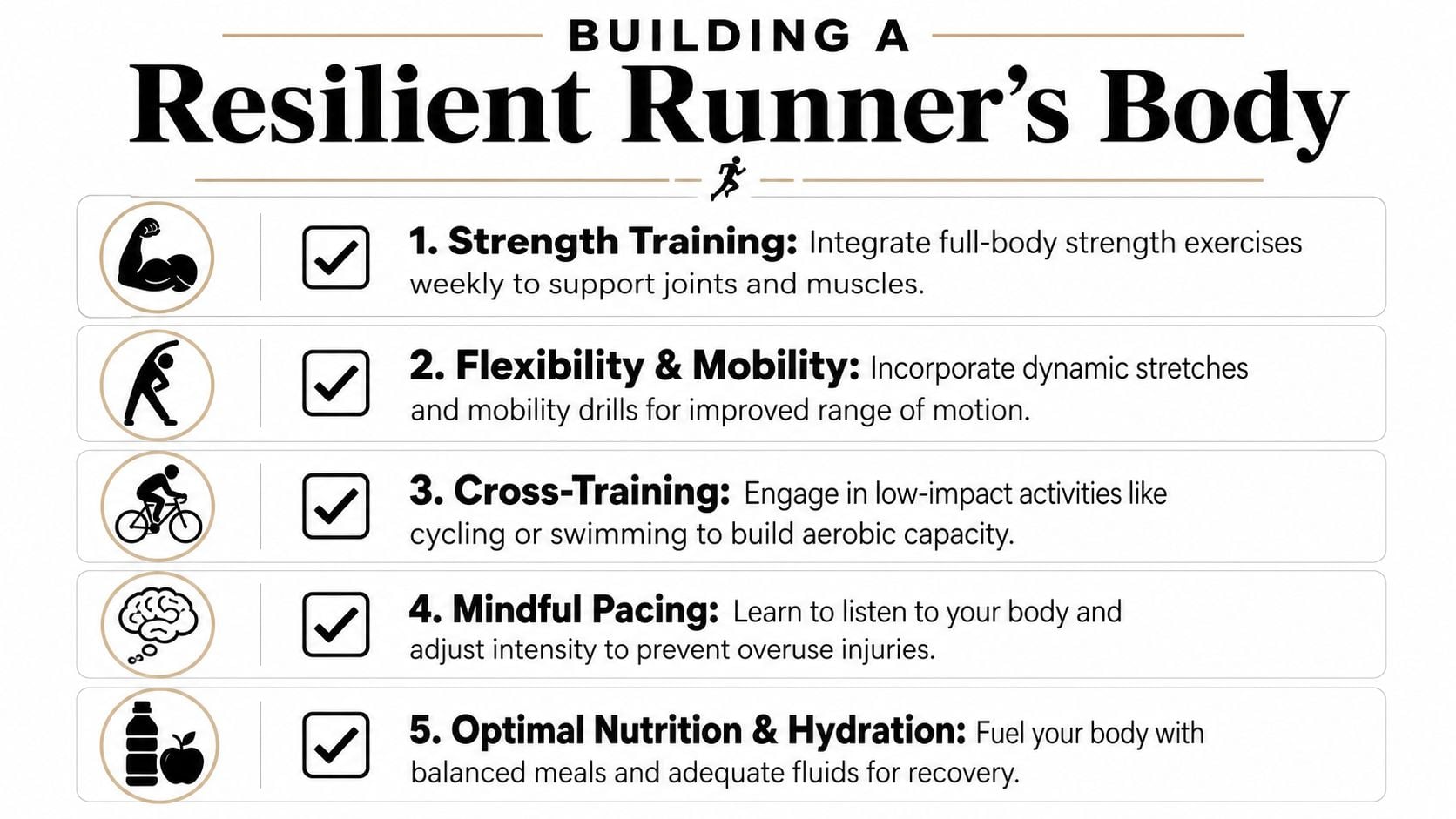
Building a Resilient Runner's Body
Runners love gear talk. Shoes are fun. Watches are fun. Gait videos are interesting. But if you want a more durable body, start with strength.
Recent public guidance keeps moving in the same direction. As noted by Guthrie's running injury prevention advice, runners often focus on shoes, surfaces, or gait, while the more useful question is which strengthening exercises for the hips, core, and lower legs will make them more durable.
Four exercises that carry over to real running
You don't need a huge gym plan. You need the right work, done consistently.
Single-leg bridge: Lie on your back, one foot planted, one leg lifted. Drive through the planted foot and lift your hips without twisting. This helps the glutes do their share instead of asking the low back and hamstrings to cover for them.
Calf raises with control: Rise up slowly, pause at the top, lower all the way down. Do them on one leg if tolerated. Runners in Boston spend a lot of time on small grade changes, curbs, and uneven pavement. The calf complex has to handle that all day.
Side plank: Keep the body long and stacked. Don't let the top hip roll backward. This builds lateral trunk and hip control, which matters when stride quality starts to fade late in a run.
Step-downs: Stand on a step, lower one heel toward the floor, then return with control. Watch the knee track over the foot. This is a practical drill for downhill tolerance and single-leg control.
What to look for while you do them
Strength work only helps if the body part you're targeting is doing the work. If every bridge turns into hamstring cramping, or every calf raise rolls to the outside of the foot, that's useful information.
A few signs you need a more personalized program:
- You feel the exercise everywhere except the target area
- One side is clearly less stable
- You can run, but you can't control basic single-leg positions
- Mobility limits keep changing your form
That's where a focused screen can save time. A service like Joint Ventures Physical Therapy's Running Performance evaluation can pair movement testing, video review, and corrective exercise ideas so your strength work matches what your stride needs.
Don't ignore recovery inputs
Strength is the anchor, but runners also need recovery habits that support adaptation. That includes food, hydration, and enough rest to absorb training. If you're looking for a non-hype overview of recommended supplements for athletes, that can be a helpful companion resource. Mobility can also matter, especially if a stiff hip changes how you load the knee or foot. For practical ideas, this piece on how to improve hip mobility is worth a read.
Strength work doesn't have to leave you crushed. It has to make running feel more supported.
Your Gear and Ground Game in Boston
Boston runners don't get one predictable surface. You might leave a Back Bay apartment, hit brick, cut across concrete, settle onto the Esplanade, and finish on a slanted neighborhood road. That variety can help, but only if you stop expecting one shoe setup to solve every problem.

Choose shoes for fit first
A comfortable shoe that matches your current training is usually more useful than a trendy one that changes your mechanics overnight. Specialty running stores can help with fit, but don't outsource all decision-making. Pay attention to what your body says in the first few runs, especially through the calves, arches, and forefoot.
A few practical rules work well:
- Respect transition time: Don't debut a very different shoe during your biggest week.
- Match the shoe to the run: Daily training, workouts, and recovery jogs can feel better in different setups.
- Notice repeat patterns: If one pair always leaves the same spot irritated, that matters.
Use surfaces strategically
If your lower legs get beat up on concrete, mix in softer paths when possible. If trails make your ankle work overtime, add them gradually instead of turning one weekend run into a balance challenge. Boston gives you options. The Esplanade, Harborwalk, and local tracks all load the body differently.
The same goes for accessories. Long runs in humid weather or with sleeves and layers can make wrist comfort matter more than most runners expect. If you're replacing a worn band on a GPS watch, lightweight silicone options can be easier to live with. This collection can help you find silicone watch straps that suit sweaty training better than stiffer materials.
When extra support makes sense
Not every runner needs more structure. Some do. If pain keeps tracing back to the same foot or lower-leg loading pattern, it may be worth exploring whether an orthotic or shoe adjustment changes the picture. The key is using support as part of a broader plan, not as a substitute for progression, strength, and smart recovery.
When to See a PT at Joint Ventures
A little post-run soreness is normal. Pain that keeps repeating the same story isn't.

Red flags runners shouldn't brush off
You don't need to panic over every ache, but you also don't want to normalize warning signs. It's time to get a professional opinion if any of these are happening:
- Pain sharpens as you run: Especially if it doesn't settle after warming up.
- Symptoms linger for days: A normal hard effort fades. An irritated tissue often sticks around.
- Your gait changes: Limping, shortening your stride, or avoiding push-off means your body is compensating.
- Morning stiffness keeps coming back: If the first steps are consistently rough, pay attention.
- One spot keeps talking to you: Recurrent calf, heel, shin, knee, or hip pain usually has a reason.
What a PT can change
The value of physical therapy isn't just pain relief. It's getting specific about why the issue showed up, what's keeping it going, and how to keep you moving while it calms down. For runners, that often means looking at training history, tissue irritability, mobility restrictions, force control, and running mechanics together.
In Boston, that can be especially useful for people balancing racing goals with work and city logistics. The answer usually isn't “stop everything.” It's a more precise plan. That may include modifying hills, changing workout density, adding targeted strength, or using lower-impact sessions to maintain fitness while symptoms settle.
If you want a practical overview of what that process can look like, this guide to running physical therapy is a helpful starting point.
A quick visual can make that easier to picture:
Services that fit real runner problems
Different runners need different tools. A few examples:
- Running Performance analysis: Useful when your form breaks down, one side keeps taking more load, or you want clearer guidance before a race build.
- Trigger point dry needling: Sometimes helpful for stubborn muscle tightness that keeps altering mechanics.
- Aquatic therapy: A strong option when you need to unload irritated tissues but still want purposeful movement.
- Orthotic fitting and return-to-run planning: Relevant when foot mechanics and symptom patterns keep repeating.
If you're training around Back Bay, Kenmore Square, Fort Point or the Seaport, Downtown Boston, or nearby neighborhoods, getting seen early is often the difference between a quick adjustment and a long interruption. That's especially true when you've already tried rest, stretching, and shoe changes without a clear answer.
If a run has started to feel uncertain, book an appointment with Joint Ventures Physical Therapy. A one-on-one evaluation can help you figure out whether you're dealing with normal training fatigue or the start of a true injury, then build a plan that fits your route, schedule, and race goals in Boston.