
You step off the Green Line, turn quickly to check traffic, and the ground feels half a beat behind you. Or you stand up from your desk in a Downtown Boston office and need a hand on the chair before you trust your legs. For a lot of people, that moment gets brushed off. Stress. Fatigue. Dehydration. Maybe it passes, maybe it doesn't.
When dizziness or unsteadiness starts shaping how you move through Boston, it stops being a minor annoyance. It changes how confidently you walk on uneven sidewalks, how you handle crowded commutes, and whether you feel safe exercising, working, or even rolling over in bed. That's where balance and vestibular therapy in Boston becomes useful. It gives the problem a clinical framework and a practical plan.
Regain Your Footing in Boston
A busy city exposes balance problems fast. Boston doesn't give you much room to hide them. You're moving through stations, staircases, office lobbies, crosswalks, and narrow sidewalks while your eyes and inner ear constantly sort motion, position, and visual input.
That's one reason these symptoms deserve attention sooner than is often realized. Over 4 in 10 Americans experience a significant dizzy spell in their lifetime, according to Boston-area vestibular rehabilitation data. In a city full of commuters, runners, students, and active older adults, that's not niche care. It's a common rehab need.
Some people notice spinning. Others never use the word vertigo at all. They say they feel off, foggy, pulled to one side, uneasy on stairs, or weirdly disoriented when they move their head fast. Those details matter because vestibular issues rarely show up in a neat, textbook way.
If you live or work near the Financial District, it helps to know there are practical local options for care, including physical therapy in Downtown Boston that fits around a workday instead of forcing you into a long commute for treatment.
Practical rule: If you've started changing how you move because you don't trust your balance, it's time for an evaluation.
Signs You May Need Vestibular Therapy
A lot of Boston patients assume vestibular therapy is only for severe spinning dizziness. It isn't. Balance disorders can show up as visual symptoms, motion sensitivity, unsteadiness, or a vague sense that your body isn't tracking well in space.

Does this sound like you
- You feel unsteady on uneven ground. Cobblestones, broken pavement, curb changes, or crowded station platforms make you feel less secure than they used to.
- Turning your head quickly blurs your vision. You check for bikes or traffic and your eyes seem slow to catch up.
- Getting in or out of bed triggers symptoms. Rolling, lying back, or looking up can bring on a brief wave of dizziness.
- You feel off after a concussion. Not necessarily spinning, but fogginess, motion sensitivity, or trouble in visually busy environments.
- You avoid exercise because movement provokes symptoms. That can include gym workouts, yoga, running, or even brisk walking.
- You've started touching walls, counters, or railings more often. People often notice this before they admit they're worried about falling.
Boston Medical Center notes that balance problems can come from a broad set of systems, including the inner ear, brain, muscles, joints, senses, and even blood vessels or the heart. That's why symptoms don't always look identical from one person to the next.
What patients often miss
The biggest mistake is waiting for “real vertigo” before doing anything. Many vestibular patients don't describe the room spinning. They describe hesitation. Slower walking. Avoiding head turns. A sense that escalators, grocery aisles, or crowded sidewalks suddenly feel harder.
For older adults and family members trying to reduce fall risk at home, these caregiving resources for fall prevention can be a helpful complement to formal therapy.
If your symptoms match more than one item on that list, it's worth learning more about how to treat vertigo, and it is paramount to get assessed so the right treatment matches the right cause.
Dizziness that changes your behavior is already affecting function, even if you've gotten good at hiding it.
Your First Vestibular Evaluation at Joint Ventures
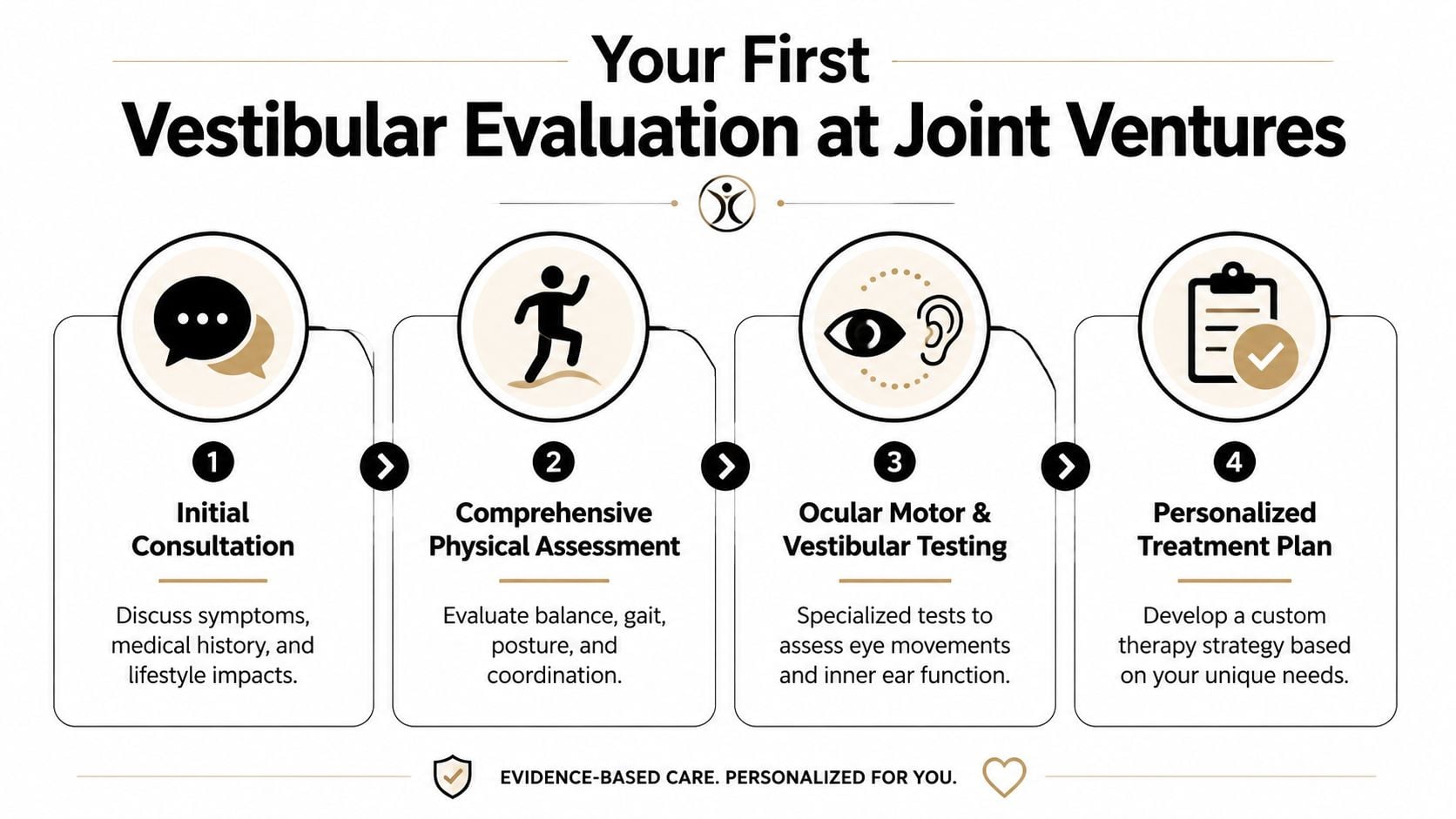
It's often a relief to realize a vestibular evaluation isn't mysterious. It's a structured, one-on-one visit built to answer a simple question: what's driving your symptoms?
What happens in the visit
It starts with your history. We want to know what you feel, when it happens, how long it lasts, what positions or environments set it off, and how it affects your day. The details matter. “Dizzy” can mean several different things clinically.
Then comes movement testing. That may include eye tracking, head movement tasks, standing balance, walking, turning, posture, and coordination. If your symptoms suggest a positional issue such as BPPV, your therapist may also perform specific positional testing.
Why the assessment is detailed
A quick generic balance screen usually isn't enough. A detailed evaluation is critical because the balance system involves the inner ear, eyes, joints, and brain, and Boston Medical Center's balance disorder guidance emphasizes that specialized exercises should match the patient's exact impairment profile rather than a one-size-fits-all plan.
That's why two people who both say “I'm dizzy” can leave with very different treatment plans. One may need repositioning maneuvers. Another may need visual tracking work. Another may need gait and balance retraining because the main issue is how the body uses sensory input during movement.
What patients usually worry about
Most patients ask whether testing will make them symptomatic. Sometimes it can reproduce the problem briefly, and that's often useful because it helps identify the trigger. The difference is that symptoms are provoked in a controlled setting, by someone who knows what they're looking for.
A good evaluation doesn't just label the problem. It tells you what to work on, what to avoid for now, and what recovery should look like in practical terms.
Common Treatment Approaches for Balance Disorders
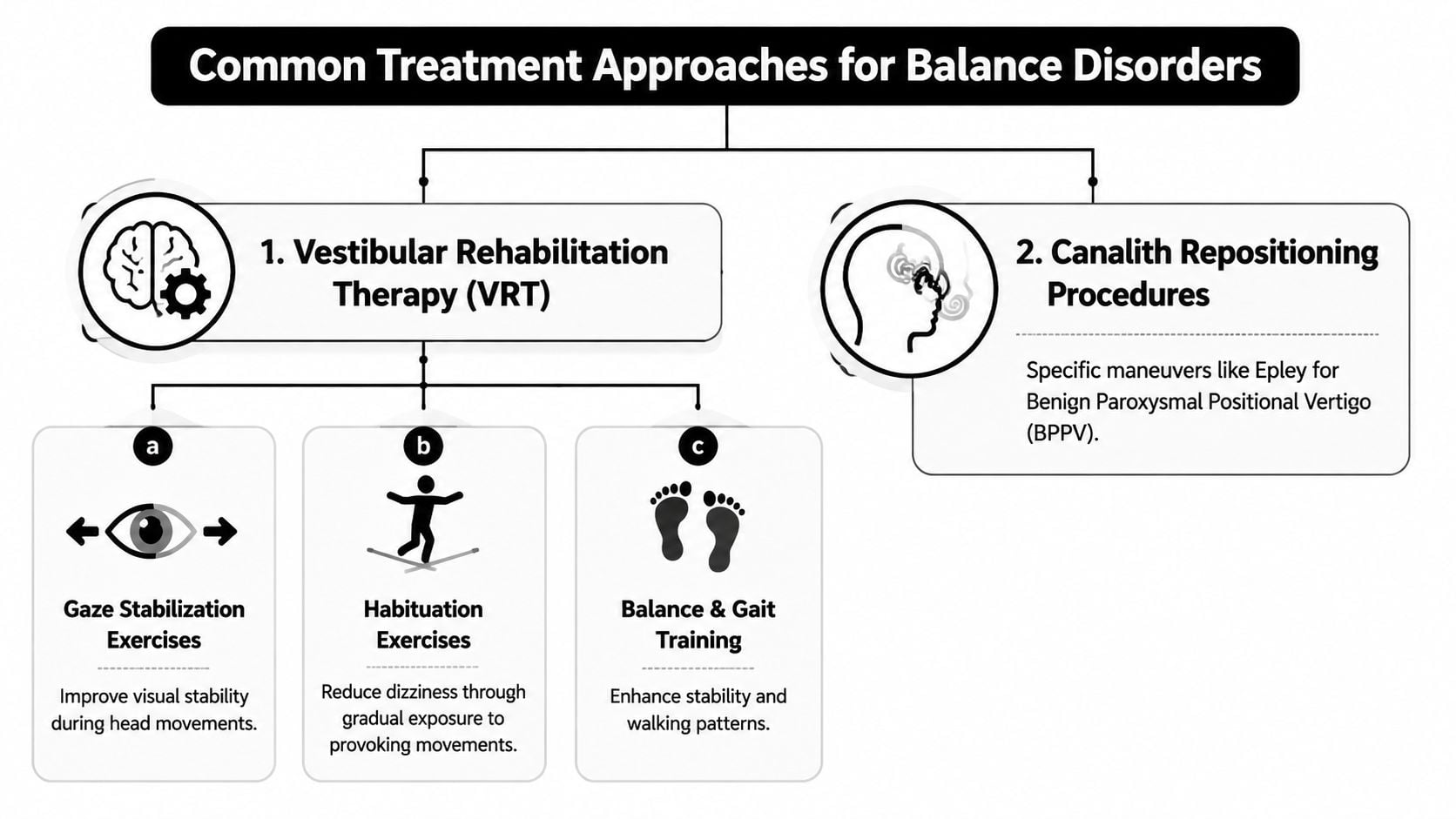
Once the evaluation identifies the pattern, treatment gets much more specific. That's the difference between effective vestibular rehab and random balance drills from the internet. Targeted therapy matters, and Boston-based rehab programs such as Spaulding report success rates as high as 90% for treating vertigo and balance disorders with specific, evidence-based techniques.
Repositioning maneuvers for BPPV
If your symptoms come from benign paroxysmal positional vertigo, treatment may be surprisingly direct. Canalith repositioning maneuvers, such as the Epley maneuver, are designed to move displaced inner ear particles back where they belong.
This is one of the clearest examples of why diagnosis matters. If BPPV is the issue, general strengthening won't fix it. The right maneuver often changes things much faster than people expect.
Gaze stabilization and visual control
Some people don't spin at all. They lose visual clarity when the head moves. Street signs blur while walking. Crowded environments feel overstimulating. Turning quickly makes the world feel delayed.
Gaze stabilization exercises train the eyes and vestibular system to work together better. The goal isn't just “less dizziness.” The goal is practical function, such as reading signs while walking, moving through a train station without visual overload, or exercising without feeling disoriented.
Habituation for motion sensitivity
Habituation is useful when certain motions repeatedly provoke symptoms. Instead of avoiding those motions forever, therapy uses graded exposure. The dose matters. Too little and nothing changes. Too much and symptoms flare.
Many self-directed programs fail. People either push far too hard or stop as soon as they feel symptoms. The sweet spot is controlled provocation followed by recovery.
If an exercise makes you miserable for the rest of the day, it was probably the wrong dose.
Balance and gait retraining
When the issue is broader instability, treatment often includes a mix of:
- Postural control work that improves how you align and recover when your center of mass shifts
- Proprioceptive training to sharpen body awareness when the ground or visual input is less reliable
- Strength and coordination work that supports steadier walking, turning, and stair negotiation
- Task-specific gait practice that matches what your real life demands, whether that's commuting, running, or moving confidently at work
This is also where balance and vestibular therapy in Boston becomes highly practical for active adults. A runner may need symptom control during faster head movement and dynamic impact. A postpartum patient may need a plan that respects fatigue, core recovery, and changing body awareness. Someone recovering from concussion may need visual and motion tolerance before they can return to sport or full workdays.
For people building a home program, tools can help, but they don't replace clinical reasoning. If you're looking at simple equipment options, this guide to best bands for recovery can help you choose something useful for strength and stability work.
For broader educational articles on anatomy, injury recovery, and movement mechanics, visit Highbar Health.
Sample Home Exercises Your Therapist May Recommend
Home work is part of most vestibular plans, but it should fit the problem. The right exercise for one patient can be the wrong one for another. These examples are safe, common starting points, not a substitute for an evaluation.
Head turns while focusing on a target
Sit or stand facing a letter on the wall. Keep your eyes on the target and turn your head side to side at a pace that is tolerable.
- Why it helps: This trains visual stability during head movement.
- What to watch for: Mild symptoms can be appropriate. A major symptom spike that lingers usually means the dose needs adjusting.
Supported single-leg stance
Stand near a counter. Shift onto one leg while keeping a hand close to support if needed. Alternate sides.
- Why it helps: This challenges balance, ankle strategy, and body awareness in a simple, controlled setup.
- Who often benefits: Active older adults, patients returning to walking programs, and people who feel less steady during turns or quick direction changes.
Feet together with head turns
Stand in a safe corner or near a sturdy surface with your feet together. Slowly turn your head right and left while staying upright.
- Why it helps: This combines postural control with vestibular input, which is often more useful than practicing either one alone.
Marching in place
Stand tall near support and march slowly in place, focusing on posture and even weight shift.
For some patients, hip stability is part of the bigger balance picture. If you're interested in adjacent strengthening work, these best gluteus medius exercises can add context, especially when side-to-side control is weak.
If your main goal is steadier everyday movement, these balance exercises for elderly adults are another practical resource. The important caveat is that effective vestibular home programs are individualized. The exercise itself matters less than choosing the right one, at the right dose, for the right reason.
How to Choose the Right Vestibular Therapist in Boston
A good vestibular therapist should make the process clearer within the first visit. You should leave with a working diagnosis, a plan that fits your symptoms, and a sense of how treatment will fit into your week in Boston.
What to look for
Start with experience that is specific to dizziness and balance disorders. A general orthopedic background helps, but vestibular rehab requires more than standard strength and mobility work. The therapist should be able to sort out whether your symptoms look positional, motion-sensitive, concussion-related, visually driven, or tied to a broader balance problem. Those categories change the treatment plan.
Session format matters too. Vestibular treatment works best when the therapist is watching closely for eye movement changes, postural compensation, symptom spikes, and recovery time. If a clinic routinely divides attention across several patients at once, subtle findings can get missed and progression is often less precise.
Location also affects results. In Boston, patients often try to fit care around train commutes, office hours, childcare, and walking-heavy days. If getting to the clinic feels like a project, attendance usually drops right when consistency starts to matter.
A practical checklist
- Regular vestibular caseload: Ask how often the therapist treats vertigo, dizziness, post-concussion symptoms, and fall-related balance issues.
- One-on-one visits: You want direct observation and real-time adjustments, not a generic program handed off after an evaluation.
- Convenient Boston access: Back Bay, Kenmore Square, Fort Point/Seaport, Downtown Boston, and nearby neighborhoods are easier to build into a workday or commute.
- Clear front-desk support: Insurance verification, scheduling help, and straightforward communication reduce friction before care even starts.
Joint Ventures Physical Therapy is one local option. The clinic provides one-on-one physical and occupational therapy in Greater Boston and includes vestibular care along with concussion, pelvic floor, TMJ, hand, and orthopedic services.
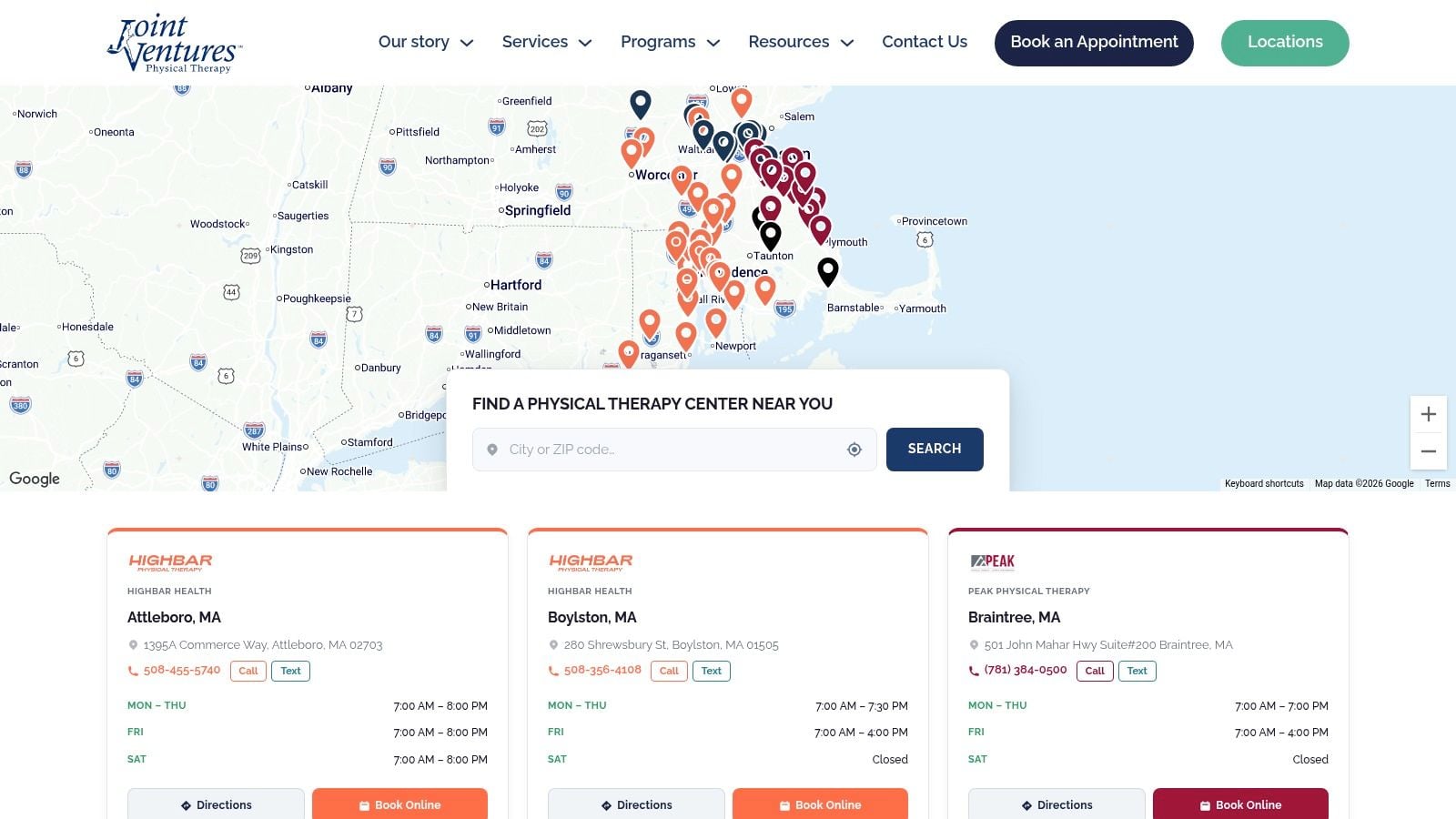
Here's a quick look at how location convenience can factor into your decision:
What doesn't work well
Some patterns are worth avoiding.
- The same program for every dizzy patient: Vestibular rehab should match your triggers, exam findings, and daily demands.
- No explanation for the diagnosis: If the therapist cannot tell you what they think is driving the dizziness, treatment usually stays too broad.
- Exercises that leave you flared up for hours: Mild symptom provocation can be useful. Repeated overload usually means the dose or exercise choice is off.
- A plan that ignores your real routine: If your symptoms show up on the Green Line, in grocery aisles, while turning in a crowded office, or when walking Boston sidewalks, treatment should address those situations directly.
The right clinic should feel organized, specific, and practical. If you are comparing options in Boston, book an evaluation with a therapist who treats vestibular problems regularly and can explain exactly what they are seeing and how they plan to help.
Your Questions About Vestibular Therapy Answered
How many visits will I need
It depends on the diagnosis, how long symptoms have been present, and how your system responds to treatment. Some people improve quickly when the issue is positional. Others need a longer progression for motion sensitivity, post-concussion symptoms, or more global balance deficits. What matters most is having a plan with clear goals and regular reassessment.
Does insurance usually cover vestibular therapy
Many plans do cover physical therapy, including vestibular treatment, when it's medically appropriate. Coverage details vary by plan, visit limits, and authorization rules. A clinic's front desk team should help verify benefits and explain the practical details before treatment gets underway.
Do I need a referral in Massachusetts
Massachusetts allows direct access to physical therapy in many cases, so you may be able to start without a physician referral. That said, insurance rules can differ, and some medical situations still warrant physician involvement. If your symptoms are new, unusual, or accompanied by other concerning signs, medical screening is important.
What if treatment makes me a little dizzy
That can be normal. Vestibular rehab often uses carefully chosen movements that reproduce symptoms in a controlled way so your system can adapt. The key is dosage. A little symptom increase can be useful. A big flare that doesn't settle is a sign the program needs modification.
If dizziness, vertigo, or unsteadiness is making Boston feel smaller than it should, book an evaluation with Joint Ventures Physical Therapy. You can choose a convenient Greater Boston location, get a focused one-on-one assessment, and leave with a plan that matches how you move, work, and live.