
You're on a Zoom call in Back Bay, you take a bite of lunch between meetings, and there it is again. Click. Maybe it happens when you yawn on the T or when you chew after a hard workout. It's common to immediately search for ways to address the jaw clicking because the sound feels like something must be wrong.
Usually, the better question is simpler. Is this just a noise, or is it a problem that needs treatment?
In Boston clinic conversations, this comes up all the time with professionals who sit at a desk all day, runners training through stress, students grinding through exams, and active adults who've started noticing jaw tension along with neck stiffness and headaches. The good news is that a clicking jaw often responds best to calm, practical care. Not panic. Not a race to procedures. For many people, the path forward starts with reducing joint irritation, improving muscle control, and figuring out what's overloading the jaw in the first place.
That Annoying Jaw Click and What It Really Means
A lot of people describe the same pattern. The jaw clicks for weeks or months. It isn't always painful at first, so they ignore it. Then work stress ramps up, sleep gets worse, they clench more, and suddenly the click is joined by soreness near the ear, tightness in the cheeks, or a sense that opening the mouth feels off.
That's why the word cure can be misleading. With jaw clicking, the primary goal is usually symptom management and functional improvement, not chasing one magical fix.
The sound is only part of the story
A click by itself doesn't tell you enough. In practice, what matters more is the full picture:
- Pain level: Does it hurt at rest, while chewing, or first thing in the morning?
- Motion quality: Does your mouth open smoothly, or does it shift and hesitate?
- Daily impact: Are meals, conversations, workouts, dental visits, or sleep getting harder?
- Related tension: Do you also feel neck stiffness, temple pain, or clenching at night?
For a quick outside perspective, this guide to clicking jaws by TMJ experts does a good job walking through the common reasons people notice jaw sounds.
A jaw click matters less because it's noisy and more because it can reveal how the joint is handling load.
What concerned professionals in Boston usually need
Most busy adults don't need an aggressive answer. They need a clear plan. That usually means identifying whether the jaw is just noisy or whether it's becoming irritated, overloaded, and less coordinated.
For someone working in Seaport or Downtown Boston, the pattern often looks familiar. Long screen time. Slight forward-head posture. Clenching during concentration. Gum chewing, protein bars, or tough meals on the go. Add one bad night of sleep, and the jaw muscles never fully settle down.
If that sounds familiar, you're not stuck. A clicking jaw can often be managed well, especially when you address the habits and mechanical stress feeding it.
Why Your Jaw Clicks and When to See a Specialist in Boston
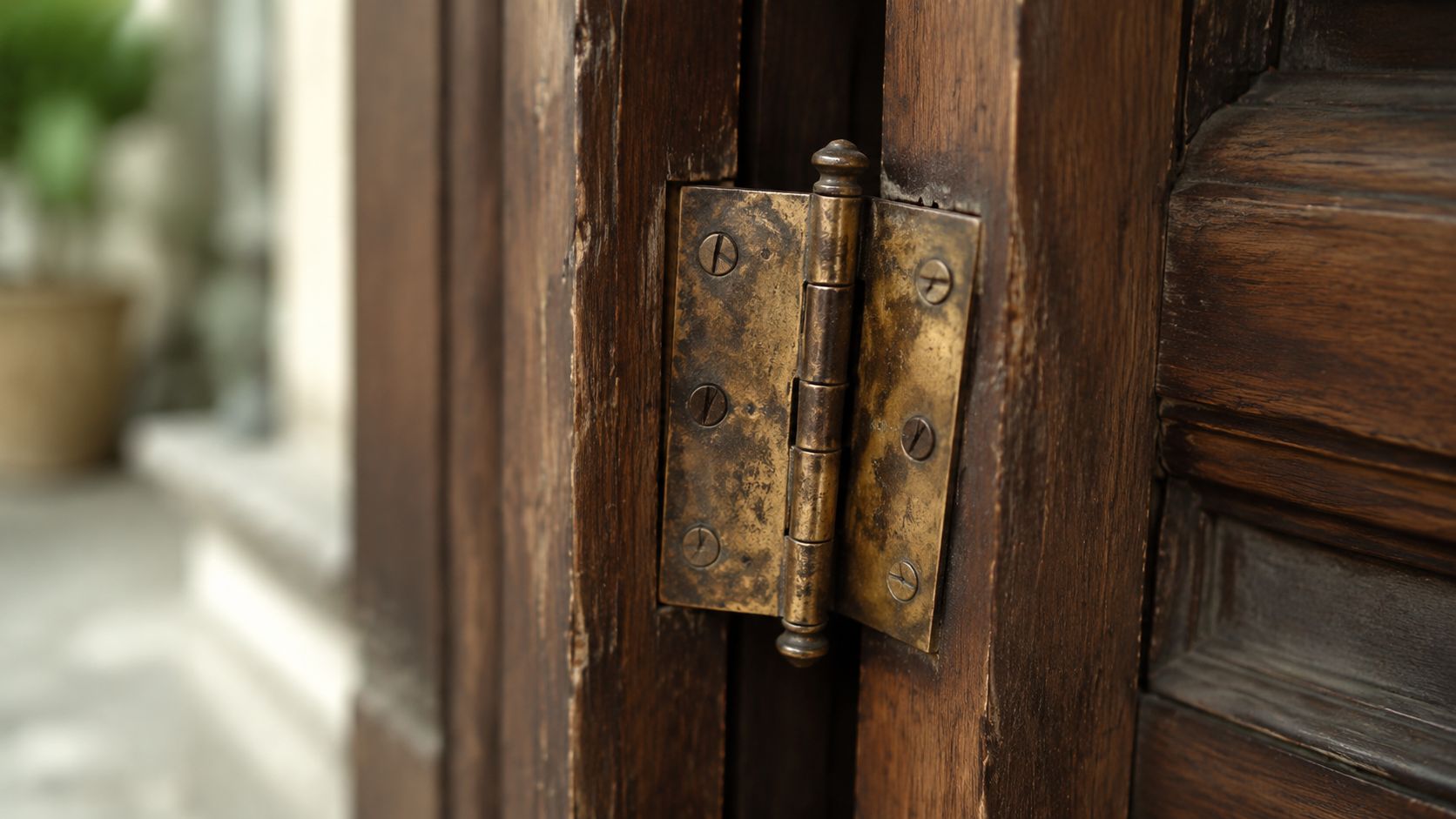
The simplest way to think about a clicking jaw is a door hinge that's slightly off track. The joint still opens and closes, but it doesn't glide as cleanly as it should. Something shifts, catches, then resets. That reset is often the click you hear.
The common mechanical reason
A jaw click is often tied to the disc inside the temporomandibular joint moving out of ideal position and then slipping back into place during opening or closing. The important point is that the click is often a mechanical event, not automatically a dangerous one.
The U.S. National Institute of Dental and Craniofacial Research notes that a clicking or popping sound in the jaw without pain is common and often considered normal, and treatment is typically reserved for cases involving pain, limited opening, or dysfunction. The same source notes that temporomandibular disorders can affect as many as 25% of people at some point (NIDCR).
When the click is probably not the main issue
If the sound is painless, your mouth opens normally, and you're eating and speaking without trouble, the click itself may not need treatment. It may be something to monitor rather than chase.
That said, Boston lifestyles can push a mild issue into a symptomatic one. Common aggravators include:
- Work stress: clenching during meetings, deadlines, and long computer sessions
- Training load: jaw tension during lifting, racing, or hard conditioning sessions
- Sleep-related habits: waking with sore cheeks or tight temples
- Food choices: bagels, crusty bread, chewy foods, and frequent gum
If the jaw clicks but works well and doesn't hurt, you may only need simple monitoring and a few habit changes.
When to see a Boston specialist
You should get assessed if any of these are showing up:
| Sign | Why it matters |
|---|---|
| Pain with chewing | The joint or surrounding muscles may be irritated |
| Limited opening | Motion loss usually needs targeted treatment |
| Locking or catching | The disc and movement pattern may need specialist input |
| Jaw fatigue by end of day | Muscle overuse is often part of the problem |
| Neck pain or headaches with jaw symptoms | The jaw rarely works in isolation |
If you want to understand how dental evaluation can fit into the picture when pain is present, this overview of expert care for jaw pain in Atascocita is a useful example of when a dentist may need to be involved alongside conservative care.
Your First Steps At-Home Relief Strategies for Jaw Pain
Typically, the first step isn't a procedure. It's lowering irritation and giving the joint a calmer environment to move in.
The standard of care has shifted strongly toward conservative management. Mayo Clinic and related guidance support starting with home care such as heat or cold for 15 to 20 minutes several times a day, soft foods, and gentle jaw stretching and massage. Many symptoms improve within weeks or months with these simple approaches alone (Mayo Clinic).
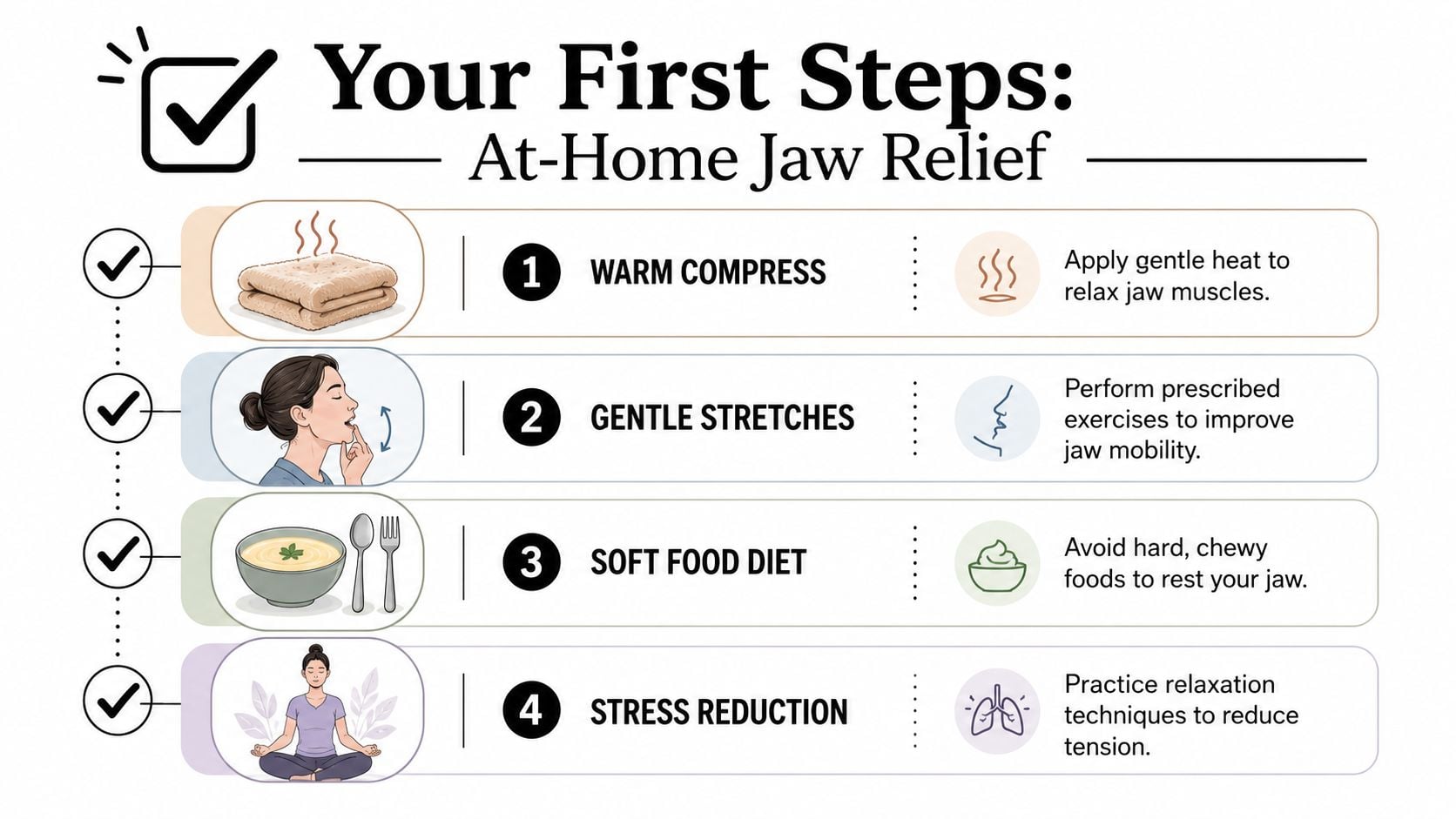
Four things to do right away
Use heat or cold consistently
Try a warm pack or cold pack for 15 to 20 minutes several times per day. Heat often helps when the muscles feel tight. Cold can be helpful when the joint feels irritated after chewing.Shift to softer foods for a stretch
This doesn't mean you can never eat normally again. It means giving the jaw a break. Think eggs, yogurt, soups, rice bowls, oatmeal, smoothies, fish, or softer pasta dishes instead of chewy bread, steak tips, or gum.Reduce wide opening
Big yawns, giant sandwiches, and aggressive dental-style opening can keep a sensitive joint irritated. Smaller movements usually calm things down faster.Relax the resting position of the jaw
A useful cue is: tongue on the palate, lips together, teeth apart. That reduces unnecessary clenching during work and concentration.
What helps and what usually doesn't
Here's the practical version.
- Helpful: brief self-massage to the jaw and temple muscles
- Helpful: paying attention to daytime clenching
- Helpful: reducing gum chewing and nail biting
- Less helpful: repeatedly forcing the jaw to pop
- Less helpful: testing it every few minutes to see if it still clicks
- Less helpful: jumping from one internet exercise to another without a plan
For a local exercise resource, Joint Ventures has a practical page on TMJ pain relief exercises that can help you start with safer movement strategies.
The best early home program is boring on purpose. Calm the joint down, reduce load, move gently, and stop provoking it.
A quick Boston-specific reality check
If your symptoms spike during busy workweeks, commuting, or marathon training blocks, don't ignore the neck and posture side of this. Jaw symptoms often rise when the whole upper-quarter system gets tense. If home care helps but the problem keeps returning, that's usually the point where a skilled evaluation saves time.
Evidence-Based TMJ Treatment Physical Therapy in Boston
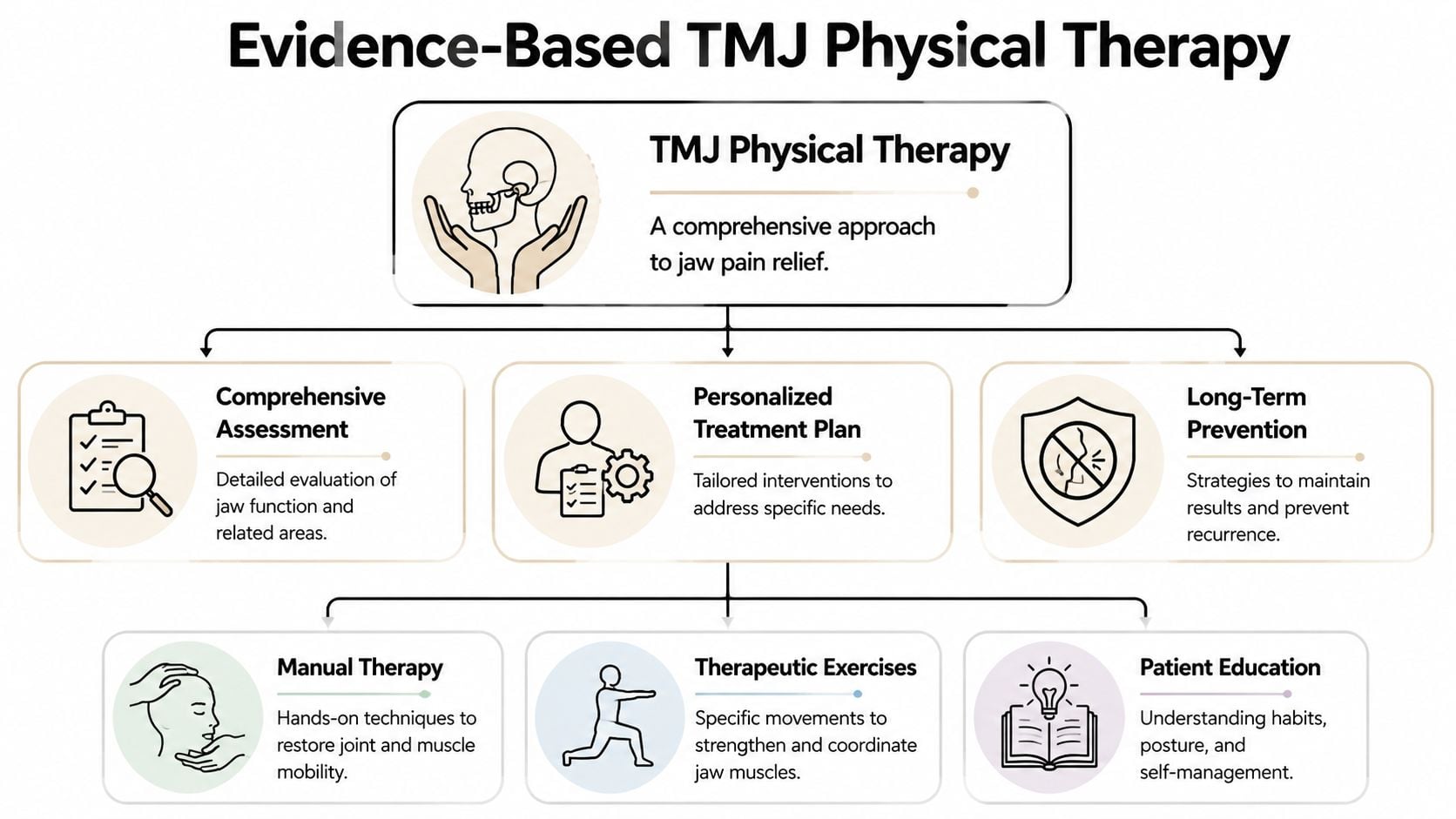
When a clicking jaw becomes painful, stiff, or disruptive, physical therapy makes sense because it addresses the underlying issues. Load, movement control, muscle tension, and related neck mechanics.
What PT is trying to change
The click is often the sound of the articular disc slipping back into place. That's why effective care focuses on reducing joint load and improving movement control, not just trying to silence the noise. A review on disc displacement with reduction also supports conservative management first, including intraoral devices in some cases, behavioral modification, and guided exercise approaches for pain and dysfunction (PMC review).
A good TMJ PT evaluation usually looks beyond the jaw itself. It includes how you open and close, whether the jaw deviates, what your resting posture looks like, how the neck contributes, and whether the chewing muscles are overworking.
What treatment often includes
At this point, professional care becomes much more specific than generic online advice.
- Hands-on treatment: manual therapy to the jaw, face, and neck when the tissues are stiff or guarded
- Motor control retraining: learning how to open, close, chew, and rest the jaw with less compensation
- Targeted exercise: gentle mobility and stability work matched to your exact presentation
- Postural correction: especially useful for professionals spending long hours at a laptop
- Habit coaching: reducing clenching, hard chewing, and high-irritation patterns
For some people, the jaw isn't the only driver. Neck tightness, upper trap overuse, and facial trigger points can keep the area irritated. That's one reason some clinics also use options like trigger point dry needling when it fits the presentation.
A more detailed local overview is available in this page on TMJ physical therapy in Boston.
This short video gives a useful visual sense of guided TMJ rehab:
Why the local setup matters
For a Boston patient, convenience often determines follow-through. If your office is near Back Bay, Kenmore Square, Fort Point, or Downtown Boston, a plan is far more likely to work when appointments fit around real life.
Joint Ventures Physical Therapy offers one-on-one PT care in those areas, which matters for TMJ because this is not a condition that does well with rushed, generic exercise handouts. It needs careful assessment, progression, and coaching.
What About Dental Splints and Jaw Surgery
People usually land in one of two extremes online. Either they're told to ignore the problem completely, or they're pushed toward aggressive treatment too early. The better model is stepped care.
Where splints can help
Dental splints and night guards can be useful, especially if clenching or grinding is part of the problem. In some cases, an intraoral device can reduce irritation and give the jaw a less provocative resting pattern at night.
That said, a splint doesn't retrain how the jaw moves during the day. It also doesn't fix neck tension, chewing habits, posture, or the way someone braces through stress. That's why splints often work best as one part of a broader plan rather than the whole answer.
Where PT fits compared with dental care
A practical comparison helps:
| Option | Best role | Main limitation |
|---|---|---|
| Home care | First step for mild symptoms | Can stall if the problem is recurring or more complex |
| Physical therapy | Improves movement, load tolerance, muscle balance, and habits | Needs consistent follow-through |
| Dental splint | Useful when bruxism or bite-related loading is part of the issue | Doesn't address full-body mechanics or daytime behavior |
| Surgery | Reserved for severe structural cases | Not appropriate for most clicking jaws |
For people weighing conservative care against bigger interventions, this article on physical therapy vs surgery from a PT perspective reflects the broader principle well. Start with the least invasive option that has a real chance of helping.
When surgery is actually on the table
Surgery is not the standard answer for a clicking jaw. The modern approach reserves invasive treatment for cases with severe symptoms or joint destruction that haven't responded to simpler care. That's consistent with the stepped model described earlier from major clinical sources.
Most clicking jaws do not need surgery. They need accurate diagnosis, reduced irritation, and a plan that matches the person's daily load.
If you want deeper educational content about musculoskeletal problems, recovery planning, and conservative treatment philosophy, visit Highbar Health. That's the right place for broader condition education, while local hands-on care decisions should stay tied to the clinic and clinician treating you in Boston.
Your Next Step Find Lasting Jaw Pain Relief in Boston
If you searched for a cure for clicking jaw, the honest answer is this. There usually isn't one instant fix. There is, however, a very workable path toward less pain, smoother motion, and a jaw that stops taking over your day.
That matters if you're a professional in Downtown Boston trying to get through meetings without facial tension, a runner in the middle of a training block, a student near Fenway or Kenmore dealing with stress clenching, or an active adult who's tired of modifying every meal.

Signs it's time to book an evaluation
You don't need to wait until the jaw locks to get help. A PT evaluation makes sense when:
- The click is joined by pain
- Opening feels restricted or uneven
- Chewing is tiring
- Neck tension and headaches keep showing up with jaw symptoms
- Home care helped, but only temporarily
If you're also exploring whether a dental appliance might help with nighttime clenching, this overview of night guards for bruxism and TMJ is a reasonable companion read.
What good care should feel like
You should leave an evaluation with answers that are specific to you. Not vague reassurance. Not fear. Not a pile of unrelated exercises.
A good plan should tell you:
- what is likely driving the symptoms,
- which daily habits are keeping the jaw irritated,
- what movements to change,
- and when to bring in other providers such as a dentist or oral specialist.
For Boston patients, access matters. If you live or work near Back Bay, Kenmore Square, Fort Point and Seaport, Downtown Boston, Brookline, or Allston, there's a practical advantage to getting care close to where you already spend your time. That makes it easier to stay consistent long enough to get the jaw to settle, move better, and stay that way.
The right next step isn't guessing. It's getting the jaw assessed by someone who treats this problem regularly and can tell you whether the click is just noise, a manageable TMJ issue, or something that needs coordinated care.
If your jaw clicking is turning into pain, stiffness, headaches, or daily frustration, book an evaluation with Joint Ventures Physical Therapy. Their Greater Boston locations make it easier to get one-on-one care near work or home, with a treatment plan built around how you live, train, and work.