
Running physical therapy isn't about just chasing your pain. It’s a specialized approach focused on finding the root cause of that pain. We dig into your unique running form, strength imbalances, and training patterns to solve the puzzle of why you keep getting hurt and build you into a stronger, more resilient runner.
Why Your Running Pain Keeps Coming Back
It always starts small. A little twinge in your knee after a long run, or a tightness in your hip you try to stretch out. But then that small ache turns into a constant pain that keeps you off the roads and trails you love. If you’re a runner, this story probably sounds way too familiar.
Most runners get stuck treating the symptom, not the source of the problem. You rest for a few days, foam roll the sore spot, or maybe even stop running altogether. But as soon as you start building your mileage back up, the pain comes right back. Why? Because the site of your pain is almost never the actual cause of it.

Beyond Just Treating Symptoms
This is where true running physical therapy differs from general PT. We're a specialized field that treats you as a whole athlete, not just as an injured body part. We don't just look at your sore Achilles; we look at the entire kinetic chain to figure out why it's getting overloaded in the first place.
Think of us as your personal running detectives. Our job is to connect the dots between your pain, your running mechanics, your strength—and your weaknesses.
This specialized approach means we take a deep look at how you move. We analyze your biomechanics to find the underlying issues that lead to all those common running injuries. A few of the key areas we investigate include:
- Strength Imbalances: Weak glutes and a weak core are huge culprits. When they're not pulling their weight, other muscles and joints have to work overtime, which leads to breakdown and injury.
- Poor Running Mechanics: Seemingly small habits like overstriding, letting your hip drop with each step, or having your foot roll in too much can create massive amounts of stress over the thousands of steps you take on a run.
- Training Errors: Pushing too hard, too soon is one of the biggest and most common mistakes we see. We'll help you structure a smarter training plan that builds you up, not breaks you down.
Our goal isn't just to get you running again. It’s to figure out the real reason for your recurring pain and give you the tools to become a stronger, more efficient, and more durable runner for years to come.
The Most Common Running Injuries We See
If you've been running for any length of time, you’ve probably felt that first twinge of pain and thought, "Uh oh." You’re definitely not alone. We see dedicated runners walk through our doors every single day, and many of them are dealing with the same handful of aches and pains.
These issues almost always come down to one thing: the repetitive stress running puts on the body. The good news? These injuries are incredibly well-understood. They're what we call orthopedic conditions, which happen to be the single largest focus of physical therapy. It's a huge part of our field, as highlighted in this physical therapy market report, because musculoskeletal issues are just that common for active people.
Most running pains fall into a few familiar categories. We've broken down the most frequent culprits below, including where you'll feel it and what's often behind the pain.
Common Running Injuries and Their Telltale Signs
| Injury Name | Typical Pain Location | Common Causes |
|---|---|---|
| Runner’s Knee | A dull ache around or behind the kneecap | Weak hips/glutes, poor running mechanics, muscle imbalances |
| IT Band Syndrome | Sharp, stabbing pain on the outside of the knee | Overuse, weak hip abductor muscles, dramatic increase in mileage |
| Shin Splints | Aching or throbbing along the shin bone (front or inside) | "Too much, too soon," worn-out shoes, running on hard surfaces |
| Achilles Tendinopathy | Pain and stiffness at the back of the ankle/heel | Tight calf muscles, sudden increase in intensity or hill work |
| Plantar Fasciitis | Sharp, stabbing pain in the heel or arch of the foot | Inadequate footwear, tight calves, high-impact activities |
While this table gives you a starting point, a physical therapist's job is to connect the dots. The pain is just the symptom; our real work is finding the why and building a plan to fix it for good.
Pain Above the Ankle: Runner’s Knee and IT Band Syndrome
Knee pain is easily one of the top complaints we hear. Two of the biggest offenders are runner’s knee (officially patellofemoral pain syndrome) and IT band syndrome. Even though they show up in different spots around the knee, they often share the same root causes—think weak hip muscles or inefficient running form.
Runner’s knee usually feels like a dull, persistent ache around or behind your kneecap. It tends to get angrier when you're running on hills, climbing stairs, or even just sitting for a while with bent knees.
With IT band syndrome, the pain is sharp and stabbing, and it’s always on the outside of your knee. A classic sign is that it feels fine when you start your run, but gets progressively worse until you’re forced to stop.
The pain is the symptom, but the cause is usually somewhere else. For knee pain, we almost always look "upstream" to the hips and core to find the real source of the problem.
Pain Below the Knee: Shin Splints, Achilles, and Plantar Fasciitis
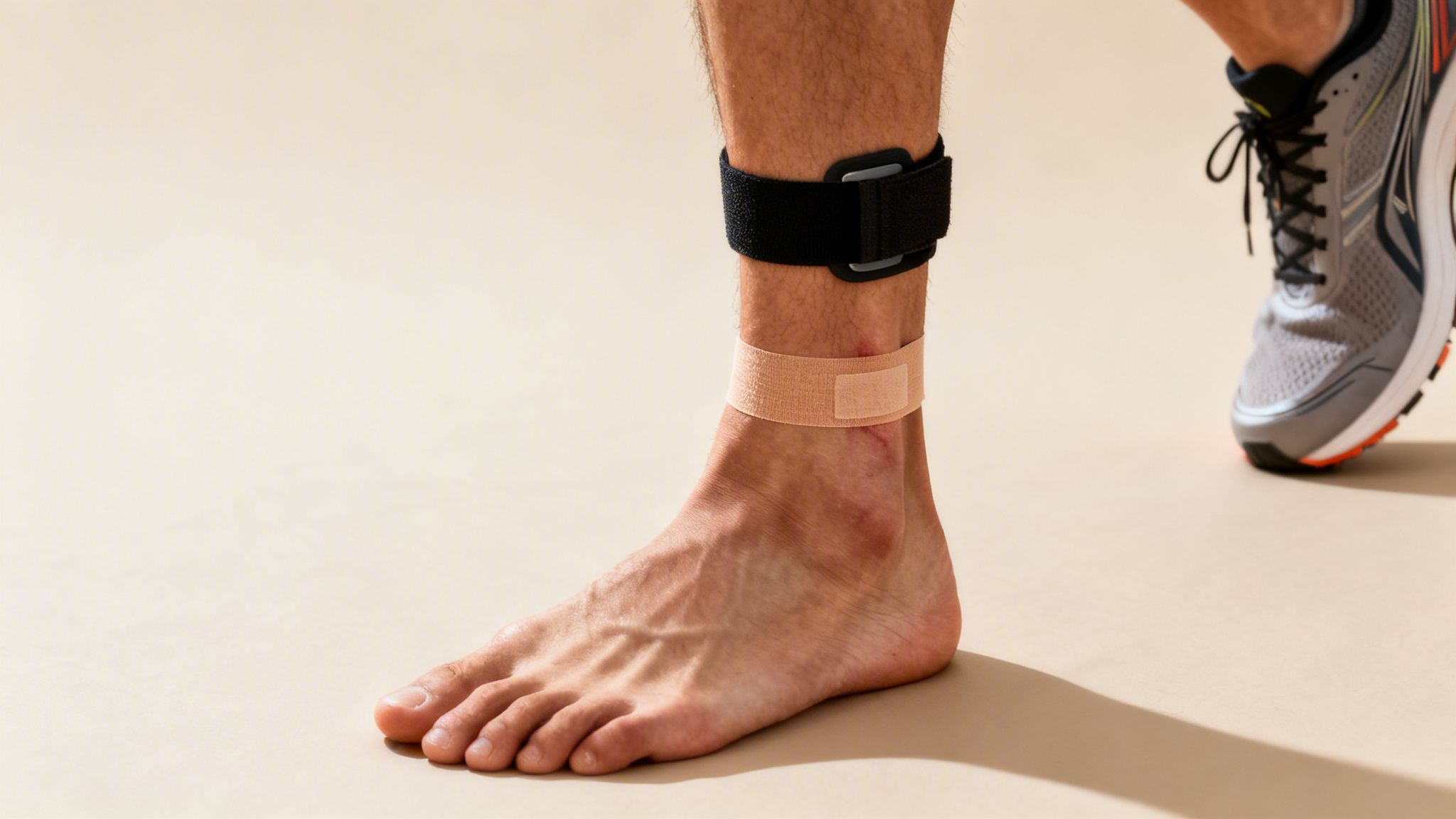
The lower leg and foot take a massive beating during a run, so it's no surprise that this area is prone to overuse injuries. These problems are often a direct result of doing too much, too soon.
Shin splints, for example, bring on a nagging pain along the inside or front of your shin bone. It’s a textbook overuse injury, frequently triggered by a sudden jump in mileage or intensity without proper preparation.
Then there's Achilles tendinopathy, which creates pain and stiffness in that big tendon at the back of your ankle. If your ankle is incredibly stiff and sore first thing in the morning, the Achilles is a likely suspect.
And, of course, there’s plantar fasciitis. This is the classic sharp, stabbing pain in your heel or arch that’s most intense with your first few steps out of bed.
All of these are your body's way of telling you that specific tissues are being overloaded. A running physical therapy expert digs in to figure out why they’re overloaded and gives you the tools to solve the problem.
Your Comprehensive Running Performance Evaluation
Your first physical therapy visit isn’t about just looking at your knee. It's a conversation. We want to hear your full story—your running history, your goals, and exactly what happens when that pain kicks in. You’re talking to a physical therapist who is also a runner, someone who understands the difference between "sore" and "injured."
That conversation guides our hands-on assessment. We’ll look at your mobility, flexibility, and strength from head to toe, searching for the imbalances and weak links that often cause problems elsewhere. The root of your foot pain might actually be in your hip, and a thorough exam is how we find it.
Going Beyond the Surface with Video Analysis
The most powerful part of your evaluation is our video running analysis. We'll have you run on a treadmill for a few minutes while we film you from multiple angles. This is where we uncover the clues your body is giving us.
We then slow that video down, frame by frame. Why? Because the problems are almost never visible at full speed.
Running injuries are rarely caused by one big, dramatic event. They're caused by tiny, inefficient movements repeated thousands of times over a single run. Slow-motion analysis is how we see them.
This lets us identify the specific biomechanical habits that are holding you back. We’re looking for common culprits like:
- Overstriding: Your foot lands too far in front of your body, creating a braking force with every single step.
- Hip Drop: One hip dips down as you land, a classic sign of weak glute and core stabilizers.
- Poor Cadence: You’re taking too few steps per minute, which increases the impact forces traveling up your legs.
If you’re wondering about your own mechanics, our guide on how to improve your running form is a great place to start.
This isn't about finding fault with how you run. It's about understanding your unique movement signature so we can build a plan that works for your body. More and more runners are seeking this kind of specialized care. The physical therapy market is projected to grow from USD 26.04 billion in 2025 to USD 49.18 billion by 2034, a clear sign that people are investing in expert guidance to stay active and avoid injury.
Building Your Personalized Return to Running Plan
Once we've finished the evaluation, the real work begins. We take everything we learned—your strength tests, your mobility profile, and the insights from the video analysis—and build a recovery plan that is 100% designed for you.
There are no generic protocols here. Your body, your running history, and your specific injury are unique, and your comeback plan needs to reflect that.
The Core Components of Your Treatment
Think of your plan as a two-part strategy. We need to calm down the tissues that are currently angry and painful, but we also have to fix the underlying mechanical issues that created the problem.
This almost always involves a mix of hands-on care and specific exercises.
- Hands-On Manual Therapy: This is where we use our hands to directly improve how your body moves. We might use joint mobilizations to restore ankle or hip motion that you've lost, or perform soft tissue work to release tight muscles that are pulling your mechanics out of line.
- Targeted Strengthening Exercises: Weakness is the secret enemy behind most running injuries. We'll give you specific exercises designed to wake up and strengthen the muscles that actually support you when you run—especially your glutes, core, and hip stabilizers.
- Running Form Drills: We don't just tell you to "run differently." We give you targeted drills to retrain your movement patterns. This is how we correct things like overstriding or a slow cadence, making your stride more efficient and resilient.
For some runners, we may also recommend trigger point dry needling. It's a precise technique we use to release those deep, stubborn muscle knots that just won't let go, often providing fast relief and helping the muscle function properly again.
This journey from our initial conversation to the deep analysis gives us the complete picture we need to build your plan.
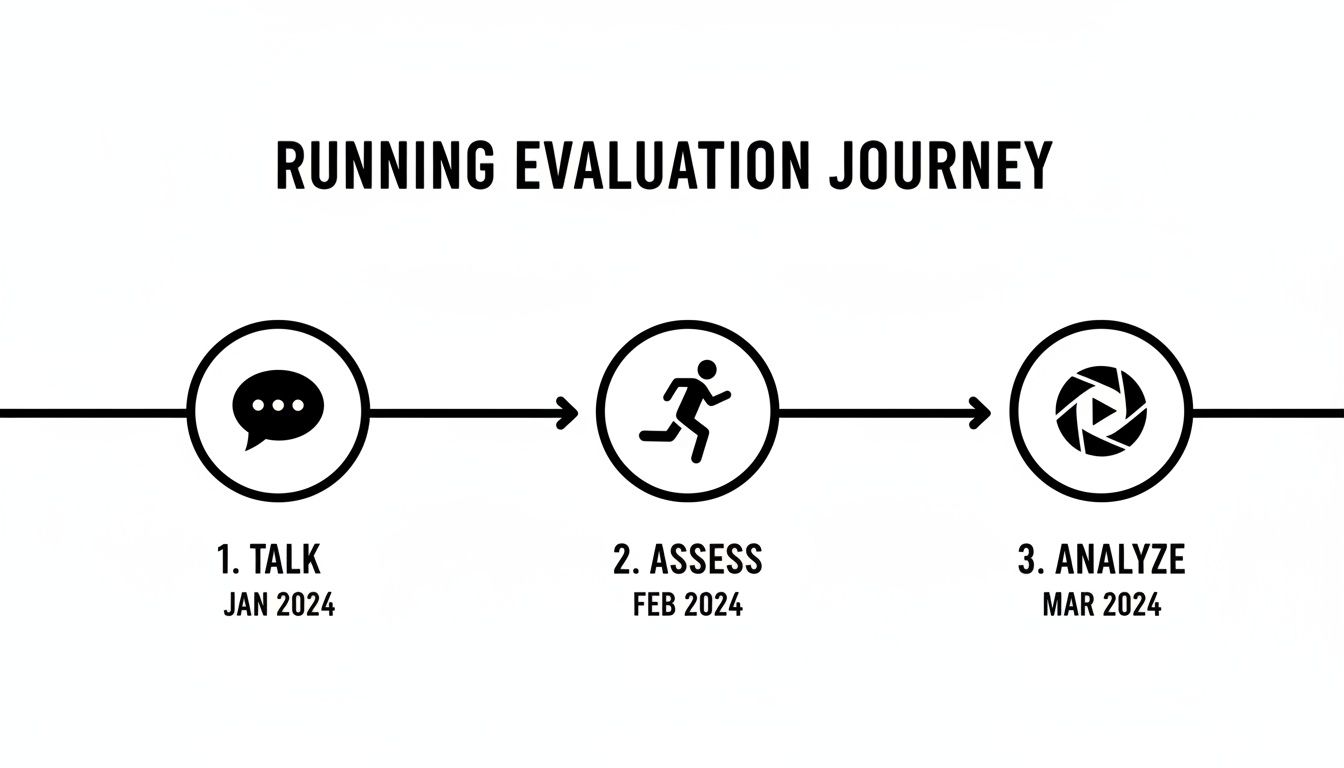
Each step informs the next, ensuring your treatment strategy is built on a solid foundation of evidence.
Safely Getting You Back on the Road
The most important part of your running PT is the structured return-to-run program. Simply telling you to "take it easy" isn't a plan; it's a guess. We guide you day-by-day and week-by-week with a schedule that carefully reintroduces running.
The biggest mistake runners make when returning from injury is doing too much, too soon. A phased program is non-negotiable for rebuilding your body's tolerance to running without risking a frustrating setback.
We always start with short run/walk intervals. This allows your body to get reacquainted with the impact of running in a very controlled, low-risk way.
As you get stronger and your body adapts, we methodically increase the running and decrease the walking. This progression is based entirely on how you are responding—no pain flare-ups, no new issues. For more great advice on this process, check out our guide on how to spring your way back into running outdoors.
Below is a quick look at what the very first phase of a plan might look like. Remember, this is just a sample—yours will be customized based on your specific injury and fitness level.
Sample Phased Return-to-Run Program (Phase 1)
| Day | Workout | Total Time |
|---|---|---|
| Day 1 | Walk 5 min, then 6x (Run 1 min / Walk 4 min), Walk 5 min cool-down | 40 min |
| Day 2 | Rest or Cross-Train (e.g., bike, swim) | – |
| Day 3 | Walk 5 min, then 6x (Run 2 min / Walk 3 min), Walk 5 min cool-down | 40 min |
| Day 4 | Rest or Cross-Train | – |
| Day 5 | Walk 5 min, then 5x (Run 3 min / Walk 3 min), Walk 5 min cool-down | 40 min |
| Day 6 | Rest or Cross-Train | – |
| Day 7 | Rest | – |
This slow and steady approach is the smartest way to ensure your return to running is successful and, most importantly, permanent.
How to Build a More Resilient Runner's Body
Getting you out of pain is just the first step. Our real goal is to build you into a more durable, efficient, and confident runner for the long haul. This is where we shift from just treating an injury to proactively building a body that can handle the demands of consistent training, mile after mile.
It’s about focusing on the building blocks of a healthy runner. And that process starts before you even take your first stride.
Why Your Warm Up Is Non-Negotiable
A proper warm-up isn’t just jogging slowly for five minutes. The old "bend and hold" static stretching is best saved for after your run. Before you start, your body needs movement.
We’re talking about dynamic warm-ups—controlled, running-specific motions that increase blood flow, wake up key muscles, and get your nervous system ready for the work ahead. Think of it as telling your glutes and core to get ready to fire from the very first step, not halfway through your run when it's too late.
A good dynamic warm-up is like a dress rehearsal for your run. It gets all the right muscles working together, reducing the strain on your joints and tendons when you start moving.
The Secret Weapon for Injury Prevention
If there's one thing that will keep you running healthier than anything else, it's a consistent strength training routine. Too many runners avoid the weight room, worried it will make them slow or bulky. The opposite is true.
Strength training is the single best tool you have to prevent running injuries.
Remember, running is just a series of single-leg hops, repeated thousands of times. Without a strong foundation, something is eventually going to break down. We focus on building strength in the key areas that support you on the run:
- Glutes: Your powerhouse muscles that control your pelvis and propel you forward.
- Core: The crucial link that transfers energy between your upper and lower body.
- Hamstrings and Quads: The primary movers and shock absorbers for every single stride.
This doesn't mean you need to spend hours in the gym. Simple, effective exercises done just two or three times a week can make a massive difference. For example, we know strong hips are non-negotiable for runners. If you feel like yours are holding you back, we have a guide on how to improve hip mobility that can help get you started.
Of course, building a resilient body also means making your runs as comfortable as possible. To support that consistent training, you might want to check out the ultimate guide to sweatproof earbuds for running to keep your motivation high without any distractions.
Ultimately, by addressing your body's specific needs with smart warm-ups and targeted strength work, you’re not just lowering your injury risk. You’re unlocking your potential to run better and with more confidence. This is how you build a body that’s truly ready for the long run.
Why Runners Trust Our One-on-One Approach
When you’re sidelined by a running injury, the last thing you want is to feel like just another number in a crowded clinic. We get it. That’s why we’ve built our entire practice around a simple, powerful idea: true one-on-one care.
From the moment you walk in, your physical therapist is 100% focused on you for the full hour. You won’t be passed off to an aide or left alone with an ice pack while your PT juggles other patients. That dedicated time is everything.
The Power of Dedicated Time
This one-on-one model allows us to do what we do best: listen, perform detailed hands-on treatments, and provide the focused coaching you actually need to get better. Our therapists aren’t just experts in running mechanics; many are runners and athletes themselves, with advanced certifications in sports rehab and running analysis. We understand the mindset because we live it, too.
And the demand for this kind of expert, individualized care is only growing. The physical therapy market is projected to hit $186.90 billion by 2033, with North America leading the charge. As this report on the physical therapy services market shows, more people are demanding specialized treatment to stay active. Our model was built from day one to meet that demand with real quality and attention.
We are committed to being your partner in recovery. Our job is to provide the expert guidance you need to get back to chasing your goals, whether it’s your first 5K or your next marathon.
This isn’t just about treating an injury. It’s about building a relationship founded on trust and a shared mission—getting you back to the sport you love, feeling stronger and more confident than you were before. We’re here to support you every single step of the way.
Your Running Physical Therapy Questions Answered
When you're sidelined by pain, the questions start piling up. You're not just thinking about recovery; you're focused on timelines, logistics, and getting back on the road.
We hear these questions every day in our clinics. Here are the straight-up answers to the most common ones.
Do I Need a Doctor's Referral for Running Physical Therapy?
No, you don’t. Massachusetts is a “Direct Access” state, which means you can schedule an appointment with a physical therapist without seeing a doctor first. The moment you feel pain, you can book a visit with us and get the process started.
We’ll conduct a full evaluation, pinpoint the root cause of your pain, and can often begin treatment that same day. If we find anything that needs a physician's eyes, or if your specific insurance plan happens to require a referral, our team will handle the coordination and make sure the process is seamless for you.
How Long Until I Can Run Pain-Free Again?
This is the number one question on every runner’s mind. The honest answer: it depends. Your recovery timeline is completely individual, shaped by the type of injury, how long it's been bothering you, and your body's unique healing capacity.
A minor muscle strain might clear up in a few weeks with the right care. A more stubborn, chronic issue could take a couple of months of consistent work. Our goal is always the same: build a realistic plan that gets you back to running safely and makes you more resilient against future injuries.
We’ll be transparent with you about your progress and what to expect every step of the way.
Is Running Physical Therapy Covered by Insurance?
Yes, in the vast majority of cases, it is. Health insurance covers physical therapy for running injuries just like it would for any other orthopedic problem, like a sore shoulder or an aching back. An injury is an injury, whether it happened on a run or not.
Before your first visit, our administrative team will verify your insurance benefits and explain your coverage in plain English. That way, there are no financial surprises, and you can put all your energy into getting better.
Ready to get to the root of your running pain and build a stronger, more resilient body? The expert team at Joint Ventures Physical Therapy is here to help you get back on the road. Schedule your one-on-one evaluation today!