
You roll over in bed, sit up, and the room whips sideways.
Maybe it hit when you looked up at the kitchen cabinet. Maybe you turned your head crossing Boylston, stepped off the Green Line, or got out of a spin class and suddenly felt like the floor moved first. Typically, these experiences lead to looking up Vertigo near me. They don't want a long lecture. They want to know what's happening, whether it's dangerous, and where to go in Boston to get steady again.
That urgency makes sense. Vertigo is unsettling, distracting, and hard to ignore. It can knock out a workday, make commuting feel risky, and leave you avoiding simple head movements because you're bracing for the next wave.
That Spinning Sensation Just Won't Stop
A lot of people think they must be dealing with something rare because the sensation feels so strange. It isn't rare. Dizziness including vertigo affects roughly 15% to over 20% of adults each year, is about 2 to 3 times more common in women, and nearly 80% of patients report that vertigo interrupts daily activities according to the NCBI overview of vertigo and dizziness.
That matters because the search for Vertigo near me is usually practical, not academic. You're trying to figure out if you can drive, work, exercise, or even turn over in bed without setting it off again.
What this feels like in real life
For some Boston patients, it starts with one specific movement. Rolling to the right. Looking up to grab a bag from an overhead bin at South Station. Tilting the head back in the shower. The pattern is often the clue.
Other people don't describe it as “spinning” right away. They say the room “shifted,” their balance “dropped out,” or they felt “pulled” to one side. Those words count. In a vestibular clinic, the exact trigger matters more than whether you used perfect medical terminology.
Practical rule: If head movement repeatedly sets off a short burst of spinning, don't just wait it out and hope it disappears. Get assessed.
The next clear step in Boston
If your symptoms sound positional, a vestibular physical therapy evaluation is often the fastest useful next move. A skilled vestibular PT doesn't just hand you generic balance exercises. They look for the movement pattern, test what provokes it, and decide whether the issue fits a mechanical inner-ear problem, a balance-system problem, or something that needs referral elsewhere.
That's the big difference between random online advice and local care. Good vestibular treatment gives you a path. In Boston, that means finding a clinic that can evaluate dizziness and vertigo in a one-on-one setting, explain what they see, and act on it the same visit when appropriate.
Is It Vertigo or Just Dizziness
Those words get lumped together all the time. In clinic, they point us in different directions.
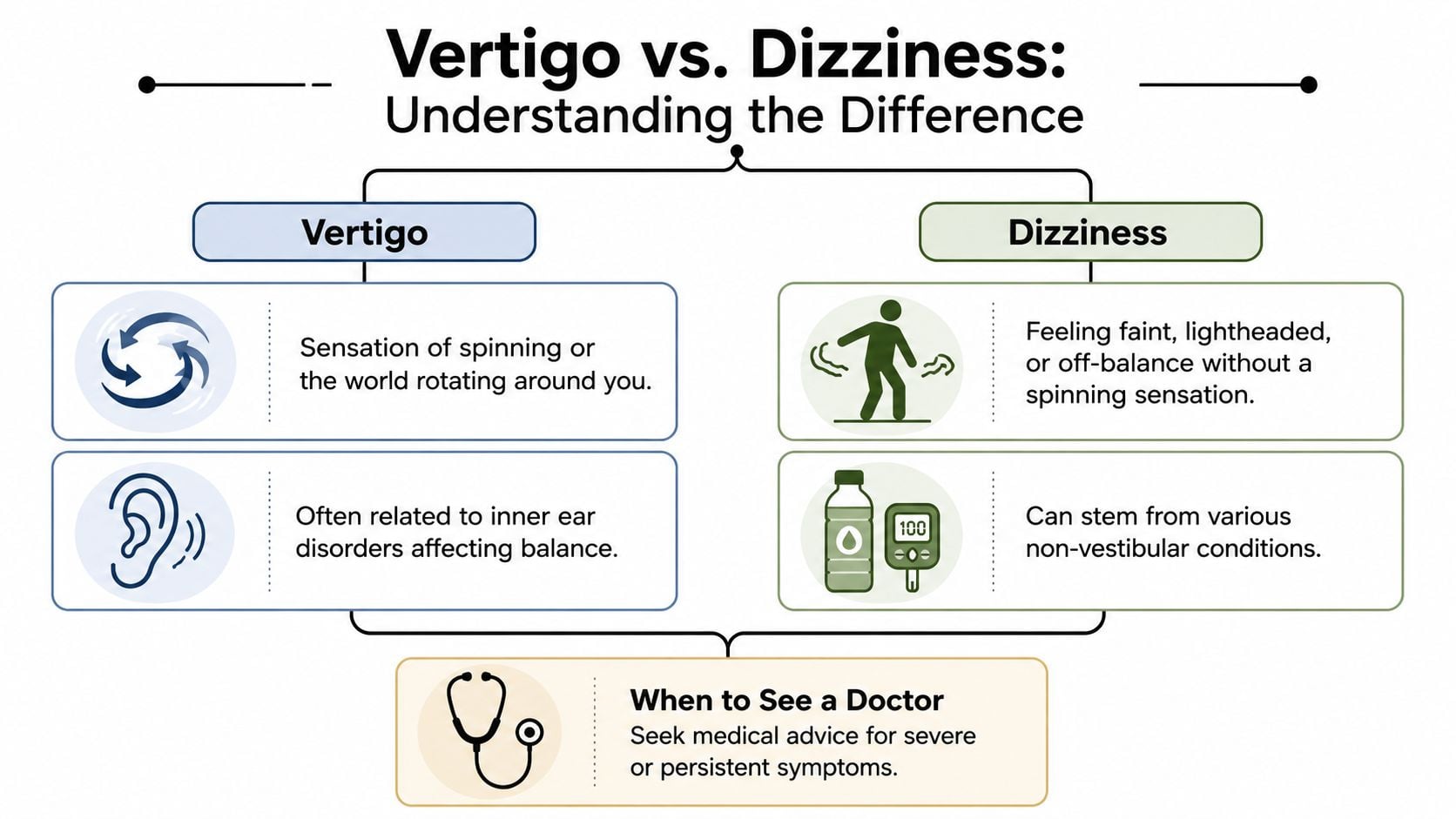
The fastest way to sort it out
Use your symptom, not the label you typed into Google.
| Feeling | What it usually suggests |
|---|---|
| Vertigo | A false sense of spinning, tilting, or motion. You move, or the room seems to move. |
| Dizziness | A general off feeling. Foggy, unsteady, floaty, or disoriented. |
| Lightheadedness | Faint, weak, or close to passing out. |
That difference matters. A Boston patient who gets a sudden spin when rolling in bed needs a very different evaluation than someone who feels woozy after standing up fast on the T platform or skipping lunch.
The pattern we see most often in vestibular PT
When the story is brief spinning tied to head position, BPPV jumps high on the list. BPPV happens when tiny calcium carbonate crystals shift into the wrong part of the inner ear. Position changes then send a false motion signal, which can trigger short bursts of vertigo, as explained in WebMD's overview of vertigo causes and symptoms.
That explanation helps for one reason. It turns a frightening symptom into a problem you can test and often treat directly.
What actually helps you tell the difference
Ask three questions:
Does it feel like motion?
Spinning, tilting, or being pulled points more toward vertigo.Is there a clear trigger?
Rolling, bending, looking up, or turning quickly gives your PT useful diagnostic clues.How long does each episode last?
Brief, repeatable attacks suggest a different problem than all-day imbalance or faintness.
These details matter more than whether you picked the perfect word in your search. They help a vestibular PT decide whether you likely have BPPV, another vestibular disorder, a blood pressure issue, or something that needs medical referral.
A lot of Boston patients try home maneuvers before getting assessed. That is understandable, but it is also where people lose time. The wrong maneuver, done for the wrong side or wrong canal, can stir symptoms up and leave you less certain about what is going on. For background on treatment methods, read this overview of vestibular rehabilitation therapy, but do not use it as a substitute for an exam.
A better question than “Is this dizziness?” is “What exactly triggers it, what does it feel like, and does that pattern fit a vestibular problem?”
If your search for vertigo near me is really asking, “Who in Boston can figure this out without sending me in circles,” that is the right question. The next useful step is a local vestibular evaluation that matches the symptom pattern to a treatment plan.
When to See a Physical Therapist for Vertigo
Searching for Vertigo near me in Boston gives you a messy list. ENT. Neurology. Urgent care. Audiology. Physical therapy. That's exactly why people lose time. The list doesn't tell you who makes sense first.
A major challenge is that vertigo can come from inner-ear, neurologic, or other systemic causes, and the wrong first stop can delay care. That's why clear triage matters more than a generic directory, as noted by Cleveland Clinic's balance and vertigo service overview.
When PT is a smart first stop
A vestibular physical therapist is often the right first appointment if your symptoms are clearly movement-related and especially if they show up with:
Rolling in bed
A classic complaint. You turn to one side and the room suddenly spins.Looking up or bending down
Reaching into a cabinet, tying shoes, loading a dishwasher, or checking a blind spot can bring it on.Feeling off balance after the spinning stops
The brief vertigo may fade, but you still feel unsettled walking, turning, or navigating stairs.Symptoms that keep returning with the same positions
Repetition is useful. It gives the clinician something specific to test.
A vestibular PT can examine eye movements, positional triggers, balance, and motion sensitivity. If the pattern fits a vestibular problem, treatment can usually begin right away. If it doesn't, the PT should tell you plainly and direct you to the right medical follow-up.
When you should skip PT and get urgent help
Some symptoms do not belong in a routine outpatient appointment. Go to the ER or seek urgent medical evaluation if the vertigo comes with:
- Difficulty speaking
- Double vision
- A new severe headache
- Sudden neurologic changes
- Chest pain or other concerning whole-body symptoms
Those signs raise a different level of concern. A responsible vestibular clinician won't try to “treat through” them.
Don't let the directory make the decision for you
The first available result isn't always the right one. If your vertigo seems positional and repeatable, seeing a clinician trained in vestibular rehab is often more efficient than bouncing between unrelated appointments. Boston has plenty of healthcare options. The value is choosing the one that matches the pattern you're having.
Your Vertigo Evaluation at Joint Ventures in Boston
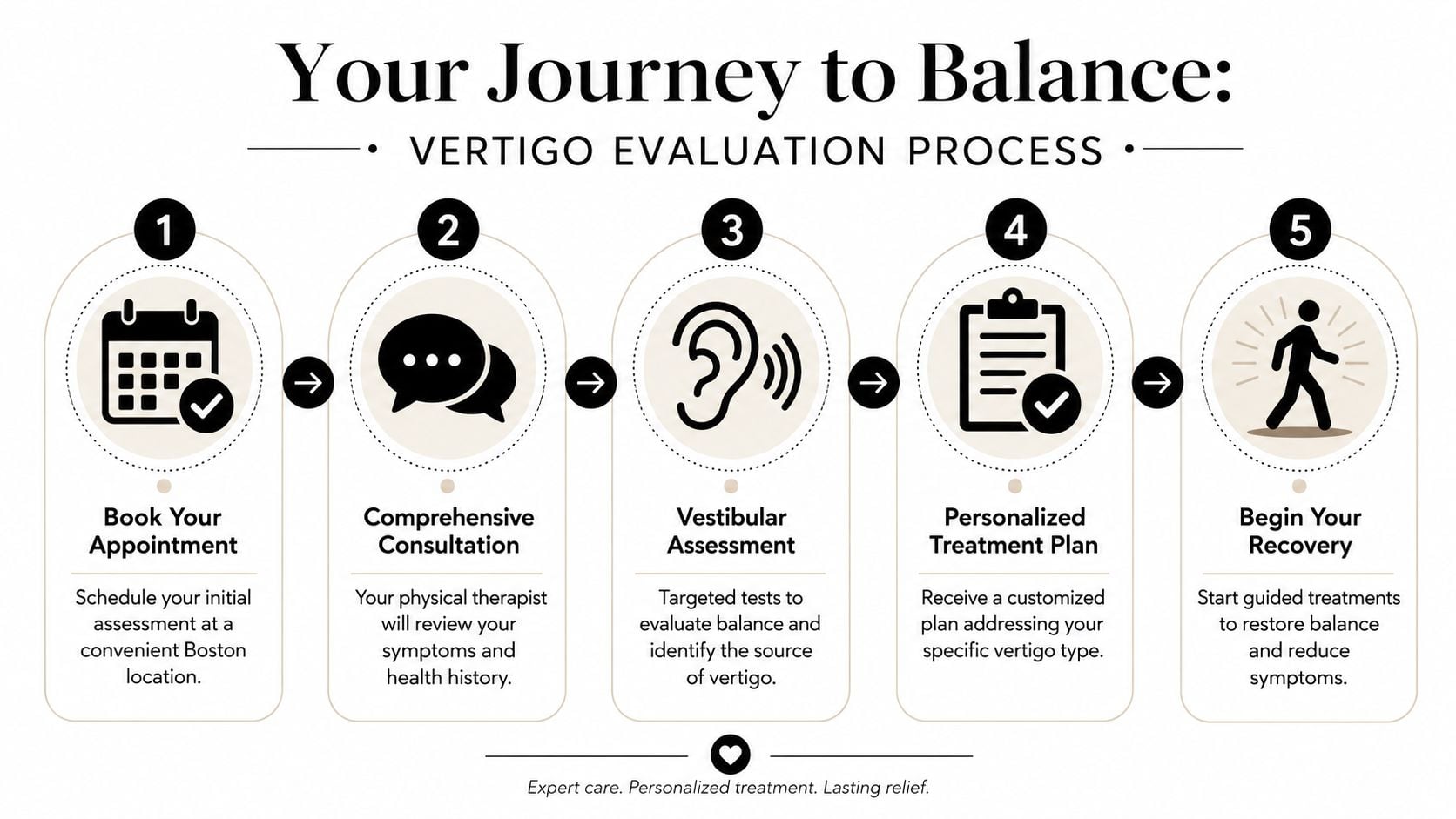
Patients often walk into a vertigo appointment tense. They're worried the testing will make them miserable, or that no one will really listen and they'll leave with vague advice. A good evaluation should feel structured, calm, and specific.
At a Boston vestibular PT clinic, the first visit usually starts before any testing happens. The therapist asks for the full story. What movement started this? How long does each episode last? Is it spinning, drifting, swaying, or faintness? What happens when you roll in bed, look up, bend down, walk in crowds, or ride the T?
What the therapist is trying to learn
Those questions aren't filler. They narrow the possibilities quickly.
A careful vestibular evaluation is trying to answer a few practical questions:
Is this positional?
If one head movement predictably triggers symptoms, that points in a very different direction than constant disequilibrium.Is the inner ear involved?
Eye movement testing and symptom behavior often help sort that out.Is balance still affected between episodes?
Some people only spin briefly. Others keep feeling unstable afterward.Does this fit a rehab problem or a referral problem?
That decision matters more than sounding impressive.
What testing usually looks like
The exam may include positional testing, visual tracking, eye movement observation, walking and balance tasks, and motion-based screening. Some tests are designed to reproduce symptoms briefly in a controlled way. That's not the therapist being careless. It's how the cause gets identified.
If you've been searching for Vertigo near me because turning your head sets things off, this part is often the turning point. Instead of guessing, you get a pattern confirmed or ruled out.
If a test briefly brings on your symptoms in a controlled way and then the clinician explains exactly why, most patients feel relieved. The unknown is usually worse than the test.
What this looks like across Boston locations
For people in Greater Boston, convenience matters because vertigo doesn't pair well with long, complicated travel days. If you live or work near Back Bay, Kenmore Square, Fort Point and the Seaport, Downtown Boston, Brookline, or Allston, it helps to book close to where your day already happens.
A clinic visit should also feel one-on-one, not rushed. You want uninterrupted time with someone who can examine the problem, answer your questions, and make a plan that fits your work commute, exercise routine, and home setup.
If your symptoms sound like BPPV and you want to understand the maneuver side of treatment before your visit, this local guide on the Epley maneuver near you is a useful preview.
What you should leave with
You should not leave your first visit wondering what just happened.
You should leave with:
- A working explanation of the likely cause
- A clear next step for treatment or referral
- Practical advice on what movements to modify for now
- A realistic recovery plan based on your symptom pattern
That clarity is the whole point. A vestibular evaluation isn't just about naming the problem. It's about replacing panic with a plan.
Personalized Vertigo Treatment Plans and Outcomes
You search for help because the room spins when you roll over, look up, or turn too fast. What you need next is not generic advice. You need a treatment plan that matches the reason you are dizzy.

When BPPV is the problem
If your symptoms fit BPPV, treatment is usually very specific. A vestibular physical therapist identifies the affected side and canal, then uses the correct repositioning maneuver to move the displaced crystals where they belong. Healthdirect's vertigo treatment overview gives a good general explanation of that process.
I strongly recommend getting this checked in person instead of guessing from videos. The right maneuver helps. The wrong maneuver can leave you frustrated, still dizzy, and unsure what happened.
Some Boston patients feel much better right away. Others need more than one visit because the crystals were not fully cleared, the irritated vestibular system needs time to settle, or the spinning stopped but the unsteadiness stayed behind. That pattern is common.
Why treatment often includes more than a maneuver
A good vertigo plan does more than stop a brief spinning episode on the table. It should also address the leftover problems that make daily life in Boston feel harder than it should.
That usually means vestibular rehab built around the movements you make through your week. Crowded T platforms, fast head turns in crosswalks, screen-heavy workdays, grocery store aisles, dim stairwells, and busy gyms all expose symptoms fast. If treatment ignores those triggers, progress feels incomplete.
At Joint Ventures Physical Therapy, that one-on-one approach matters. Positional vertigo can be treated directly, then followed with rehab that targets the specific movements and environments still setting you off.
What a personalized plan can include
Your plan should match your symptom pattern, not a generic handout. Depending on the findings, treatment may include:
- Repositioning treatment for confirmed BPPV
- Gaze stabilization exercises if quick visual shifts, scrolling, or turning your head makes you feel off
- Balance training if walking, pivoting, or uneven ground feels less steady than standing still
- Gradual motion exposure if you started avoiding movement and your confidence dropped
- Neck treatment if stiffness and head movement are feeding into the problem
If neck tension is part of your symptom picture, this guide to neck exercises for vertigo explains that overlap clearly.
There is also value in seeing how organized rehab plans are structured in other settings. These examples of CBT and PT treatment plans are useful because they show what a clear, practical care plan looks like when symptoms start disrupting normal daily function.
Here's a short visual explanation of the maneuver side of treatment:
What improvement usually feels like
Recovery is often quieter than people expect.
It usually shows up in ordinary moments first. You roll in bed without bracing for the spin. You reach for something on a high shelf without freezing. You walk through South Station, step onto an escalator, or turn your head during a conversation with less hesitation.
That is the outcome to aim for. Less spinning, steadier walking, and the confidence to move normally again.
Book Your Vertigo Assessment at a Boston Location Near You
If you're still searching for Vertigo near me, stop scrolling and choose the most practical next step. Book an assessment at a clinic that treats vestibular problems regularly and is close enough that getting there won't turn into another ordeal.
For Greater Boston patients, that usually means choosing a location near where you live, work, or commute. Back Bay works well for professionals and students moving through central Boston. Kenmore Square is convenient for the Fenway area and nearby campuses. Fort Point and the Seaport fit downtown office schedules. Downtown Boston is an easy option for people coming in by train or subway.

Make the booking process easy on yourself
When people put off care, it's usually not because they don't want help. It's because logistics feel like one more problem.
Look for a clinic that makes these parts easier:
Insurance support
Administrative teams that verify benefits and handle authorizations remove a lot of friction.Early and late appointments
That matters if you're working full time, in school, or coordinating around family responsibilities.Neighborhood convenience
The less complicated the trip, the more likely you are to follow through.Specialty depth
A clinic that already treats vestibular issues, balance problems, concussion-related symptoms, and related movement concerns is easier to trust than a generic listing.
Why local clarity matters
A good local healthcare website should do more than exist. It should explain what the clinic treats, where it's located, and how to take action when symptoms disrupt daily life. If you're curious about why specialty clinics invest in location-based visibility, this piece on how practices drive growth with specialized SEO gives useful business context from the patient-access side.
The main point is simpler than that. You need the right care path, close to home, with fewer obstacles between symptoms and treatment.
What to do today
If spinning hits when you roll in bed, tip your head back, or change position, book an evaluation. If you have red-flag symptoms, get urgent medical care. Don't stay stuck in the search results trying to solve it alone.
Boston is full of options. Pick the one that gives you an actual vestibular assessment, a clear explanation, and a local plan you can follow.
If vertigo is disrupting your workday, commute, workouts, or sleep, take the next step with Joint Ventures Physical Therapy. Book a vestibular assessment at a Boston-area location that fits your routine, and get a clear plan for what's causing the spinning and what to do next.