
You're probably feeling it right now.
You finish a morning of Zoom calls in Seaport or a block of spreadsheet work Downtown, stand up, and your neck doesn't quite turn normally. Your low back feels locked. Your wrists are irritated enough that typing changes how you hold your hands. By the end of the week, it's not dramatic pain. It's just constant enough that you start planning your day around it.
That pattern is common among Boston professionals. Long commutes, hybrid setups that alternate between a proper office and a kitchen counter, laptops in conference rooms, and long stretches of focused work all add up. The problem usually isn't one bad lift or one isolated strain. It's the repetition of the same position, the same screen height, the same muscle tension, day after day.
Physical therapy for desk workers in Boston should address that reality directly. Not with a generic handout of stretches you'll forget by Thursday, but with a plan built around your actual work demands, your commute, your training schedule, and the specific way your symptoms build over the course of a workday.
The Desk Worker's Dilemma in Boston
A lot of desk workers wait too long because the pain feels too ordinary to justify treatment. It starts as end-of-day stiffness in Back Bay after a long legal brief. Then your upper trap feels tight driving home. Then your jaw starts clenching during deadlines. Then you stop going to the gym because rows, presses, or even running seem to flare everything up.
That progression matters. Desk-related pain rarely stays neatly in one area. A stiff thoracic spine can show up as neck strain. A cramped laptop setup can lead to shoulder tension and wrist irritation. A low back that feels “fine enough” at noon can become the reason you keep shifting in your chair by 4 p.m.
Boston professionals are especially good at normalizing this. They're busy, they're high-performing, and they assume the answer is to push through. Sometimes they buy a standing desk, sometimes they add a few random stretches between meetings, and sometimes they just accept that desk work hurts.
It doesn't have to work that way.
In a Boston clinic setting, the desk worker who does best is usually the one who stops chasing quick relief and starts solving the pattern. That means looking at workstation setup, movement habits, tissue stiffness, strength endurance, and the secondary issues that often ride along with desk posture, including TMJ tension, headaches, pelvic floor pressure, or hand symptoms.
Pain from desk work is often predictable. That's good news, because predictable problems respond well to a targeted plan.
Why Your Desk Job Is Causing Aches and Pains
Most desk pain comes from one simple problem. Your body stays in one position too long, and the same tissues absorb the load over and over.
For desk workers, the highest-yield physical therapy target is usually postural load management, not just pain relief. PT programs combine workstation changes with movement breaks, mobility work, and endurance training to restore movement diversity and reduce cumulative tissue strain, as described in this discussion of physical therapy for desk workers with back pain.

Static load is the real issue
People often blame posture as if there's one perfect way to sit. That's too simplistic. The bigger issue is static loading. If your lumbar spine stays flexed, your shoulders stay protracted, and your neck stays slightly forward for hours, your system loses movement variability. Some muscles stay on all day. Others stop contributing well.
That's why symptoms often show up in clusters:
- Neck stiffness and headaches from prolonged forward-head positioning and upper-quarter muscle overuse
- Mid-back tightness from a thoracic spine that barely moves through the day
- Low back pain when the same spinal segments carry load without relief
- Wrist and forearm irritation when keyboard and mouse setup keeps the upper limb working from a poor base
If neck pain is already part of your day, this guide to neck pain physical therapy in Boston is a useful next read.
Your work setup shapes your symptoms
The body adapts to what you ask it to do repeatedly. At a desk, that usually means shortened hip flexors, reduced thoracic motion, and trunk muscles that don't have the endurance to support long-duration sitting well. Then people try to “sit up straight” harder, which often just creates more tension.
Here's what usually doesn't work:
- Random stretching once a day
- Buying equipment without adjusting habits
- Standing all day instead of sitting all day
- Strength work that ignores the workstation causing the problem
Here's what does work better:
- Change the load source with desk and monitor adjustments.
- Interrupt the position with repeated movement breaks.
- Restore motion where desk work takes it away.
- Build endurance so your body can tolerate your real schedule.
The goal isn't perfect posture. The goal is giving your body more options during the workday.
Your Personalized Assessment at Joint Ventures
When a desk worker comes in for an evaluation, the most important part usually isn't the painful area itself. It's the pattern behind it.
Someone may book for right-sided neck pain, but the bigger story often includes a laptop-heavy setup in Fort Point, a long Red Line commute, strength training that's been scaled back because pressing hurts, and symptoms that spike after back-to-back meetings. If you don't ask about those details, you miss the case.
What a thorough evaluation should cover
A useful desk-worker assessment has to connect symptoms to function. That means looking at more than range of motion and tenderness.
A strong initial visit should include:
- Workday mapping so the therapist understands when symptoms start, what tasks trigger them, and what positions make them worse
- Postural and movement review to see how you sit, stand, rotate, reach, breathe, and transition out of sustained positions
- Mobility testing in the thoracic spine, hips, shoulders, and other regions that often stiffen with desk work
- Strength and endurance screening because many desk workers aren't weak in a max-effort sense, but they do lack positional endurance
- Irritability assessment to separate a manageable overuse issue from a more reactive presentation that needs a different pace
One-on-one care is particularly important. High-volume treatment models tend to flatten these cases into a standard neck or back protocol. Desk workers rarely fit a standard protocol.
The practical difference between generic care and real diagnosis
Good assessment doesn't just identify pain. It identifies why this person hurts in this environment.
A finance professional in Downtown Boston may need a plan built around prolonged seated work and late-day stiffness. A graduate student near Kenmore may need upper-quarter treatment for laptop posture plus hand symptoms from sustained typing. A hybrid worker in Back Bay may need two setup strategies, one for the office and one for home, because the home setup is what keeps resetting the problem.
A desk worker's pain pattern usually makes sense once you look at the schedule, setup, and movement habits together.
The administrative side matters too. People with demanding schedules need clear scheduling, insurance support, and a process that doesn't create friction before care even starts. Concierge-style support isn't fluff. It removes the small barriers that make busy professionals postpone treatment for another month.
Building Your Custom Recovery Plan
Treatment works best when it matches the actual load on the body. For desk workers, that usually means the plan has to do more than reduce symptoms for a day or two. It has to change how the body handles a full workweek.
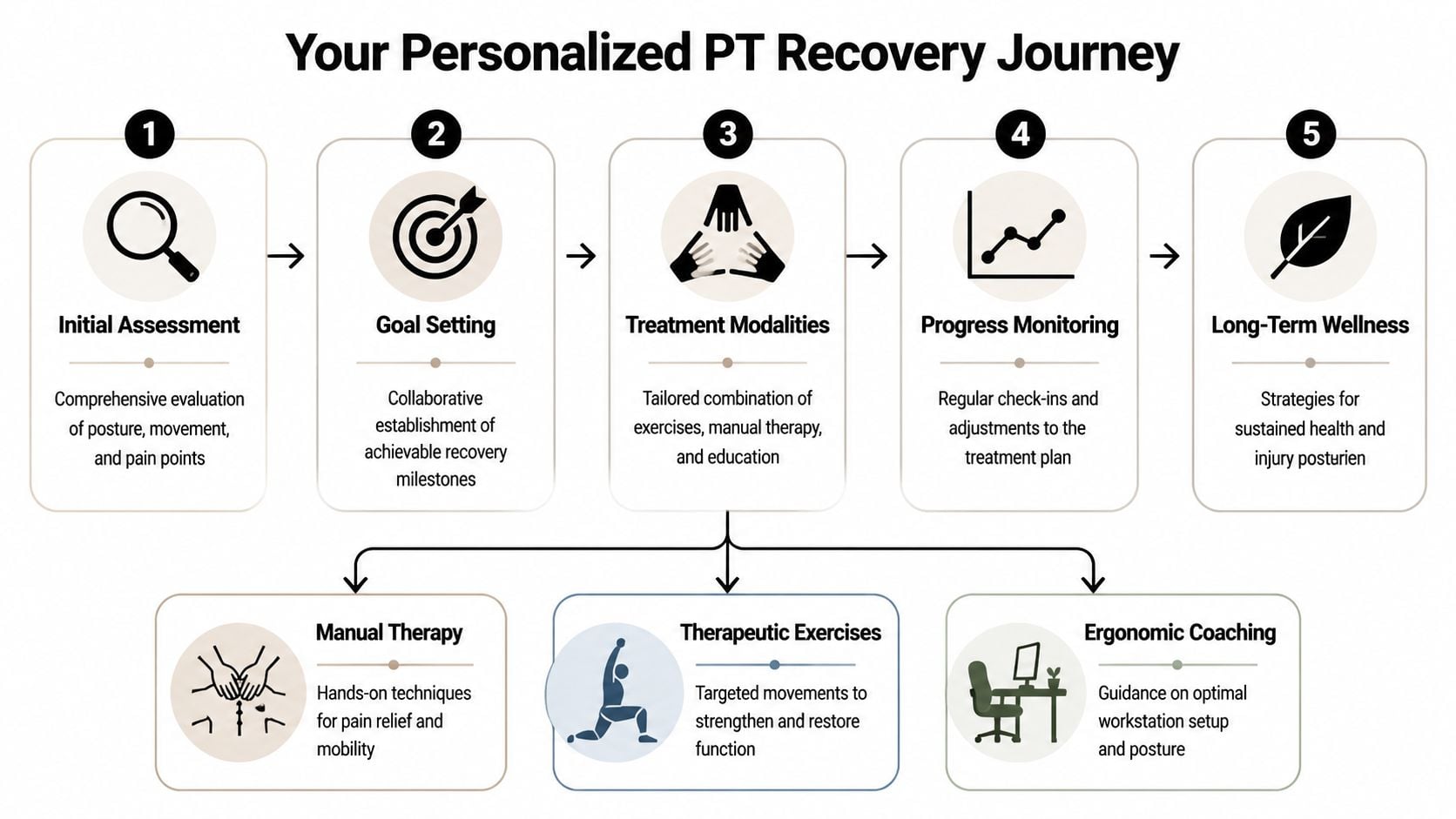
What goes into an effective plan
For Boston desk workers, the treatment mix often includes several pieces running at the same time rather than one isolated intervention.
One useful option is Joint Ventures Physical Therapy, which provides one-on-one physical and occupational therapy in Greater Boston and includes services such as workplace ergonomics, trigger point dry needling, TMJ care, pelvic floor therapy, hand and upper-extremity treatment, vestibular care, and aquatic therapy.
Here are the tools that tend to matter most.
Manual therapy for mobility restrictions
If the thoracic spine, rib cage, hips, or shoulders are moving poorly, hands-on treatment can help restore motion and make exercise more effective. It's not the whole plan, but it often helps patients move better sooner.Targeted exercise for endurance
Desk workers often need more than traditional strengthening. They need trunk endurance, scapular support, hip capacity, and movement control they can sustain through long meetings, commutes, and laptop sessions.Trigger point dry needling for persistent muscular guarding
Some patients have stubborn upper trapezius, levator scapulae, gluteal, forearm, or jaw-related tension that doesn't change much with stretching alone. In the right case, dry needling can be a useful addition to reduce irritability and improve tolerance for movement.
What doesn't work well on its own
Desk workers often come in after trying the same common fixes.
| What people try | Why it falls short |
|---|---|
| Stretching only the painful area | It ignores the load pattern creating the pain |
| Switching to a standing desk only | It changes the position, but not necessarily the movement habits |
| Resting until symptoms calm down | The pain may settle, but the same workday usually brings it back |
| General gym exercise with no plan | It can help overall fitness, but it may not address the actual driver |
Advanced care for presentations that aren't straightforward
Some desk-worker cases spill into specialty areas. That's where a broader clinical toolbox matters.
- TMJ symptoms can overlap with deadline stress, jaw clenching, and forward-head posture.
- Pelvic floor symptoms may become more noticeable in people who sit for long stretches and brace inefficiently through the trunk.
- Hand and upper-extremity complaints can require occupational therapy input when typing, mousing, or repetitive device use is part of the problem.
- Aquatic therapy can help patients who need lower-impact re-entry to movement because land-based exercise is too provocative at first.
A custom plan also changes over time. Early treatment may focus on calming symptoms and restoring motion. Later sessions should shift toward work tolerance, gym return, commuting strategies, and prevention.
The right plan doesn't just make a patient feel better on the table. It helps them handle a Tuesday full of meetings without paying for it that night.
Proactive Strategies for Your Boston Workspace
Boston work setups are rarely as polished as people think. A home office in a Back Bay brownstone may mean a dining chair and a laptop riser. A startup space in Seaport may look modern but still leave people reaching for a mouse all day with no arm support. A Downtown office may have better furniture but longer uninterrupted sitting.
The fix isn't to obsess over perfect ergonomics. It's to reduce repeated strain and make movement easier to maintain.
Start with changes you can feel immediately
Try these first:
- Raise the screen so you're not living in neck flexion all day. If you use a laptop, pair it with an external keyboard and mouse when possible.
- Support the feet if your chair height leaves your legs hanging. A stable base changes what your low back has to do.
- Bring the tools closer so the mouse, notebook, and frequently used items stay in your working zone.
- Use movement cues tied to your schedule. After calls, between meetings, or when you send a batch of emails, stand up and move.
For employers thinking beyond individual fixes, broader workplace habits matter too. This overview from SleepHabits on corporate wellbeing is a useful reminder that recovery, fatigue, and work design all affect how people feel at their desks.
Generic advice vs a PT-guided plan
| Common Problem | Generic Online Advice | Joint Ventures PT Approach |
|---|---|---|
| Neck and upper trap tension | “Sit up straight” | Adjust monitor and arm support, restore thoracic motion, improve deep neck and scapular endurance |
| Low back pain after long meetings | “Get a better chair” | Review sitting tolerance, hip mobility, trunk endurance, and movement-break timing |
| Wrist and forearm irritation | “Stretch your wrists” | Assess keyboard and mouse setup, upper-quarter mechanics, and repetitive loading patterns |
| Jaw tension and headaches | “Relax more” | Screen for TMJ involvement, neck contribution, breathing pattern, and work stress behaviors |
| Pain that returns every week | “Do these 5 stretches daily” | Match treatment to your actual schedule, setup, exercise tolerance, and progression |
If you want more detail on setup and prevention, this article on workplace ergonomics and physical therapy in Boston adds useful local context.
Discreet movements that work at a desk
These are usually more useful than dramatic stretches:
- Chin retraction for people who live on laptops and dual screens.
- Thoracic extension over the chair back to break up mid-back stiffness.
- Scapular setting and reach resets after long keyboard blocks.
- Seated pelvic tilts or sit-to-stands to change lumbar load.
- Brief walks between meetings, especially if your afternoon symptoms are worse than your morning ones.
How to Get Started with Physical Therapy in Boston
Most desk workers should stop trying to tough it out when symptoms start changing behavior. If you're avoiding workouts, adjusting how you type, waking up stiff after a workday, or noticing pain that keeps returning after short-term fixes, it's time for a proper evaluation.
The same is true if your symptoms start spreading. Neck pain that becomes jaw tension, back pain that now affects sitting tolerance, or hand symptoms that interfere with work deserve more than internet advice.
What the first step looks like
Booking care should be straightforward. Choose a location that fits your commute and schedule, get your insurance questions answered up front, and come in with a clear picture of when symptoms appear during your day. In Boston, convenience matters. Back Bay, Kenmore Square, Fort Point or Seaport, Downtown Boston, and nearby neighborhoods all have different traffic and commute realities, so proximity often helps people stay consistent.

If you want to know what to expect before day one, this guide on how to prepare for your first physical therapy appointment is worth reviewing.
When you want more clinical depth
This page stays focused on local care and next steps in Boston. For deeper educational content on injury mechanics, rehab principles, and specialty topics, visit Highbar Health.
The main point is simple. Desk pain is common, but it isn't something you have to organize your life around. A structured plan can help you work, train, commute, and sit through meetings with a lot less friction.
If desk work is starting to dictate how you sit, move, exercise, or focus, book an evaluation with Joint Ventures Physical Therapy. With locations across Greater Boston and one-on-one care built around your schedule, your setup, and your goals, it's a practical place to start.