
You leave South Station, feel the pull in your neck again, and tell yourself you'll deal with it next week. Or after this project wraps. Or after the race. That works for a while, until the shoulder starts barking during laptop work, the dizziness shows up on staircases, or your jaw starts aching halfway through the commute home.
That pattern is common in downtown Boston. People don't ignore pain because they don't care. They ignore it because the day is already full. Between train schedules, office hours, childcare pickup, and trying to protect a little time for exercise, healthcare often loses to logistics.
The problem is that convenience alone isn't enough. If you need physical therapy near South Station Boston, you also need the right kind of care. A clinic can be close to the station and still be the wrong fit if it only handles basic orthopedic cases, has limited scheduling, or can't help with issues like TMJ, pelvic floor symptoms, dizziness, or running injuries.
Expert Physical Therapy That Fits Your Commute
You get off the train, check the time, and do the math. If treatment adds 45 minutes to an already packed day, it usually does not happen. That is why people working near South Station need more than a clinic that looks close on a map. They need care they can keep showing up for.
In practice, adherence is one of the biggest predictors of progress. A strong treatment plan does not help much if appointments keep getting pushed because the location is awkward, the schedule is too narrow, or the clinic only treats part of the problem. For Boston professionals, the best fit is usually a clinic near the station with hours that work before work, after work, or during a lunch break, plus therapists who can treat more than standard back and shoulder pain.
That matters because commuter injuries and office-driven pain patterns are rarely just one thing. Neck tension can come with headaches or dizziness. Jaw pain can build from stress and posture. Postpartum patients may need pelvic floor care close to work because getting across the city is not realistic. Runners training before the workday need a therapist who understands mileage, load, and race calendars, not generic advice to rest.
Here is the standard I recommend patients use:
- Keep travel simple: The clinic should fit your existing route between South Station, the Financial District, Seaport, or Downtown Crossing.
- Protect your schedule: Early morning, evening, and lunch-hour appointments make consistency more realistic.
- Choose a clinic with specialty depth: TMJ, pelvic floor, vestibular care, post-operative rehab, and running injuries should not require separate referrals across town.
- Expect a clear plan from day one: You should leave the first visit knowing what is driving the issue, what treatment will involve, and what progress should look like.
At Joint Ventures, that is the model. The Downtown Boston physical therapy location works well for patients who want skilled care near South Station without turning rehab into another commute.
A convenient clinic is helpful. A convenient clinic with the right specialty care is what usually gets people better.
Joint Ventures Clinics Minutes from South Station
The biggest mistake people make is choosing a clinic by map pin alone. What matters more is whether you can get there easily on a workday, and whether the appointment times line up with real life.
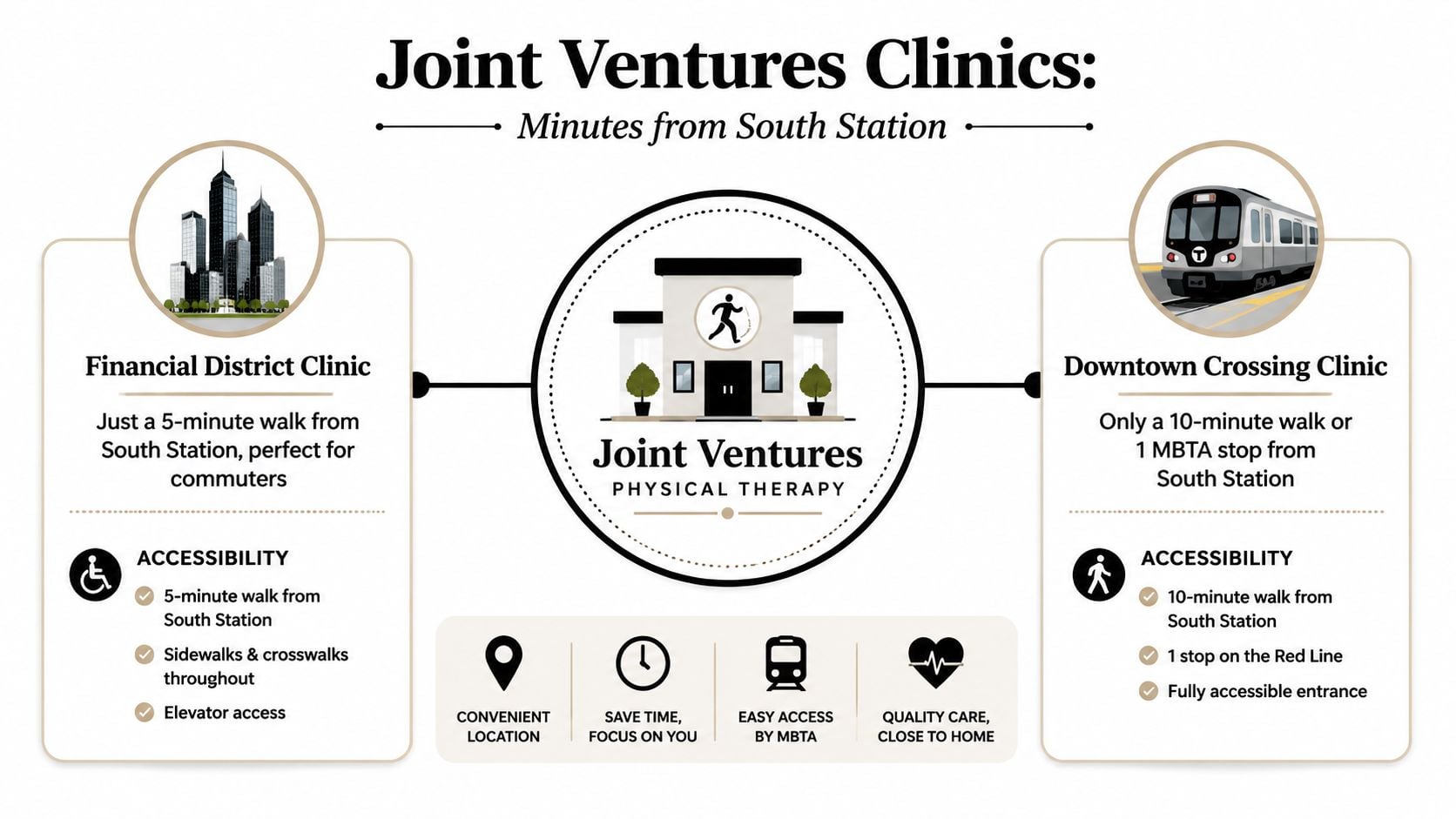
For patients moving through South Station, the two locations that usually make the most sense are Fort Point and Downtown Boston. One serves the South Station to Seaport flow well. The other fits the Financial District and central downtown routine.
Fort Point for commuters heading toward Seaport
If you exit South Station and walk toward Fort Point, this location is often the cleanest fit for people who work in Seaport, along the Channel, or in nearby tech and office buildings. The walk is manageable for many patients, which matters more than people expect when they're trying to stay consistent with rehab.
Fort Point also has the kind of schedule that supports follow-through. The clinic runs extended weekday hours, with appointments as early as 6:40 AM and as late as 7:20 PM on some days, according to the Joint Ventures Fort Point location page. That matters for post-operative rehab, vestibular care, and sports return-to-play work, where showing up consistently is half the battle.
Downtown Boston for Financial District routines
If your workday stays closer to downtown, the Downtown Boston location is often the simpler choice. It's the kind of clinic setup that works well for a morning appointment before you badge in, a midday break, or a session before your trip home.
Boston's core PT market is built for access, not just neighborhood visibility. Medicare's provider search shows 104 clinicians affiliated with one Boston-area physical therapy group near the city, which reflects a dense metro market, and Boston Medical Center lists multiple rehabilitation sites across Greater Boston with hours as broad as 7 a.m. to 7 p.m. Monday through Thursday and 7 a.m. to 4:30 p.m. Friday, a pattern visible in Medicare's provider comparison details for a Boston-area group. In other words, patients here should expect access-oriented scheduling.
A clinic near South Station only helps if you can realistically keep the visits on your busiest weeks.
How to choose between the two
A quick way to decide:
| Best fit | Usually choose |
|---|---|
| You work or live closer to Seaport or Fort Point | Fort Point |
| You're based in the Financial District or central downtown | Downtown Boston |
| You need very early or later weekday options | Choose based on the schedule that fits your commute best |
If you're comparing neighborhoods and trying to decide whether Seaport access makes more sense, the Boston Seaport physical therapy overview gives helpful local context.
Specialized Services for Boston's Active Professionals
Convenience gets you in the door. Specialty care determines whether you're in the right room.
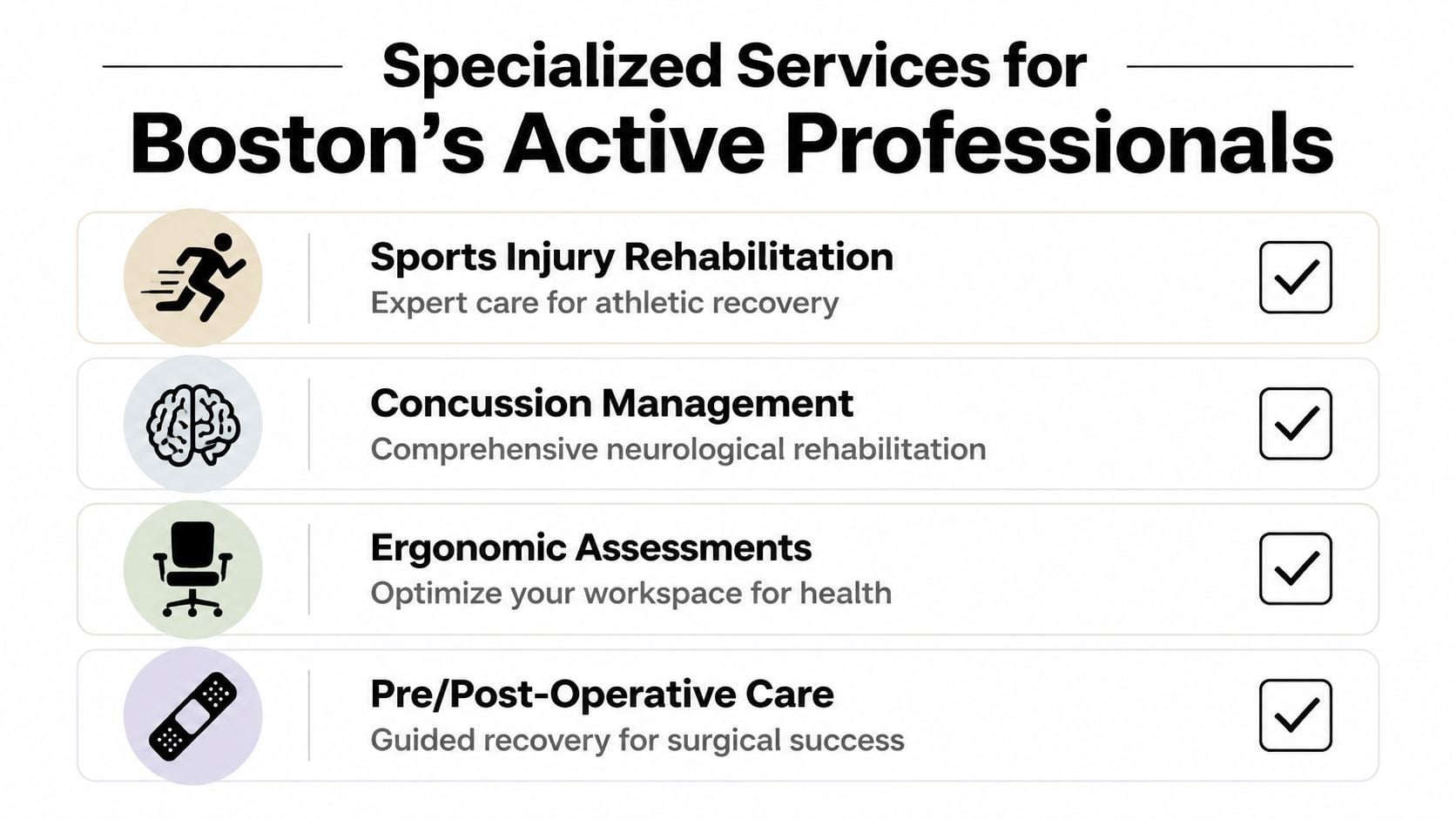
That distinction matters around South Station because many clinics can treat a straightforward sprain or post-workout flare-up. Fewer make it easy to identify whether they handle the more specific issues that busy professionals often bring in. Think jaw pain from clenching during stressful workdays, dizziness that makes commuting feel unsafe, postpartum pelvic floor symptoms, or running pain that keeps resurfacing every training cycle.
The services people often struggle to find nearby
The local search environment shows a real gap here. While many clinics offer general rehab, finding TMJ, vertigo, or pelvic floor care near a transit hub can be difficult, and some nearby clinics mention those services without making them easy for patients to identify, as shown on Bay State Physical Therapy's South Boston location page.
That's why generic “we treat everything” messaging doesn't help much. Patients don't search that way. They search with the symptom or life problem in mind.
- TMJ dysfunction: Jaw pain, clenching, headaches, and discomfort with chewing or talking through a full workday.
- Vestibular and balance care: Dizziness, vertigo, motion sensitivity, and unsteadiness that can make transit and crowded stations stressful.
- Pelvic floor physical therapy: Postpartum recovery, pelvic pain, bladder symptoms, and return-to-exercise concerns.
- Running performance and running injury rehab: Important in Boston, where many professionals train before work and want a smarter path back to mileage.
- Workplace ergonomics and dry needling: Useful when the issue is repetitive desk strain, persistent muscle tension, or recurring flare-ups tied to work setup.
Why this matters more than a short walk
A short walk from South Station doesn't automatically mean you've found the right clinician for your problem. If your symptoms are niche, the wrong clinic can delay progress because the evaluation starts from the wrong lens.
That's where a practice like Joint Ventures Physical Therapy can fit well in Greater Boston. It offers one-on-one physical and occupational therapy and includes services such as running performance, TMJ care, vestibular and balance treatment, pelvic floor therapy, dry needling, hand and upper-extremity rehab, concussion baseline screening, and workplace ergonomics.
The best downtown PT option isn't just the one that's easiest to reach. It's the one that matches the problem you actually have.
If you want deeper education on injury mechanics, recovery planning, or specialty treatment topics, that content belongs on Highbar Health, which is the better place for broader clinical explainers.
Your First Visit A Personalized Plan of Care
Most patients are relieved once they know what the first appointment looks like. The anxiety usually isn't about the exercises. It's about the unknowns. How long will this take? Will anyone really listen? Am I going to spend the visit dealing with forms and insurance questions?
A strong first visit should feel organized from the start.

What happens in the evaluation
Your first session is where the clinician connects the dots. That starts with your history, but not in a rushed way. A useful evaluation covers what you feel, when it started, what makes it worse, what you've already tried, and what you need to get back to.
Then comes movement assessment. That may include walking, balance, strength, mobility, task-specific movement, or symptom-provoking positions depending on why you came in. If you're a runner, that conversation should include training patterns. If you're postpartum, the goals may look completely different. If you have desk-related neck pain, work setup matters.
What a plan should give you on day one
A good first visit should leave you with clarity, not just paperwork. You should understand:
- What the clinician thinks is driving the problem
- What the early treatment plan looks like
- What you can start doing right away at home or work
- How often visits make sense based on your goals and schedule
What patients need most after the first session: a plan they can follow on a Tuesday, not just a diagnosis label.
Administrative support matters too. When a clinic verifies benefits, handles authorizations, and helps patients understand the process, people can focus on recovery instead of chasing insurance details between meetings.
If you want a simple checklist before your evaluation, the guide on preparing for your first physical therapy appointment is a practical place to start.
From Commuter Pain to Peak Performance
The people looking for physical therapy near South Station Boston usually don't all look the same. The goals are different, the injuries are different, and the point of treatment is different. What they share is a schedule that doesn't leave much room for wasted visits.
The desk worker with neck and jaw pain
One common patient profile is the downtown professional who spends most of the day on a laptop, clenches through meetings, and starts feeling neck tightness, headaches, and jaw discomfort by midweek. What doesn't work is treating that like a random shoulder strain and ignoring the TMJ component or the workstation setup.
What usually works better is combining hands-on care, movement work, and a realistic ergonomic strategy the patient can maintain in a real office. The goal isn't just pain relief in the clinic. It's getting through a full workday, commute included, without the symptoms ramping up.
The runner trying to stay on track
Another familiar profile is the commuter who trains early in the morning. Maybe it's a half marathon, maybe a Boston Marathon qualifying attempt, maybe they just want to keep running without the same hip or knee pain reappearing every few weeks.
The wrong approach is stopping all activity without a plan. The better approach is to identify the load problem, clean up the movement issues that matter, and build a return that fits training goals and work constraints. That's where running-focused PT is far more useful than generic “rest and stretch” advice.
The new parent returning to work and exercise
There's also the patient who has returned to a downtown routine after having a baby and is dealing with pelvic floor symptoms, core weakness, or discomfort that makes commuting and exercise harder than expected. Generic orthopedic rehab often misses the underlying issue.
Care works best when it addresses the postpartum demands of lifting, walking, sitting for long work stretches, and gradually returning to fitness without guessing.
Your Questions Answered About PT Near South Station
If you work near South Station, the last thing you need is a care plan that adds more friction to an already packed day. By the time patients reach this point, the questions are usually straightforward. Can I start quickly, can I make the schedule work, and is this clinic a good fit for what I need?

Do I need a referral to start
Often, no. Many patients can start physical therapy without waiting for a referral, but the final answer depends on your insurance plan and your medical situation.
The fastest way to sort that out is to call the clinic before booking. A good front desk should confirm what your plan requires, explain any authorization steps, and save you from delaying care based on a bad assumption.
How long are appointments and how often do I come
That depends on two things. Your condition, and how much treatment you can realistically attend.
A strong plan does not force the same visit schedule on every patient. Someone recovering from surgery or dealing with dizziness may need closer follow-up early on. Someone with a lower-grade overuse problem may do well with a different cadence, especially if they are consistent with the home program.
For South Station commuters, clinic hours matter almost as much as clinical skill. Early morning, lunchtime, and after-work availability often make the difference between finishing a plan and dropping off after two visits.
What should I wear
Wear clothes that let you move and let the therapist examine the involved area without a struggle.
A few practical choices help:
- For knee, hip, or back issues: Shorts or flexible pants make movement testing easier.
- For shoulder, neck, or TMJ concerns: A T-shirt or tank under your work layers usually works well.
- For before-work or after-work visits: Bring sneakers if you commute in dress shoes, boots, or anything stiff.
Will the clinic help with insurance and logistics
They should. For busy professionals, weak front-desk support creates problems before treatment even starts.
Ask how the clinic handles benefits checks, scheduling changes, and authorizations. If those basics are disorganized, care usually feels disorganized too. Good therapy is not just the session itself. It is also getting appointments booked, questions answered, and the plan kept on track when your workweek gets tight.
How do I know if a clinic is the right fit near South Station
Use a practical filter.
First, the location has to work with your real commute, not the ideal version of your week. Second, the hours need to fit a Boston workday. Third, the clinic should treat the issue you have, whether that is pelvic floor dysfunction, TMJ pain, a running injury, or a standard orthopedic problem.
That third point gets missed all the time. A nearby clinic is helpful, but convenience alone is not enough if you end up in the wrong kind of care.
If you want a PT option that fits a downtown schedule and also offers specialty care beyond general rehab, book an evaluation with Joint Ventures Physical Therapy. The Fort Point and Downtown Boston locations are well suited for South Station commuters who need care that is close, efficient, and specific to the problem they want to solve.