
You finish a run along the Charles, slow to a walk, and feel it. A sharp pull in the calf. A knee that suddenly won't trust the next step. A shoulder that started as “just tight” after rec league and now hurts reaching for the seatbelt. The injury is frustrating enough. Then comes the Boston part of the problem. You search for help and get buried in hospital programs, orthopedic groups, urgent care pages, and generic PT directories.
That confusion is normal. Boston has a deep sports medicine bench, but not every clinic solves the same problem, and not every injured athlete needs the same first stop.
If you're trying to figure out where to go, think less about finding a famous name and more about finding the right fit for your situation, schedule, sport, and goals. A marathon trainee with Achilles pain needs a different setup than a college athlete after a concussion, and both need something different from a gymnast dealing with repeated skin tears and hand irritation from training. For that last issue, a practical overview of gymnastics hand rip treatment can help you sort out what's minor, what needs protection, and when it makes sense to get evaluated in person.
That Sudden Pain and the Boston-Sized Search for Help
A lot of people start the same way. They wait a few days. They stretch more. They take a run off, then test it again too soon. Or they book the first appointment they can find without knowing whether that office is built for sports rehab, post-op care, pelvic health, concussion follow-up, or general orthopedic volume.
That usually creates two problems.
First, the wrong setting slows decision-making. Second, the wrong plan can leave you active enough to keep irritating the injury but not strategic enough to fix it.
What most active Bostonians are actually asking
They're not really asking, “Who treats knee pain?”
They're asking things like:
- Can someone tell me if I should stop training or modify it?
- Do I need imaging, or do I need a movement-based exam first?
- Can I get seen before this turns into a month-long setback?
- Will this clinic understand runners, lifters, field sport athletes, dancers, and active adults, or am I just another generic orthopedic slot?
Practical rule: The best early appointment is the one that gives you a clear next decision, not just reassurance.
Why the search feels harder in Boston
Boston has a long history in sports medicine. Boston Children's Hospital describes its Sports Medicine Division as “the first and largest pediatric sports medicine practice in the country” and notes that it supports more than 30 school and college teams across New England through real-time injury evaluation and care, which shows how established and high-volume the region's sports rehab ecosystem is for athletes across age groups (Boston Children's Sports Medicine).
That's good news for patients because the city has real expertise. It also means the menu of options is wide, and the labels can blur together. “Sports medicine,” “orthopedics,” “rehab,” and “performance” don't always mean the same thing from one practice to the next.
The way through it is simple. Match the injury, the urgency, and the kind of support you need to the kind of clinic that delivers it.
Decoding Boston's Sports Medicine Landscape
Search for a sports injury clinic Boston, and you are not choosing between identical offices with different logos. You are choosing between very different care models, and that choice affects how fast you get answers, who evaluates you, and whether your plan matches your sport.
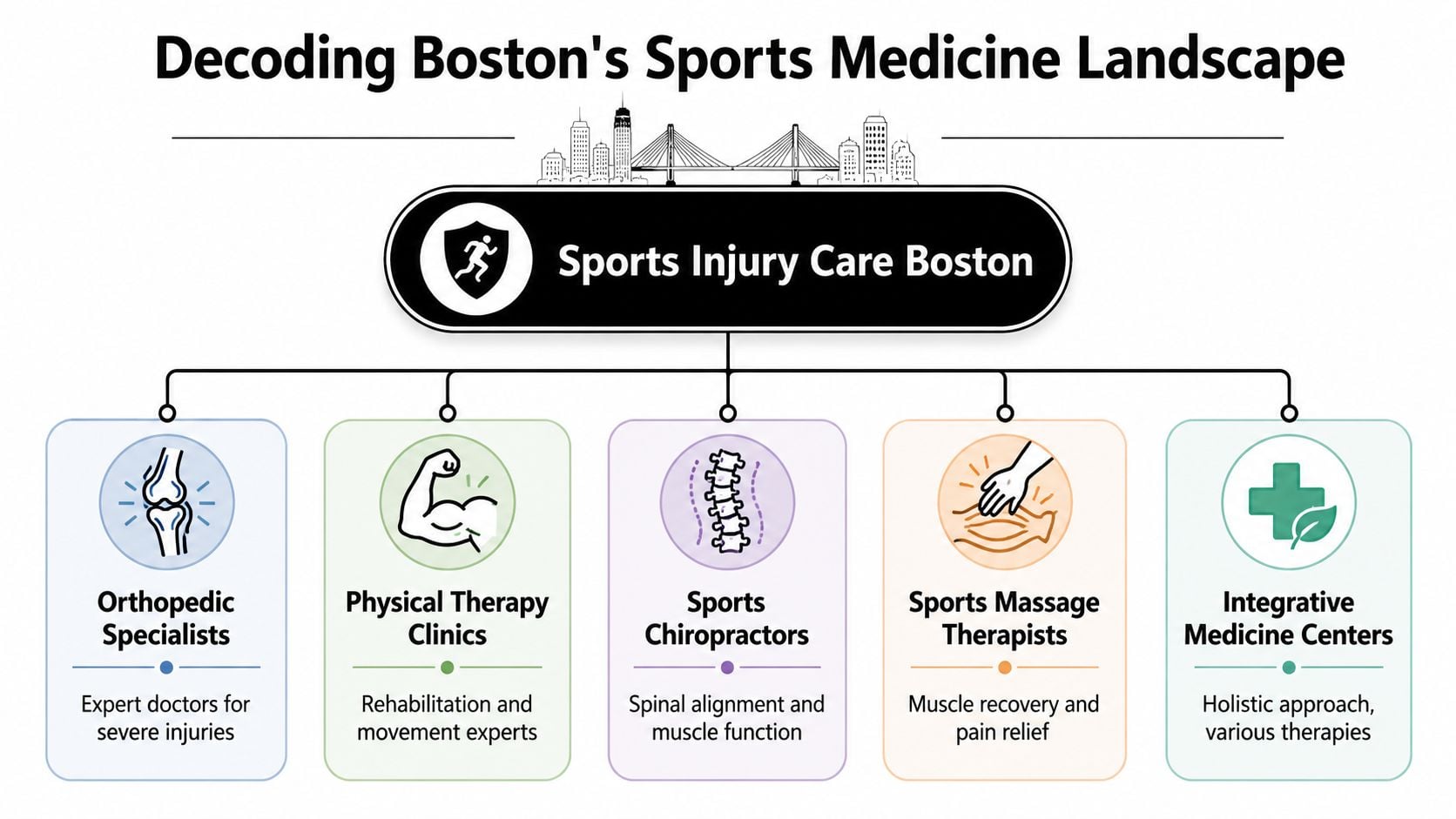
In Boston, I usually see patients sort into three broad buckets. The right fit depends less on reputation alone and more on what has to happen next.
The three tiers most patients run into
| Care setting | Best for | Trade-off |
|---|---|---|
| Large hospital systems | Complex injuries, specialist access, imaging, surgical coordination | More moving parts, more scheduling layers |
| High-volume PT chains | Broad availability, straightforward rehab needs | Experience can vary by clinician and visit structure |
| Specialized private practices | Sport-specific rehab, close plan adjustment, direct therapist access | You need to verify services and insurance fit up front |
Large medical centers make sense when the case is medically messy. A knee that locked after a pivot, a shoulder that may need imaging, a concussion with lingering symptoms, or pain that points to a surgical consult often belongs in a setting where physicians, imaging, and rehab can coordinate quickly.
That model has real value in Boston because the city has strong multidisciplinary sports medicine programs. If your injury may need imaging, injections, or a physician workup before rehab really starts, an integrated system can save time and reduce handoff problems.
The trade-off is time and attention. In a bigger system, excellent care is possible, but the process can involve more referrals, more waiting, and shorter treatment visits once you get into rehab.
High-volume PT chains sit in the middle. They are often easier to book, they may have multiple locations, and they can work well for straightforward recoveries. An uncomplicated ankle sprain or post-op protocol may do fine there if you are paired with the right clinician.
The variable is consistency. Patients should ask who they will see each visit, how much one-on-one time they get, and whether the therapist regularly treats their sport.
Specialized private practices fill a different role. They are often the best match when the problem is less about getting a diagnosis on paper and more about figuring out why the same tissue keeps getting overloaded. That matters for runners with recurring calf pain, lifters with hip pinching, field athletes returning to cutting, or active adults who feel fine walking but flare up every time training volume goes up.
In that setting, the visit should center on movement, load, and progression. The therapist watches how you move, adjusts the plan week to week, and ties rehab to your actual training schedule. That is the model many athletes want, but not every clinic that says “sports medicine” is built that way.
Boston has no shortage of sports-focused rehab options, which is good for patients and makes the vetting process more important. If you want a clearer picture of what that approach looks like in practice, this guide to sports rehab in Boston shows how a more focused, 1-on-1 model differs from general PT.
How to Find and Shortlist Your Options in the City
Don't start with “best physical therapy Boston.” That search is too broad to help. Start with your sport, your neighborhood, and your real commute.

Search the way you actually live
A strong search usually combines four things:
- The body region or problem
- The activity
- The neighborhood or landmark
- The type of care you want
Examples that work better than generic searches:
- Runner's knee physical therapy Back Bay
- Sports rehab near South Station
- Concussion baseline screening Boston
- Pelvic floor PT for return to running Boston
- Dry needling for calf strain Seaport
- Aquatic therapy Boston sports injury
If you work near Fenway or commute through that corridor, this guide to physical therapy near Fenway Park is a good example of how location can narrow your options in a practical way.
Use insurance second, not first
Patients often start inside the insurance directory. That's useful, but it shouldn't be your only filter.
Build a shortlist first based on fit, then check network status, referral requirements, and any authorization rules. The reason is simple. A clinic can be in-network and still be a poor fit if it doesn't offer the services your case needs.
Look for websites that clearly list services such as:
- Running performance for runners who want gait and load-management guidance
- Titleist evaluations if the issue shows up in golf swing mechanics
- Aquatic therapy when land-based loading is too irritable early on
- Trigger point dry needling when symptom modulation is part of the plan
- Pelvic floor therapy for postpartum or female athletes whose symptoms don't fit a standard ortho script
- Concussion baseline screening for athletes who need sport-specific tracking
- Vestibular and balance care when dizziness is part of the story
- Hand and upper-extremity OT for wrist, elbow, and hand-heavy sports
Shortlist for logistics, not just credentials
A great plan still fails if the clinic is impossible to get to twice a week.
Check these details before you call:
- Commute realism: Can you reach it before work, at lunch, or after practice?
- Appointment times: Early and late hours matter for Boston professionals.
- Visit consistency: Can you see the same therapist regularly?
- Neighborhood fit: Back Bay, Kenmore, Seaport, Downtown, Brookline, and Allston each serve different daily patterns.
One local option to consider is Joint Ventures Physical Therapy, which offers one-on-one physical and occupational therapy in Boston neighborhoods including Back Bay, Kenmore Square, Fort Point and Seaport, Downtown, and nearby communities, with services that include sports rehab, pelvic floor therapy, vestibular care, aquatic therapy, dry needling, hand therapy, concussion baseline screening, and performance-focused evaluations.
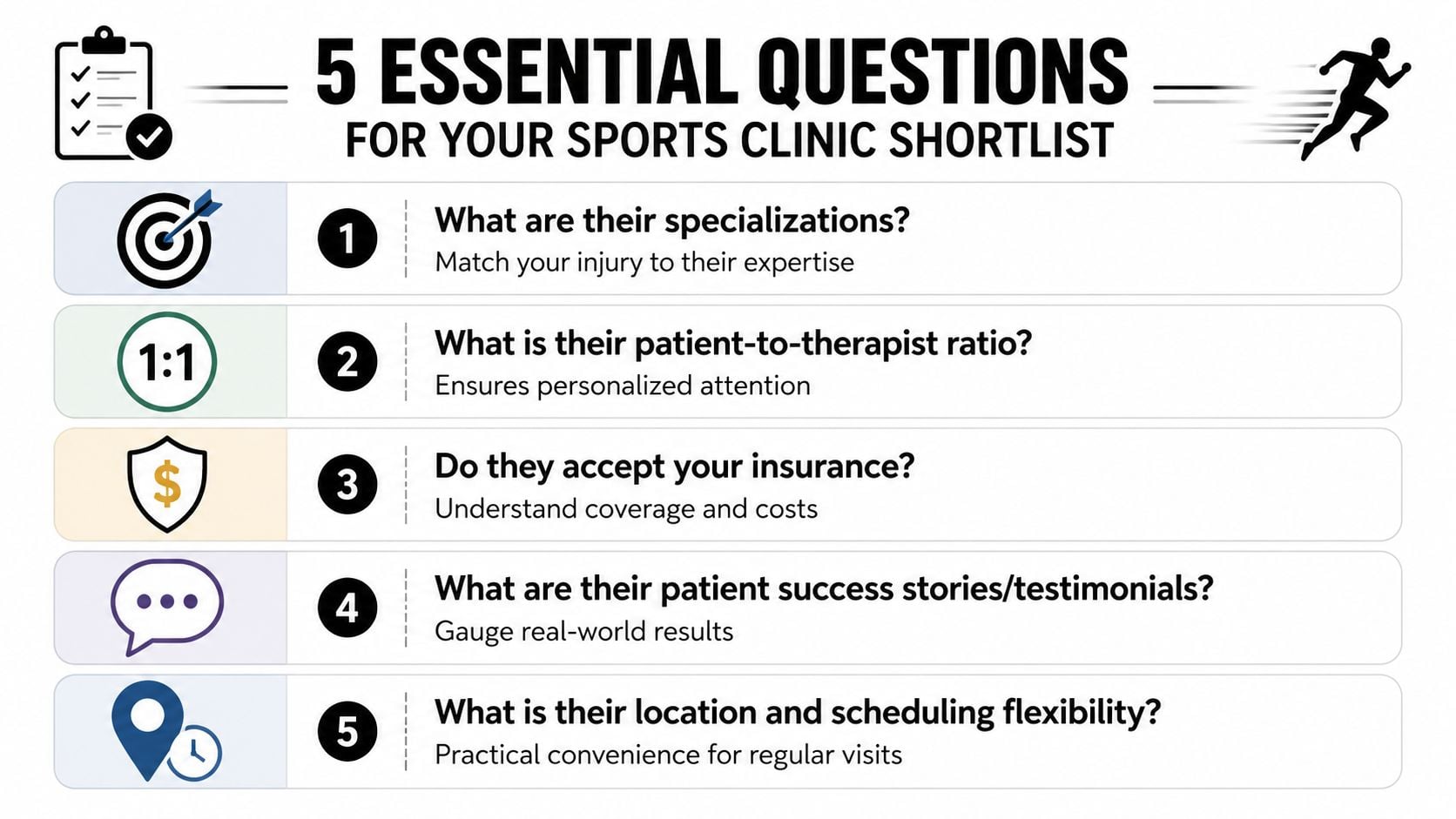
The Five Questions to Ask Before You Book
A clinic's website can look polished and still tell you almost nothing about how care operates. The fastest way to separate a good fit from a frustrating one is to call or message and ask direct questions.
Ask about the visit structure
Will I be one-on-one with a licensed therapist for the full session?
That answer changes the whole experience. Athletes usually need real-time adjustment, coaching, and progression. If a clinic moves patients between staff members or leans heavily on overlapping appointments, you may get less analysis and less precision.
If your sport has moving parts, your rehab visit should too. You want someone watching what changes rep to rep.
Ask who treats your kind of problem
Not every “sports PT” treats the same athlete.
A runner with recurrent bone stress issues, a goalie with hip pain, a postpartum athlete returning to impact, and an office worker trying to keep lifting all need different expertise. For female and postpartum athletes, return-to-play decisions often depend on pelvic health, load management, and core stability, not just pain relief. Specialized clinics such as Mass General's Women's Sports Injury & Performance Clinic highlight that gap in generic sports rehab (women's sports injury and performance discussion).
Ask plainly:
- Have you treated this issue in people who do my sport?
- Do you have pelvic floor expertise if symptoms overlap with core control, pressure, or postpartum return?
- Do you offer vestibular care if my concussion symptoms include dizziness?
- Do you have OT or hand specialization for wrist, elbow, or grip-heavy demands?
Ask what tools they can use
You don't need every advanced service. You do want options.
A clinic should be able to tell you whether they offer dry needling, aquatic therapy, running analysis, golf-specific assessments, concussion support, or collaborative referral pathways when your case needs another specialist.
Ask how they handle the non-clinical friction
This part matters more than people think.
Ask who verifies benefits, who handles authorizations when needed, and what they need from you before the first visit. Efficient admin support doesn't make the diagnosis, but it often determines whether care starts smoothly or gets delayed.
Ask what “success” means in their plan
Listen for specifics. A strong answer sounds like return to running progression, tolerance for change of direction, overhead loading, lifting volume, pelvic-floor-aware impact progression, or confidence with sport demands.
A weak answer sounds like “we'll reduce pain and see how it goes.”
What to Expect at Your First Assessment
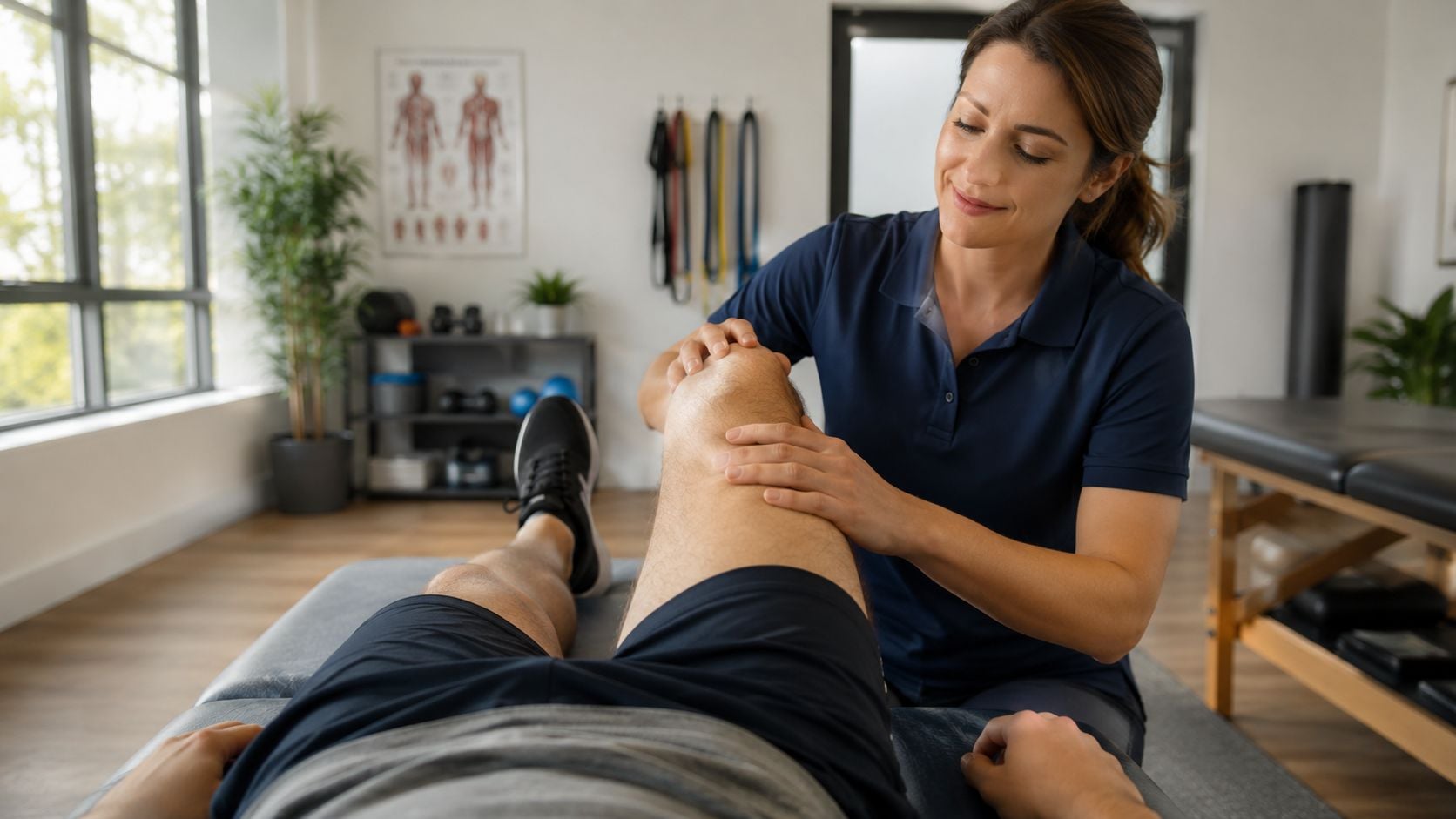
A good first appointment should feel detailed, collaborative, and useful. You should leave knowing what the likely problem is, what needs to change right away, and what the next few weeks are trying to accomplish.
The evaluation should go beyond the sore spot
The strongest sports injury assessments don't just test tissue irritability. They look at the athlete in context.
A 2022 clinical review supports individualized screening across physical, psychological, and social domains, with periodic re-screening and plan adjustment rather than one-size-fits-all protocols. The review also recommends multidisciplinary input and education to improve implementation fidelity, which is another way of saying plans work better when they're personalized and explained clearly (clinical review on individualized sports injury screening).
That means your therapist should ask about more than pain.
What a thorough first visit usually includes
- Your training and activity history: What you do, how often, what changed, and what you're trying to get back to.
- Behavior of symptoms: What brings pain on, what settles it, whether symptoms are sharp, delayed, unstable, pressure-related, or fatigue-driven.
- Movement testing: Strength, control, mobility, impact tolerance, balance, and sport-relevant mechanics.
- Load discussion: Whether you should stop, reduce, modify, or continue some activity.
- Plan of care: Visit frequency, home work, expected checkpoints, and signs that referral out may be needed.
Published outcome summaries in sports-related orthopedic rehabilitation report 73% long-term resolution among patients treated with physical therapy. Another dataset summarized in the literature found 86% significant pain reduction, 80% range-of-motion improvement, and 74% functional recovery after PT for sports-related orthopedic injuries. The same report notes that when patients average seven visits, the chance of success rises to 77%, which is a helpful benchmark when setting expectations for consistency and follow-through (sports-related orthopedic PT outcomes review).
That doesn't mean every athlete needs the same number of visits. It does mean sporadic attendance usually isn't enough.
Recovery usually improves when the plan is adjusted over time. One evaluation alone rarely solves a sports injury.
What to bring and how to prepare
Before your appointment, keep it simple:
- Wear clothing you can move in: Shorts for lower body issues, a tank or loose shirt for shoulder or neck problems.
- Bring the basics: Insurance card, ID, referral if your plan requires it, and any imaging reports you already have.
- List your real goals: Race date, league return, lifting targets, work demands, childcare lifting, commute tolerance.
- Bring shoe or equipment context if relevant: Running shoes, orthotics, or braces can help the visit feel more specific.
For a more detailed checklist, review this guide on how to prepare for your first physical therapy appointment.
Start Your Comeback with a Boston-Based Expert
You finish a run along the Charles, test the knee on the stairs to the T, and realize it still is not right. At that point, the goal is not more searching. The goal is getting in front of the right Boston clinician quickly enough to stop losing training time.
In this city, good care exists at several levels. Hospital-based sports medicine programs are useful when the injury may need imaging, injections, or a surgeon's opinion early. A focused physical therapy practice is often the better fit when the problem is movement-driven and you need a clear rehab plan, close reassessment, and enough one-on-one time to make real changes. Some cases also need a therapist who can connect the main injury to other factors that slow recovery, such as pelvic floor symptoms, dizziness, hand demands, or work strain.
That matching process matters more than branding.
Location matters too. Back Bay, Kenmore Square, Seaport, Downtown, and the nearby neighborhoods all offer options, but the best plan on paper fails if visits are hard to reach before work, after practice, or during a lunch break. Consistency is what turns an evaluation into progress.
If you want broader educational content on injury recovery, running mechanics, pelvic health, or performance topics, visit Highbar Health. That is a good place to learn more about specific conditions while you decide what type of local care fits your situation.
If you are ready to stop guessing and start a return-to-sport plan, book an evaluation with Joint Ventures Physical Therapy. The model is straightforward. One-on-one care, Boston-area access, and a treatment plan built around how you move, train, work, and what you want to get back to doing.