
You finish a workday in the Financial District with a stiff neck, ride the T home trying not to turn your head too quickly, and wake up the next morning feeling it again before your feet hit the floor. Or you're training along the Charles, lifting at a Back Bay gym, or grinding through long laptop days in Seaport, and the same nagging pain keeps cutting into how you move, sleep, and focus.
That pattern is common in Boston. It’s also frustrating because many individuals have already tried the obvious fixes before they look for neck pain physical therapy Boston. They’ve stretched. They’ve changed pillows. They’ve told themselves to sit up straighter. Sometimes that helps for a day. Often it doesn’t.
Your Guide to Neck Pain Physical Therapy in Boston
For a lot of active professionals, neck pain doesn’t start with one dramatic injury. It builds. A few hard weeks at a laptop. A bad lifting session. A long drive. A golf swing that feels off. Then the pain starts traveling into the upper trap, shoulder blade, or base of the skull, and normal routines get smaller.

Neck pain isn’t a niche problem. It accounts for about 25% of all outpatient physical therapy cases in the U.S., and research shows that combining manual therapy with exercise works better than exercise alone for reducing pain and disability according to the clinical evidence summarized by JOSPT.
That matters in Boston because the people seeking care here usually want more than symptom control. They want to get through a commute without guarding. They want to run, train, work, lift, golf, parent, and sleep without constantly managing discomfort.
What Boston patients usually want
- Less pain during the workday: Not just temporary relief between meetings.
- Confidence with exercise again: Especially if symptoms flare during lifting, running, or golf.
- A plan that fits city life: Convenient care near Back Bay, Kenmore Square, Downtown Boston, or Fort Point matters when your schedule is packed.
Neck pain treatment works better when it matches the demands of your actual day, not an idealized version of it.
Golfers often come in with neck pain tied to swing mechanics, rotational stiffness, or compensation from older injuries. If that sounds familiar, these straight answers on Hovland's situation offer useful context on how neck issues can affect performance and return timelines.
What a better approach looks like
The modern standard isn’t generic posture advice. It’s a multimodal plan that blends hands-on treatment, progressive exercise, movement analysis, and goal-specific programming. For a desk worker, that might mean restoring rotation and endurance. For a runner or golfer, it may also include thoracic mobility, balance, visual input, or sport-specific loading.
That’s the difference active Bostonians usually feel. The treatment isn’t built around “tight muscles.” It’s built around what’s limiting you.
Why Generic Neck Pain Advice Falls Short
“Just stretch it” is easy advice to give. It’s also the reason many people stay stuck.
If your neck pain keeps returning, the problem usually isn’t that you forgot one upper trap stretch. The issue is that pain can come from several overlapping drivers at once: stiff joints, overloaded muscles, movement habits, irritated tissues, reduced strength, poor endurance, or mechanics that break down under work or sport demands.
Common advice that misses the point
A lot of people hear some version of the same script:
- Stretch more: Useful if a muscle is the limiting factor. Not enough if joint mobility or motor control is the bigger issue.
- Fix your posture: Good posture doesn’t solve much if you can’t sustain it under a real workday, long commute, or training session.
- Buy a different pillow: Sometimes helpful for symptom relief. Rarely the full answer to persistent pain.
- Rest until it calms down: Reasonable during a sharp flare. Not a long-term strategy if movement quality and tolerance never improve.
The trade-off is simple. Generic advice can feel safe because it’s familiar, but it often treats neck pain as a one-variable problem when it isn’t one.
What often gets missed
A painful neck may be reacting to restrictions lower down. The thoracic spine may not rotate well. The shoulder blade may not move well under load. Deep neck endurance may be poor. Jaw tension, dizziness, previous concussion history, or visual strain can also complicate the picture in ways a quick internet checklist won’t catch.
Clinical reality: Two people can both say “my neck hurts,” but one needs mobility work and another needs load tolerance, balance retraining, or a change in lifting mechanics.
That’s why low-effort advice tends to produce low-effort results. A few stretches might feel good. They usually won’t solve a problem that shows up every workweek, every golf round, or every time you try to train harder.
What doesn’t work well by itself
| Approach | Why it can fall short |
|---|---|
| Stretching alone | It may reduce tension briefly without changing the cause |
| Passive massage alone | Relief can fade if strength and movement don’t improve |
| Perfect posture chasing | Most people can’t maintain rigid positions all day |
| Avoiding activity | Deconditioning often makes return to activity harder |
When neck pain lingers, the next step isn’t “try harder.” It’s getting a more precise diagnosis of what your body is doing and why symptoms keep returning.
Our One-on-One Diagnostic Approach
A good first visit should answer two questions quickly. What is driving your symptoms, and what will change them?
That’s why the evaluation for neck pain physical therapy Boston needs to go beyond the neck itself. If you spend the whole session getting heat and generic exercises, you’re missing the part that matters most: figuring out why your pain behaves the way it does.
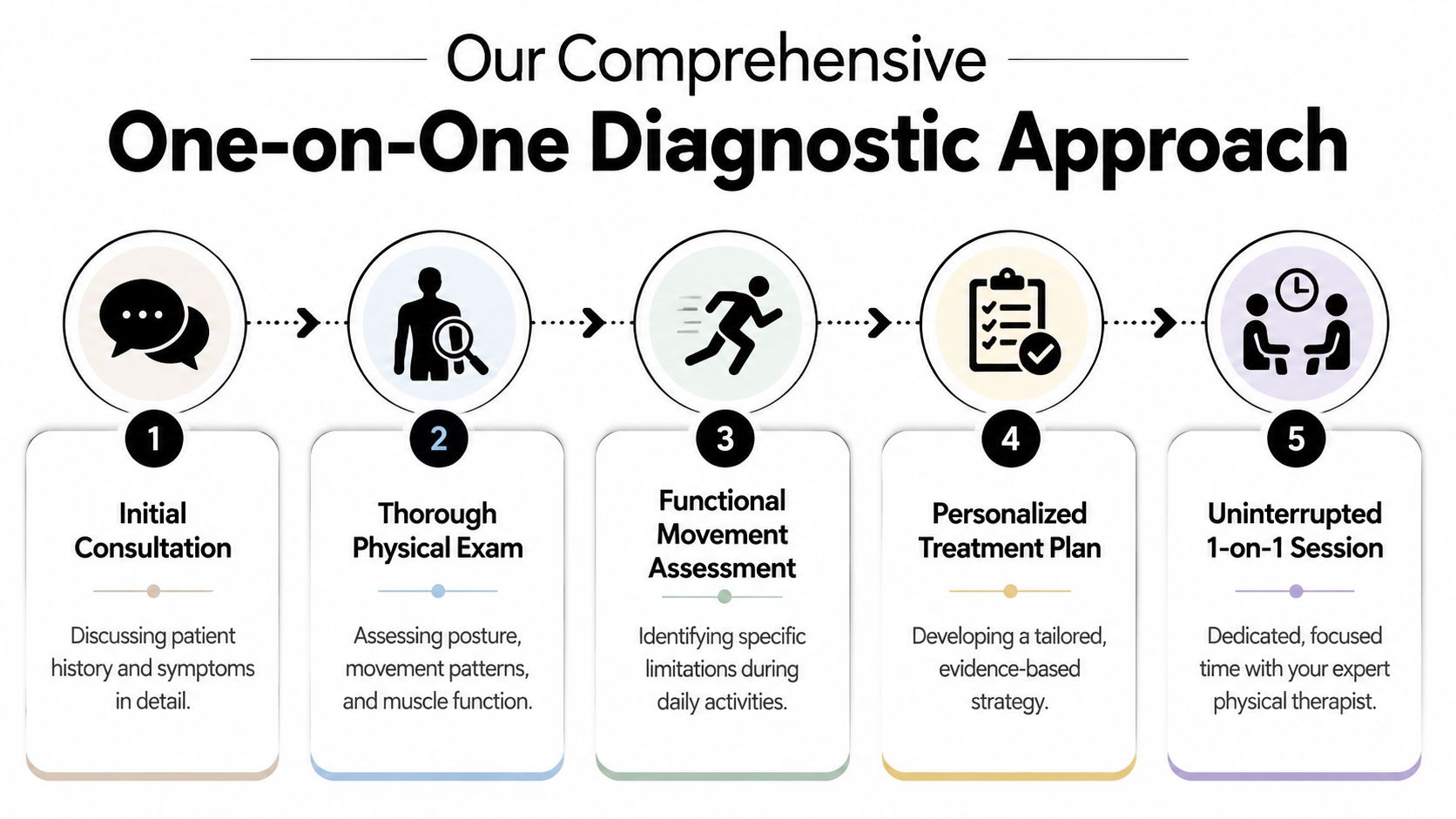
What we assess on day one
The first visit should look at the full movement problem, not just the painful spot. That typically includes:
Symptom behavior
When does the pain start, spread, or ease off? Workday pain behaves differently from lifting pain or headache-related neck pain.Movement quality
We look at neck rotation, flexion, extension, shoulder mechanics, thoracic mobility, and how those systems work together.Load tolerance
Some people move well once, then lose control after repetitions or sustained positions. That matters for desk workers and athletes alike.Relevant systems outside the neck
Dizziness, balance issues, jaw symptoms, previous concussion history, and visual strain can all change the plan.
Why one-on-one care matters
Uninterrupted one-on-one time changes the quality of the diagnosis. It gives the clinician space to test, retest, and adjust in real time instead of pushing you through a preset flow.
That matters for outcomes. Data from high-volume physical therapy settings shows a clear dose-response relationship. Patients averaging seven visits improved success rates from 70% to 77%, and for chronic neck pain this often means about 4 to 5 weeks of consistent therapy to see meaningful progress, based on Boston University Sargent’s write-up on treatment data.
A strong evaluation doesn’t just label pain. It identifies which movements help, which ones provoke symptoms, and how quickly you can start loading back into normal life.
The output isn’t a diagnosis alone
What patients usually need is a movement diagnosis. That might sound like this:
- Your neck rotation is limited because the thoracic spine is stiff and your upper trap is overworking.
- Your pain ramps up after desk time because endurance is low, not because your posture is “bad.”
- Your headaches and neck tightness are tied to jaw tension and cervical mobility.
- Your golf swing is forcing compensation because you can’t rotate cleanly through the upper back.
One option in Boston for this kind of uninterrupted, individualized care is Joint Ventures Physical Therapy, which provides one-on-one physical therapy visits across Greater Boston with clinicians who assess orthopedic, vestibular, sports, TMJ, and chronic pain presentations within the same plan of care.
Modern Manual Therapy for Faster Relief
Manual therapy isn’t code for “massage.” At its best, it’s a targeted way to restore motion, calm pain, and make exercise work better.
For neck pain, that can include joint mobilization, soft tissue treatment, passive stretching, and in the right case, manipulation. The point isn’t to keep you dependent on hands-on care. The point is to create a window where movement feels easier and exercise becomes more productive.

What hands-on treatment is actually doing
A useful manual therapy session should have a clear purpose:
- Improve mobility: Helpful when turning your head, checking a blind spot, or extending through the upper back feels blocked.
- Reduce guarding: Tight muscles often calm down when the underlying joint and tissue restrictions improve.
- Change pain enough to train: If pain drops and motion improves, we can load the system more effectively with exercise.
That last point matters most. Passive treatment without active follow-through tends to fade.
Where manipulation fits
Randomized clinical trial evidence found that cervical spine manipulation produced better outcomes than thoracic spine manipulation and conventional physiotherapy, with benefits seen at 4 weeks, 8 weeks, and 6 months according to this comparative effectiveness summary. That doesn’t mean manipulation is appropriate for every patient. It means the right manual technique, selected for the right person, can meaningfully improve pain, disability, and quality of life.
Decision rule: The best manual therapy is the one that changes your symptoms and lets you move better right away, then gets reinforced with the right exercise.
What works and what doesn’t
Here’s the practical split:
| Works better | Usually falls short |
|---|---|
| Hands-on care matched to a clear movement finding | Generic soft tissue work with no reassessment |
| Manual therapy followed by exercise | Passive treatment with no progression |
| Technique chosen for your irritability and goals | The same treatment for every neck pain patient |
Golfers are a good example. Some need cervical mobility. Others need thoracic rotation, scapular control, or workload changes. If you’re sorting through training adjustments outside the clinic, these solutions for golfer back pain can add useful perspective on how movement limitations affect the swing.
For a deeper look at how clinicians use these techniques in practice, review this manual physical therapy overview.
Advanced Treatments Including Trigger Point Dry Needling
Some neck pain settles with manual therapy and exercise. Some doesn’t. When symptoms stay stubborn, you need more than a basic template.
That’s where specialty services can change the pace of recovery, especially for active Bostonians dealing with chronic tightness through the upper trap, levator scapulae, or shoulder girdle.

Why dry needling matters for stubborn neck pain
Many local neck pain pages still focus on stretches, posture cues, and standard manual care. Those can help, but they don’t always address persistent trigger points well. A 2023 systematic review found that trigger point dry needling provided superior short-term pain reduction and improved range of motion for chronic neck pain compared with standard exercises alone, with effects lasting up to 12 weeks, as described in this summary of the evidence.
For the right patient, dry needling can help reduce muscle guarding and create faster access to better movement. It’s especially useful when a muscle stays reactive even after you’ve already tried stretching, mobility drills, and soft tissue work.
What it adds beyond standard care
Dry needling isn’t a replacement for exercise. It’s a way to improve the starting point.
Consider where it fits well:
- Persistent trigger points: Pain that keeps referring into the shoulder blade or base of the skull.
- Training-related irritation: Runners, lifters, and golfers who can’t fully unload the area by resting.
- Desk-driven overuse patterns: People whose neck and shoulder muscles stay “on” through long computer sessions.
If you want a general consumer-facing overview of technique and expectations, this guide on effective dry needling techniques is a useful companion read.
Other advanced tools that can change the plan
Dry needling is only one example. Some Boston patients also need:
- Vestibular therapy when neck pain overlaps with dizziness or visual sensitivity
- TMJ-informed treatment when jaw tension is feeding upper cervical symptoms
- Titleist evaluations when golf mechanics are driving repetitive neck strain
- Workplace ergonomics when the setup itself keeps reloading the problem
Specialty care becomes practical, not flashy. You use the tool that matches the presentation.
A closer look at local dry needling care is available in this Boston dry needling resource.
Here’s a quick visual overview of how dry needling is used in practice:
If your neck pain has lasted long enough that you’ve started planning around it, it’s reasonable to consider treatments beyond the basic “stretch and posture” script.
Start Your Recovery at Our Boston Locations
The right plan for neck pain usually isn’t one thing. It’s the right combination, delivered in the right order, with enough consistency to change how you move and feel.
That’s why local care matters. Boston patients need treatment that fits real schedules and real goals, whether that means getting through a workweek in Downtown Boston, training near Kenmore, managing long hours in Fort Point and Seaport, or staying active in Back Bay and nearby neighborhoods.
What to do next
- Book an evaluation near where you live or work: Start with a location that makes follow-through realistic.
- Bring the full picture: Work demands, gym routine, running schedule, golf volume, headaches, dizziness, and sleep issues all matter.
- Expect a plan, not just a session: The goal is lasting change, not temporary relief.
To find the most convenient clinic, see all Joint Ventures Boston-area locations.
If you want more in-depth educational content on injury recovery, anatomy, and performance topics, visit Highbar Health. That’s the best place for broader clinical education while you decide on local next steps.
Frequently Asked Questions
Do I need a doctor’s referral to start physical therapy in Massachusetts
Many patients can begin physical therapy through direct access, but referral requirements can vary depending on your insurance plan and situation. The fastest way to avoid surprises is to contact the clinic and have the team verify what your plan requires before the first visit.
What should I wear to my first neck pain visit
Wear comfortable clothes that let the clinician assess your neck, shoulders, and upper back easily. Athletic clothing usually works best. If your pain is related to lifting, running, golf, or work setup, bring anything relevant you want reviewed, such as your training notes, shoe information, or photos of your workstation.
What happens at the first appointment
Expect a one-on-one evaluation focused on symptom behavior, movement testing, and the activities that matter most to you. You may also begin treatment that day, depending on what the assessment shows and how irritable the symptoms are.
How many visits will I need
That depends on how long the pain has been present, how easily symptoms flare, and what your goals are. Some people mainly need a short reset and a targeted home plan. Others need a more progressive course to restore mobility, strength, endurance, and sport-specific function.
Will treatment be painful
Treatment shouldn’t feel random or excessive. Some techniques can create temporary soreness, especially if the area has been guarded for a while, but the session should still feel purposeful and tolerable. You should understand why each part of the plan is being used.
Do you take insurance
Insurance participation and benefits vary by location and plan. Most patients should verify coverage, authorization requirements, and visit limits before starting. Front-desk teams can usually help clarify those details so you know what to expect.
If your neck pain is limiting work, training, sleep, or daily movement, schedule an evaluation with Joint Ventures Physical Therapy. With convenient Greater Boston locations, one-on-one care, and access to services like manual therapy, dry needling, vestibular therapy, and sport-specific evaluation, the next step can be practical and local.