
You finish a run along the Charles or stand up after a long stretch at your desk in the Seaport, and the same symptoms show up again. A little leaking. Pelvic heaviness. Pressure with hills, strength work, or the walk home from South Station. If you recently had a baby, you may also feel frustrated that recovery has not followed the timeline you expected.
These symptoms are common in women with busy, active lives in Boston. They are also easy to dismiss when work is full, training is on the calendar, or getting across the city for one more appointment feels unrealistic.
For Boston women who want practical answers about pelvic floor PT, this guide is a local starting point. It focuses on decisions that matter. How to recognize when symptoms deserve attention, how to choose care that fits your schedule, and how to find a clinic location that works whether you live in Back Bay, commute from Cambridge, or spend most of your week downtown.
Your Guide to Pelvic Floor PT in Boston
You may notice it on the T ride home after a long day in the Seaport. Or halfway through a run along the Charles. Or when you lift a stroller up your front steps in South Boston and feel pressure you keep hoping will pass on its own.
Many Boston women are good at pushing through. Work is busy. Training plans are already mapped out. Childcare, commuting, and packed schedules make it easy to put pelvic symptoms at the bottom of the list.
Pelvic floor symptoms still deserve attention.
Leaking, pelvic heaviness, pain, constipation, and pressure are common reasons women start looking for answers. The hard part is often not deciding whether something feels off. It is figuring out where to go, whether treatment will fit into a real Boston schedule, and whether the clinic is close enough that you will keep going when traffic, weather, and work all get in the way.
Why local access matters
Convenience changes follow-through. A clinic near Back Bay, Kenmore Square, Downtown, or the Seaport can make the difference between starting care and sticking with it long enough to improve.
Pelvic floor PT is rarely a one-visit fix. Good care usually means an individualized plan, a therapist who can connect symptoms to daily habits and activity demands, and appointments that are realistic to attend. For a marathon trainee, that may mean working around long runs and strength days. For someone in a client-facing office role, it may mean early or late visits that do not disrupt the workday.
If you want a clearer sense of what treatment involves, this overview of what pelvic floor therapy includes can help before you book.
Practical rule: If your symptoms affect exercise, sitting, sleep, travel, work, or confidence in your body, they are worth an evaluation.
What good care should feel like
Pelvic health care should feel private, straightforward, and useful. You should leave with an explanation that makes sense, a plan you can apply at home, and a clear idea of what progress should look like.
That is the kind of guidance many women want when looking for pelvic floor PT in Boston. Not vague reassurance. A practical plan that fits life here, whether you live in Back Bay, commute in from Cambridge, or spend most of your week downtown.
What Pelvic Floor Physical Therapy Actually Is
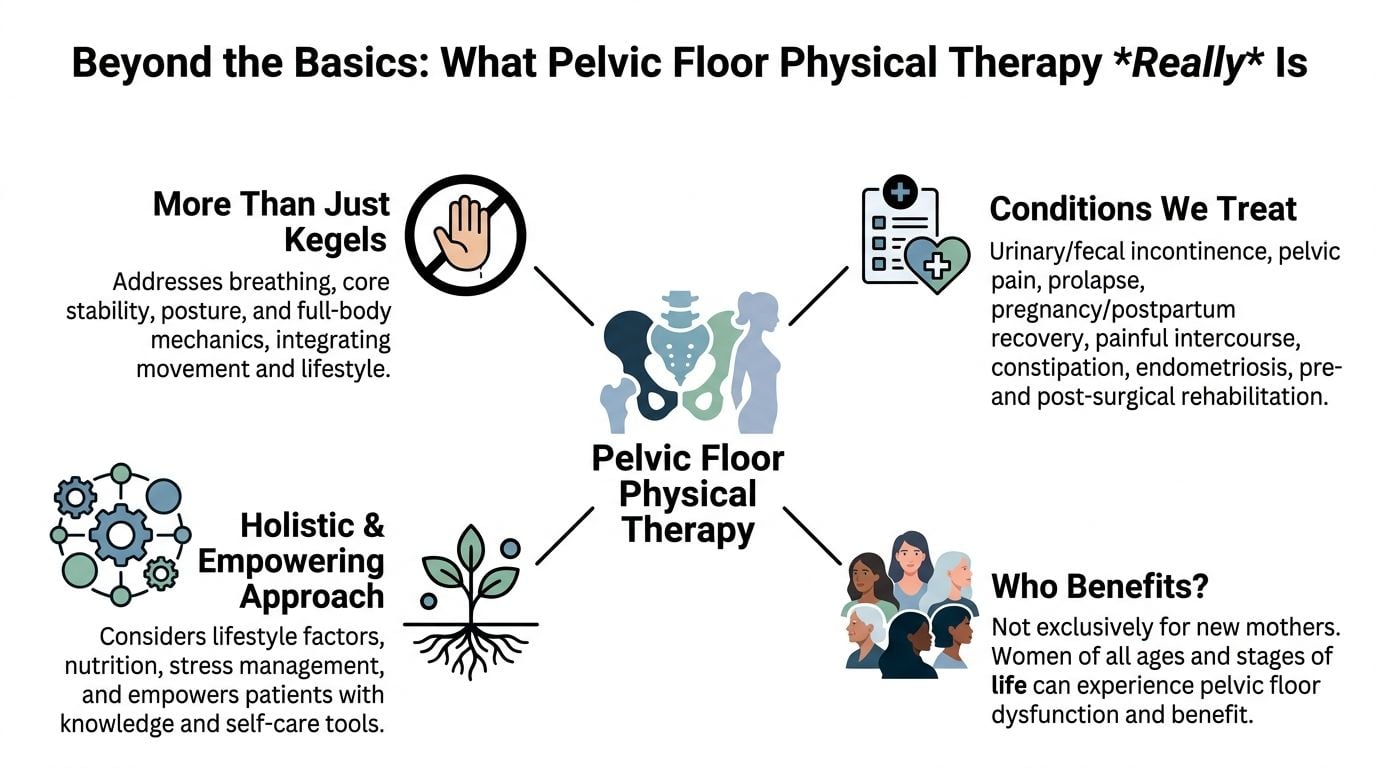
A lot of Boston women come in expecting one of two things: postpartum rehab only, or a sheet of Kegels to do at home. Pelvic floor PT is broader and more useful than that.
Boston hospital programs describe pelvic floor therapy as care for a wide range of symptoms, including pelvic pain, bowel dysfunction, endometriosis-related pain, and changes that can show up around perimenopause, as outlined by Brigham and Women's rehabilitation services.
It's a movement and symptom exam, not just an exercise handout
Pelvic floor PT looks at how your pelvic muscles work with the rest of your body. That includes bladder and bowel function, breathing, pressure control, abdominal coordination, hip strength, mobility, and the way symptoms show up during real life.
For one woman, the problem is poor strength after pregnancy. For another, it is too much tension from constant bracing, long seated workdays, or pain with intimacy. For a runner training along the Charles, leakage may be tied to impact tolerance and timing. For someone spending ten hours at a Seaport desk, the bigger driver may be breath holding, abdominal gripping, and a pelvic floor that never fully relaxes.
That difference matters. The wrong plan can keep symptoms going longer.
Problems pelvic floor PT can address
Common reasons Boston women book pelvic floor PT include:
- Bladder symptoms such as leakage with running, coughing, sneezing, lifting, or urgency that interrupts meetings, commuting, or sleep
- Pelvic pain during exercise, sitting, intimacy, gynecologic exams, or daily movement
- Bowel symptoms like constipation, straining, pressure, or trouble fully emptying
- Pregnancy and postpartum concerns including core weakness, heaviness, scar sensitivity, and return to exercise
- Perimenopause-related changes that affect tissue comfort, urgency, and pelvic support
- Ongoing symptoms connected to endometriosis-related pain, bladder pain, or abdominal and pelvic tension
Treatment is hands-on, practical, and individualized. A therapist may use education, breathing retraining, mobility work, strength progressions, relaxation strategies, manual therapy, and exercise changes based on what your body is doing.
Internal assessment is sometimes helpful, but it is never automatic and should always be explained first. Good care is collaborative and respectful.
What treatment often looks like in real life
In practice, pelvic floor PT usually means connecting symptoms to the parts of your routine that are keeping them going. That may be how you lift at the gym, how you manage pressure during a hard run, how you sit through back-to-back calls, or how your body responds after childbirth.
I often tell patients that pelvic floor therapy works best when it solves a problem you can feel in your day. Fewer leaks on a run. Less heaviness after a commute. Easier bowel movements. More comfort with intimacy. Better confidence returning to workouts.
If you want a clearer local explanation, read what pelvic floor therapy involves at Joint Ventures. If postpartum recovery is part of your decision, this guide to postpartum recovery essentials can help you understand the broader recovery picture.
Is Pelvic Floor PT Right for You
A lot of women don't ask whether they need pelvic floor PT. They ask whether their problem is “bad enough.”
That question usually delays care.
The runner training through leakage
You might be training for a fall race, adding speedwork, and noticing leakage on harder efforts or downhill running. Maybe there's also a sense of heaviness after long runs, or your core never seems to engage the way it used to.
What doesn't work well is guessing. Doing random Kegels from social media often misses the point because some runners need better timing and coordination, not more gripping.
What tends to work is an evaluation that connects symptoms to movement. Breathing strategy, trunk control, hip loading, and pressure management matter as much as the pelvic floor itself.
The professional who feels worse after sitting all day
This is common in Boston offices. Long hours in the Seaport, Downtown, or Cambridge can leave women with pelvic tension, abdominal gripping, bowel changes, tailbone discomfort, or symptoms that flare by the end of the day.
The trade-off is familiar. You can push through your workday and try to “stretch more” at night, but if sitting posture, breath holding, and constant bracing are feeding symptoms, relief usually stays temporary.
A smarter approach looks at the whole routine:
- Desk demands that keep you static for hours
- Commuting habits that increase tightness and pressure
- Workout choices that may be outpacing your current control
- Bathroom habits that can reinforce urgency or straining
The postpartum mom who wants real recovery
The evidence is especially helpful. In a peer-reviewed postpartum study, women who received pelvic floor physical therapy had a 29.2-point decrease on the PFDI-20 from 2 weeks to 12 weeks postpartum, while the standard-care group showed 0.0 change. The difference was statistically significant at p=0.002, with significant improvement across all PFDI-20 subscales, as reported in this postpartum PFPT study in PMC.
That matters because postpartum recovery is often approached as an issue women should wait out. The study suggests otherwise. Structured pelvic floor rehab can produce measurable symptom improvement over a short postpartum window.
If you're also sorting through the basics of new-parent recovery, this guide to postpartum recovery essentials is a useful non-clinical companion resource.
Signs it's worth booking
You don't need every symptom on this list. Even one can be enough.
- Leakage during activity that changes how you run, lift, or move
- Pelvic heaviness or pressure that shows up later in the day or after exertion
- Pain with sex or pelvic exams that makes you avoid care or intimacy
- Constipation or bowel difficulty that doesn't improve with basic routine changes
- Postpartum symptoms that persist beyond what feels manageable or expected
If you've changed your route, your workout, your clothing, your bathroom planning, or your social life around symptoms, pelvic floor PT is a reasonable next step.
What to Expect at Your First Appointment
Most women feel some level of uncertainty before a pelvic floor evaluation. That's normal. The first visit should reduce anxiety, not create more of it.
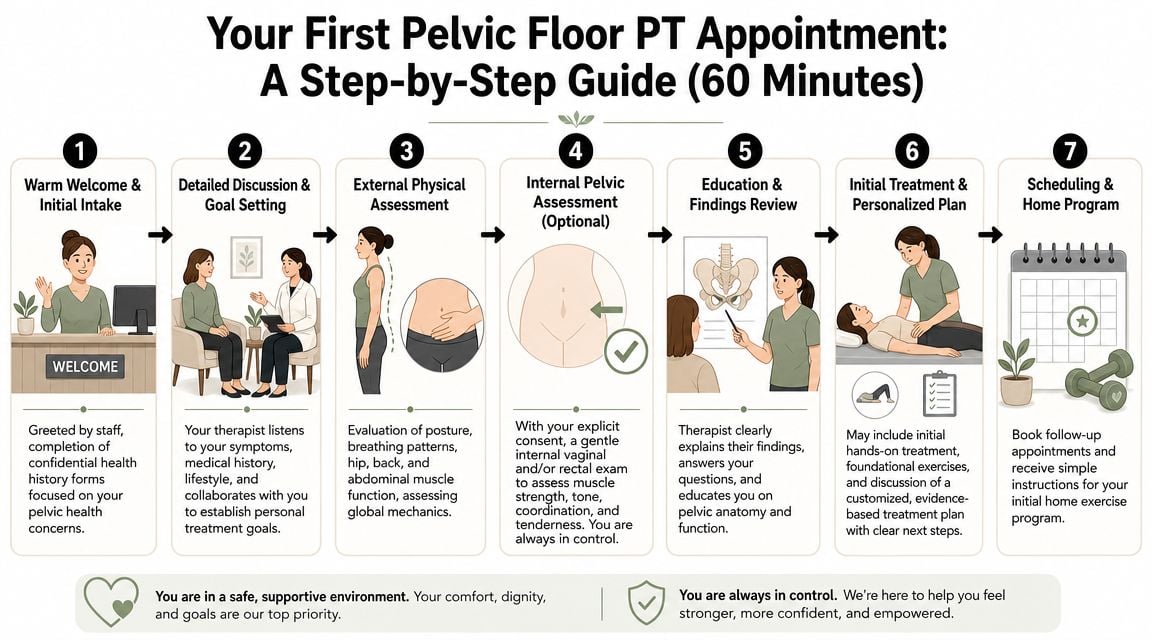
A typical first session is a 60-minute thorough evaluation that assesses the bladder, bowel, and reproductive systems while establishing a baseline of muscle function, alignment, and movement mechanics, according to Emerson Health's description of pelvic health physical therapy.
To make the process easier to picture, here's the flow many women find helpful to know in advance.
The first part is conversation
Your therapist starts by hearing your story. Symptoms, routines, goals, pregnancy or surgical history, exercise habits, work setup, bowel and bladder patterns, and what you've already tried all matter.
That conversation is clinical, but it should also feel human. If you're a runner, dancer, lifter, office worker, student, or new mom, those details shape the plan.
The exam is broader than most women expect
A strong evaluation usually includes observing how you stand, breathe, move, and manage load. Your therapist may assess the hips, low back, abdomen, posture, and pressure strategy, because pelvic symptoms rarely happen in isolation.
Internal assessment may also be discussed when appropriate, and only with your explicit consent. It can help evaluate muscle tone, coordination, tenderness, and the ability to contract and relax effectively. You are always in control of that part of the visit.
A good pelvic floor exam is collaborative. Nothing should feel rushed, forced, or unexplained.
A useful local read for new mothers is this page on postpartum pelvic floor therapy.
After the exam, some women like seeing a visual explanation of how therapists think through movement and symptoms. This short video can help make the process feel more familiar.
You should leave with a plan
By the end of the appointment, you should know:
- What the therapist found in clear, plain language
- What the main drivers may be rather than just the symptom label
- What you'll start doing now at home, at the gym, or at work
- What the next phase looks like in terms of treatment focus and follow-up
The best first visits don't overwhelm you with a giant exercise list. They narrow the problem, set priorities, and give you a few high-value next steps.
How to Choose the Right Pelvic Floor PT in Boston
Boston has no shortage of clinics. That doesn't mean every clinic is the right fit for pelvic health.
When women search for pelvic floor PT in Boston, they often compare by insurance or distance first. Those matter, but they shouldn't be the only filters. The quality of the evaluation and the amount of one-on-one attention usually shape the experience more than the waiting room does.
What to look for first
Start with specialization. Pelvic health is a distinct skill set, not just general orthopedics applied to a more private area of the body.
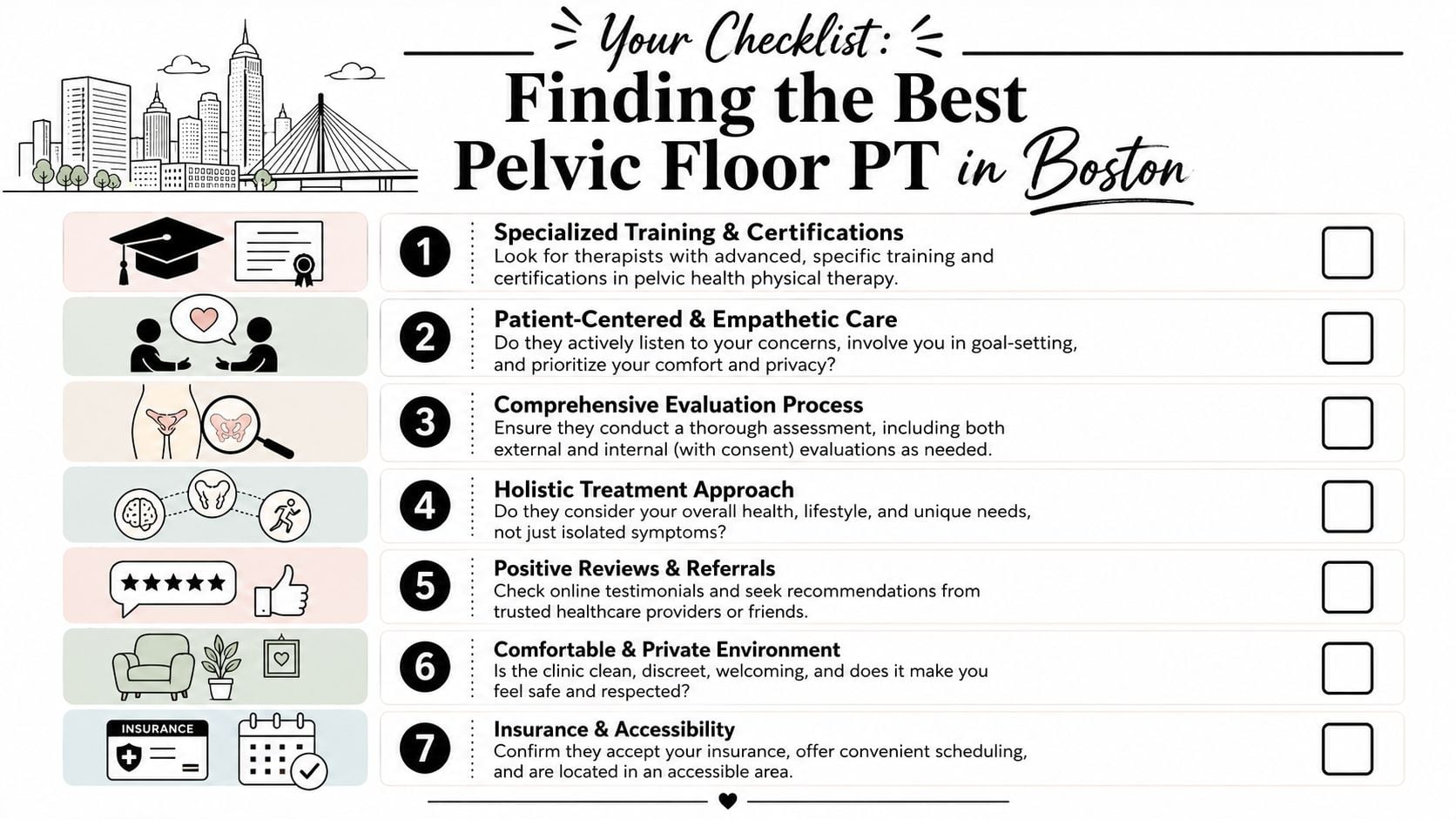
Here's a practical checklist.
- Advanced pelvic health training. Ask whether the therapist has focused coursework, mentoring, or board-level specialization in pelvic health.
- True one-on-one time. Pelvic floor rehab is hard to do well in a high-volume model where attention is split.
- Comfort with your specific problem. Leakage in runners, postpartum symptoms, pelvic pain, bowel dysfunction, and return-to-sport planning all require slightly different clinical reasoning.
Questions worth asking before you book
These questions can save you time:
| Question | Why it matters |
|---|---|
| Will I have uninterrupted time with my therapist? | Pelvic health visits work better when the therapist can listen, assess, and adjust in real time. |
| Do you treat my type of symptom regularly? | Experience with your presentation matters more than a generic service list. |
| Is the clinic convenient to my commute or neighborhood? | Consistency is easier when care fits your schedule. |
| Will the therapist look beyond Kegels? | Good treatment should include movement, pressure management, and whole-body factors when relevant. |
The practical Boston filter
Location changes follow-through. A clinic near work may beat one near home. For some women, Kenmore Square is easiest after class or hospital shifts. For others, Back Bay or the Seaport makes more sense before work, after work, or on lunch break.
Joint Ventures Physical Therapy is one local option women consider when they want pelvic health care within a broader one-on-one PT model across Greater Boston. The key is to choose a clinic where you can realistically attend, feel comfortable asking personal questions, and get a plan tied to your actual routine.
Find Expert Pelvic Floor PT at Joint Ventures
Once you know what you're looking for, the next step is choosing the location that will be easiest to use consistently. In Boston, convenience often decides whether care becomes part of your routine or stays on your to-do list.
For women balancing office commutes, childcare, classes, training, or recovery, it helps to pick a clinic near the places you already go. If you want a direct overview of local treatment options, this page on pelvic health therapy services in Boston is the most useful place to start.
What makes a location practical
The right clinic is usually the one you can get to without rearranging your whole week.
Some women prefer a site near work so they can come before or after office hours. Others want something close to home, especially during postpartum recovery or when symptoms make longer travel less appealing. If you ride the T, proximity to a familiar stop often matters more than neighborhood name alone.
Joint Ventures Physical Therapy locations for pelvic health
| Location | Neighborhood | MBTA Access | Key Services |
|---|---|---|---|
| Back Bay | Back Bay | Convenient for Back Bay transit and central Boston commutes | Pelvic health physical therapy, orthopedic PT, running-related care, workplace ergonomics |
| Kenmore Square | Fenway/Kenmore | Convenient for Kenmore area commuters, students, and hospital-adjacent routines | Pelvic health physical therapy, sports rehab, running performance, orthopedic PT |
| Fort Point/Seaport | Fort Point and Seaport | Convenient for Seaport office workers and South Station access | Pelvic health physical therapy, orthopedic PT, workplace ergonomics, wellness-focused care |
| Downtown Boston | Downtown | Convenient for downtown workers and multi-line MBTA access | Pelvic health physical therapy, orthopedic PT, vestibular and balance, hand and upper-extremity care |
How women usually choose between them
- Back Bay often fits women who want central access near shopping, work, and nearby residential neighborhoods.
- Kenmore Square can be a practical choice for students, medical staff, and active women already spending time near Fenway.
- Fort Point or Seaport is often the easiest option for professionals who want care close to the office.
- Downtown Boston tends to work well for commuters who need broad T access.
If your goal is to stop delaying care, choose the clinic that fits your actual week, not your ideal one.
Boston Pelvic Health PT FAQs
Do I need to be postpartum to see a pelvic floor therapist
No. Many women seek care for leakage, pelvic pain, bowel symptoms, pressure, pain with sex, or exercise-related symptoms unrelated to childbirth. Postpartum recovery is one reason to book, not the only one.
Is the internal exam required
No. It may be offered when it would add useful information, but it should always be explained clearly and done only with your consent. A therapist can still learn a lot from history, breathing, posture, abdominal control, hip mechanics, and external assessment.
Should I just try Kegels on my own first
Usually not. Some women do need strengthening. Others need relaxation, better timing, improved pressure management, or changes in movement strategy. Doing more contractions without knowing the problem can be unhelpful and sometimes aggravating.
The right exercise depends on the reason your symptoms are happening.
What should I wear to the appointment
Wear comfortable clothes you can move in. Athletic wear is usually easiest. You don't need anything special, and you shouldn't feel like you need to “prepare” your body before coming in.
Can pelvic floor PT help if I'm active
Yes. It's often very relevant for active women. Symptoms may show up during running, lifting, jumping, cycling, yoga, or return to exercise after pregnancy. The goal isn't only symptom relief. It's helping you move with better control and confidence.
How many visits will I need
That depends on your symptoms, goals, schedule, and how long the issue has been present. Some women improve quickly once they understand the key driver. Others need a longer progression, especially if the symptoms are layered with pain, postpartum recovery, or return-to-sport demands.
Will insurance cover it
Coverage depends on your plan and the clinic's participation. The most useful next step is to contact the clinic and ask about verification, referrals if needed, and what your out-of-pocket responsibility may be. Clear front-desk support matters here because insurance questions are one of the biggest reasons women postpone care.
When should I stop waiting and book
Book when the issue starts changing your behavior. If you're avoiding workouts, mapping bathrooms, sitting differently, skipping intimacy, or worrying about symptoms during the day, it's time to get an evaluation.
Take the Next Step to Feel Your Best
A lot of Boston women wait longer than they need to. They adjust. They skip the Charles River run, choose the end seat in a Seaport meeting, map out bathrooms on Newbury Street, or assume discomfort after pregnancy or workouts is just part of life.
Pelvic floor symptoms can shrink your routine in quiet ways. Good care helps you get that space back.
The turning point is often simple. Get a clear evaluation, name the actual problem, and follow a plan that fits your body and your week. That matters in a city where your day may include a commuter rail ride, a desk job, strength training, and getting home in time for family life.
When something feels off enough to look for pelvic floor PT Boston women, that concern is valid. Symptoms during runs, long workdays, lifting, intimacy, postpartum recovery, or even sitting through a Sox game are worth addressing early, before they start shaping more of your decisions.
Practical details matter too. Choose a clinic location that makes attendance realistic. Ask insurance questions up front. Pick a therapist who listens carefully, explains findings in plain language, and gives you a treatment plan you can follow between visits.
If you're ready to get answers and start a plan that fits your life in Boston, book an evaluation with Joint Ventures Physical Therapy.