
You’re a few weeks into your build. The miles along the Charles are stacking up, your long runs are getting serious, and something small has started to whisper. Maybe your calf tightens when you push the pace near the Esplanade. Maybe your knee talks back on the descents. Maybe nothing hurts yet, but you know Boston isn’t a race that forgives vague preparation.
That instinct is usually right.
Boston Marathon physical therapy training isn’t about waiting until you’re injured. It’s about preparing for a course that asks different questions than a flat fall marathon. The opening downhill miles punish runners who feel too good too early. The Newton Hills expose weak links late. The finish on Boylston rewards athletes who trained with restraint, not just grit.
Your Boston Marathon Journey Starts Here
A lot of Boston runners hit the same moment in training. You finish a solid run by the river, look at the watch, and think, “Fitness is coming.” Then the second thought shows up. “But is my body ready for Boston?”
That question matters more here than it does in most marathons. This race has history, prestige, and a course profile that can turn a strong build into a rough day if your plan is generic. The runner who can handle rolling miles around the city isn’t automatically ready for the downhill start, the cumulative pounding, and the late-race climbing.
PT is already built into Boston Marathon culture
Physical therapy isn’t an afterthought at this race. It’s part of the event’s infrastructure. On race day for the 128th Boston Marathon in 2024, approximately 100 physical therapists were stationed in five areas just beyond the finish line, treating issues ranging from exertional heatstroke to severe muscle strain, according to Northeastern’s reporting on Boston Marathon medical and physical therapy support.
That matters for one simple reason. If the race itself relies on PT expertise at the finish, runners should be using that same expertise long before they get to Hopkinton.
Practical rule: Don’t think of PT as what happens after something goes wrong. For Boston, PT works best when it shapes training decisions early.
What Boston runners usually get wrong
The common mistake isn’t laziness. It’s overconfidence in a standard marathon plan.
A smart, ambitious runner will follow the mileage, hit tempo work, add long runs, and still miss the details that matter most for this course. They won’t always prepare the quads for downhill load. They won’t always adjust strength work as the build progresses. They won’t always know whether a nagging symptom is normal fatigue or the start of a training interruption.
That’s where a Boston-based PT lens changes things. You’re not just asking, “Can I run more?” You’re asking better questions:
- Can my body absorb early downhill pounding without cooking my quads?
- Can I climb late without changing form under fatigue?
- Can I keep training if a symptom shows up, or do I need to modify load now?
- Is my recovery strategy supporting performance, or just helping me survive workouts?
Boston runners tend to be disciplined. That’s an advantage. It also means they’ll push through warning signs longer than they should. The goal isn’t to make training easier. It’s to make it more precise.
Why the Boston Course Demands Smarter PT Training
Boston is not a rhythm marathon. It’s a sequencing marathon. The course gives you downhill stress first, then asks for restraint, then tests strength and durability later when form is harder to hold.
That order changes how training should look.

The early downhills are not free speed
The opening miles tempt runners into a mistake that feels smart in the moment. The pace comes easily, the legs feel fresh, and the effort seems controlled. But downhill running creates heavy eccentric demand, especially through the quads. That load accumulates early, often before the athlete realizes the cost.
For Boston, “comfortable” in the first part of the race can still be expensive.
A generic marathon plan often underprepares runners for this kind of stress. It may include hills, but not enough specific downhill exposure, not enough eccentric strength work, and not enough attention to how the athlete responds in the days after those sessions.
Heartbreak Hill gets the headlines, but fatigue is the real problem
The Newton Hills matter because they arrive after a lot of pounding. By the time you reach them, the question isn’t just aerobic fitness. It’s whether your mechanics still hold when your legs are tired and the course keeps asking for force production.
Smart PT training proves its worth. A runner who looks fine at mile 6 can unravel at mile 20 if they don’t have enough single-leg control, trunk stability, calf capacity, and hip strength. The course exposes whatever your training didn’t address.
Boston doesn’t usually beat runners with one dramatic event. It exposes the cost of small mistakes repeated for hours.
What smarter prep looks like in practice
Boston-specific preparation usually works better when it includes these trade-offs:
| Training choice | What works | What usually backfires |
|---|---|---|
| Hill preparation | Mix of uphill and downhill running with recovery planning | Only training climbs and ignoring descents |
| Strength work | Eccentric quad, calf, and single-leg loading tied to the training week | Random “runner strength” circuits with no progression |
| Pacing practice | Effort-based long runs on rolling terrain | Chasing even splits in every workout |
| Form work | Small gait changes when they solve a real problem | Trying to overhaul mechanics mid-build without context |
Why PT belongs in the training plan, not outside it
The best Boston Marathon physical therapy training doesn’t replace coaching. It sharpens decision-making around load, movement, and recovery. It helps answer the questions many runners can’t answer alone:
- Is this soreness expected, or risky?
- Should we change volume, intensity, terrain, or strength first?
- Are you under-recovered, or just uncomfortable because training is hard?
- Is your stride helping you, or making the course more costly than it needs to be?
That’s the difference between arriving at the start line fit and arriving prepared.
Common Training Injuries on Boston's Roads and Hills
The injuries that derail Boston runners usually aren’t random. They follow patterns. The route you choose, the timing of your hill work, the surfaces you repeat, and how quickly you build all shape what starts to flare.
A runner doing repeated descents through the Emerald Necklace often presents differently than someone hammering hill repeats in Brookline or stacking tired miles on the Charles before work. The body keeps receipts.
What tends to show up during a Boston build
Some issues are especially common because they match the demands of the course and local training routes:
- Knee pain on descents often shows up when runners add downhill exposure before they’ve built enough quad control.
- Achilles or calf irritation tends to surface when hill volume rises too quickly or speedwork lands on top of tired tissue.
- Outer hip or lateral knee symptoms often build from a mix of fatigue, stride compensation, and not enough single-leg strength.
- Foot or shin irritation commonly appears when runners increase volume while ignoring surface changes and recovery.
If you’re dealing with repeat symptoms, a running-specific plan matters more than a generic “rest and stretch” approach. Joint Ventures has a practical overview of running physical therapy for Boston runners that fits this kind of training context.
Boston Marathon Training Injuries and PT Solutions
| Injury | Common Cause on Boston's Course | Joint Ventures PT Solution |
|---|---|---|
| Patellofemoral pain | Repeated downhill loading early in training and race simulation | Strength progression for quads and hips, movement assessment, downhill tolerance planning |
| Achilles tendon irritation | Aggressive hill repeats, fast mileage increases, stiff calves under load | Calf loading program, ankle mobility work, running load modification |
| Calf strain | Late-stage fatigue, pace changes, and hilly long runs without enough recovery | Tissue-specific strength work, return-to-run progression, stride review |
| IT band related lateral knee pain | Fatigue on rolling terrain, poor load control on descents | Hip and trunk strength, cadence or stride adjustments when indicated, route modification |
| Plantar foot pain | Higher volume on unforgiving surfaces, reduced foot capacity | Foot and calf strengthening, footwear review, impact management |
| Hip pain | Weakness or compensation during hill work and long-run fatigue | Single-leg control training, gait review, progressive return to harder terrain |
What works and what doesn’t
Boston runners are often willing to work hard. The issue is directing that effort well.
What usually works
- Load changes with a reason: Pull back from the irritant, not from all running.
- Strength tied to symptoms: Match exercises to the tissue and movement problem.
- Route selection: Flat routes for a short period can keep training alive while a problem settles.
- Watching the runner move: The treadmill, track, or hallway often reveals what the table exam misses.
What usually doesn’t
- Pushing through every warning sign: Some discomfort is manageable. Persistent deterioration isn’t.
- Collecting random mobility drills: More exercises don’t equal better rehab.
- Assuming pain location equals pain source: The sore spot isn’t always the actual issue.
- Stopping all training for too long: Many runners lose confidence faster than they lose fitness.
A good rehab plan should let you understand which runs are helping, which are neutral, and which are digging the hole deeper.
A local lens matters
Boston runners train through cold starts, uneven sidewalks, bridges, and rolling routes that don’t forgive sloppy loading. That’s why the plan has to be specific. “Runner’s knee” means one thing on paper. It means something more useful when you know the pain spikes on downhills and stairs the day after a hilly long run near Chestnut Hill.
The Joint Ventures Approach to Marathon Training Plans
A marathon training plan should answer two questions at once. What will make you faster, and what will keep you available to train? Most runners lean too hard toward one side. They either chase fitness and ignore warning signs, or they get so cautious after a setback that the plan loses enough stimulus to stop working.
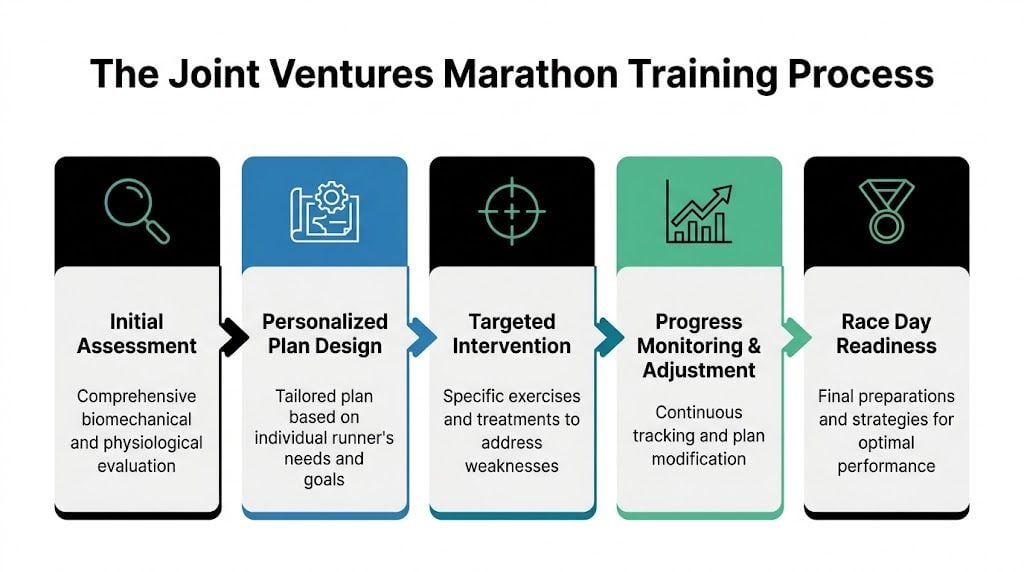
The better approach is individual, measurable, and adjustable.
What a serious running evaluation should include
A useful assessment goes well beyond “where does it hurt?”
For Boston Marathon physical therapy training, the evaluation needs to connect your body to your schedule. That means looking at how you move, but also when symptoms show up, what kind of week triggers them, how you recover, and what this race specifically demands from you.
A solid first evaluation usually includes:
Training history review
Mileage patterns, workout distribution, terrain, recovery habits, prior injuries, and race goals all matter. The runner chasing a first finish and the runner trying to race aggressively don’t need the same plan.Functional strength testing
Single-leg loading, calf capacity, hip control, trunk stability, and how force moves through the chain tell you a lot about whether your current system can handle Boston’s demands.Video running analysis
This isn’t about forcing a textbook stride. It’s about seeing whether cadence, posture, overstriding, asymmetry, or late-stance mechanics are adding unnecessary cost.Program design that fits the build
The plan has to fit your actual week. If you work long hours in Back Bay, commute across the city, and squeeze runs into early mornings, the ideal program on paper may not be the one you’ll execute.
The taper is where many runners either sharpen or sabotage fitness
One of the most misunderstood parts of marathon prep is the taper. Some runners panic and do too much. Others shut things down so much they feel flat.
Analysis of marathoners found that a well-executed taper, reducing training volume by 40 to 60% and frequency by 20 to 30% in the final 4 weeks, can improve finish times by 5 to 15 minutes, according to this PubMed-indexed marathon taper analysis. That’s not a cue to coast. It’s a cue to remove fatigue without losing sharpness.
What data-driven PT changes in a marathon block
Individualized PT planning is particularly useful, especially in a city full of ambitious runners trying to balance work, weather, and high standards.
Instead of guessing, the plan can account for:
- When to keep quality sessions in
- When to reduce total load
- How to layer strength without wrecking key runs
- Whether a symptom needs treatment, a route change, or a schedule change
- How to practice downhill tolerance without overcooking the legs
One local option for that kind of work is Joint Ventures Physical Therapy, which offers Running Performance evaluations in Greater Boston as part of a broader one-on-one PT model.
What the right plan feels like
It shouldn’t feel easy. It should feel clear.
You should know why you’re doing each hard session, why your strength work is in that spot of the week, and what to do if a pain pattern changes. You should know the difference between fatigue that belongs in a marathon build and fatigue that signals the plan needs adjustment.
The best training plans aren’t the most aggressive ones. They’re the ones you can absorb, repeat, and trust on tired legs.
Advanced PT Services to Optimize Your Race Day
Performance PT matters most when it solves a bottleneck. If your stride gets expensive late in long runs, if your calf stays guarded, or if impact keeps accumulating faster than you can recover, advanced services can help. The key is using the right tool for the right reason.
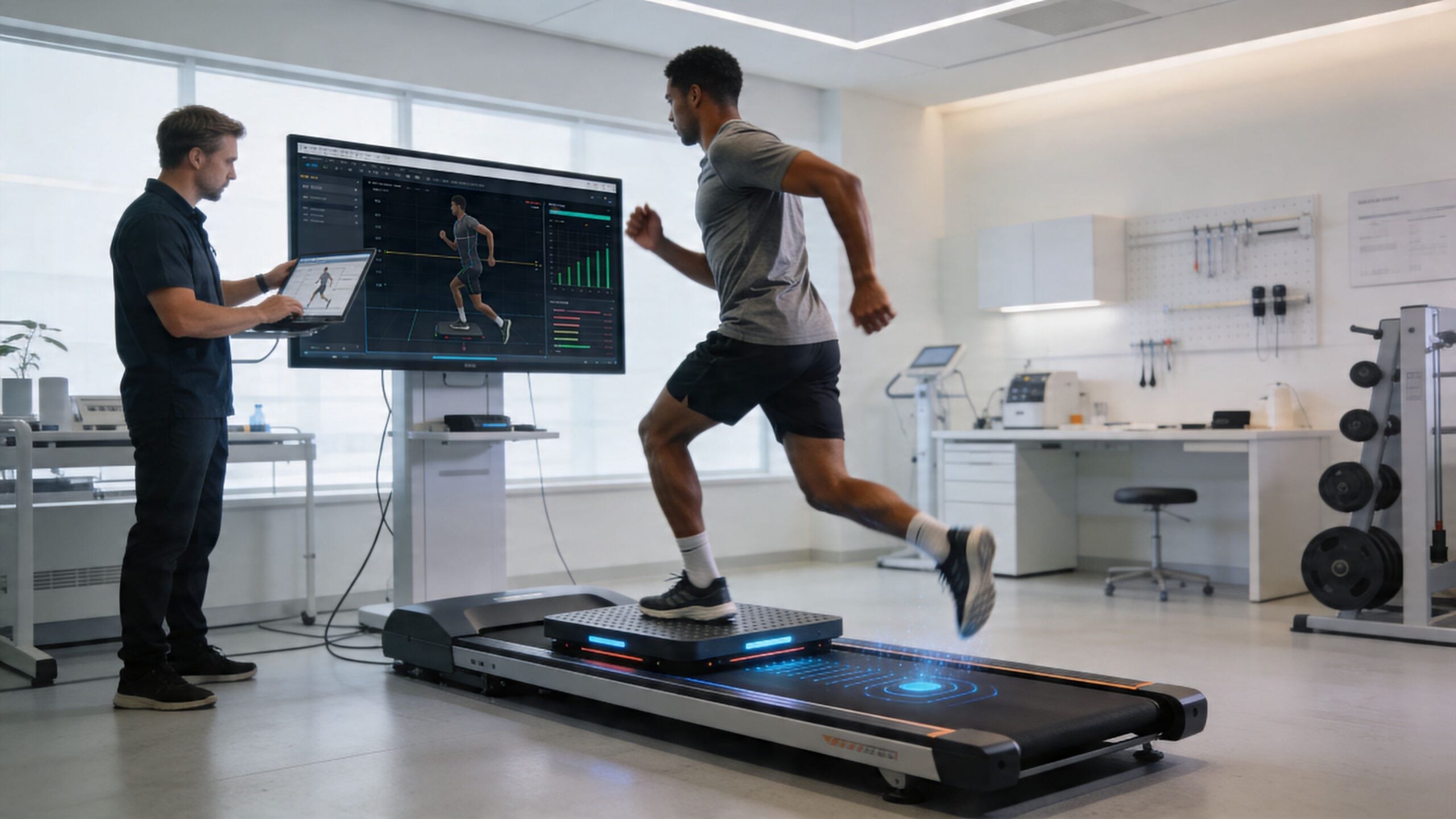
Gait analysis can uncover wasted effort
A lot of runners assume form only matters if they look obviously awkward. That’s not how it usually works. More often, the issue is subtle. A stride is just a bit too reaching on descents. A trunk position shifts when fatigue sets in. One side loads differently enough to keep a calf or hip from calming down.
In a study of 917 Boston Marathon athletes from the 2022 field, changes in training volume and frequency in the final months before the race explained 52.6% of the variance in World Athletics points, according to the Boston Marathon athlete analysis published on PMC. That finding supports something clinicians see every season. Fine-tuning matters.
For a runner, that fine-tuning may involve training load. It may also involve form. If you’re curious about mechanics, this guide on how to improve running form is a useful place to start.
Services that help when the basics aren’t enough
The runners who benefit most from advanced PT usually fall into one of three groups. They’re plateaued, they’re repeatedly irritated in the same area, or they need a lower-impact way to keep building capacity.
A few services stand out in Boston marathon prep:
- Trigger point dry needling can help when excessive muscle tone keeps blocking progress in the calf, quad, or hip.
- Aquatic therapy gives runners a way to train movement and capacity with less pounding when land volume needs temporary adjustment.
- Running Performance evaluation helps match strength, stride, and workload to the demands of the course.
- Wellness or tune-up visits can help experienced runners catch small issues before they cost a training block.
Not every advanced tool is useful for every runner
That’s where people go wrong. They chase treatments instead of solving problems.
Dry needling won’t replace strength. Aquatic work won’t replace long-run specificity. Manual treatment won’t fix a poor training rhythm. These tools work best when they create room for better loading, better movement, and better recovery.
This short video gives a practical sense of how running-focused care can fit into training.
If a treatment feels great in the clinic but doesn’t improve the next week of training, it’s probably not the main answer.
Specialized Training Plans for Every Boston Runner
One-size-fits-all marathon advice breaks down fast in real life. It breaks down even faster for postpartum runners, runners with pelvic floor symptoms, and athletes trying to return to serious training while their body is still adapting to major change.
Boston’s course makes that gap more obvious. The downhill-heavy opening miles increase impact demand early, and generic “core work” usually doesn’t prepare the pelvic floor for that kind of repeated loading.

Postpartum runners need more than clearance to exercise
A lot of athletes hear some version of, “You’ve been cleared, so ease back in.” That’s incomplete advice. Medical clearance and race-specific readiness aren’t the same thing.
Content analysis on Boston Marathon training guidance shows a significant gap in advice for postpartum runners, despite data showing up to 50% of female marathon trainees experience pelvic floor dysfunction, according to this review of Boston Marathon physical therapy guidance for runners. That gap matters in a city where many runners want to return to high-level training, not just casual jogging.
Why generic core work often falls short
Pelvic floor symptoms in runners don’t always show up as pain. They may show up as leaking, pressure, heaviness, or a sense that impact just doesn’t feel right. A basic core class or a sheet of exercises often misses the underlying issue because the runner may need coordination, timing, pressure management, and gait-specific changes.
That’s especially relevant on Boston’s early descents. The challenge isn’t just “be stronger.” It’s whether the whole system can manage load repeatedly, under fatigue, and at marathon volume.
What tailored care should include
For postpartum Boston runners, a better marathon plan often includes a mix of these pieces:
- Pelvic floor assessment to understand whether the issue is weakness, overactivity, poor coordination, or a combination.
- Running gait retraining when stride mechanics are increasing impact cost.
- Strength work linked to return-to-run demands rather than generic postpartum exercise.
- Load progression based on symptoms so the runner can train with confidence instead of guessing.
- Coordination with broader orthopedic care if hip, back, abdominal wall, or rib issues are also part of the picture.
For deeper clinical education on pelvic floor recovery and return to activity, visit Highbar Health.
Clearance gets you back to exercise. A personalized plan gets you back to running well.
What to Expect at Your Marathon PT Visit in Boston
Booking PT is easier when you know what the visit will feel like. Most runners aren’t worried about the work itself. They’re worried about wasting time, getting generic advice, or being told to stop running without a real plan.
A good marathon PT visit should feel specific from the start.
Before you walk in
The process usually starts with scheduling at a location that fits your routine, whether that’s near Back Bay, Kenmore Square, Downtown Boston, or the Seaport. The front desk team can help with insurance verification and the practical details that tend to hold people up.
If you want a sense of scheduling and visit structure ahead of time, this overview of how long physical therapy appointments are answers common questions.
What happens in the first session
Expect a one-on-one conversation first. A marathon-focused clinician should ask about more than pain. They should ask about your race, your current block, what routes you use, what workouts trigger symptoms, what shoes you rotate through, and what you’re trying to salvage or improve.
After that, the visit usually moves into a focused exam. Depending on the issue, that may include:
- Movement testing such as single-leg squat, balance, step-down, calf raises, and hop tolerance
- Strength and mobility assessment tied to your symptoms and training demands
- Hands-on evaluation to understand what tissue is irritated and how reactive it is
- Running observation or video review if the problem is tied to stride mechanics or fatigue
What you should leave with
You should not leave with a vague list of stretches and a “see how it goes.”
You should leave with:
- A working explanation of what’s driving the issue
- A plan for running that tells you what to continue, modify, or pause
- A short, focused exercise program tied to your actual problem
- Clear benchmarks for what improvement should look like over the next stretch of training
Some runners come in because they’re injured. Others come in because they want Boston Marathon physical therapy training that helps them avoid losing a block to preventable mistakes. Both are valid reasons to book.
Boston Marathon Training FAQs
When should I start PT for Boston Marathon training
Earlier than most runners think. The best time is often when training starts to become specific, not when pain is already limiting mileage. If you’re building toward Boston, PT can help with route selection, strength planning, downhill tolerance, and small load adjustments before those details become bigger issues.
Do I need to be injured to see a PT
No. A lot of runners use PT proactively for gait analysis, strength planning, taper decision-making, or a running performance check-in. That’s often the cleaner path because you can make changes before symptoms force your hand.
What if I already have a coach
That’s common, and it usually works well. Coaching and PT do different jobs. A coach builds the broader training plan. PT helps with movement, tissue tolerance, symptom management, and the trade-offs that come up when your body isn’t responding perfectly to the plan.
What should I bring to the first appointment
Bring the shoes you run in most often, and if relevant, the pair you use for workouts or long runs. It also helps to bring a rough summary of your recent training, any questions about race goals, and a simple description of what makes symptoms better or worse.
Will I be told to stop running
Not automatically. A runner-focused clinician should try to determine what level of running is still productive. Sometimes the answer is temporary reduction. Sometimes it’s changing terrain, duration, or workout type. The goal is to keep as much useful training in place as your body can handle.
Can PT help if my issue only shows up late in long runs
Yes. That pattern is common. It often points to a capacity issue, a fatigue-related form change, or both. Those cases usually respond better when the treatment plan accounts for the exact context in which symptoms appear.
I’m postpartum and training again. Is marathon PT different for me
Yes. It should be. Return-to-run planning after pregnancy needs more than standard orthopedic rehab. If you’re dealing with leaking, pelvic pressure, heaviness, back pain, or uncertainty around impact, your plan should reflect that instead of treating you like every other runner in a marathon block.
Do you accept insurance
Insurance questions are best answered by the clinic team because plans vary. In most cases, the front desk can help verify benefits and explain the next steps before your first visit, which makes the process much easier.
Can PT help if I’m not running Boston but train in the city
Absolutely. The same issues show up in runners training along the Charles, around Fenway, through Brookline, and on neighborhood hills across Greater Boston. The course may change, but the need for smart load management and running-specific care doesn’t.
If you’re training for Boston and want a clearer plan for pain, performance, or both, book a visit with Joint Ventures Physical Therapy. With one-on-one care, running performance expertise, pelvic floor support, and convenient Greater Boston locations including Back Bay, Kenmore Square, Fort Point/Seaport, and Downtown Boston, it’s a practical next step for runners who want to train with more confidence.