
You’re probably asking a practical question, not an academic one.
You tweaked your knee on a run, your neck has been flaring up after long workdays, or you’re trying to get ahead of pelvic floor symptoms before they get more disruptive. Now you’re looking at your calendar and wondering how long are physical therapy appointments, how often will I need them, and can I realistically make this work?
Those are the right questions. Good physical therapy should fit your life while still giving your body enough time to improve. The clock matters, but the bigger issue is what happens during that time. A shorter visit can feel convenient and still miss what you need. A well-structured one-on-one session can move care forward quickly because every minute has a purpose.
Planning Your Recovery What to Expect from Your PT Schedule
Many individuals do not start physical therapy with extra free time.
They start when life is already full. A parent is squeezing care between school pickup and work meetings. A runner is trying to stay active without making a shin injury worse. A new mom is looking for help with pelvic floor symptoms and wondering how to get to appointments without turning the whole week upside down.
The first thing I want patients to know is this: your treatment schedule should be clear, intentional, and realistic. If you do not understand the time commitment, it is hard to commit fully. If the schedule feels random, it usually feels harder than it needs to.
A good plan looks at more than your pain. It looks at your workday, commute, family responsibilities, training goals, and what kind of support you need between visits. In some cases, people also pair PT with guided movement work outside the clinic. For patients who benefit from controlled, low-impact strength and stability work, this overview of Pilates for rehabilitation can be a useful companion resource.
Key takeaway: The best PT schedule is not the busiest schedule. It is the one you can follow consistently, with enough one-on-one care to make each visit count.
Your First Appointment The All-Important Initial Evaluation
Your first visit is the longest for a reason. It is not a quick screening. It is the appointment where your therapist builds the foundation for everything that follows.
Initial evaluations commonly require 60 to 90 minutes to gather the clinical information needed for an effective plan, with 15 to 20 minutes for history, 20 to 25 minutes for physical assessment, and 20 to 25 minutes for goal-setting and planning, according to this overview of PT appointment length.

The conversation comes first
Before I care about the perfect exercise, I need the full picture.
That means your therapist asks about how symptoms started, what makes them worse, what you have already tried, your training or work demands, your past injuries, surgeries, and what you want to get back to. Pain is part of the story, but it is not the whole story.
A runner with hip pain, a patient with dizziness, and someone recovering from hand surgery may all describe “pain” or “difficulty,” but those words point to very different problems. The conversation helps narrow the right path.
The physical assessment answers different questions
During the physical assessment, your therapist looks at movement, strength, mobility, balance, control, joint irritability, and the specific tasks that bring on symptoms.
A quality assessment is not rushed. It often includes testing the body part that hurts and the nearby regions that may be contributing. For example, knee pain may involve the hip, ankle, and even running mechanics. Jaw pain may involve posture, neck mobility, and stress-related clenching patterns.
The plan should feel specific
By the end of the visit, you should know what your therapist thinks is going on, what the first treatment priorities are, and what progress should look like.
You should not leave wondering what just happened.
If you want a practical checklist before day one, this guide on how to prepare for your first PT visit is helpful: https://www.jointventurespt.com/blog/how-to-prepare-for-your-first-physical-therapy-appointment/
Tip: Bring your questions written down. Patients often remember the important ones right after they leave.
The Standard Follow-Up Visit How We Use Your 45 to 60 Minutes
Often, the answer to how long are physical therapy appointments is straightforward. Standard follow-up visits in the United States usually last 45 to 60 minutes, and that timing often shifts by recovery phase, with around 60 minutes in the acute phase, 45 minutes in the strength phase, and 30 to 45 minutes for maintenance, based on this PT session length summary.
What matters is how that time gets used.
A strong follow-up visit has a rhythm
A good session usually starts with a focused check-in. Not a long chat. A clinical update.
We look at how you responded to the last visit, what happened with your home program, whether symptoms changed, and whether your body is ready for progression or needs a different approach that day.
Then the visit usually moves through a sequence like this:
- Reassessment: A quick look at the movement, activity, or symptom that matters most right now.
- Hands-on treatment when appropriate: Manual therapy can help reduce guarding, improve mobility, or make movement work more effective.
- Targeted exercise: This phase builds gains. Strength, motor control, balance, endurance, or positional tolerance.
- Home plan review: You leave knowing what to do next, not guessing.
Why one-on-one time matters here
Here, higher-volume care can break down.
If a therapist is splitting attention between multiple patients, the session often turns into fragmented care. A few minutes of conversation. A handoff to an aide. Exercises done with limited correction. Less adjustment in real time.
That approach can still check the box of “attended PT,” but it often misses the value of PT.
A dedicated visit works differently. Your therapist can watch how you move, change the load or position instantly, catch compensation patterns, and decide whether your body needs more mobility work, more strength, or less intensity that day.
What does not work well
Some sessions run too passive. Patients lie on a table, get a little treatment, and leave without enough active work.
Others go too far the other way. People are handed a list of exercises before the therapist has figured out what their body is tolerating.
The sweet spot is individualized treatment with enough time to reassess and progress. That is what makes a 45 to 60 minute visit useful rather than repetitive.
Why Some Appointments Need More or Less Time
Not every problem belongs in the same time slot.
A college runner with mild shin pain may move quickly through care. A patient after knee surgery may need more hands-on guidance, more exercise coaching, and more frequent reassessment. Both deserve personalized care, but the treatment demands are different.
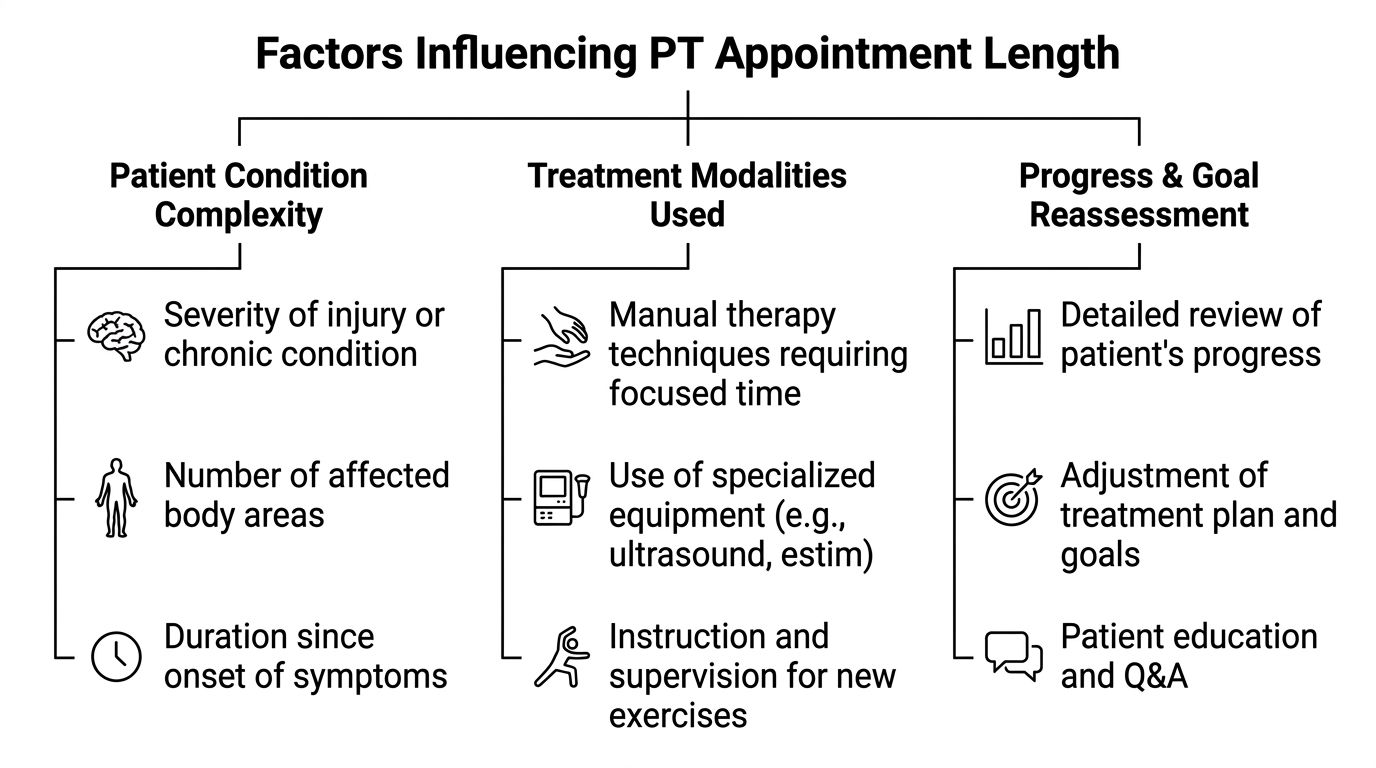
Complexity changes the pace
The more clinical variables involved, the more time a session may need.
A straightforward ankle sprain often allows for efficient progress once swelling, mobility, and load tolerance begin improving. A more complex presentation, such as pelvic floor dysfunction, vestibular symptoms, or TMJ issues, may require a slower pace because symptom triggers can be more nuanced and education is a larger part of treatment.
Here are some common reasons appointment length changes:
- Condition complexity: More body systems or symptom drivers usually mean more clinical decision-making.
- Type of treatment: Manual therapy, movement retraining, and symptom-specific exercise coaching take focused attention.
- Stage of recovery: Early rehab often needs more guidance. Later care may focus on refinement and independence.
- Tolerance that day: Some patients can progress aggressively. Others need a lower-intensity visit to stay on track.
The setting matters too
A clinic’s care model influences how useful the scheduled time feels.
This article on how many patients new grad PTs should really be seeing per hour speaks to an issue patients feel immediately, even if they do not know the staffing model behind it. When clinicians are stretched thin, evaluation quality, exercise correction, and treatment progression often suffer.
Clinical reality: The right appointment length is not the longest one. It is the one that gives enough uninterrupted time to assess, treat, teach, and adjust.
Two examples patients understand quickly
A runner with an overuse injury may improve with a focused exam, strength work, load management, and a well-built home plan. Once the key drivers are identified, visits often become more efficient.
A post-surgical knee patient is different. Swelling, stiffness, gait changes, strength loss, pain behavior, and surgical precautions all affect the session. That patient often needs more direct supervision and less generic programming.
The point is simple. Time should follow the problem, not a rigid template.
How to Maximize Every Minute of Your PT Session
Patients have more influence over visit quality than they realize.
You do not need to know anatomy or rehab science to get more from your appointments. You just need to show up prepared, communicate clearly, and follow through between sessions.

Before you walk in
A few simple habits can make the session more productive from the first minute.
- Wear the right clothing: If we need to see your knee, shoulder blade movement, or pelvic alignment, restrictive clothing gets in the way.
- Know what changed: Think about what felt better, worse, or different since the last session.
- Bring key gear if it matters: Running shoes, orthotics, a brace, or a mouth guard can all be relevant depending on the issue.
During the session
Be specific. “It hurts” is a start. “It hurts when I go downstairs, but not upstairs” is more useful.
If an exercise feels wrong, say so. If your home program is not fitting into your day, say that too. A plan you cannot follow is not a good plan.
Tip: Honest feedback helps more than perfect compliance. Your therapist can adjust a plan they know is not working. They cannot adjust one they never hear about.
For a quick visual on movement quality and coaching, this clip is a useful example of the kind of active guidance that matters during rehab:
After you leave
The visit does not end when you walk out of the clinic.
Your progress usually depends on what happens between sessions:
- Do the home program as prescribed. Not extra. Not less. The right dose matters.
- Track your response. Notice whether symptoms settle quickly, linger, or shift.
- Keep notes for next time. Questions are easier to answer when you remember them.
One option some patients use for ongoing, one-on-one movement-focused care is Joint Ventures Physical Therapy, which offers personalized physical and occupational therapy and wellness-focused visits across Greater Boston.
Navigating Scheduling Insurance and Modern Care Options
The treatment itself should not be the only part of care that feels organized. Scheduling, insurance verification, and authorizations matter too because administrative friction is one of the fastest ways to derail consistency.
Many patients need a schedule that works around work hours, childcare, athletics, or a commute. Early and late appointments can make the difference between staying on plan and missing visits. The administrative side should support recovery, not compete with it.

How often will you go
Nationally, patients average 10 to 12 visits total, often scheduled 2 to 3 times per week initially, with many plans of care running 6 to 8 weeks for soft tissue healing, as described in the earlier PT session length source. In practice, that frequency often makes sense early on because momentum matters. Close follow-up helps your therapist respond quickly to stiffness, pain flares, or exercise tolerance issues.
In-person care versus hybrid models
Telehealth and hybrid models have grown, but many conditions still benefit most from in-person treatment. A dedicated 45 to 60 minute one-on-one session allows for manual therapy, immediate exercise correction, and diagnostic adjustments that are central to orthopedic and specialty rehab, according to this discussion of PT visit structure and care quality.
That does not mean remote care has no place. It can help with education, exercise review, or certain follow-up needs. But when movement quality, tissue irritability, balance, dizziness, jaw mechanics, or post-surgical progression are central issues, in-person care usually gives your therapist more useful information and gives you more precise guidance.
If online booking matters to you, this scheduling option can make the logistics easier: https://www.jointventurespt.com/online-scheduling/
Your Time Is an Investment in Your Health
The shortest answer to how long are physical therapy appointments is this: the first visit is longer because it builds the blueprint, and follow-up visits are long enough to create measurable progress when the time is used well.
That is the part patients feel quickly. Good PT does not feel rushed or vague. You know what your therapist is targeting, why the visit is structured the way it is, and what you are supposed to do next.
The larger point is not just about minutes on a schedule. It is about protecting the quality of your care. Uninterrupted time lets a clinician listen carefully, test the right things, make smart adjustments, and coach you through the details that change outcomes.
If you are committing time to rehab, that time should move you toward something specific. Less pain. Better movement. More confidence. A safer return to running, lifting, parenting, working, or competing.
That is not time lost from your week. It is time invested in getting your body back.
If you’re ready to stop guessing and start a clear plan, Joint Ventures Physical Therapy offers one-on-one care designed around your goals, your schedule, and the kind of focused treatment time that helps recovery feel organized from day one.