
Your jaw starts clicking halfway through lunch in the Seaport. Later, during the Commuter Rail ride home, you catch yourself clenching again. By night, you’re searching for stretches, trying a few in front of the bathroom mirror, and then wondering why your jaw feels more irritated instead of better.
That confusion is common with TMJ problems. A stretch can help one person and flare up another because jaw pain isn’t one single thing. Sometimes the issue is overworked muscle. Sometimes it’s the joint. Sometimes the underlying cause is your neck, your posture, your breathing pattern, or the way stress shows up in your body.
Boston patients often tell us the same version of the story. They’ve tried to “loosen it up,” but they’re not sure whether the soreness afterward means progress or a warning sign. That’s the question that matters. If you guess wrong, you can keep feeding the cycle.
Struggling with Jaw Pain in Boston
If you're dealing with jaw pain in Boston, you're not overreacting and you're not alone. TMJ disorders affect approximately one third of the population at any given time according to this local overview of TMJ in Boston. In a city full of desk jobs, stress, long commutes, and hard training schedules, jaw symptoms show up in ways people don't always connect right away.
For some people, it’s soreness when chewing a bagel on the way to work. For others, it’s morning tightness from clenching overnight, a headache that starts near the temple, or neck tension after hours on a laptop in Fort Point. Some notice noise first. If that’s you, this explanation of jaw popping is a helpful dental perspective on why the joint can click even before pain becomes the main complaint.
Why online stretches can backfire
The internet usually treats TMJ like a simple mobility issue. Open wider. Stretch harder. Repeat.
That works poorly when the jaw is irritated for reasons that have nothing to do with stiffness alone. If your system is already guarding, if the joint is inflamed, or if your neck is driving the problem, forcing more motion can make the area angrier.
Clinical reality: The same stretch that feels relieving for a tight jaw can feel sharp, unstable, or exhausting in a different TMJ presentation.
That’s why TMJ physical therapy Boston patients benefit from isn't just a list of exercises. It starts with figuring out what tissue is irritated, what movement is faulty, and what your symptoms are trying to tell you.
The better next step
A good TMJ plan should answer a few simple questions:
- What triggers it: chewing, talking, yawning, stress, sleep, posture, workouts, or all of the above.
- What kind of symptoms you have: clicking, locking, headaches, ear-area pain, neck pain, dizziness, or muscle fatigue.
- What happens after self-care: relief, no change, or a flare.
Once you know that, treatment gets more precise. Until then, stretching is mostly trial and error.
Productive Soreness Versus A Problem Signal
Not every sore jaw after stretching means you did damage. But not every sore jaw means progress either.
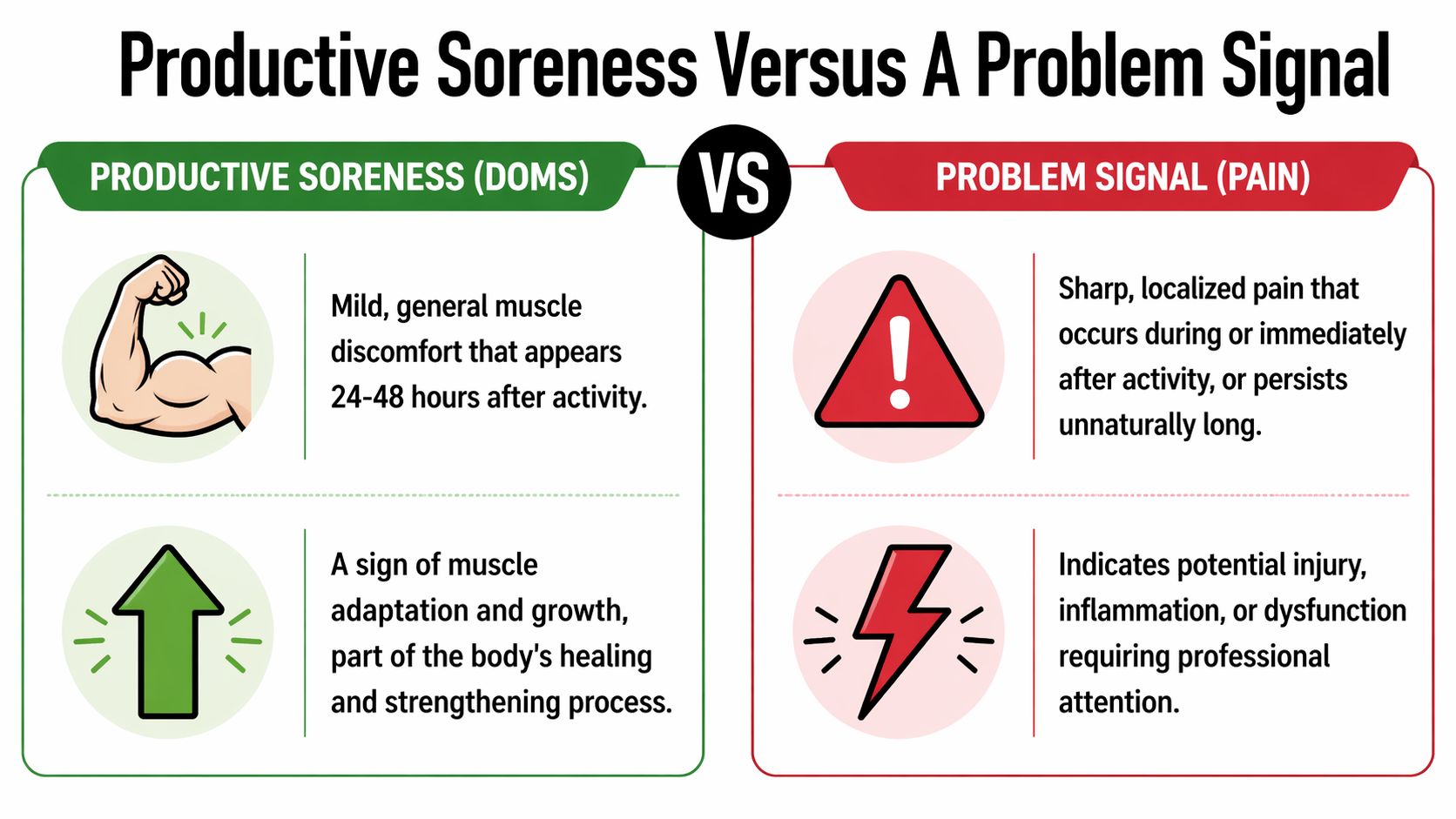
A useful comparison is the feeling after a smart gym session versus the warning light on your dashboard. Productive soreness is usually mild, broad, and temporary. It feels like tissue worked. A problem signal tends to feel sharp, pinchy, unstable, or oddly persistent. It may show up during the stretch, immediately after, or with everyday tasks like chewing and speaking.
What productive soreness usually feels like
If your jaw muscles have been clenching all day, a small amount of dull ache later can happen when those muscles finally do controlled work in a new pattern. It tends to be:
- Diffuse, not pinpointed: more like tired muscles than one exact painful spot
- Short-lived: it settles rather than escalating
- Tolerable during function: you can still talk, eat, and yawn without feeling like something is catching
That kind of response can happen when the issue is mostly muscular.
What a problem signal usually feels like
Pain deserves more respect when it’s specific and mechanical. Stop and reassess if you notice:
- Sharp pain during the motion
- A sense of catching, locking, or shifting
- Symptoms that spread into the ear, temple, face, or neck
- More pain with chewing after the stretch
- Pain that keeps ramping up instead of calming down
Pain that gets more precise, more protective, or more disruptive after stretching usually means the exercise doesn’t match the problem.
That mismatch matters because TMJ symptoms don’t all come from the same source. Physical therapists classify TMJ presentations into distinct categories such as inflammatory conditions, limited jaw range of motion, excessive jaw range of motion, arthrogenous disc displacement, jaw muscle pain, and cervicogenic headaches, each needing a different treatment approach, as described in this overview of TMJ headaches and presentation types.
Why diagnosis changes the exercise
Here’s where many self-treatment plans fail. A jaw that doesn’t open well might need gentle mobility. A jaw that already moves too much may need control and stability instead. A patient whose headaches are coming from the neck can spend weeks stretching the jaw and still not fix the actual driver.
A quick comparison makes that clearer:
| Response after stretching | More likely interpretation | Better next move |
|---|---|---|
| Mild muscular ache later | Tissue tolerance challenge | Reduce intensity and monitor |
| Sharp joint pain during stretch | Mechanical irritation | Stop that motion |
| Clicking with loss of motion | Joint-disc issue possible | Get assessed |
| Neck and temple symptoms | Cervical contribution possible | Treat jaw and neck together |
Boston patients often assume more mobility is always the answer. In TMJ care, the right answer is often better control.
Three Reasons Your Jaw Is Sore After Stretching
Jaw soreness after stretching usually points to a mismatch between the exercise and the problem you are dealing with. In Boston, I see this all the time. Someone with headaches, neck tension, ear symptoms, or a jaw that clicks tries a generic stretch they found online, then wonders why the jaw feels worse later that day.
Your chewing muscles are overworked
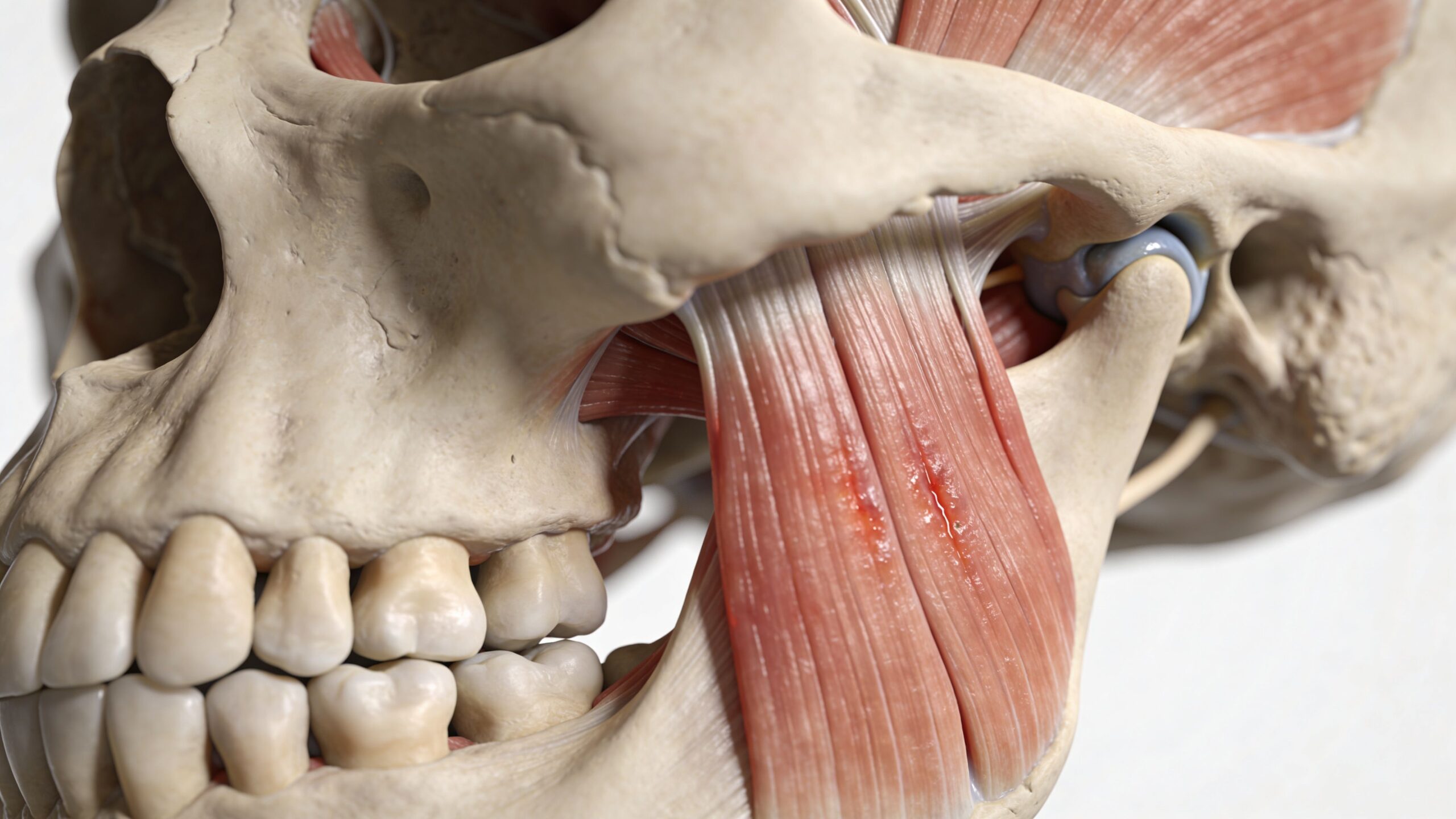
One common reason is simple muscle overload. The masseter and temporalis can already be doing too much before you stretch. That shows up in people who clench through the workday in the Seaport, grip through a delayed Commuter Rail ride, or wake up after grinding at night.
That soreness usually feels broad, tired, and local. It often shows up later rather than as an immediate sharp pain. The trade-off is straightforward. A little load can help a guarded system. Too much load on already irritated muscles just adds one more stressor.
You are forcing motion into an irritated or unstable joint
A jaw can feel tight even when the actual issue is poor control. That is a big reason stretching backfires.
If the joint is inflamed, if the disc is not moving well, or if the jaw already opens too far, pushing for more range can aggravate the tissues that are trying to protect you. The result may be soreness near the joint, pinching in front of the ear, or a sense that the bite feels off after the stretch. That pattern matters in active adults too. Runners, lifters, and court-sport athletes in Boston often notice that jaw irritation changes neck tension, breathing pattern, and even balance. More motion is not always better motion.
Your neck is contributing to the jaw pain
The jaw and neck work together. If the neck is stiff, the upper cervical joints are irritated, or the surrounding nerves are sensitive, a jaw stretch can flare symptoms outside the jaw itself.
That is why some people feel pain into the temple, cheek, ear, or side of the neck after stretching. A laptop setup in Back Bay, long hours at a desk, or constant forward-head posture on the train can load the same system all day. In those cases, the jaw is only part of the problem. At Joint Ventures, we check the neck, posture, breathing pattern, and jaw mechanics together because isolated jaw exercises miss this pattern all the time.
A stretch that creates spreading symptoms usually deserves a closer look.
A quick self-check
Use these questions right after you stretch and again later that day:
- Does it feel muscular, or does it feel like joint irritation? A dull ache suggests muscle loading. Pinching, catching, or sharp pain points more toward joint irritation.
- Do symptoms stay at the jaw, or do they travel? Pain into the temple, ear, face, or neck suggests a broader pattern.
- Is function better afterward? If chewing, talking, yawning, or opening feels worse, the stretch was probably the wrong fit.
- Did you have to brace through your neck or shoulders to do it? That often means the exercise is pulling in the wrong helpers.
If you want examples of lower-force movements that are usually safer than aggressive stretching, start with these TMJ pain relief exercises for controlled jaw motion.
The same sore jaw can come from very different drivers. That is why generic jaw exercise advice only gets some people better. If your soreness keeps returning, or if jaw pain is coming with headaches, neck pain, dizziness, or changes in athletic performance, book an evaluation. A one-on-one TMJ assessment can tell you whether you need mobility, stability, neck treatment, or a combination of all three.
A Safe Stretching Protocol to Try at Home
If you want to test movement at home, think gentle control, not aggressive stretching.
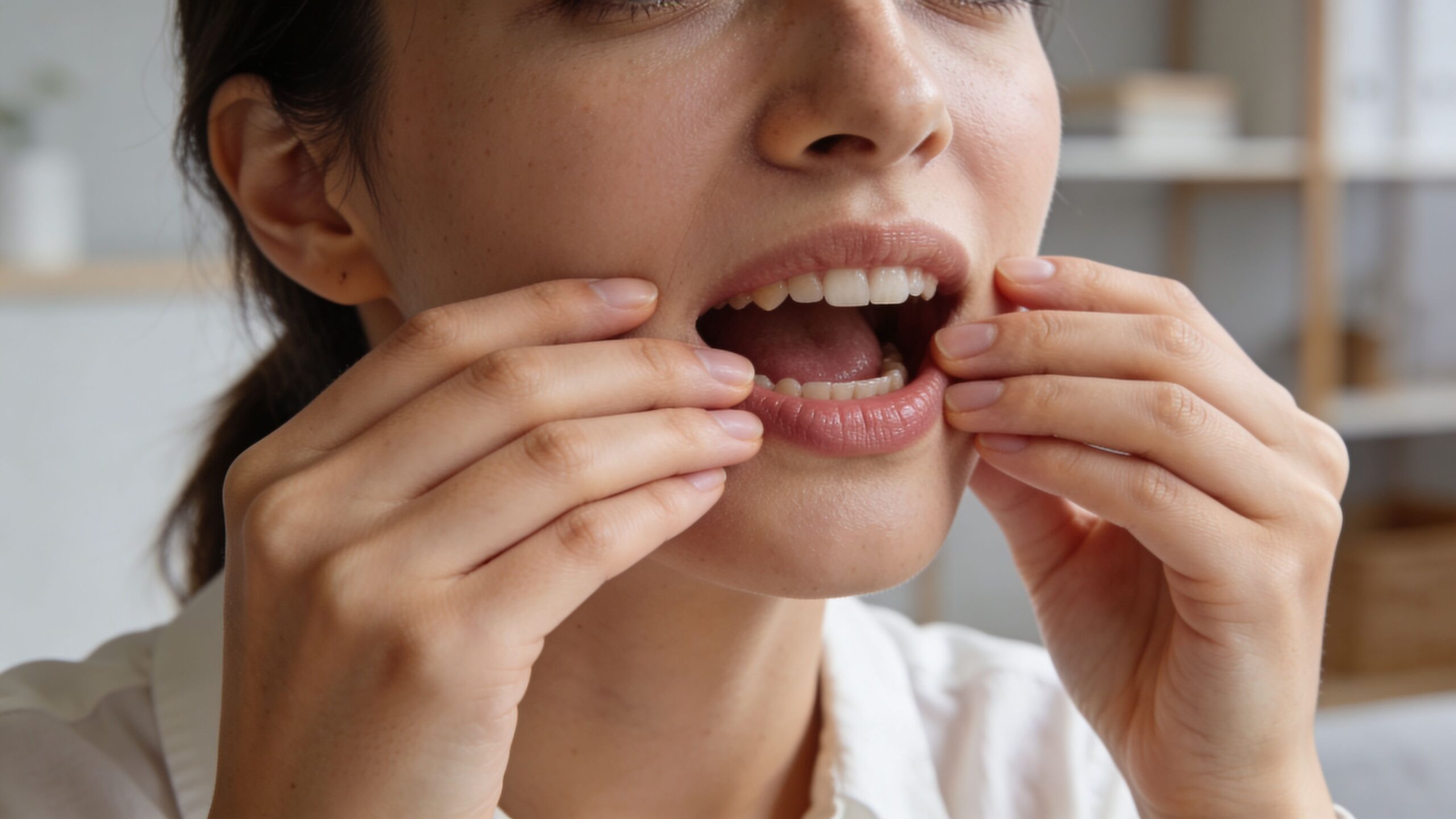
The goal isn't to force the jaw open. The goal is to see whether calm, low-load motion decreases tension or immediately irritates the system. If you want examples, these TMJ pain relief exercises show the kind of controlled movement that tends to be safer than high-force stretching.
Start with controlled motion
Try this sequence once or twice in a quiet setting, not while multitasking.
Tongue-up opening
Rest your tongue lightly on the roof of your mouth. Open slowly only as far as you can without sharpness, catching, or deviation.Small side-to-side motion
Move the jaw gently right and left in a very small range. Keep the effort light.Relaxed nasal breathing
Let the shoulders soften. Don’t brace through the neck while you move the jaw.
Keep the work easy. This is a test, not a workout.
Use the traffic light rule
A simple filter helps prevent overdoing it.
- Green light: movement feels smooth, symptoms stay low, and the jaw settles afterward
- Yellow light: mild dull ache, mild fatigue, or uncertainty. Reduce range, slow down, and see how you feel later.
- Red light: sharp pain, locking, major clicking with pain, dizziness, ear pressure increase, or symptoms that spread into the face or neck
Home rule: If you have to push through it, it’s too aggressive for self-care.
That’s especially true if your pain changes your eating, speaking, or sleep.
A short visual demo can help you compare your motion quality with calmer movement patterns:
What this can and can’t do
At-home mobility can reduce guarding in some mild cases. It can also tell you quickly when you need more than internet advice.
What it can’t do is determine whether your real problem is jaw muscle overload, joint irritation, cervical involvement, breathing mechanics, or a mix of several. If the traffic light stays yellow or red, guessing usually drags the problem out longer.
The Joint Ventures Approach Goes Beyond Stretching
Stretching alone is usually too small a tool for a problem that often involves the jaw, neck, posture, breathing mechanics, and daily load.

A 2023 systematic review found that treating the neck and jaw together leads to better pain and functional outcomes than focusing on the TMJ alone, according to this summary of evidence-based TMJ physical therapy. That tracks with what we see clinically. The jaw rarely acts alone.
What a more complete plan looks like
When TMJ physical therapy Boston patients respond to, it usually includes more than one input. The plan may involve:
- Manual treatment for the jaw and surrounding muscles: both external work and, when appropriate, more specific tissue treatment
- Cervical spine care: mobility and control work for the neck because limited or overloaded neck mechanics often keep feeding jaw symptoms
- Motor control retraining: learning how to open, close, chew, and rest the jaw without compensation
- Postural correction: especially for people spending long days at a desk in Seaport, Downtown Boston, or the Longwood area
- Load management: reducing clenching habits, modifying workouts, and adjusting bite-heavy behaviors like gum chewing
- Adjunct options when appropriate: including trigger point dry needling for stubborn muscle guarding
One option people consider locally is jaw massage for TMJ, which can help some muscular cases. But massage by itself often isn’t enough if the bigger issue is neck-driven movement, poor jaw control, or repeated clenching.
Why athletes and dizzy patients need a wider lens
Boston’s active population often gets shortchanged by generic TMJ content. Runners, lifters, tennis players, and contact-sport athletes don’t just need a jaw to stop hurting. They need a system that works under load.
Jaw dysfunction can show up as headache, neck tightness, facial tension, or a feeling that balance is off. That matters for people training hard, returning after concussion, or dealing with vestibular symptoms. In those cases, jaw care may need to sit next to running analysis, vestibular work, breathing retraining, or upper-quarter rehab.
If your jaw pain changes when your neck position changes, your treatment shouldn’t stop at the jaw.
What usually doesn’t work well
Some approaches help briefly but don’t hold because they don’t address the driver. The common misses are:
- Only stretching
- Only resting and waiting
- Only using a night guard without addressing daytime mechanics
- Only treating the painful spot
- Only thinking dental or only thinking musculoskeletal when both may matter
The better approach is integrated care. That’s where a one-on-one PT evaluation becomes useful. It sorts out whether your biggest limiter is mobility, stability, tissue irritability, posture, stress behavior, cervical contribution, or a combination.
When to See a Physical Therapist for Jaw Pain in Boston
You don’t need to wait until jaw pain becomes severe to get help. In Boston, conservative physical therapy is a first-line treatment approach, and only 10 to 15% of patients require surgery after non-invasive care fails, according to Boston Medical Center’s overview of TMJ disorders.
That matters because many people treat PT like a last resort. For TMJ, it often makes more sense as an early move.
Signs it’s time to book an evaluation
Consider getting assessed if you notice any of these:
- Pain with chewing, talking, or yawning
- Jaw locking or a feeling that it gets stuck
- Clicking or popping that’s painful or paired with loss of motion
- Headaches that seem tied to jaw tension or neck posture
- Pain that radiates into the neck, temple, ear area, or face
- Symptoms that keep returning after you try self-care
- Soreness after stretches that doesn’t make sense or doesn’t settle
A good PT evaluation can tell you whether the problem is more muscular, more joint-driven, more cervical, or mixed.
You can start faster than you think
Massachusetts has direct access, so many patients can begin physical therapy without waiting for a physician referral. That removes one of the biggest reasons people put this off.
The fastest path usually isn’t trying ten more internet exercises. It’s finding out which problem you actually have.
If your jaw pain is interfering with eating, speaking, sleep, workouts, or focus at work, that’s enough reason to stop guessing.
Your Next Step for TMJ Relief in Greater Boston
You finish a workday in the Seaport, realize you have been clenching through emails for hours, try a few stretches from your phone, and your jaw still feels off by dinner. At that point, guessing usually keeps the cycle going. A focused evaluation can sort out whether the main driver is the jaw joint, the chewing muscles, the neck, or a combination that also explains the headaches and tension you have been brushing off.
That bigger picture matters in Boston. Jaw pain often shows up alongside neck stiffness from desk work, temple headaches after a Commuter Rail ride, dizziness, poor sleep, or even changes in lifting and running because the body stays braced. Generic jaw exercise advice misses those connections.
At Joint Ventures, TMJ care is one-on-one and built around how you move through the week. We assess jaw motion, muscle irritation, cervical mechanics, posture, breathing pattern, and the habits that keep symptoms active. That lets treatment stay specific instead of turning into a long list of random drills.
If you have been reading about various TMJ disorder treatment options, the next useful move is to find out which approach fits your case.
Book an evaluation if jaw symptoms are affecting meals, meetings, sleep, workouts, or focus. The goal is simple. Get clear answers, calm the irritation, and build a plan that fits your life in Greater Boston.
Frequently Asked Questions About TMJ Therapy
Do I need a referral for TMJ physical therapy in Boston
In many cases, no. Massachusetts direct access allows patients to start physical therapy without waiting for a referral. If your insurance has specific requirements, the front desk can help verify them before your first visit.
| Question | Answer |
|---|---|
| Do I Need a Referral for TMJ Physical Therapy in Boston? | Often, no. Many patients can begin through direct access, though insurance rules can vary. |
What happens at the first TMJ visit
Your first visit focuses on finding the main driver of the problem. A PT looks at jaw motion, symptom behavior, neck mobility, muscle tenderness, posture, and the daily habits that keep the issue going. If your headaches, dizziness, or athletic performance seem connected, that should be part of the exam too.
Is TMJ care only about the jaw
No. Good TMJ care often includes the neck, upper back, breathing pattern, and habit retraining. If you’ve been looking into various TMJ disorder treatment options, that broader view is useful because not every case responds to the same kind of treatment.
Can I keep working out while treating TMJ
Often yes, with modifications. The answer depends on what flares your symptoms. Heavy gripping, neck tension, impact, and clenching under effort may need to change temporarily, but many people can stay active while they recover.
How do I know if my jaw issue is related to headaches or balance
You may notice that neck posture changes the headache, or that jaw tension ramps up when dizziness does. Those patterns are worth evaluating instead of treating as separate problems. If symptoms overlap, your plan should address the overlap.
How should I prepare for my appointment
Bring a short list of what triggers your symptoms, what time of day they’re worst, whether chewing or talking changes them, and what you’ve already tried. If you use a mouthguard or have recent dental guidance, bring that too.
Book an evaluation with Joint Ventures Physical Therapy if you’re dealing with jaw pain, headaches, neck tension, or clicking that hasn’t settled. A one-on-one visit can clarify what’s driving the problem and help you start the right plan close to home in Greater Boston.