
That clicking, poppin', or relentless ache in your jaw isn’t just an annoyance—it’s a signal. When the muscles you use for chewin' and clenchin' get overworked, they let you know. A targeted jaw massage for TMJ can offer real relief by releasin' that built-up tension, easin' pain, and helpin' you get your jaw’s range of motion back.
This is your first step toward managin' that discomfort right from your own home.
Your Guide to At-Home TMJ Relief
Every day, we see patients walk into our Boston PT clinics—from Back Bay to Brookline—with that same familiar story. It might be a dull ache that never goes away, a loud click with every bite, or a tension headache that starts at the temples and won't quit.
Our first message is always the same: you aren't alone in this, and you don’t have to just put up with it. We're here for you.
This is an incredibly common issue. Temporomandibular Disorders (TMD) affect millions of Americans, and the cost of managing them is estimated at $4 billion annually in the US. Research from sources like Balfour Dental on TMD prevalence shows that about 1 in 12 people—or roughly 12% of the population—is dealing with a TMJ disorder, with women being affected far more often than men.
We created this guide to give you the same practical advice we share during a one-on-one session right here in the clinic.
Why Your Jaw Needs a Little Help
Your temporomandibular joint (TMJ) is a small but powerful hinge connectin' your jaw to your skull. It’s constantly workin' when you talk, yawn, and chew. It gets a serious workout.
When the muscles surroundin' the joint get tight—from stress, nighttime clenching, or even poor posture (yeah, that "tech neck" from lookin' down at your phone on the T is a major factor)—it can cause a whole cascade of problems.
A tight jaw rarely stays a jaw problem. We tell our patients it can be the hidden source of naggin' headaches, neck stiffness, and even ear pain or ringin'. Releasin' that tension is often the key to feelin' better all over.
This is exactly where a gentle jaw massage for TMJ makes a difference. By applyin' specific, controlled pressure to the key muscles, you can start to see real changes.
For a quick overview of how to get started, here’s a simple breakdown.
Quick Guide to Self-Massage for TMJ
Here's a quick look at the simple steps for safe and effective TMJ self-massage.
| Action | What to Do | Why It Helps |
|---|---|---|
| Warm-Up | Apply a warm, moist towel to the side of your face for 5-10 minutes. | Relaxes the muscles, making them more receptive to massage. |
| Find the Muscle | Place your fingertips in front of your ears and clench your jaw to feel the masseter muscle contract. | This is the main chewing muscle and a primary source of tension. |
| Apply Pressure | Using your index and middle fingers, apply firm, steady pressure. Move in small, circular motions. | Directly targets and releases trigger points and muscle knots. |
| Hold and Breathe | Hold the pressure on any tender spots for 30-60 seconds while taking slow, deep breaths. | Encourages the muscle to release and calms the nervous system. |
This simple routine, done consistently, can make a huge impact on your pain levels.
A dedicated self-massage routine helps you:
- Reduce Muscle Tension: You're directly addressin' the tightness and trigger points that are causin' the pain in the first place.
- Improve Blood Flow: Bringin' fresh oxygen and nutrients to the area promotes healin' and helps reduce inflammation.
- Increase Jaw Mobility: This helps restore your natural range of motion, makin' it easier to open your mouth without that painful click.
- Break the Pain Cycle: Gentle massage can provide immediate relief, which helps calm down an overactive and sensitized nervous system.
Think of this as your startin' point for takin' back control. We'll show you exactly how to use these simple, effective self-massage techniques to start feelin' better today. Let's get you on the path to a healthier, happier jaw.
Understanding Your Jaw Anatomy for Better Massage
Before you try a jaw massage for TMJ, it helps to know what you’re workin' on. Think of it like learnin' the neighborhood before tryin' to find a shortcut through the North End—a little local knowledge goes a long way.
Let’s take a quick tour of the main muscles involved in your jaw pain. When you know what you’re targetin', your self-massage becomes much more effective. You’re not just randomly rubbin' your face; you’re zeroin' in on the specific spots causin' all the trouble.
The Powerhouse Chewing Muscle: The Masseter
This is the big one. The masseter muscle is a thick, powerful slab of muscle runnin' from your cheekbone down to your lower jaw. It’s the primary engine for chewin', clenchin', and grindin'.
Want to find it? Place your fingertips on your cheeks, just under the cheekbone. Now, clench your teeth together like you're about to bite into a tough steak.
Feel that bulge pop out? That’s your masseter. For many of our patients, this muscle is ground zero for TMJ tension. Because it's so strong and used so often, it’s a magnet for developin' tight, painful knots called trigger points. These knots can shoot pain to your teeth, ear, and even spark a headache.
The Fan-Shaped Muscle: The Temporalis
Next up is the temporalis muscle. This is a wide, fan-shaped muscle coverin' the side of your head. It starts above your ear and spreads up toward your temple, and its main job is to help close your jaw and pull it backward.
To feel it in action, put your fingertips on your temples and clench your teeth again. That subtle tightenin' you feel under your fingers is your temporalis contractin'.
A lot of my patients are surprised when I tell 'em their tension headaches are actually comin' from a tight temporalis. When you clench, this muscle gets overworked and can create that classic feelin' of a tight band wrapped around your head.
The Hidden Instigators: The Pterygoids
Finally, we have the pterygoid muscles. These are the tricky ones because they’re located deep inside your jaw structure. The lateral and medial pterygoids are the muscles that let you move your jaw side-to-side and forward—essential for grindin' food properly.
You can't really get to these with a simple external massage. They're often a major source of pain, clickin', and that awful "stuck" feelin' in your jaw. A physical therapist can use specific intra-oral techniques to release 'em, but just by workin' on the masseter and temporalis, you can still get some fantastic indirect relief.
Understandin' that jaw pain is a neighborhood issue—not just a single spot—is key.
Your Guide to Safe and Effective Jaw Massage
Alright, let's get hands-on. These are the exact techniques we teach our patients right here in the clinic to manage their own jaw pain. We're lookin' out for you, and we want you to have these tools.
First, a little prep work goes a long way. Try applyin' a warm, moist towel to the side of your face for about 5-10 minutes. This simple step helps the muscles relax, makin' 'em much more receptive to the massage you're about to do.
The goal here is always firm but gentle pressure. You want to feel a deep release, not sharp pain. If anythin' hurts, ease up or stop. Your body will tell you what it needs.
The Masseter Release
The masseter is that thick, powerful muscle in your cheek that does most of the heavy liftin' when you chew. When it's full of knots, you feel it as a deep, naggin' ache.
- Locate the Muscle: Place the pads of your index and middle fingers on your cheek, just below your cheekbone. Now, clench your teeth for a second. Feel that bulge? That’s your target.
- Apply Gentle Pressure: With your jaw relaxed, press into the muscle. Start movin' your fingers in slow, deliberate circles.
- Search for Tender Spots: As you massage, you'll probably find specific points that feel more tender than the areas around 'em. Those are trigger points. When you find one, just hold steady pressure for 30-60 seconds. Focus on takin' slow, deep breaths. This sends a signal to your nervous system that it's okay to let go.
To take this a step further, you can add a gentle stretch by slowly openin' your jaw while keepin' light pressure on the muscle. This helps lengthen the muscle fibers right after you've worked out the knot.
The Temporalis Soother
Remember that fan-shaped muscle on the side of your head? A tight temporalis is a classic culprit behind those tension headaches that wrap around your skull.
This one is simple but incredibly effective. Place your fingertips on your temples—that soft spot on either side of your forehead. Usin' gentle but firm pressure, massage in small, circular motions. Work your way up toward your hairline and then back toward your ears.
Many of our patients find this technique especially relaxin' at the end of a stressful day. Closin' your eyes and breathin' deeply as you do it can provide almost immediate relief when you feel a headache comin' on.
The diagram below shows exactly where these key muscles are located so you can focus your efforts.
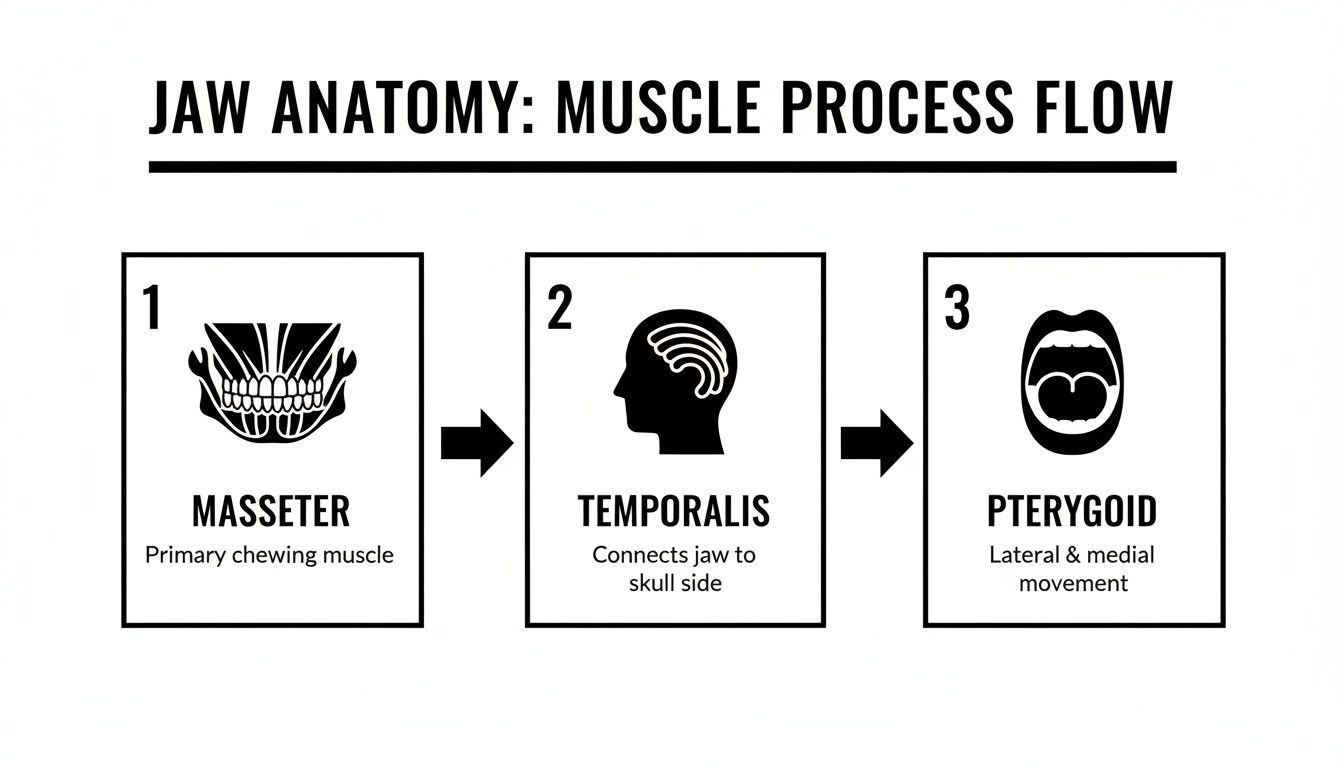
This visual guide helps you pinpoint the masseter, temporalis, and the deeper pterygoid muscles, ensurin' your self-massage is both safe and effective.
The Pterygoid Release (Intra-Oral)
Now for the tricky ones. The pterygoid muscles are located inside your mouth, which is why they're often missed. Releasin' 'em requires an intra-oral technique, but it can be a game-changer for a jaw that feels "stuck" or clicks constantly.
Important: Please always wash your hands thoroughly with soap and water before doin' this. It's also a great idea to make sure your fingernails are trimmed to avoid accidentally scratchin' your gums. We're all about safety first.
- Get into Position: You'll use your opposite hand for each side. So, for the left side of your jaw, you'll use your right thumb. Keep your jaw relaxed.
- Insert Your Thumb: Gently slide your thumb into your mouth, positionin' it along the outside of your upper teeth, until you reach the very back molar. You should feel a fleshy pocket of muscle there, between your upper and lower jaw.
- Apply Pressure: Press gently outward and slightly upward into that muscle pocket. Your goal is to find those tender spots and hold gentle pressure for about 20-30 seconds. Again, never push to the point of intense pain.
This technique can feel a little strange at first, but for folks with chronic clickin' or limited openin', it's often the missin' piece of the puzzle.
If you're dealin' with these symptoms, you are far from alone. Temporomandibular disorders (TMDs) are a significant issue. In fact, a major 2025 review found that about 29.5% of people worldwide have some form of TMD. The research also highlighted that women are 1.75 times more likely to be affected than men, with muscle pain (myalgia) and joint clickin' bein' incredibly common. You can explore the full findings from this comprehensive study on TMD prevalence in the Journal of Public Health.
Habits to Support a Happy Jaw
A targeted jaw massage for TMJ is a fantastic tool, but real, lastin' relief comes from what you do every day. Think of it this way: massage unlocks the tight muscles, but buildin' good habits is what stops 'em from lockin' up again.
Here in our Boston clinics, we always pair manual therapy with practical self-care. These are the simple, effective things you can do at home to support the work we do together and keep your jaw feelin' good long after your appointment.
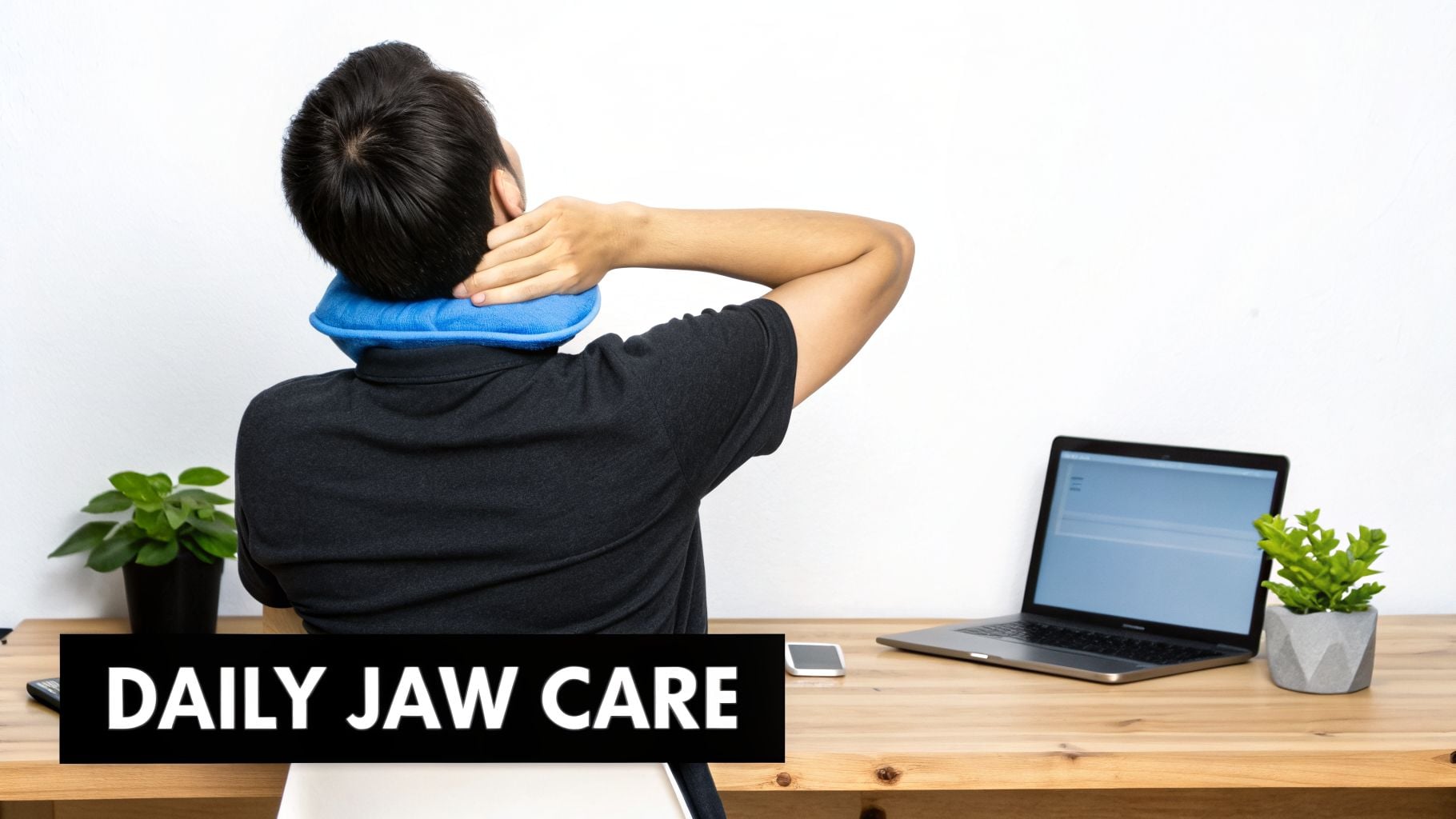
Gentle Stretches for Better Mobility
The best time to stretch your jaw is right after a massage. Your muscles are warm and more pliable, makin' it the perfect window to improve your range of motion.
A simple, effective stretch we teach patients is the "Resisted Opening." Just place two fingers under your chin and apply some gentle upward pressure. Now, slowly open your mouth against that light resistance. Hold it for 3-5 seconds, then relax. Repeatin' this 5-10 times helps retrain and strengthen the muscles you use to open your mouth.
Another great one is the "Tongue Up" stretch. Put the tip of your tongue on the roof of your mouth, right behind your front teeth. While keepin' it there, slowly open your mouth as wide as you comfortably can. This gives the joint and its surroundin' muscles a controlled, focused stretch.
The Smart Use of Heat and Ice
Heat and ice are classic tools for a reason—they work. But knowin' when to use each one makes all the difference.
Heat Is for Tightness: Use a warm, moist compress for 10-15 minutes before you massage or stretch. Heat boosts blood flow and helps relax those chronically tight, achy muscles, makin' 'em much more responsive to your self-care.
Ice Is for Acute Pain: If you’re dealin' with a sharp, painful flare-up and you notice some swellin', ice is your best bet. Apply an ice pack (wrapped in a thin towel, never directly on the skin) for 10 minutes on, then 10 minutes off. This is great for reducin' inflammation and calmin' down those sharp pain signals.
Check Your Posture Right Now
We see it all day, every day: "tech neck." It's that forward-head posture we all slip into while starin' at screens—our laptops, our phones on the T, you name it.
When your head juts forward, it puts a massive strain on your neck and, you guessed it, your jaw muscles. They have to work overtime just to hold your head up, which is a direct path to clenchin' and tension.
Think of your head as a bowlin' ball. When it’s balanced right over your shoulders, it’s easy to hold. The moment it drifts forward, your neck and jaw muscles have to pull back with incredible force, leadin' straight to pain. This is something we really focus on with our patients because small changes here make a huge difference.
A simple cue we give our patients is to think about keepin' your ears aligned over your shoulders. Every time you catch yourself slouchin', gently tuck your chin back and reset. It seems small, but practicin' this consistently can take a huge load off your jaw. If you're lookin' for more ways to make positive changes last, check out our guide on getting new habits to stick.
Take a Breath and Relax
Stress is a massive trigger for TMJ pain. When we get stressed, we unconsciously clench our jaws and grind our teeth, often without even knowin' we're doin' it. For long-term relief, findin' ways to manage that stress is non-negotiable.
This doesn't mean you need to start an hour-long meditation practice (unless you want to!). It can be as simple as takin' five deep, slow belly breaths before a meetin' or while stopped at a red light. Simple relaxation techniques like this calm your nervous system, which in turn tells your jaw muscles it's okay to let go.
We're huge advocates for empowerin' you with tools like a good jaw massage for TMJ and other self-care habits. These at-home strategies can be a game-changer for managin' daily muscle tension and discomfort.
But as physical therapists, we also know that self-care has its limits. Part of our job is bein' upfront about when it’s time to call in a professional. We want what's best for you, and knowin' when to get help is just as important as knowin' the massage techniques themselves.
Warning Signs You Shouldn't Ignore
Sometimes, what feels like a simple jaw ache is a sign of somethin' that needs a clinical diagnosis. If you run into any of the followin', it's time to put the self-massage on pause and give a professional a call. Don't try to push through these—they are your body's way of askin' for more targeted help.
These are the signals that mean the issue is likely beyond simple muscle work:
- A Locked Jaw: This is when you suddenly can’t open or close your mouth all the way. It’s a clear mechanical signal that the joint itself needs to be evaluated.
- Severe, Sudden Pain: A sharp, intense, or sudden onset of pain is never somethin' to ignore or try to massage away.
- Numbness or Tingling: Any persistent "pins and needles" sensation or numbness in your face, jaw, or tongue requires immediate professional assessment.
- Pain That Isn't Improving: If you've been consistent with self-care for a couple of weeks and your pain is gettin' worse—or just not gettin' any better—it's time for a new plan.
Your body is smart. When it sends these kinds of loud signals, it's tellin' you that the issue is beyond what simple muscle release can fix. This is when an expert diagnosis becomes crucial for safe and effective recovery.
What to Expect From a PT Evaluation
Walkin' into a physical therapy evaluation for your jaw isn't intimidatin'. It’s the first step toward findin' out exactly what's goin' on and buildin' a plan to fix it.
We’ll start by just talkin'. We want to hear your story and understand what you’ve been feelin'. From there, we’ll do a thorough assessment of your jaw's range of motion, your neck posture, and the strength of the muscles around your head and neck. That information allows us to build a plan specifically for you. You can find out more about what our approach to TMJ physical therapy in Boston looks like right here.
This condition is a global issue, though it presents differently worldwide. A recent meta-analysis showed that while North America has a TMD prevalence of about 26%, other regions are much higher. For instance, in South America, the rate hits 47% overall and climbs to 56% for adults aged 18-60. These variations highlight how complex TMD can be, makin' personalized care essential.
For very severe cases that don't respond to conservative care like PT, some patients may need to explore more intensive treatments such as jaw surgery. However, for the vast majority of people, a focused physical therapy plan is incredibly effective. Seein' a PT isn't about givin' up on self-care; it’s about gettin' the right expert on your team to guide you.
Common Questions About Jaw Massage and TMJ
As physical therapists here in Boston, we hear a lot of questions about TMJ pain. When your jaw is hurtin', it's completely normal to have concerns and want clear answers. So, let's walk through some of the most common things our patients ask when they first start usin' jaw massage for TMJ.
How Often Should I Do These Massages?
This is probably the number one question we get. For most people, a great startin' point is to do your self-massage routine once or twice a day. Just a few minutes in the mornin' can help work out stiffness from clenchin' overnight, and another quick session in the evenin' can release the tension that's built up durin' the day.
The real key here is consistency, not intensity. A short, gentle massage done daily is far more helpful than one long, aggressive session once a week. You have to listen to your body—if your jaw feels pretty good, you might drop down to once a day or even every other day just for maintenance.
Is It Normal to Feel Sore After a Jaw Massage?
It’s definitely possible to feel some mild tenderness, especially when you're just startin' out. You're workin' on muscles that have been tight and unhappy for a long time. Think of it like the muscle soreness you'd get after a good workout at the gym. It's a sign that you've worked the muscles in a new way.
That tenderness should be mild and short-lived, lastin' no more than a day or two. If you feel any sharp, shootin', or severe pain either durin' or after the massage, you’re pushin' too hard. Back off the pressure immediately or take a day off. That's our advice for keepin' it safe.
If you are a bit sore, try a warm compress on the area to help soothe the muscles. Your goal should always be relief, not creatin' more pain.
Can Massage Help with Jaw Clicking?
Jaw clickin' is a tricky one. Sometimes, that pop or click happens because tight muscles are pullin' the jaw joint just slightly out of its proper alignment. In those cases, yes, a consistent jaw massage for TMJ can absolutely help. By relaxin' those muscles, you allow the joint to track more smoothly, often reducin' the click.
However, a click can also signal that the small articular disc inside your joint has shifted. While massage is still beneficial for reducin' the muscle tension around the joint, it might not eliminate the click entirely if there's an internal joint problem. If your click is painful or your jaw ever feels like it's gettin' "stuck," that's a clear sign to come see us for a professional evaluation.
Is Jaw Massage a "Cure" for TMJ?
We really wish it were that simple! Jaw massage is an incredibly powerful tool for managin' your symptoms, but it’s almost never a standalone "cure." TMJ is usually a complex issue, influenced by everythin' from stress and clenchin' to your posture and even your bite alignment.
True, long-term relief almost always comes from a well-rounded approach. Jaw massage is a critical piece of the puzzle, but it works best when you pair it with other strategies like:
- Posture correction
- Gentle stretchin'
- Stress management techniques
- Professional physical therapy when needed
Beyond at-home remedies and physical therapy, some patients explore options like Botox as a treatment for TMJ for severe clenchin'. Think of massage as your best first-line defense for immediate relief, and think of physical therapy as the expert guidance that gets to the root causes.
At Joint Ventures Physical Therapy, our team is here to give you the personalized, one-on-one care you deserve. If you're tired of guessin' and want a clear path forward, book an appointment with us and let's get you feelin' better, together. Find out more at https://jointventurespt.com.