
Jaw pain is one of the most overlooked musculoskeletal issues in Boston.
Between high-stress careers, long commutes, cold weather muscle guarding, and long hours on screens, TMJ dysfunction is more common than most people realize. Many professionals dismiss it as “just stress” or assume it’s purely a dental issue — when in reality, the jaw is deeply connected to the neck, posture, and nervous system.
If you’re searching for TMJ Physical Therapy Boston, you’re not alone. Let’s break down what’s happening and why it’s especially common here.
1. What Is TMJ?
The temporomandibular joint (TMJ) connects your jawbone to your skull. It allows you to chew, speak, yawn, and move your jaw side to side.
When this joint or its surrounding muscles become irritated or overloaded, symptoms can include:
- Clicking or popping
- Jaw locking or catching
- Headaches (often at the temples)
- Ear pain or pressure
- Neck tension
- Pain while chewing
Because the TMJ sits so close to the ear and shares muscular connections with the neck, symptoms are often confusing. Many patients think they have migraines, sinus pressure, or ear infections before realizing the jaw is involved.
2. Why TMJ Is Common in Boston
Boston has a unique lifestyle profile.
This city is filled with high-performing professionals, healthcare workers, academics, finance leaders, tech employees, and students. Many are operating under constant deadlines and cognitive load.
Here’s why that matters:
- Stress → Jaw clenching: Chronic stress often leads to unconscious clenching or grinding.
- Cold weather → Muscle guarding: Boston winters cause people to tighten their shoulders and jaw muscles.
- Desk posture → Forward head position: Long hours on laptops strain the neck and jaw connection.
- Screen time → Static positioning: Sustained posture increases cervical tension.
- Commuting → Muscle bracing: Driving or riding the train while tense reinforces jaw tightening.
Jaw pain in Boston isn’t random. It’s predictable.
When you combine stress, posture, and environmental factors, TMJ dysfunction becomes much more likely.
3. TMJ vs. Headaches – How They’re Connected
Many patients search for TMJ headache Boston because the symptoms overlap significantly.
Here’s why:
- The jaw muscles connect directly to the temples and skull.
- The cervical spine (neck) shares neural pathways with the jaw.
- Tight upper neck muscles can refer pain into the head.
If the cervical spine isn’t moving well, the jaw often compensates. If posture is poor, the jaw joint experiences altered loading.
This is why dentists alone may not fully resolve the issue. While bite guards can protect teeth, they don’t address:
- Neck mobility restrictions
- Postural strain
- Muscle overactivity
- Stress-driven clenching patterns
That’s where a broader musculoskeletal approach becomes essential.
4. How Physical Therapy Helps TMJ
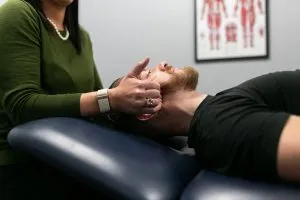
TMJ Physical Therapy in Boston focuses on the entire system — not just the joint.
Treatment may include:
- Manual therapy to the jaw and cervical spine
- Postural correction strategies for desk work
- Neck mobility exercises
- Jaw motor control retraining
- Stress reduction and relaxation techniques
- Strengthening deep stabilizing muscles
Because Boston professionals often return quickly to demanding schedules, care must be efficient, practical, and realistic. The goal isn’t just symptom reduction — it’s building resilience so flare-ups don’t keep returning.
5. When to See a PT for Jaw Pain
Jaw discomfort that comes and goes occasionally isn’t unusual. But you should consider an evaluation if you experience:
- Pain lasting more than 2 weeks
- Difficulty chewing or opening your mouth
- Headaches that don’t resolve with typical treatment
- Jaw locking episodes
- Ear pain without infection
The earlier you address TMJ symptoms, the easier they are to manage. Waiting often allows muscle guarding and compensation patterns to become more entrenched.
Frequently Asked Questions
Can physical therapy help TMJ?
Yes. Physical therapy addresses muscular, postural, and cervical spine contributors to jaw pain, not just the joint itself.
Is TMJ common in Boston professionals?
Yes. High stress, prolonged desk posture, commuting tension, and cold-weather muscle guarding all contribute significantly to TMJ symptoms.
Do I need a referral for TMJ physical therapy in Boston?
Often no. Massachusetts direct access laws allow many patients to begin physical therapy without a referral. Insurance policies may vary, so it’s best to confirm coverage.
Experiencing Jaw Pain or Headaches?
If you’re dealing with jaw clicking, tension headaches, or persistent neck tightness, don’t ignore it.
Schedule a TMJ evaluation at one of our Boston locations and take the first step toward lasting relief with targeted, whole-system care.