
Your jaw starts the day already tight. You notice it on the first sip of coffee, then again halfway through a meeting when talking feels effortful, and later when lunch from a Seaport takeout spot turns into careful chewing on one side only. By evening, the ache has crept into your temple and neck, and you're wondering whether this is a dental issue, a stress issue, or just one more thing to push through.
That pattern is common in Boston. Busy professionals spend long hours at laptops, carry tension through the neck and shoulders, and often ignore jaw symptoms until they start affecting eating, sleep, workouts, or concentration. The good news is that jaw pain usually isn't something you have to tolerate. There's a practical path forward, and it starts with figuring out what's driving the problem.
Is Jaw Pain Affecting Your Daily Life
A lot of people arrive with the same story. The jaw clicks during breakfast. Talking through presentations makes the face feel tired. A long day at a desk in Back Bay or Downtown Boston ends with a headache that seems to wrap from the temple into the neck. Some people wake up sore from clenching at night. Others notice they avoid chewy foods, wide yawns, or even singing because the joint feels unreliable.

When jaw pain starts changing normal routines
Jaw pain rarely stays limited to the jaw. It can alter how you eat, how clearly you speak at work, how well you sleep, and how comfortable you feel during exercise. That's usually the moment people stop searching random advice online and start looking for TMJ physical therapy Boston options that make sense for real life.
In Massachusetts, many patients can begin physical therapy without a physician referral because of direct access laws, which can make it easier to get evaluated sooner for jaw pain. Boston-area care also tends to treat this as conservative first-line management, with attention to the jaw, neck, and posture rather than only the joint itself, as described in Joint Ventures' overview of TMJ care in Boston.
Practical rule: If your jaw pain is interfering with eating, speaking, sleeping, training, or desk work, it's worth getting assessed instead of waiting for it to “settle down.”
Why early evaluation matters
What works is an early, specific assessment that looks at movement, muscle tension, aggravating habits, and neck involvement. What usually doesn't work is trying to force through wide opening, repeatedly stretching into pain, or assuming every jaw symptom has the same cause.
For busy Bostonians, speed matters. If you can start with a physical therapy evaluation promptly, you can often stop guessing and start following a plan that fits your schedule, work demands, and daily triggers.
Understanding TMJ Dysfunction for Bostonians
A lot of Boston patients arrive assuming the joint itself is the whole problem. In practice, jaw pain usually reflects a pattern that includes the jaw, the muscles around it, the neck, breathing habits, sleep position, and how your body holds tension during the day. That is why one person feels clicking with no real pain, while another has morning soreness, temple headaches, ear symptoms, and fatigue after back-to-back meetings.
TMD is common and often has more than one driver. The National Institute of Dental and Craniofacial Research, as summarized by Bay State Physical Therapy, describes jaw pain, headaches, ear pain, neck pain, and limited opening as common features in their TMJ and TMD overview.
For people working in Boston, the pattern is familiar. Hours at a laptop in the Seaport or Back Bay can leave the head drifting forward and the neck working too hard. Long commutes can mean clenched teeth, raised shoulders, and shallow breathing before the workday even starts. Add stress, poor sleep, or hard training on top of that, and a sensitive jaw often stays irritated longer than it should.
That does not mean your job or commute caused TMD by itself. It means your routine may be keeping it active.
A good TMJ evaluation looks at more than opening and closing. I want to know whether the joint is stiff, whether the muscles are overworking, whether the jaw tracks evenly, and whether the neck changes your symptoms. Those details matter because the treatment is different for each pattern. Someone with painless clicking needs a different plan than someone who cannot open fully or gets headaches after talking all day.
Boston patients also run into a practical issue. It can be hard to tell whether pain is coming from the jaw, the teeth, sinus pressure, or facial muscles. If you are sorting through that overlap, Inspire Dental Group's expert team offers a helpful patient-friendly explanation of how tooth pain and jaw pain can be confused.
The other trade-off is timing. Waiting can make sense for mild symptoms that settle within a few days. It is less helpful when pain keeps returning during meals, work calls, exercise, or sleep. In those cases, targeted care and a few TMJ pain relief exercises for jaw tension and mobility usually give you better information than more guessing online.
Your Personalized TMJ Treatment Plan in Boston
The right treatment plan starts with a simple question. What is your jaw struggling to do? Open fully, chew comfortably, move evenly, tolerate long conversations, or stay relaxed during stressful workdays? The answer shapes the treatment.
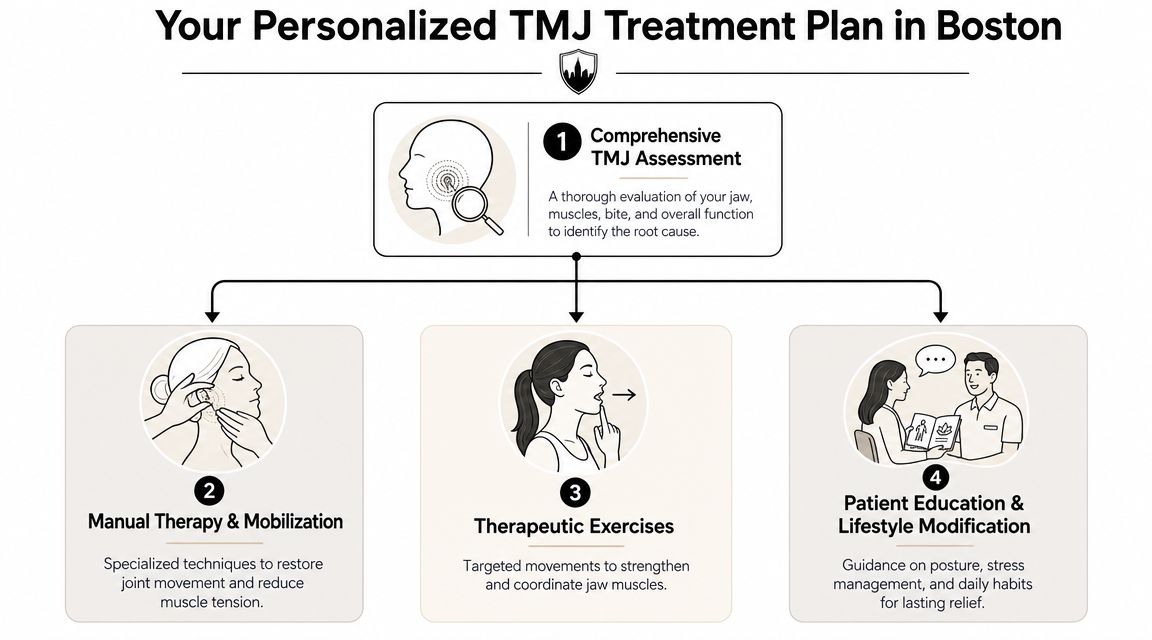
Boston TMJ rehab commonly combines manual therapy with progressive exercise because the joint and surrounding muscles can become painful for different reasons. Local clinical descriptions emphasize restoring joint play, improving jaw opening and closing mechanics, reducing muscle overactivity, and building longer-term tolerance for chewing, speaking, and daily load in this overview of evidence-based TMJ physical therapy.
What treatment often includes
Some parts of care are hands-on. Others are active. The best plans use both.
- Manual therapy for the jaw and neck helps reduce stiffness and calm down irritated tissues. This may include soft tissue work, gentle mobilization, and treatment to the cervical spine when the neck is clearly part of the pattern.
- Jaw motor control retraining teaches smoother opening and closing, especially when the jaw shifts, catches, or moves unevenly.
- Postural correction for desk work matters when symptoms build during laptop use, calls, or long seated stretches.
- Deep stabilizing exercise supports the jaw and neck so you're not relying on overworked surface muscles all day.
- Stress-reduction strategies can be surprisingly important for people who clench during deadlines, workouts, or sleep.
Where specialized tools fit
Some patients respond well to more targeted approaches when muscle guarding is stubborn. For example, trigger point dry needling can be useful in the right clinical situation when the jaw, face, or cervical muscles stay persistently overactive. It isn't a magic fix. It works best when it's part of a larger plan that also addresses movement, posture, and habits.
Aquatic therapy can also help certain patients who are globally tense, deconditioned, or flared up by land-based activity. It's not the first choice for every jaw case, but in the right person it can lower overall body tension enough to support progress.
For people comparing PT with other conservative options, some also look into whether they can alleviate jaw pain with Botox. That can be part of a broader discussion, but it doesn't replace the need to assess movement, loading habits, and neck involvement.
Here's a quick look at one educational resource that covers home strategies patients often ask about:
What usually works and what usually doesn't
A personalized plan works better than a generic “jaw exercise list” pulled from social media. If you want examples of movement-based self-care, these TMJ pain relief exercises are a useful starting point, but they work best when matched to the actual reason your jaw is irritated.
What tends to help:
- A plan matched to your symptoms
- Attention to the neck and posture
- Gradual return to normal eating and speaking
- Home exercises done consistently, not aggressively
What often backfires:
- Forcing wide opening through pain
- Chewing gum to “work the jaw out”
- Jumping between too many remedies at once
- Ignoring clenching triggers during work or sleep
One option in Greater Boston is Joint Ventures Physical Therapy, which offers one-on-one PT care and also provides services such as trigger point dry needling, aquatic therapy, and workplace ergonomics that may fit certain TMJ presentations.
What to Expect From Your TMJ Therapy Visits
Patients often feel better once they know what the first few visits will look like. The process is usually straightforward. You talk through the history, the therapist checks how the jaw and neck are moving, and then treatment begins with a clear explanation of what seems to be driving the symptoms.
A key concern for Boston patients is what happens after they start. Patient-facing clinical summaries note that care often begins with an in-depth evaluation, followed by a multimodal plan that may include manual therapy, exercise, and modalities such as dry needling, with progress tracked against functional milestones in this TMJ treatment overview.
Your first session
The first visit is usually the most investigative. The therapist listens for the pattern. Does pain worsen with chewing, stress, poor sleep, long meetings, hard training, or computer work? Then they assess how you open and close, whether there's deviation, how the cervical spine is moving, and which muscles reproduce your symptoms when palpated.
You'll also talk about daily friction points. That might be breakfast pain, tension after Zoom calls, headaches after studying, or soreness after wearing a mouthguard.
The best first visit leaves you with a working explanation, not just a list of sore spots.
Your next visits
Follow-up sessions are more focused. Once the main drivers are clearer, treatment becomes more efficient. Hands-on work may target jaw, face, and neck restrictions. Exercise gets more specific. You also start measuring progress in ways that matter to your life, such as easier eating, less morning soreness, or fewer headaches after desk work.
If you want a simple self-care technique between visits, this guide to jaw massage for TMJ can help you understand what light home work should feel like.
| Visit | Primary Focus | Key Activities |
|---|---|---|
| Visit 1 | Evaluation and diagnosis | History, jaw movement assessment, neck and posture screening, muscle testing, initial symptom relief plan |
| Visit 2 | Early symptom reduction | Manual therapy, gentle mobility work, basic home exercises, habit review |
| Visit 3 | Movement retraining | Refined exercise progression, chewing and talking tolerance strategies, posture and loading adjustments |
What good progress tracking looks like
A solid plan doesn't just ask, “Does it hurt less?” It also asks:
- Can you eat more normally
- Can you get through work calls with less fatigue
- Are mornings less stiff
- Is your opening smoother and less guarded
That kind of tracking matters because people often improve in function before they feel completely symptom-free.
How Long Does TMJ Physical Therapy Take
This is the question almost everyone asks early. The honest answer is that it depends on how long symptoms have been present, how much the neck is involved, how irritable the jaw is, and whether clenching or stress is still driving flare-ups.
That said, Boston-area clinics do give a useful range. Many report meaningful gains in about 6 to 12 sessions over 4 to 8 weeks in this local TMJ therapy summary. That's a helpful expectation because it frames care as a structured short-term plan, not a one-visit fix and not an open-ended process either.
What improvement usually looks like
Progress is often easier to spot in milestones than in one dramatic moment. Patients may first notice that breakfast is less uncomfortable, then that they're not waking with the same headache pattern, and later that they can get through long workdays with less jaw fatigue.
Common signs a plan is moving in the right direction include:
- Less pain with chewing
- Smoother jaw opening
- Reduced neck and temple tension
- Better tolerance for talking, meetings, and meals
Why some cases take longer
A straightforward muscular case often moves faster than a case involving persistent clenching, high stress load, or more complicated movement restriction. Patients also progress faster when they understand the purpose of the home plan and can fit it into their day.
If you're trying to understand scheduling and treatment frequency in a broader PT context, this guide on how long physical therapy appointments are gives helpful general context.
Recovery usually follows a pattern. Symptoms settle, movement improves, daily tasks get easier, and only then does the problem start to feel “gone.”
How to Choose Your Boston TMJ Physical Therapist
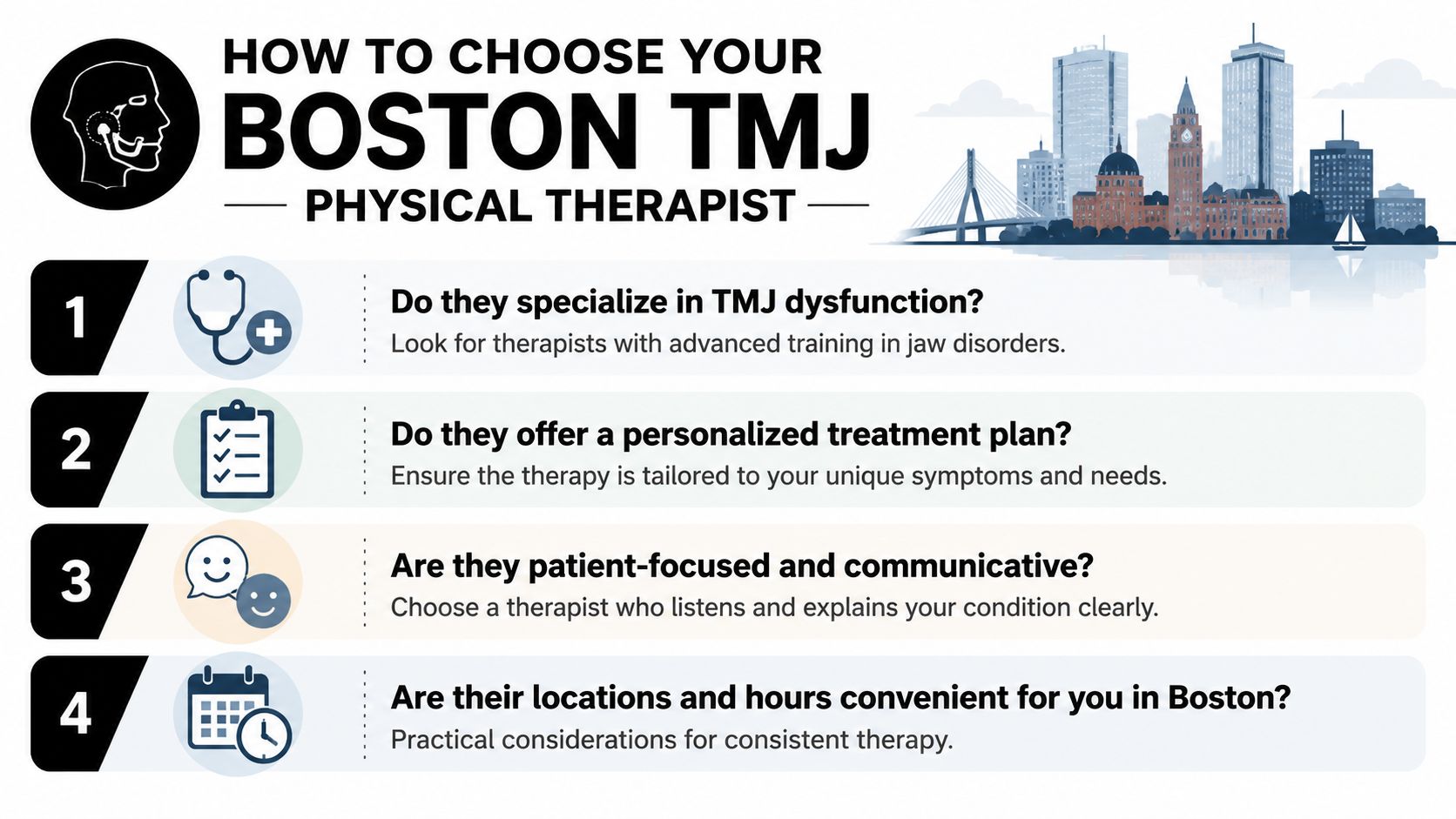
If you're comparing providers, don't just search “TMJ physical therapy Boston” and pick the closest listing. Jaw pain is too nuanced for that. You want a therapist who treats the full picture, explains findings clearly, and can build a plan around your workday, commute, and symptom triggers.
Questions worth asking before you book
Use this shortlist when you call or schedule online:
Do they treat TMJ regularly
A general orthopedic background helps, but jaw pain benefits from clinicians who are comfortable assessing the jaw, neck, muscle tension, and movement quality together.Will visits be one-on-one
TMJ treatment is hands-on and detail-sensitive. It's harder to get precise care if a therapist is splitting attention.Do they coordinate with dentists or physicians when needed
Some patients benefit from a dental appliance, medical review, or combined care. A good PT should know when to collaborate and when to refer out.Can the schedule fit real Boston life
If getting to care feels impossible, consistency drops. Neighborhood access matters.
What convenience actually means
Convenience isn't only parking or transit. It means you can get to appointments from work in Back Bay, from an apartment near Kenmore, or from a Seaport office without turning treatment into another stressor. It also means having support with practical questions like insurance verification and authorizations so you're not stuck figuring everything out yourself.
If you're comparing hands-on care models more broadly, this guide on how to find local osteopathic care is useful because it highlights the same core idea patients should use across disciplines. Look for clear communication, local access, and a provider who explains their reasoning.
A smart choice usually looks like this
The right clinic should offer:
| What to look for | Why it matters |
|---|---|
| TMJ-specific clinical experience | Jaw pain often overlaps with neck pain, headaches, and clenching |
| Personalized planning | A clicking jaw and a locked, painful jaw are not the same case |
| Strong communication | You should understand what's being treated and why |
| Convenient Boston locations and hours | Consistency is easier when care fits your actual week |
A lot of patients wait too long because they assume all PT will be the same. It won't. The difference usually shows up in the evaluation quality, the attention to the neck and posture, and whether the therapist can translate findings into a plan you can realistically follow.
Start Your Path to TMJ Relief at Joint Ventures Today
You finish a workday in Boston with a tight jaw, a headache behind the eyes, and that familiar feeling that chewing dinner is going to be annoying again. By that point, jaw pain is no longer a small issue. It is affecting how you eat, work, sleep, and get through the week.
The next useful step is a skilled evaluation. In clinic, I often see patients who have spent months trying to work around the problem by avoiding certain foods, stretching at random, or hoping the clicking will settle down on its own. Sometimes symptoms do calm down for a bit. Just as often, the pattern keeps returning because no one has looked closely at the jaw, neck, posture, and daily habits together.
That matters in Boston, where long desk hours, laptop posture, commuting, and stress tend to pile onto the same system. Good TMJ care should fit real life. You need a plan that makes sense if you work in the Seaport, live near Brookline, or are trying to squeeze appointments between meetings and the T.
For many patients, booking the first visit is the hardest part. After that, things usually get clearer quickly. You find out what is driving the pain, what is likely aggravating it, and which next steps are worth your time.
If jaw pain is interfering with meals, work, sleep, or training, book an appointment with Joint Ventures Physical Therapy. With convenient Greater Boston locations, one-on-one care, and a practical approach to TMJ treatment, it is a straightforward place to start getting answers and building a plan for relief.