
A dizzy spell in Boston rarely happens at a convenient time. It hits on the Green Line when the car lurches, halfway through a run along the Charles, or when you turn your head crossing Commonwealth Avenue and suddenly feel like the ground shifted.
For a lot of active people, that first reaction is confusion. Maybe it's stress. Maybe you stood up too fast. Maybe it'll pass. Sometimes it does. Sometimes it keeps showing up when you roll in bed, look up at a shelf, walk through a busy station, or try to get back to workouts.
That “off-balance” feeling often has a pattern, and patterns matter. When dizziness is tied to head motion, position changes, visual overload, or balance loss, vestibular therapy Boston patients receive is often the most direct way to figure out what's going on and start treating it.
That Sudden Dizzy Spell in Boston and What It Means
A common story goes like this. You're heading down stairs at Park Street, someone cuts in front of you, you turn your head quickly, and your body doesn't feel caught up to the environment. It may last seconds. It may leave you unsettled for hours.
For runners, the moment can show up differently. You finish an easy loop by the Charles, stop, turn, and feel a quick surge of spinning or a strange floating sensation. For parents, it might happen when lifting a child, looking down, then back up fast. For commuters, fluorescent lights, escalators, and crowds can make everything worse.
What that feeling often points to
Dizziness isn't one thing. Some people mean spinning. Others mean lightheadedness, visual blurring, nausea, or a sense that they're drifting when they walk. In practice, the details matter more than the label.
A vestibular problem usually involves how your brain is processing information from the inner ear, eyes, and body. If one part of that system is off, your brain starts getting mixed messages. That's when turning in bed, scanning a grocery aisle, or walking on uneven Beacon Hill sidewalks can suddenly feel difficult.
The symptom may feel vague. The cause often isn't.
Sometimes the issue is positional vertigo such as BPPV. Sometimes it's post-concussion dizziness, migraine-related dizziness, or a balance problem that became obvious only after an illness or a fall. If you want a local primer on one of the most common causes of spinning, this guide on how to treat vertigo is a helpful place to start.
Why people wait too long
Many Bostonians try to push through dizziness because they're busy and functioning “well enough.” That usually works poorly. Avoiding head turns, skipping workouts, gripping railings, or moving cautiously can reduce symptoms in the moment, but it doesn't solve the problem.
If your symptoms seem tied to migraine triggers such as light sensitivity or visual strain, some people also explore tools like precision-tinted lenses for relief alongside medical and therapy-based care. That doesn't replace an evaluation, but it can help some people understand how visual triggers fit into the bigger picture.
What Is Vestibular Therapy Really?
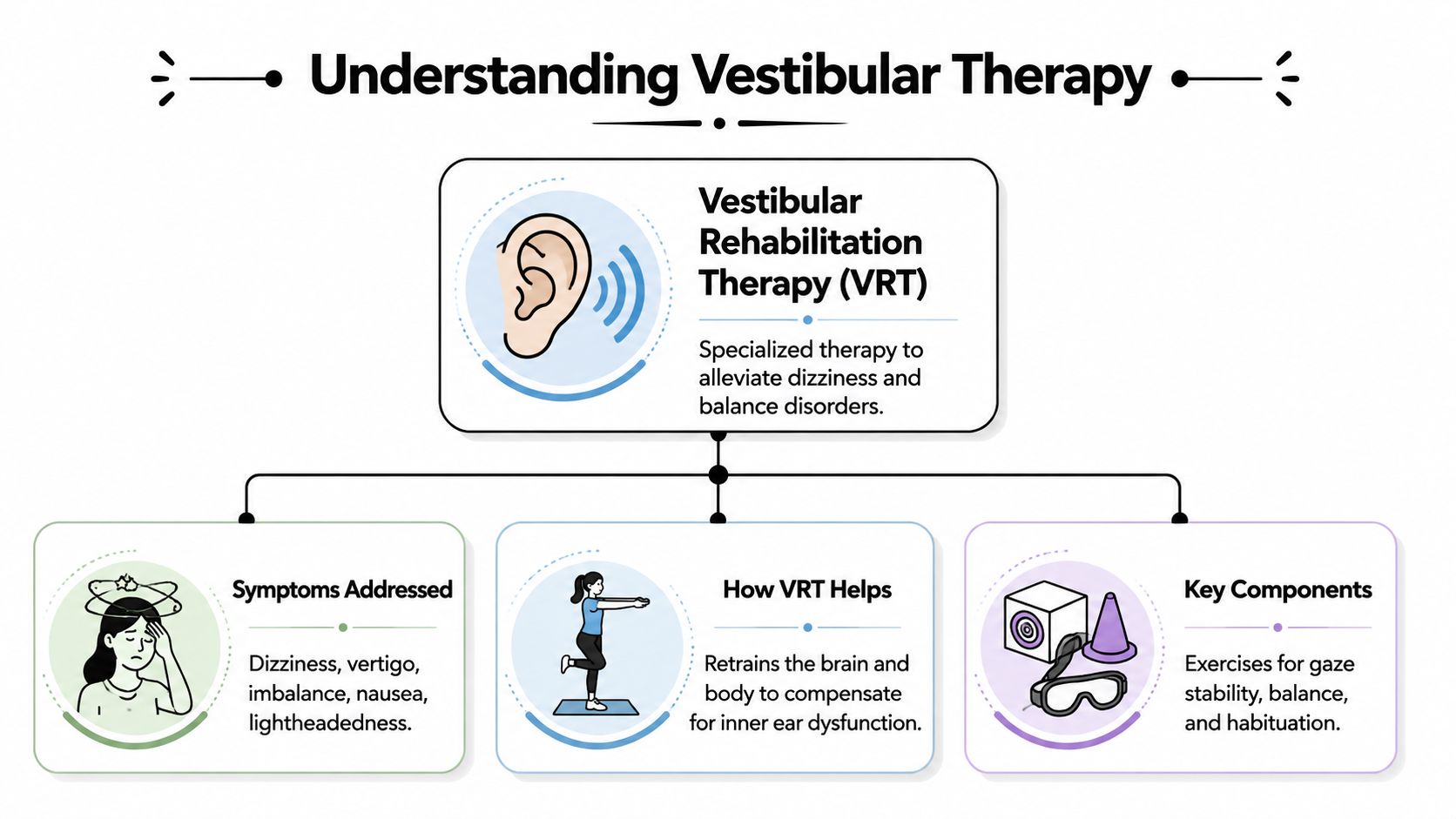
Vestibular rehabilitation therapy, usually shortened to VRT, is a targeted form of physical therapy for dizziness, vertigo, motion sensitivity, and balance problems. The simplest way to think about it is this. It retrains your brain's internal GPS when the signals coming from the inner ear system aren't being interpreted well.
Boston-area vestibular providers describe VRT as a structured, individualized plan built after a vestibular evaluation, using exercises such as habituation, gaze stabilization, balance retraining, visual tracking, and repositioning maneuvers to drive central compensation when the vestibular system isn't accurately signaling head motion, as described by Boston PT and Wellness.
It's not generic exercise
That distinction matters. Vestibular rehab is not a sheet of random balance drills and a suggestion to “be careful.” The right program is built around what provokes your symptoms and what your nervous system needs to relearn.
That may include:
- Habituation work for movements that trigger symptoms repeatedly
- Gaze stabilization if your vision blurs or bounces when your head moves
- Balance retraining if standing, walking, or changing surfaces feels unstable
- Repositioning maneuvers when the issue is positional vertigo such as BPPV
If you want a deeper local explainer on the treatment model itself, what vestibular rehabilitation therapy is gives a clear overview.
Conditions that often respond
People usually arrive thinking they have “vertigo,” but several different conditions can sit underneath that word.
Some of the patterns therapists commonly sort through include:
| Problem pattern | What people often notice |
|---|---|
| BPPV | Short spinning episodes with rolling in bed, lying down, or looking up |
| Unilateral vestibular disorders | Feeling pulled to one side, visual instability, worse symptoms with quick head turns |
| Post-concussion dizziness | Motion sensitivity, visual overload, trouble in busy environments |
| Migraine-related dizziness | Symptoms tied to light, visual motion, stress, sleep disruption, or head movement |
| Age-related balance decline | Less confidence on stairs, uneven ground, or in low-light settings |
Good vestibular therapy doesn't chase symptoms blindly. It matches treatment to the diagnosis.
Your First Vestibular Evaluation at Joint Ventures
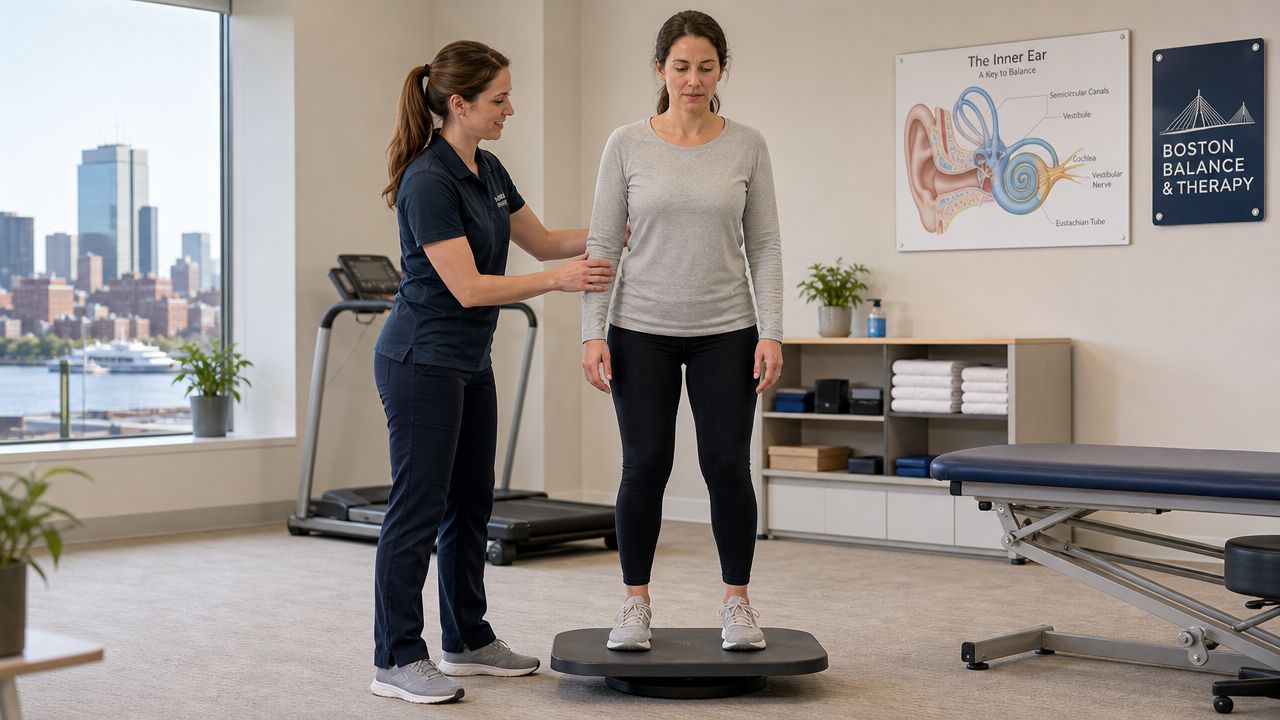
Patients often feel nervous before the first visit because they're worried they'll be made more dizzy. A proper evaluation is deliberate. The goal isn't to flare you up for no reason. The goal is to identify the exact pattern behind your symptoms.
Historically, vestibular PT has been underused even for common conditions. In a study of ambulatory care visits, PT referrals for BPPV rose to 12.9% by 2015, which still shows many people with a treatable cause of vertigo never reached vestibular rehab in the first place, according to this PubMed study on vestibular PT referral patterns.
What happens in the appointment
The first part is a conversation, but a very specific one. A vestibular therapist wants to know what your dizziness feels like, what triggers it, how long it lasts, whether you've had falls, whether visual environments bother you, and whether the problem shows up in familiar Boston situations such as stairs, crowded transit, cobblestones, winter sidewalks, or quick head turns while driving.
Then the exam starts to narrow things down. Depending on your history, that can include:
- Positional testing if symptoms happen with lying down, rolling, or looking up
- Eye movement testing to see how your visual and vestibular systems are coordinating
- Balance testing in standing and walking
- Gait assessment to watch what happens when you turn, speed up, slow down, or dual-task
- Motion sensitivity screening if symptom provocation is part of the picture
What a skilled evaluation is trying to answer
The key question isn't just “Are you dizzy?” It's “Why are you dizzy, and which system is driving it?”
That difference changes everything. BPPV may respond to a repositioning maneuver. Post-concussion symptoms may need visual and vestibular progression. Migraine-related dizziness often requires a different pacing strategy. Balance loss in an active older adult may need a heavier emphasis on gait and fall-risk reduction.
A short demonstration can help you see what vestibular treatment can look like in practice:
Practical rule: The first visit should leave you with a working explanation, not just a list of symptoms.
The Building Blocks of Your Recovery Plan
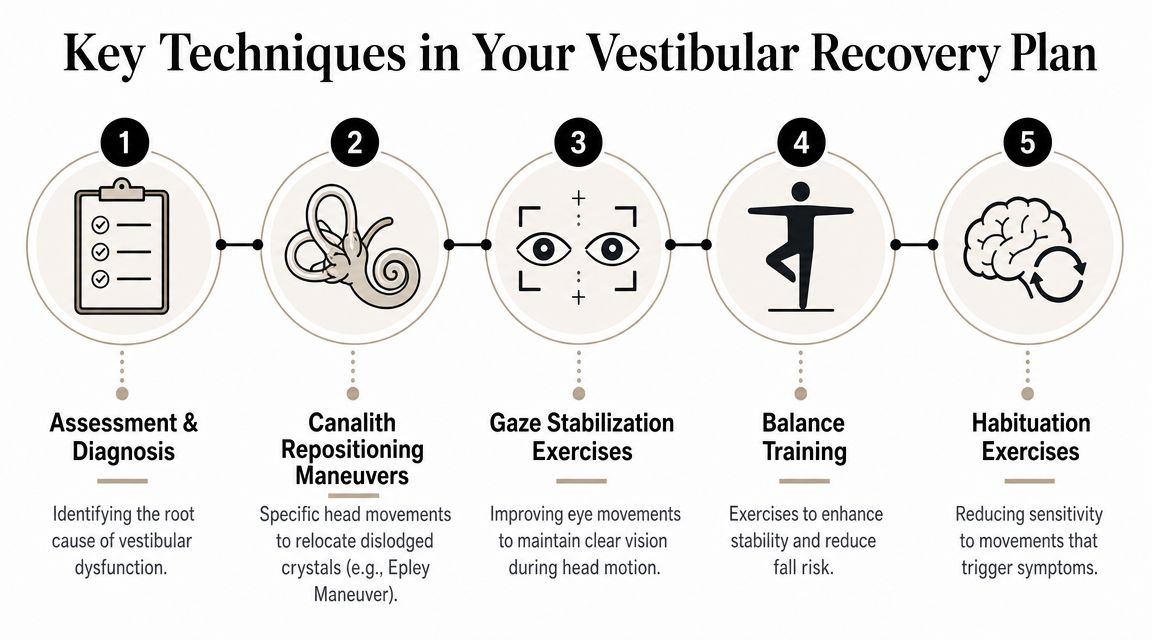
Treatment works best when every exercise has a job. If you don't know why you're doing something, adherence drops fast. In vestibular rehab, the exercise should map clearly to a real-world problem you want to solve.
Repositioning for BPPV
If you have BPPV, treatment is often very different from general balance training. The issue is positional, so the fix is positional. A therapist uses a canalith repositioning maneuver to move the problem particles in the inner ear back where they belong.
That's why doing random strengthening for positional vertigo usually misses the mark. If rolling to the right in bed triggers the room to spin, you need the right maneuver, not a month of vague exercises. For more on that pattern, BPPV exercises and treatment options can help you understand what therapists are targeting.
Gaze stabilization for visual clarity
Many people say, “I'm okay until I move my head.” That often points to a gaze stability problem. The exercise looks simple. Your eyes stay locked on a target while your head moves. The challenge is dose, speed, position, and progression.
In daily Boston life, that can mean being able to:
- Scan traffic safely while crossing a busy intersection
- Read signs on the move in South Station or on the T
- Turn your head while running without the world lagging behind you
Habituation and balance training
Some dizziness isn't caused by a crystal problem. It's caused by overreaction to movement, busy visual environments, or loss of confidence after symptoms started. That's where habituation and dynamic balance work matter.
A good plan might include repeated exposure to symptom-provoking motions in controlled amounts, then progress into more complex tasks. The point is not to overwhelm you. The point is to teach your system that these movements are safe and manageable again.
Exercises should feel targeted. They shouldn't feel random, passive, or disconnected from how you actually live.
Balance work also gets specific fast. A runner may need single-leg control and head-turn tolerance. An office worker may need confidence on escalators and in open concourses. An older adult may need better stability on stairs, low-light surfaces, and winter sidewalks.
Recovery Timelines and Expected Outcomes
The first question most patients ask is fair. How long will this take?
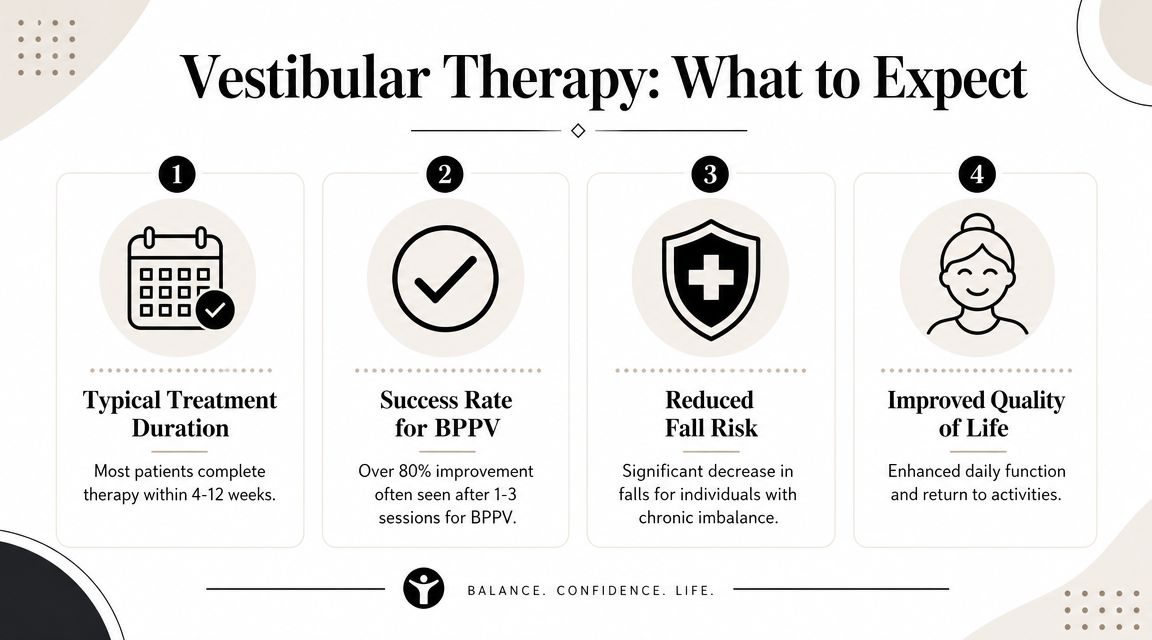
For many unilateral vestibular disorders, targeted rehabilitation can lead to meaningful improvement in roughly 4 to 6 weeks, and one expert discussion notes that some patients may feel about 50% to 75% recovered in that window, with recovery continuing after that. The same discussion reports that success rates for vertigo and balance disorder rehabilitation can be as high as 90% when specific techniques are applied correctly, as noted in this vestibular rehab expert discussion on YouTube.
What affects speed of recovery
Not every diagnosis follows the same timeline. BPPV can move quickly once correctly identified. A more complex presentation, such as post-concussion dizziness or migraine-related motion sensitivity, usually needs more reassessment and pacing.
A few factors tend to shape progress:
- Accuracy of diagnosis because the wrong plan wastes time
- Consistency with home exercises because vestibular rehab depends on repetition
- How long symptoms have been present because compensation can get harder after long avoidance
- Whether symptoms are triggered by multiple systems such as vision, motion, and balance all at once
What helps and what usually doesn't
People tend to improve faster when they stay engaged with the home program and let the plan evolve as symptoms change. Vestibular rehab is active care. It asks your nervous system to adapt.
What usually works poorly is waiting for dizziness to disappear on its own while avoiding every trigger. That often shrinks your world. You stop looking up, stop turning quickly, stop going to the gym, stop using transit comfortably, and start reinforcing the problem.
Recovery is often less about resting forever and more about exposing the right system to the right challenge at the right dose.
Why Bostonians Choose Joint Ventures for Balance Therapy
A lot of Boston patients come in after trying to push through symptoms for weeks. They are still taking the Red Line to work, still trying to get through a grocery store in Back Bay, still hoping the dizziness will settle down on its own. By the time they call, they usually want two things. A clear plan and a clinic that makes treatment realistic to stick with.
Boston has no shortage of vestibular providers. Large hospital systems and specialty rehab groups offer balance care across the region, as reflected by Northeast Rehabilitation's vestibular services overview. That gives patients real choice. It also means the biggest difference is often not whether vestibular therapy exists nearby, but how the care is delivered once you start.
The care model matters more than people expect
Vestibular rehab works best when treatment changes with your response. If turning your head is easier this week but busy visual environments still set you off, the plan should reflect that. If your dizziness shows up on the T but not during a walk along the Charles, that matters too.
Short, standardized visits can miss those details. One practical issue behind that is treatment structure. A payer document used in the Boston market notes that initial authorization is commonly 4 weeks with reassessment at 4 weeks, and it also references follow-up vestibular sessions that are typically 30 minutes long, according to Blue Cross Blue Shield of Massachusetts vestibular rehab guidance. That setup can work in some clinics. It can also leave less room for the close observation and exercise adjustment vestibular patients often need.
At Joint Ventures Physical Therapy, patients receive one-on-one PT and OT care across Greater Boston, including vestibular and balance treatment, with administrative support that helps patients handle insurance and authorizations. For this kind of problem, that structure matters. Symptoms are often provoked by motion, visual load, fatigue, and pacing errors, so the therapist needs enough time to see the pattern and adjust it.
What active Boston patients usually care about
Boston patients usually ask practical questions first.
| What patients ask | Why it matters |
|---|---|
| Will I work one-on-one with the therapist? | Vestibular symptoms can shift quickly, and real-time changes in exercise dose often improve tolerance |
| Can I get to the clinic easily from work or home? | Access affects whether you actually show up consistently |
| Will someone help me understand insurance and authorization? | Administrative delays can slow the start of care |
| Will treatment connect to my actual routine? | Home exercises are easier to follow when they match real triggers, like commuting, fitness, or crowded environments |
That last point gets overlooked. Good vestibular therapy for a Boston patient should relate to your life here. A student may need to tolerate lecture halls and fast head turns crossing Commonwealth Avenue. A runner may need to get back to the Esplanade without feeling thrown off by motion or visual flow. An older adult may care less about gym performance and more about feeling steady on uneven sidewalks in winter.
Why the local setup makes a difference
Location is not a side issue in Boston. It affects follow-through.
If you live or work near Back Bay, Kenmore Square, Fort Point, Seaport, Downtown, Brookline, or Allston, a clinic that fits your route makes it easier to come in before work, after class, or between meetings. That consistency matters because missed visits and long gaps can slow progress, especially when the home program needs updating based on your response.
For many patients here, the essential comparison is between care that adapts to the way they live and care that stays too generic. Joint Ventures stands out for people who want close attention, practical scheduling, and a treatment plan built around real Boston movement demands, not just a handout of exercises.
Your Vestibular Therapy Questions Answered
How do I know if my dizziness is BPPV or something else
You usually can't tell just from the word “dizzy.” BPPV often has a very positional pattern, while migraine-related dizziness, post-concussion symptoms, and other vestibular issues behave differently. That's why the diagnosis matters so much.
Boston vestibular providers frequently list several diagnoses on their service pages, but they rarely explain prognosis in detail. As Spaulding's balance and vestibular page makes clear, vestibular rehab is not one-size-fits-all, and treatment for BPPV is very different from treatment for migraine-related dizziness or post-concussion symptoms. A specialized evaluation is what clarifies which path makes sense for you, as outlined by Spaulding Rehabilitation's balance and vestibular program.
Should I see a physical therapist or my doctor first
If your dizziness is new, severe, clearly worsening, or comes with symptoms outside the usual vestibular picture, start with a physician. If you've already been told the problem may be vertigo, BPPV, dizziness, concussion-related, or balance-related, a vestibular PT evaluation is often the fastest way to sort out the movement side of the problem.
If you aren't sure, call and ask. A good clinic will tell you whether PT is the right first step or whether medical evaluation should happen first.
Is vestibular therapy covered by insurance
Coverage depends on your plan and whether authorization is required. The practical question isn't just “Is it covered?” It's also “How quickly can I get started, and what paperwork will I need?” That's worth clarifying before the first visit so treatment doesn't stall.
Where can I learn more before booking
If you want deeper educational content on dizziness, balance systems, injury recovery, or related rehab topics, visit Highbar Health. That's the right place for broader anatomy and condition education, while local clinic selection and scheduling decisions should stay centered on where you'll receive care in Boston.
If dizziness, vertigo, or balance loss is getting in the way of commuting, training, parenting, or moving through the city with confidence, book an evaluation with Joint Ventures Physical Therapy. A focused vestibular assessment can identify the likely cause, clarify what treatment should look like, and help you get back to your normal Boston routine with a plan that fits your life.