
Boston is full of people who don't treat movement as optional. You run the Esplanade before work, lift in Fenway after class, play in a rec league, train for the Boston Marathon, or try to squeeze golf, tennis, rowing, or strength work into a packed week. Then something starts to bite. A knee that won't settle down on descents. A shoulder that changes your lift. A calf that makes every stride feel cautious.
That moment matters. Active people in this city usually don't want generic advice, and they shouldn't settle for it. Sports physical therapy Boston should help you get out of pain, but it should also protect your training, your routine, and your confidence when you return.
For Boston's Active Population Injury Is A Detour Not A Dead End
A common Boston story starts with a small adjustment. A marathon trainee shortens a long run along the Charles because the hip feels tight. A rower notices the shoulder during catch phase. A young professional who plays pickup basketball tells himself the ankle just needs a few days. Then the compensation starts. Pace changes. Sleep gets worse. Lifting mechanics get sloppy. You stop trusting the movement that used to feel automatic.
That doesn't mean you're done with the sport. It means you need a more precise plan.

Why Boston athletes need more than rest
Rest has a role. So does modifying load for a short window. What usually fails is the middle ground where people try to "be smart" but keep training around the problem without figuring out why it started.
In Boston, that shows up in predictable ways:
- Runners keep mileage on the schedule: They drop speedwork but keep enough volume to irritate the same tissue.
- Students and club athletes push through: The season, semester, or tryout calendar doesn't wait.
- Desk workers stay active after work: They spend all day in one position, then ask a stiff body to perform at a high level at night.
Sports rehab works best when the plan matches the sport, the season, and the person's actual schedule.
That's where sports PT becomes a performance decision, not just a recovery decision. A good clinic looks at how you load, where your movement breaks down, and what return-to-sport really means for you. For one person, that's getting through Heartbreak Hill training without changing stride. For another, it's swinging a club without shoulder pain. For swimmers tracking sessions closely, tools matter too, and this expert guide to swimming Garmins is a useful example of how athletes use data to guide training decisions outside the clinic.
What motivated athletes usually get wrong
Most active adults wait too long because the issue still feels manageable. That's the trap. If you're changing your gait, cutting depth in the squat, avoiding overhead work, or skipping harder efforts because something feels off, performance has already changed.
Sports physical therapy Boston is most useful when it catches the problem before it becomes a longer layoff. The right plan keeps you connected to training while cleaning up what the injury exposed.
What Sports Physical Therapy In Boston Actually Treats
Many assume "sports PT" is reserved exclusively for collegiate athletes or post-surgical rehabilitation. In Boston, that perspective misses the full picture. The patient mix is broader. Marathon runners, CrossFit members, university athletes, recreational tennis players, dancers, skiers, golfers, and desk workers who train hard all need the same thing. A clinician who can tie pain back to movement, load, and sport demands.
Boston also has a deep talent pool. The local market includes over 3,500 listed positions, and physical therapists in Massachusetts have median salaries ranging from $98,000 to $105,000, which helps attract experienced clinicians and supports the strong 1-on-1 care models many active patients look for, according to Indeed job market data for sports physical therapists in Boston.
For runners and endurance athletes
If you're training for a spring race, building mileage on the Charles, or trying to stay durable through winter treadmill blocks, the same issues come up again and again. The label matters less than the pattern.
Common examples include:
- Knee pain during mileage build: Often tied to load tolerance, hip control, cadence, or a recent training jump.
- Shin and calf irritation: Usually aggravated by ramping volume too fast, changing surfaces, or carrying stiffness into harder workouts.
- Lateral hip or IT band complaints: These often look like "tightness" but behave more like a loading problem.
- Foot and ankle pain: Stride mechanics, shoe choice, and tissue capacity all need a closer look in these cases.
If that's your lane, this Boston runner physical therapy guide gives a more local view of how treatment should fit marathon prep and city training routes.
For student athletes and gym-based athletes
Boston's universities create a constant stream of overuse and contact-related injuries. Baseball and softball athletes deal with shoulder and elbow problems. Lifters run into low back, hip, and shoulder limitations. Court and field athletes deal with ankle sprains, knee issues, and return-to-play questions.
A sports PT evaluation should sort out whether you're dealing with pain from tissue overload, a mobility restriction, a force-production issue, or poor movement sequencing. Gymnasts and bar athletes also bring hand and grip problems into this conversation. Outside the clinic, this guide on ways to prevent hand rips on bars is a practical resource for reducing one very specific training interruption.
For active professionals
Not every sports injury starts in sport. A lot of them start with the Boston workday. Long laptop hours, train commutes, stress, and poor recovery habits can set up the shoulder, neck, back, wrist, or hip to get irritated when training resumes.
Practical rule: If work posture changes how you train, then your rehab plan has to address both.
Sports PT often treats the person whose body is getting mixed signals. Sedentary all day, then explosive at night. That's why a good plan doesn't stop at the painful area. It looks at what your week is asking your body to do.
Your Return To Sport Timeline A Look At Phased Recovery
You tweak a knee playing in a weekend soccer league, or your shoulder flares halfway through a spring rowing block on the Charles. Your first question usually is not "What exercise do I do?" It is "When can I train hard again, and will I trust the area when I do?"
That answer should come from a phased plan with clear benchmarks. In Boston, that matters because athletes are rarely training for nothing. There is a race calendar, a club season, a rec league playoff, or a return to lifting before ski season. Good sports physical therapy sets the recovery path around those demands, then adjusts it as your body proves it can handle more.
ACL rehab shows this process well. Mass General's sports physical therapy protocols lay out staged progressions tied to function, strength, and movement quality instead of pain alone. The same principle applies to ankle sprains, throwing injuries, hamstring strains, and post-op shoulders. If you want a broader look at how that process works in practice, this guide to sports rehab in Boston for active adults and athletes is a useful reference.
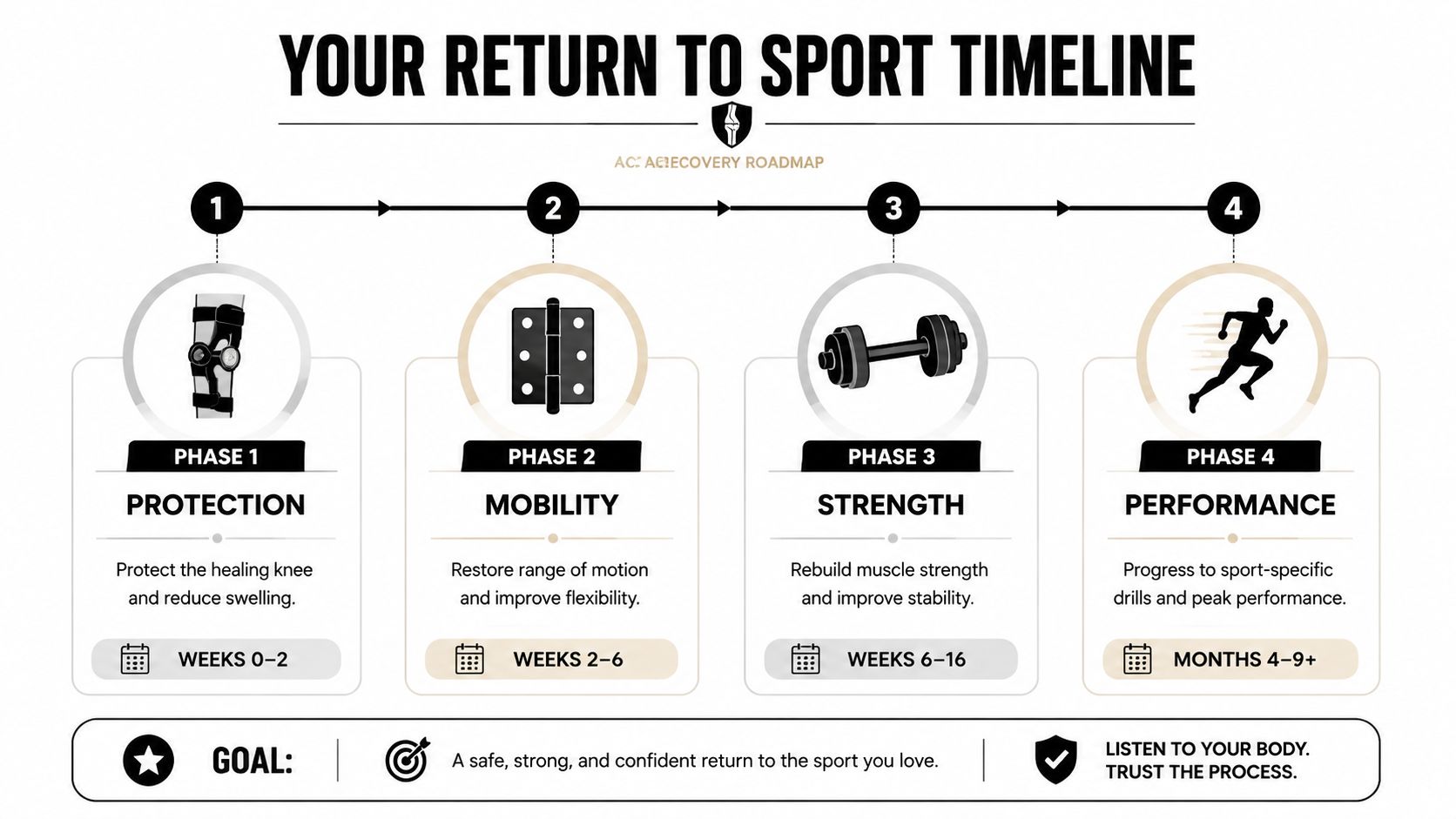
Phase one protects the joint and calms the system
Early rehab is simple on paper and easy to get wrong. The job is to reduce swelling, settle pain, restore basic motion, and load the area enough to prevent deconditioning without irritating healing tissue.
For post-op knees, the Mass General protocol starts with bracing and protection in the first several weeks. For non-surgical injuries, the trade-off is similar. Do too little, and strength and confidence drop fast. Push too hard, and the joint stays angry longer than it should.
This stage often feels slow. It should still be active.
Phase two restores motion and normal movement options
Once symptoms settle and the tissue can tolerate more load, the focus shifts to range of motion, gait, balance, and control. Athletes often get impatient at this stage. They want squats, sprints, and heavy work back on day one, but a stiff ankle, guarded knee, or shoulder that cannot move cleanly will distort everything that comes after it.
A solid clinic measures this phase instead of guessing. The same Mass General framework uses objective testing such as symmetry and landing mechanics to judge whether movement quality is returning. In practice, that means you should know what has improved, what is still limited, and what standard you need to hit before training gets more aggressive.
Phase three rebuilds strength that transfers to sport
Pain relief is a poor clearing test.
An athlete can feel much better and still be underprepared for cutting, decelerating, sprinting, or repeated lifting. This phase is where sports physical therapy becomes a performance advantage. Strength work has to match the demands of the sport, not just check a box in the clinic.
A runner needs single-leg capacity and stiffness control. A hockey or soccer athlete needs force acceptance and lateral stability. A baseball or tennis athlete needs trunk control that lets power move cleanly from the ground up. In Boston, I also look closely at whether the athlete's plan fits their real return target. Finishing a few easy miles along the Esplanade is different from being ready for hard downhill work before the Marathon. Returning to upper-body lifts is different from handling contact or repeated overhead volume.
| Rehab focus | What it should restore |
|---|---|
| Squat and hinge patterns | Controlled loading through hip and knee |
| Single-leg work | Balance, stability, and side-to-side confidence |
| Rate of force production | Readiness for faster, more explosive demands |
| Trunk and pelvic control | Better transfer into cutting, sprinting, and lifting |
Phase four earns the return
The final phase should resemble the sport closely enough that the athlete is no longer guessing. Running progressions, cutting drills, deceleration work, overhead loading, rotational power, and contact preparation all belong here when they match the sport.
The same protocol noted earlier introduces plyometric work later in the progression, after the earlier pieces are in place. That sequence matters. Skipping ahead can make an athlete feel ready for one good session, then expose the gap the moment fatigue, speed, or competition enters the picture.
Return to sport is not a date on a calendar. It is a set of proven capacities. A good sports PT in Boston should be able to tell you what you are cleared for now, what still needs work, and how to build back in a way that leaves you stronger than before the injury.
Go Beyond Rehab With Specialized Services For Boston Athletes
Standard rehab can get you out of the red. Specialized services help you move better when you're back in training. For active Bostonians, that's often the difference between returning to the same cycle and returning with a real edge.
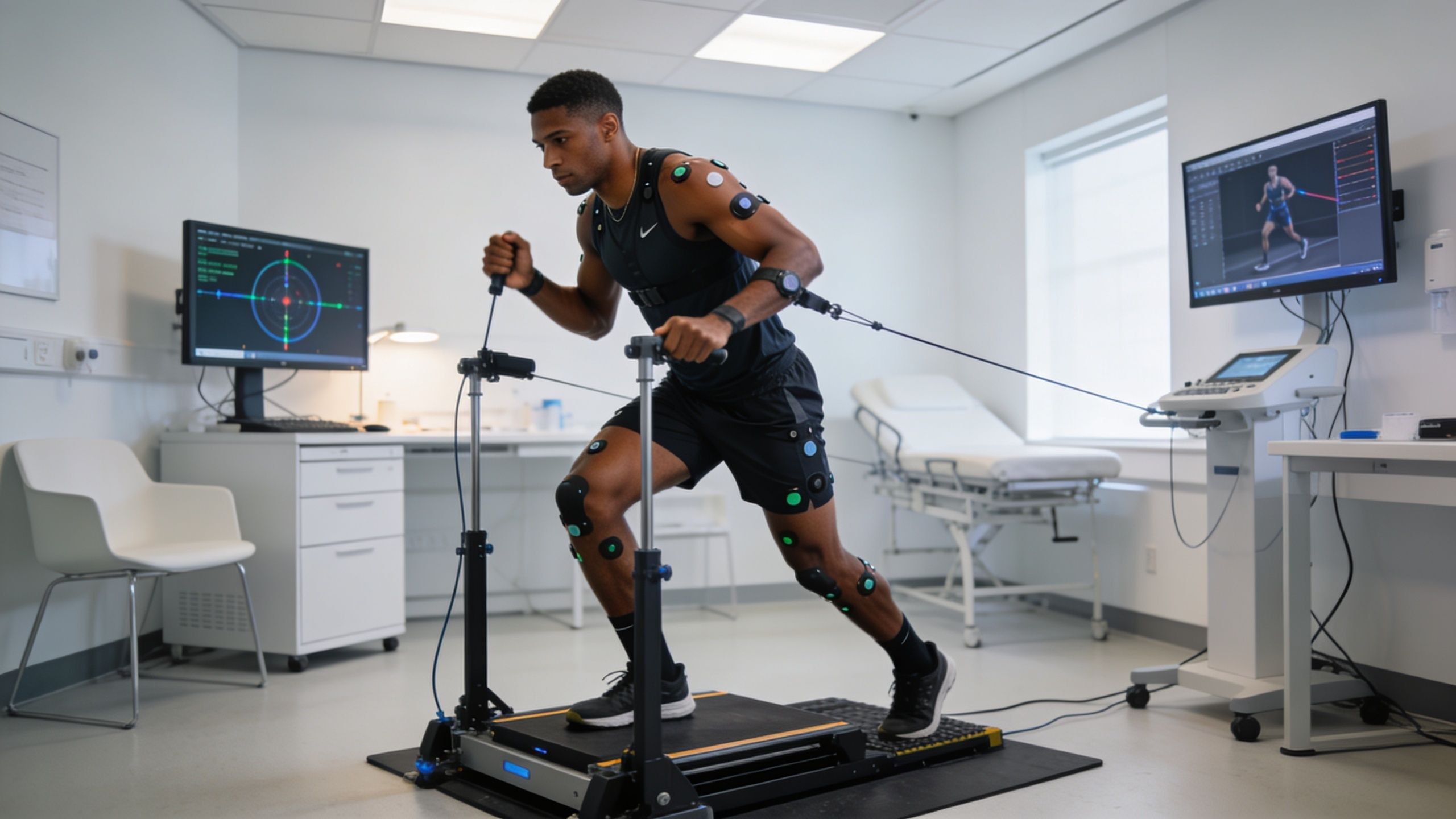
A runner doesn't just need a quiet knee. They need a stride that can hold up through Beacon Hill slopes, winter stiffness, and race-specific workouts. A golfer doesn't just need shoulder relief. They need rotation, control, and a swing they can trust over multiple rounds. That's why performance-focused services matter in sports physical therapy Boston.
Running evaluations and golf performance work
Running Performance Evaluations are useful when the same issue keeps coming back or pace falls off every time training climbs. You look at loading patterns, single-leg control, mobility where it matters most, and whether the athlete's current mechanics match the demands of the plan.
Titleist Performance Institute evaluations serve a different athlete, but the same logic applies. Golf exposes rotation limits, sequencing problems, and asymmetries that don't always show up in general strength training. If the body can't organize force well, the swing becomes the place where compensation shows up.
For a more local look at return-to-play planning and athlete-specific care, this sports rehab Boston overview is a useful reference.
Dry needling and aquatic therapy have a role when used well
Some services get oversold. These two shouldn't be used as magic tricks, but they can be valuable when matched to the right case.
According to 2025 APTA data, aquatic therapy can reduce recovery time by 28% for lower extremity sports injuries, and trigger point dry needling can decrease pain by 45% in rotator cuff cases among Boston-area athletes, as summarized by Boston PT Wellness.
That doesn't mean every shoulder needs needles or every runner belongs in the pool. It means the tool matters when the problem matches the tool.
Use aquatic therapy when:
- Land loading is too irritable: Water lets athletes keep moving with less stress on the lower extremity.
- Confidence is lagging: Some athletes need a bridge before they're ready for full-impact work.
- Conditioning still matters: You can maintain movement quality while reducing load.
Use dry needling when:
- Muscle guarding is dominating the presentation: It can help reduce reactivity so exercise becomes more productive.
- Pain is blocking useful movement: The goal is to create an opening for better mechanics, not stop at temporary relief.
- It's part of a broader plan: It should sit alongside strength, mobility, and load management.
Later in the process, visual examples can help athletes understand what progressive rehab looks like in the clinic.
What doesn't work
Passive care by itself usually fades fast. If the clinic offers a menu of treatments but can't explain how those services change your return-to-sport plan, the athlete often ends up chasing relief instead of building capacity.
One factual option in Greater Boston is Joint Ventures Physical Therapy, which offers services such as running performance evaluations, Titleist golf evaluations, aquatic therapy, and trigger point dry needling across Boston-area locations. Those tools are most useful when they're tied to clear movement findings and sport goals, not added for novelty.
How To Choose The Right Sports PT Clinic In Boston
Boston gives you options. That's a good thing, but it also means you need a filter. The wrong clinic can turn a straightforward injury into months of partial progress. The right one should feel organized, individualized, and clear about what success looks like.
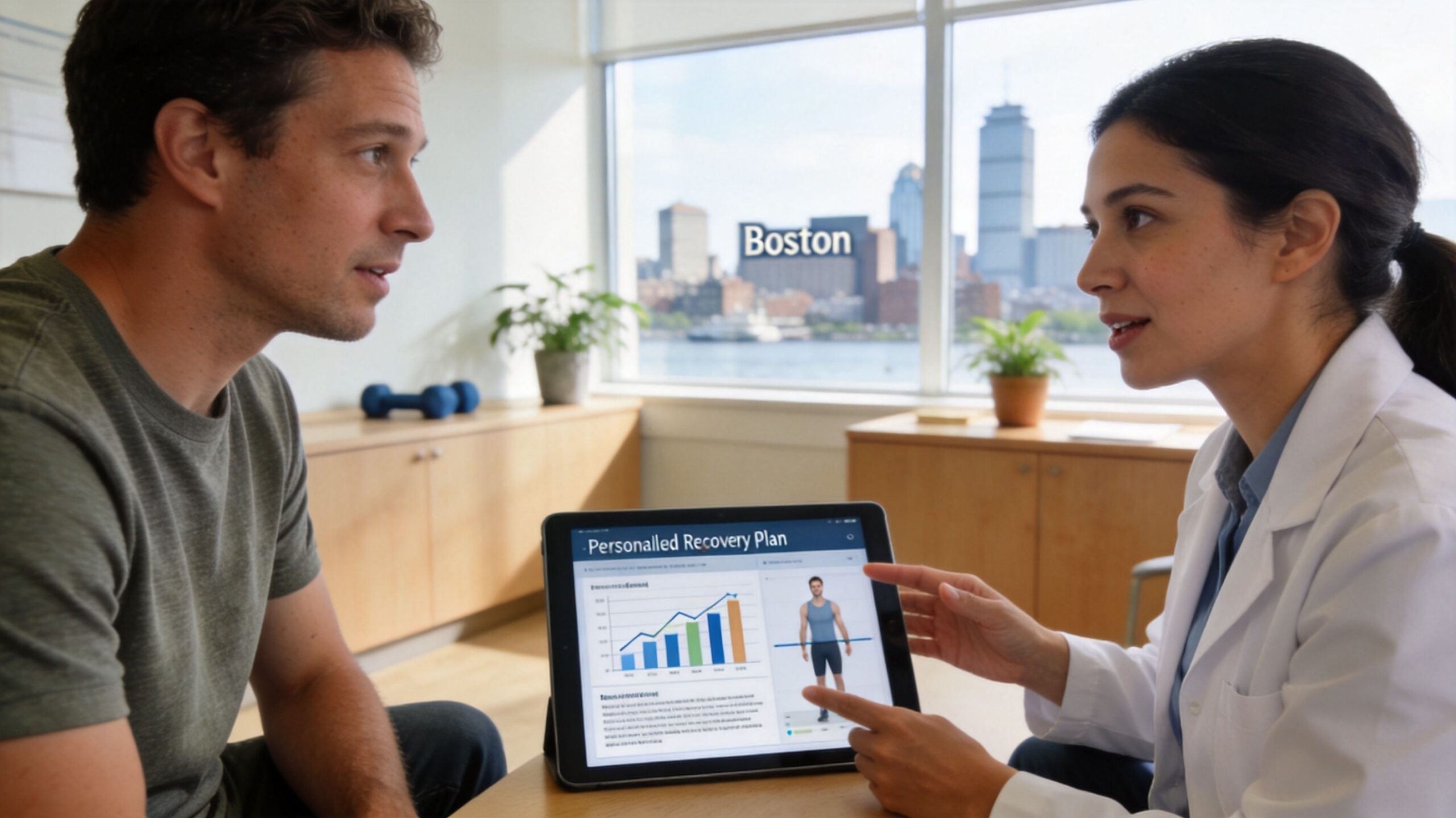
Ask how they measure progress
If a clinic can't tell you how it tracks outcomes, that's a problem. Top Boston clinics have moved toward more data-informed care.
At BU's Physical Therapy Center, the Rehab Outcomes Management System analyzes outcomes from thousands of cases to predict recovery. For rotator cuff tendonitis, the baseline success rate is 70%, and that rises to 77% with an average of seven visits, according to BU Sargent's report on ROMS and big data in rehab.
That doesn't mean every clinic needs the same software. It does mean you should expect a plan with measurable checkpoints.
Look for signs of a high-quality model
A useful screening checklist is simple:
- 1-on-1 treatment time: Ask whether you're with the same licensed clinician for the full visit.
- Sport-specific reasoning: The plan should reflect whether you're a runner, lifter, golfer, rower, or field athlete.
- Clear progression criteria: You should know what has to improve before activity advances.
- Relevant specialty services: Dry needling, aquatic therapy, vestibular care, hand therapy, or golf evaluations only matter if they fit your case.
- Communication that makes sense: If the explanation is fuzzy, the treatment usually is too.
If every patient seems to get the same exercise sheet and the same timeline, you aren't in sports rehab. You're in a volume model.
What to ask on the first phone call
You can learn a lot before you even book. Ask:
- Will I have uninterrupted time with one therapist?
- Do you treat my sport or activity regularly?
- How do you decide when I'm ready to return?
- If I need a specialized service, do you offer it in-house or refer out?
Good answers are specific. Vague answers usually predict vague care.
Your First Appointment Logistics Insurance and Preparation
A lot of people delay booking because the admin side feels annoying. It doesn't have to be. The first step is usually simpler than patients expect.
What to handle before you walk in
Start with the practical pieces:
- Insurance verification: Ask the clinic to check benefits before the first visit so you know what your plan requires.
- Referral questions: If you're unsure whether you need one, ask directly when you schedule.
- Medical records: Bring imaging reports, surgical paperwork, or prior notes if you have them.
If you want a quick checklist before day one, this guide on how to prepare for your first physical therapy appointment covers the basics in a patient-friendly format.
What to wear and expect
Wear clothing you can move in and that gives access to the area being evaluated. Shorts help for knee, hip, or ankle issues. A tank top or loose shirt helps for shoulder and neck problems. Bring your running shoes if the issue shows up while running, and bring anything specific to the activity if the therapist needs to see it.
The first visit should leave you with three things:
- A working explanation: Not just where it hurts, but why it's behaving that way.
- An early treatment plan: What you'll do in clinic and what changes between visits.
- A realistic next step: Whether that's keeping some training, modifying it, or pausing a specific demand.
Massachusetts patients often ask about direct access and referrals. The exact insurance requirement can vary, so it makes sense to confirm that with the clinic when you schedule rather than assume.
Start Your Recovery At Joint Ventures And Boston PT FAQs
You tweak a hamstring on a Charles River run, or your shoulder starts barking halfway through a lifting cycle, and the question is not whether you can get rid of pain. The key question is whether your plan gets you back to training with better capacity than you had before.
That is the standard active people in Boston should expect from sports physical therapy. Care needs to fit early meetings, class schedules, commuting, and training blocks. It also needs to match the demands of the city's athletes and active professionals, from marathon runners and rec league players to college athletes and golfers trying to hold onto club speed through a busy work season.
Joint Ventures has locations across Boston, including Back Bay, Kenmore Square, Fort Point and Seaport, Downtown Boston, and nearby neighborhoods. Access matters because missed visits and rushed scheduling can slow progress, especially when treatment depends on timely load changes, strength work, running analysis, or sport-specific progression. Convenience alone is not enough, but it does affect results.
A good clinic should also offer more than generic rehab. For Boston athletes, that can mean return-to-run planning before the B.A.A. season picks up, golf-focused care that includes TPI or Titleist-informed movement assessment, dry needling when it fits the case, and treatment that respects both tissue healing and performance goals.
Boston PT FAQs
What's the difference between sports PT and general orthopedic PT?
Sports physical therapy treats the injury and the activity that exposes it. The endpoint is not only less pain during daily life. The endpoint is getting back to sprinting, lifting, cutting, rotating, rowing, or running with enough strength and control to stay there.
How long is a typical session?
That depends on the clinic model. Ask whether visits are one-on-one, whether you'll work with the same physical therapist each time, and how exercise progressions are handled. Those details affect quality more than the posted visit length.
Can PT help if I'm not a competitive athlete?
Yes. Many patients in Boston are active adults who train before work, play pickup sports, run local races, ski on weekends, or want to keep up with a serious gym routine. You do not need to play for a college or club team to benefit from sports-focused rehab.
Should I wait and see if it calms down on its own?
Sometimes short-term irritation settles with a few smart changes. Repeated pain during the same lift, run, serve, or swing usually needs a closer look. If you keep modifying workouts, losing confidence in a movement, or seeing the problem return every time training volume rises, an evaluation can save time and frustration.
If you're ready to stop guessing and get a plan that fits your training, workday, and Boston routine, book an evaluation with Joint Ventures Physical Therapy.