
If you're training along the Charles, squeezing miles in before work in Back Bay, or building toward a spring race with the Boston Marathon in the background, you probably know this feeling. A little pain starts as an annoyance, then becomes the thing you think about at every stoplight, every hill, every next-day run.
Boston runners are rarely casual about their goals. They want to keep pace with a club workout, stay consistent through a winter build, or make it through a marathon cycle without losing weeks to shin pain, knee symptoms, or a stubborn foot issue. That’s why physical therapy for runners Boston needs to be more specific than generic injury advice. In this city, the standard has to match the training culture.
Running in Boston Is Different
A Boston runner doesn’t just run. They contend with crowded sidewalks, bridge ramps, long stretches on the Esplanade, uneven winter footing, and the pressure of a city that takes running seriously. One week might mean easy miles by the river. The next might include race-specific sessions, commuting on foot, and trying to stay healthy through a demanding work schedule.

That combination matters. Running volume is only part of the load. Terrain, weather, pace expectations, and daily life in Boston all shape what your body has to absorb. When pain shows up, it usually isn't random. It’s often the result of how training stress, mechanics, recovery, and environment stack up over time.
According to Spaulding’s National Running Center, running injuries affect 50-79% of runners yearly, and knee pain, shin splints, and stress fractures make up over 40% of cases. Those numbers hit differently in a city that hosts over 30,000 runners for the Boston Marathon annually, because so many local runners are training with a clear goal on the calendar.
Why local context changes the plan
A runner preparing for a Boston build has different needs than someone jogging a few times a week without a target race. The same shin pain means different things if it appears during marathon mileage, after speed work near the track, or while returning after time off.
Boston also has a long history of runner-focused rehab. Specialized care for runners has been part of this market since Boston Sports Medicine established its rehabilitation center in Brookline in 1999 in collaboration with the Boston Running Center, creating a model built around evaluation, diagnosis, and restoration of running performance for both elite and recreational athletes.
Practical rule: If pain changes your stride, shortens your run, or keeps returning when training picks up, it deserves a runner-specific evaluation, not more guesswork.
A lot of runners try to bargain with the problem first. They reduce mileage for a few days, swap shoes, add random stretches, then test it again. Sometimes that works. Often it doesn't, especially when the underlying driver is movement strategy, strength deficit, or a training pattern that keeps pushing the same tissue over its limit.
If you’re in that cycle, local race demands matter. So does timing. A runner managing symptoms in January with an April goal doesn’t need vague reassurance. They need a clear plan that fits Boston training reality. That’s why many runners start with race-focused guidance like this Boston Marathon physical therapy training resource, then move into a more detailed evaluation when symptoms persist.
Beyond Generic Tips for Running Injuries
Generic running advice usually sounds reasonable. Stretch more. Rest a few days. Buy different shoes. Strengthen your hips. Those ideas aren't always wrong. They’re just incomplete.
What works for runners is rarely a copy-and-paste fix. Two runners can both say, “My knee hurts at mile four,” and need completely different treatment plans. One may be overstriding late in runs. Another may be losing control through the pelvis when fatigue builds. Another may be ramping training too fast for current tissue capacity.
Why internet advice falls short
The internet is full of broad injury checklists and general prevention articles. Some can be useful starting points, including this guide to running injury prevention, but they can't tell you why your pain appears on the river path, during descents, or only after track sessions.
That’s the essential trade-off. Generic advice is convenient, but convenience often costs precision.
A runner-specific PT approach looks at:
- Training load: not just mileage, but workout density, terrain, race timing, and what changed recently
- Movement strategy: how you absorb force, create propulsion, and compensate when fatigue shows up
- Capacity: whether your calves, hips, feet, and trunk can tolerate the demands your training plan creates
- Recovery habits: sleep, nutrition, scheduling, and whether your easy days are easy
Prevention is not just for injured runners
A gap in the Boston market is how rarely clinics explain the value of preventive screening for runners who feel fine. As noted in Wellness in Motion Boston’s gait analysis page, many providers talk about injury recovery, but fewer explain why wellness visits and Running Performance evaluations matter for asymptomatic runners.
That matters because healthy runners often wait until a small issue becomes a training interruption.
Runners usually don't need more information. They need better filtering. The right exam tells you which detail matters and which one doesn't.
A preventive screen can be useful when:
| Runner situation | Why screening helps |
|---|---|
| Building toward a marathon | Identifies movement or strength issues that may matter more as volume rises |
| Returning after a prior injury | Checks whether old compensation patterns are still present |
| Chasing performance goals | Finds inefficiencies that may be limiting speed or durability |
| Balancing work stress and training | Helps adjust load before fatigue turns into pain |
For many Boston runners, the shift is mental as much as physical. PT isn't only a place to go when you’re hurt. It can also be where you refine form, improve efficiency, and stay ahead of the recurring problem that always seems to arrive in the same phase of training.
If you're trying to separate useful form advice from noise, a good next read is this running form article from Joint Ventures, which puts common cues in a practical context.
What to Expect from a Running PT Evaluation
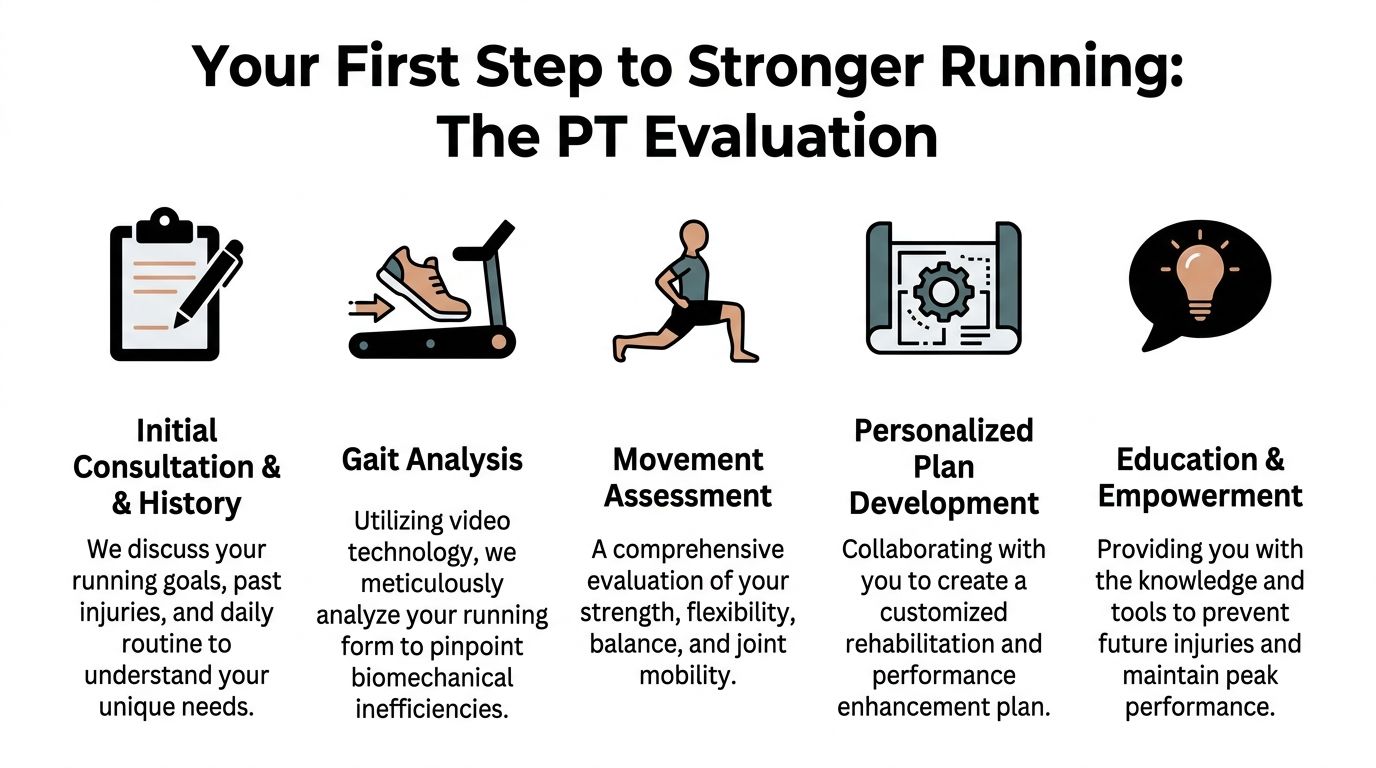
The first visit should feel less like a generic medical appointment and more like a focused performance problem-solving session. Good runner rehab starts by understanding what your body is doing under load, not by handing you a sheet of exercises before anyone watches you move.
A specialized running evaluation can last up to two hours and often includes an instrumented treadmill assessment plus high-speed video gait analysis, according to Spaulding’s running clinic overview. The point isn’t to collect data for its own sake. It’s to figure out why your symptoms keep showing up and what changes are most likely to help.
The conversation comes first
The most useful part of an evaluation often starts before the treadmill. Your PT should ask about:
- Your current training. Weekly structure, workout types, surfaces, shoes, and recent changes.
- Your symptoms. Where they appear, when they start, what makes them worse, and what you've already tried.
- Your goal. Finish a race, qualify, stay active, get back after pregnancy, or run without pain on your mind.
Those details matter because runners don’t just want pain relief. They want a plan that respects their calendar and identity.
Then we look at how you move
A thorough exam should include hands-on testing and movement assessment. Strength, flexibility, alignment, balance, control, and joint mobility all matter, but only in the context of your running.
Common findings may include:
- Loss of control at the hip or trunk, especially when fatigue shows up
- Foot and ankle limitations that change loading through the shin, calf, or knee
- Stride patterns that increase braking or impact
- Cadence issues that may respond to simple cueing
At specialized Boston clinics, gait retraining often targets measurable changes. One example is increasing cadence toward 170-180 steps per minute to reduce impact forces and lower injury risk, as described by Spaulding’s running center in the source above.
What gait analysis actually tells you
Video analysis isn't about making everyone run the same way. It helps connect what you feel with what your body is doing. A runner with chronic shin pain may show excessive loading patterns. A runner with recurring lateral knee symptoms may reveal a pattern that worsens when speed increases. A runner who says, “I only hurt on hills,” may show a form change as incline or fatigue shifts demand.
The best gait analysis answers a practical question: what do we change first that gives the runner the biggest benefit with the least disruption?
That last part matters. Not every visible asymmetry needs correction. Some changes are worth making. Some are just personal style. An experienced PT should know the difference.
You should leave with a direction, not a mystery
By the end of the evaluation, you should understand:
| What you should know after the visit | Why it matters |
|---|---|
| Your likely injury drivers | So treatment targets cause, not just symptoms |
| Which training variables need adjustment | So you can keep moving when appropriate |
| What to strengthen or retrain | So rehab feels specific, not generic |
| Early return-to-run guidance | So you know what “safe progress” looks like |
That clarity is what makes runner-specific PT different. You’re not just told to stop. You’re shown what your system can handle now, what needs to improve, and how to build from there.
How We Help You Recover and Get Stronger
Once the evaluation identifies the problem, treatment should become active, specific, and progressive. Runners usually don't need more passive care alone. They need a plan that reduces irritation while building the strength and mechanics that make the next training block possible.

At this stage, what doesn’t work is important too. Endless rest can make some runners more deconditioned and more frustrated. Random online exercises often miss the actual limiter. Returning to full mileage because pain “seems a little better” is one of the fastest ways to repeat the cycle.
Treatment should match the runner, not the diagnosis alone
Two runners with the same label may need different rehab. One may need calf loading and gait cues. Another may need trunk and hip control. Another may benefit from tissue-specific unloading before rebuilding.
Useful tools in modern runner rehab can include:
- Targeted strength progressions: loading the calf complex, glutes, hamstrings, foot intrinsics, and trunk in ways that transfer to running
- Manual therapy: used to improve comfort or mobility when it helps you move and train better
- Trigger point dry needling: sometimes helpful for reducing irritability in overworked tissues so active rehab becomes more productive
- Movement retraining: drills and cues that change how force travels through the system during stance and push-off
Data can sharpen the plan
At clinics using more advanced performance tools, force dynamometry can track strength imbalances over time, and blood flow restriction training can help some runners gain strength early in rehab with lower loads. According to Elliott Physical Therapy’s runner therapy page, BFR can produce 10-20% greater strength gains than traditional methods in early rehab, and structured return-to-run progressions help reduce the risk that comes with jumping back too quickly.
That kind of objective feedback matters when a runner feels ready before the tissue is ready.
One local option for this type of service is the Running Performance Evaluation at Joint Ventures, which includes gait analysis, corrective exercise planning, video review, and follow-up around running mechanics and injury risk.
Return to running should be built, not guessed
A structured return usually starts with controlled exposure. Elliott’s guidance highlights walk-run intervals as an important starting point rather than an abrupt jump back into normal mileage. That approach is practical because it gives the body repeated, tolerable doses of running load without forcing a full training day before the system is ready.
A useful treatment progression often looks like this:
Calm symptoms enough to move well
Reduce the irritability that changes your stride or limits loading.Restore key capacity
Build the strength, stiffness tolerance, and coordination the injured area and surrounding system need.Reintroduce running in layers
Start with controlled intervals, then add duration, then speed, then race-specific demands.Test the real-world demands
Bridges, turns, tempo efforts, commuting on foot, and back-to-back run days all matter in Boston.
What usually fails: runners skipping from “I can jog” to “I can resume my normal schedule.” The gap between those two points is where re-injury often happens.
Recovery also depends on what happens outside the clinic. If a runner is under-fueled, not recovering well, or trying to train hard through a busy week, progress stalls. Nutrition support matters here, and some runners find it helpful to review broader recovery topics like essential amino acids for health as part of their overall training support. That doesn’t replace rehab, but it can complement the bigger picture.
The key is that treatment should leave you stronger than before, not just less symptomatic. If rehab only gets you back to baseline, the next build often recreates the same problem.
The Joint Ventures Advantage for Boston Runners
Boston runners usually ask a simple question: when can I get back to full mileage without landing right back here? That question matters more than a diagnosis alone. Many clinics can identify an injured structure. Fewer can map out the progression in a way that fits a real runner’s schedule, race goal, and tolerance.
That gap is well recognized. As described on Alterra PT, runner care often lacks clear guidance around how to safely progress mileage after injury. Frameworks such as Reset, Reintegrate, and Reload stand out because they focus on measurable benchmarks and staged return, not just symptom relief.

What Boston runners usually need from a clinic
Convenience matters more than many runners admit. If your PT plan doesn’t fit your week, it becomes one more thing you can’t do consistently. Locations in Back Bay, Kenmore Square, Fort Point and Seaport, Downtown Boston, Brookline, and nearby neighborhoods make it easier to keep care close to work, home, or your running route.
The second piece is attention. For runners, one-on-one care matters because subtle changes in training load, form response, or symptom pattern can shift the whole plan. You want a clinician who notices that your pain only appears after threshold work, or that your form falls apart late in the session, or that your left calf can’t tolerate the same loading as your right.
Why this model fits Boston life
A useful local PT experience should solve practical problems, not add more friction.
- Busy schedule compatibility means early or late appointments can work around commuting and training.
- Concierge-style front desk support matters because insurance verification and authorizations can otherwise delay care.
- Broader specialty access helps when the runner in front of you also has vestibular symptoms, pelvic floor concerns, TMJ issues from stress, or a post-surgical history that affects training.
A good runner rehab plan doesn't just answer, “What hurts?” It answers, “What can you do this week, what changes next week, and what tells us you're ready for more?”
That level of planning is especially useful in Boston’s competitive running culture, where many athletes are balancing race goals with work, family, and city logistics. The value isn’t hype. It’s clarity.
For a deeper educational resource on anatomy, tissue recovery, and injury mechanics, visit Highbar Health at highbarhealth.com. That’s the right place for a broader clinical library. Local care decisions, scheduling, and runner-specific next steps belong closer to where you train and live.
Take the Next Step to Pain-Free Running
If running matters to you, the answer usually isn't to stop caring less. It’s to get more precise about the problem. Boston runners do best when care matches the way they train, work, commute, and recover.
That means a clear diagnosis. A useful gait and strength assessment. A plan that respects your race calendar. And a return-to-run progression that doesn’t leave you guessing every time you add a mile.
You don’t need another month of trial and error. You need to know whether the issue is mechanics, load, strength, recovery, or a combination of all four. Once that’s clear, the path forward usually gets much simpler.
The right PT process should help you answer questions like:
- Can I keep running right now, or do I need to modify?
- Which workouts are the problem?
- What should I strengthen first?
- How do I build back without repeating this in the next block?
Those are the questions that matter on the Charles, on Commonwealth Avenue, on the way to a track workout, and in the final stretch of a marathon build.
If you’ve been dealing with recurring pain, a sudden setback, or just the sense that your running form and durability could be better, now is a good time to act. Getting assessed early usually gives you more options. It also makes it easier to stay connected to training instead of waiting until the problem forces a longer break.
If you're looking for Joint Ventures Physical Therapy in Boston, schedule a runner-focused evaluation at the location that fits your routine best. With convenient Greater Boston locations, one-on-one care, and support for both recovery and performance, it’s a practical next step if you want to get back to pain-free running and stay there.