Your calf still tightens halfway through a run on the Esplanade. Your shoulder feels fine until you get back to the gym. Your jaw starts aching again by the end of a long day in the Seaport. You’ve rested, stretched, maybe even tried a few online exercises, and the problem keeps hanging around.
That’s usually the point where people start looking for something more advanced than “take it easy for a week.”
In sports rehab Boston patients often need more than generic advice. Runners are trying to stay on track for spring races. College athletes need to get through a season. Professionals with desk-heavy jobs want the pain down, but they also need to lift, commute, sleep, and focus without thinking about their neck, knee, or foot every hour of the day. One tool that can help in the right setting is advanced laser therapy, used as part of a larger physical therapy plan to calm irritated tissue and create a better window for movement and loading.
Your Guide to Advanced Sports Rehab in Boston
You finish a run along the Charles, sit through a full workday, and realize the problem is still there. The pain may be quieter than it was two weeks ago, but your stride is off, your lift feels guarded, or your shoulder still does not trust overhead work. That is the gap advanced sports rehab is meant to close.
In Boston, that gap shows up in a specific group of patients. Runners want to keep training without turning a small tendon issue into a season-long stop. Recreational athletes want to get back to league play without feeling one cut or one hard swing away from another flare-up. Professionals need treatment that helps them handle long commutes, desk time, travel, and exercise in the same week. At Joint Ventures, we use tools like advanced laser therapy for a practical reason. It can reduce irritability in tissue so the rest of rehab can move sooner and more productively.
A good rehab plan has to answer one question. What is stopping you from loading, moving, and training normally right now?
When progress stalls
Stalled rehab usually has a pattern:
- Pain drops, but performance does not return. Daily life gets easier, yet running, lifting, cutting, or throwing still brings symptoms back.
- Time off helps only briefly. A few easier days calm things down, then the same pain returns as soon as mileage, intensity, or work demands increase.
- Your body starts working around the problem. You shorten your stride, shift weight, change mechanics, or tense nearby muscles. That often creates a second issue.
Laser therapy has a role here, but only when it serves a clear purpose. In practice, we use it to calm an irritable area enough that patients can tolerate the parts of rehab that restore capacity, including strength work, mobility, manual therapy, running analysis, and sport-specific progressions. The trade-off is simple. If a treatment feels good but does not help you train better over time, it is support, not the full solution.
Why advanced rehab looks different in Boston
Boston patients usually are not asking for high-tech care just because it sounds modern. They want care that fits a demanding routine and a physically active city. That is why treatment decisions need to be specific. A marathon runner with Achilles pain, a CrossFit athlete with shoulder irritation, and a consultant with neck pain from travel and laptop hours may all benefit from laser therapy, but not for the same reason and not with the same rehab plan.
For a broader look at how that care is structured locally, see our guide to sports physical therapy in Boston.
The value of advanced laser therapy in sports rehab is not the device by itself. The value is how it is used, who it is used for, and whether it helps you return to your normal training, work, and life with fewer setbacks.
Understanding Class III and Class IV Laser Therapy
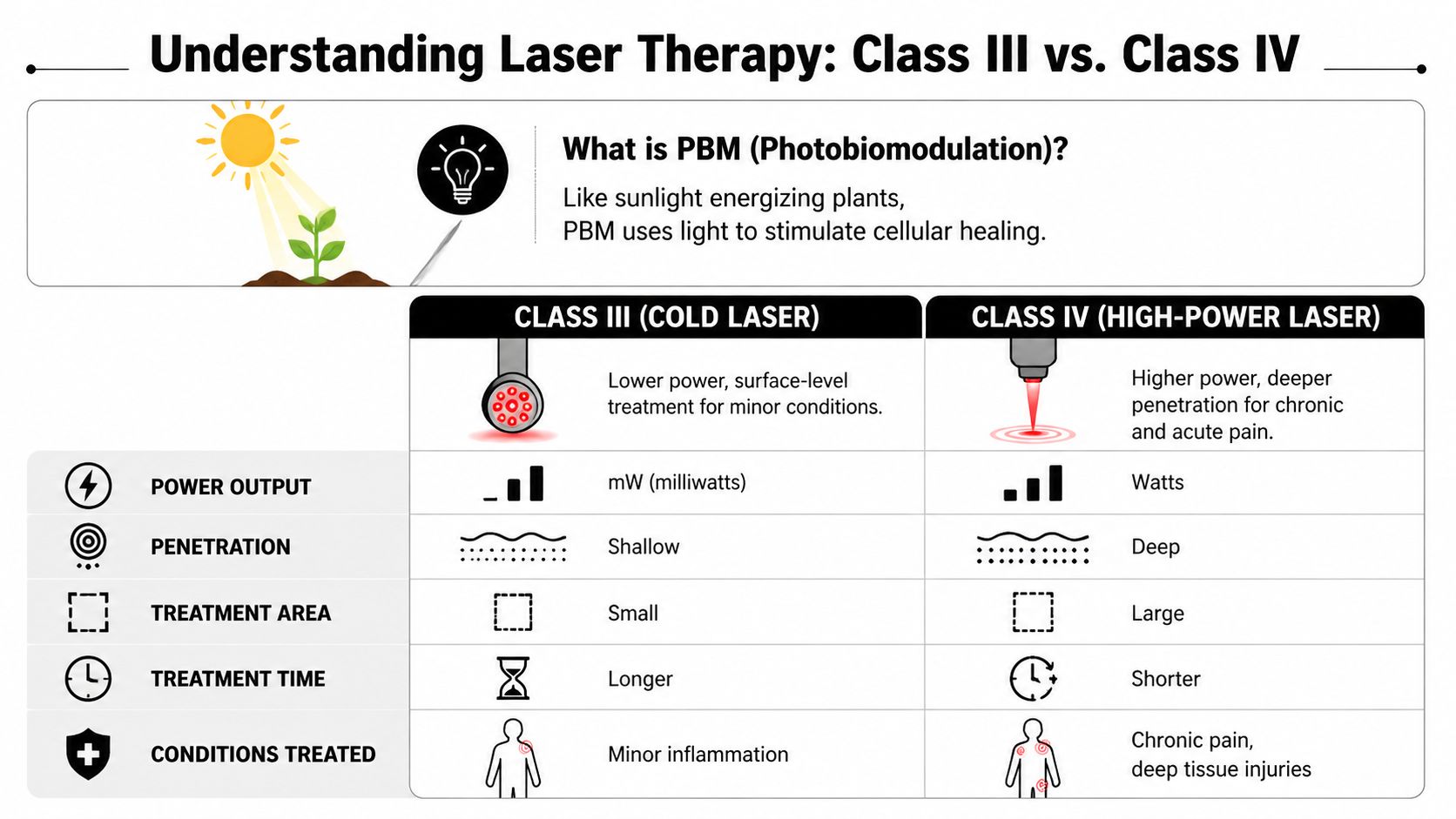
Laser therapy is often called photobiomodulation, or PBM. The easiest way to think about it is this: light is used to stimulate a healing response in tissue. It’s a little like giving cells a targeted energy signal. That analogy isn’t perfect, but it helps people understand why the treatment isn’t about heat alone and isn’t the same thing as a surgical laser.
The real difference between Class III and Class IV
Patients often hear “cold laser” and “high-power laser” used almost interchangeably. They’re not the same in practice.
| Type | Typical role in rehab | Best fit |
|---|---|---|
| Class III | Lower-power application, often used for more surface-level treatment | Smaller or less irritable areas, lighter treatment goals |
| Class IV | Higher-power application designed to reach deeper structures more efficiently | Orthopedic injuries, larger muscle groups, deeper tendon or joint issues |
A useful comparison is spotlight versus floodlight. Class III can be appropriate when you want a smaller, lighter application. Class IV gives the clinician more ability to treat deeper tissue and broader regions that are common in sports rehab Boston patients deal with, such as the Achilles, hamstring origin, hip rotators, rotator cuff, or lumbar paraspinals.
Why power matters clinically
More power doesn’t automatically mean “better.” It means the therapist has a different tool with different dosing options.
That distinction matters because the wrong choice can miss the target. If someone has a deeper orthopedic issue, a lower-powered device may not match the clinical problem well. On the other hand, blasting every painful area with a stronger setting also isn’t smart care. Dosage, tissue depth, irritability, and treatment goals all matter.
The question isn’t “Does this clinic have a laser?” It’s “What kind of laser is it, and why are they using it for my specific problem?”
Where a sports rehab clinic usually leans
In an athletic rehab setting, Class IV tends to make more practical sense for common Boston cases:
- Running injuries that involve thicker tendon and calf tissue
- Shoulder pain in lifters, swimmers, or overhead athletes
- Hip and low back irritation in rowers, desk workers, and field sport athletes
- Post-op stiffness and pain where the area is sensitive but still needs progressive rehab
The key point is that laser type should match the tissue and the plan. If your therapist can’t explain why a certain laser is being used, that’s a problem. Good rehab always connects the modality to a specific functional goal, such as tolerating single-leg loading, restoring shoulder motion, or reducing pain enough to retrain gait mechanics.
Common Conditions We Treat with Laser Therapy in Boston
The most helpful way to understand laser therapy is to see where it fits in real Boston lives. Not abstract diagnoses. Actual patterns we see every week.
Runners along the Charles
The classic Boston runner problem isn’t usually “I have pain.” It’s “I can still run, but every run is bargaining with the pain.”
Laser therapy often comes up with runners dealing with plantar heel pain, Achilles irritation, lateral knee pain, and lower leg overload. A runner training through Iliotibial Band Syndrome (Runner's Knee), for example, may need more than mileage reduction and foam rolling. If the tissue stays reactive, it’s hard to clean up mechanics, restore hip control, and rebuild workload without flare-ups.
What tends to work:
- Using laser to calm a hot tissue area so the runner can tolerate strength and movement correction
- Pairing it with gait review or running-specific programming
- Adjusting load without shutting training down more than necessary
What usually doesn’t work:
- Chasing symptoms only
- Treating the foot when the driver is higher up the chain
- Returning to speed work too soon because pain briefly dropped
Seaport and Financial District professionals
A lot of sports rehab Boston care isn’t about team sports. It’s about active professionals who sit too long, carry stress in the wrong places, and still want to train hard after work.
For this group, laser therapy can fit into care for:
- Neck and upper trap irritation from long laptop hours
- TMJ dysfunction tied to clenching, posture, and neck tension
- Shoulder pain that shows up during pressing, reaching, or sleeping
In these cases, laser isn’t the whole answer. If someone has jaw pain and never addresses clenching habits, neck control, breathing pattern, or workstation setup, progress usually stalls. But when an area is sensitive enough that hands-on work and exercise keep provoking it, laser can help reduce that threshold and make the rest of treatment more productive.
For desk-based patients, the win isn’t just “less pain at work.” It’s being able to work all day and still have enough margin left to train.
Post-surgical athletes and active adults
After surgery, tissues are healing but often remain guarded, painful, and stiff. That early period is delicate. You need enough treatment to move forward, but not so much that you irritate the joint or repair.
Laser therapy can be useful here because it’s non-invasive and easy to layer into a session without adding mechanical stress. Common examples include:
- Knee procedures where swelling and pain limit quad activation
- Shoulder procedures where the area is too guarded to progress comfortably
- Ankle or foot procedures where walking mechanics stay protective longer than expected
The trade-off is important. Modalities can support progress, but they can also create false confidence if they’re not tied to milestones in motion, strength, and load tolerance.
Specialty cases that need a more tailored approach
Boston patients also look for rehab that respects problems that don’t fit a simple sports template.
That includes people dealing with pelvic health concerns who want to return to lifting or running, golfers using performance evaluations to understand movement limits, and patients with concussion-related symptoms or vestibular issues who need a careful progression back to work and exercise. In those cases, laser may be part of care for pain or tissue irritability, but only when it supports the bigger goal.
A good plan stays specific to the person in front of you. The marathon runner, the attorney near South Station, and the rec tennis player in Back Bay may all have “hip pain,” but they don’t need the same rehab.
Clinical Evidence and Outcomes for Boston Patients
A Boston runner training for the Marathon, a skier trying to get back before the next trip, and a consultant who sits through long days in the Financial District usually ask the same thing. Will this help me recover faster, or is it just another add-on?
That is the right question.
The clinical case for laser therapy is practical. In the right patient, it can reduce pain and tissue irritability enough to make the rest of rehab more productive that day. At Joint Ventures, that usually means better tolerance for range of motion work, cleaner movement during exercise, or less symptom flare after loading. Those are the outcomes that matter in a sports rehab plan.
What evidence looks like in real practice
Research on laser therapy is mixed by condition, dose, and treatment setup, which is exactly why it should be used by a clinician who can match the tool to the problem. The useful takeaway for Boston patients is not that laser works for every diagnosis. It is that some patients respond well when it is applied to a clear treatment goal and paired with exercise, load management, and reassessment.
In clinic, I look for short-term changes that we can test right away. Can the shoulder reach higher with less guarding? Can the Achilles handle calf work more comfortably? Can the irritated knee tolerate the next step in strength training instead of stalling for another week?
If we do not see a meaningful change, we adjust the plan.
Boston patients tend to appreciate that approach because they are balancing real constraints. They want to keep commuting, working, training, and parenting while they recover. A treatment earns its place when it helps them do those things with fewer setbacks.
Outcomes should be measurable
Symptom relief alone is not enough. Progress has to show up in something concrete, such as:
- improved motion that holds after treatment
- better tolerance for strength work or plyometrics
- less pain during a specific run, lift, swing, or work task
- fewer symptom spikes between visits
- steadier progression toward return to sport or full work capacity
That standard keeps laser in the right role. It supports rehab. It does not replace the parts of rehab that rebuild capacity.
Patients who are new to physical therapy often do better when they understand how each piece fits together. A quick guide to preparing for your first physical therapy appointment can help set expectations before the evaluation.
Safety matters as much as results
Laser therapy still requires screening and clinical judgment. The target area has to make sense. The treatment goal has to be clear. The therapist also has to decide whether reducing pain that day will help progress, or just mask a problem that still needs stricter loading limits, different exercise selection, or a medical referral.
Situations that call for added caution include:
- areas that are not appropriate to treat
- individual medical factors that need review before use
- cases where temporary symptom relief could encourage a patient to do more than the tissue can currently handle
That last point matters for active people in Boston. A runner who feels better after treatment may be tempted to test a hard workout too soon. A desk-based professional may sit through another ten-hour day because the pain eased temporarily. Good rehab plans account for that trade-off and set clear activity targets after each session.
For broader education on rehab research, treatment options, and condition-specific recovery topics, visit Highbar Health. The local question is still more specific. How do we use the right tool, at the right point in rehab, so you can return to your training, your commute, and your work without losing momentum?
What to Expect During Your Laser Therapy Session
It is a relief to discover that a laser therapy visit is simple. There’s no complicated prep, no recovery downtime, and no dramatic sensation during treatment.
Before the session
You usually don’t need to do anything special beforehand. Wear clothing that allows access to the area being treated, and bring the details that matter to your plan, such as what movements are provoking symptoms, what training you’re trying to keep up with, and what has or hasn’t helped.
If it’s your first visit, a quick way to know what to bring and how the visit flows is this guide on preparing for your first physical therapy appointment.
During treatment
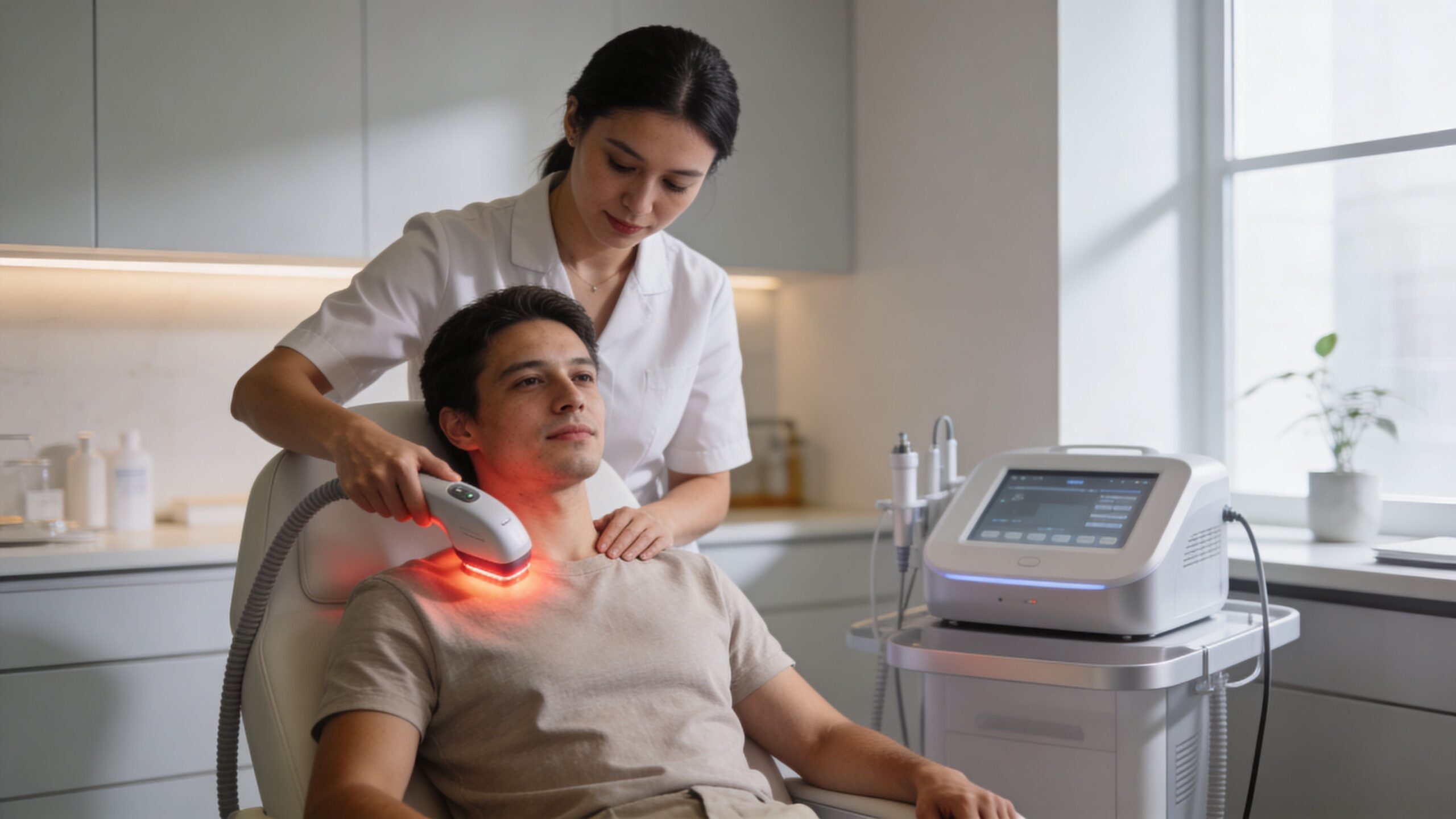
The therapist first checks the area and confirms why laser is being used that day. That part matters. The treatment should be tied to a problem the therapist is trying to solve, such as painful shoulder elevation, a reactive Achilles, or a jaw that’s too irritable for manual work.
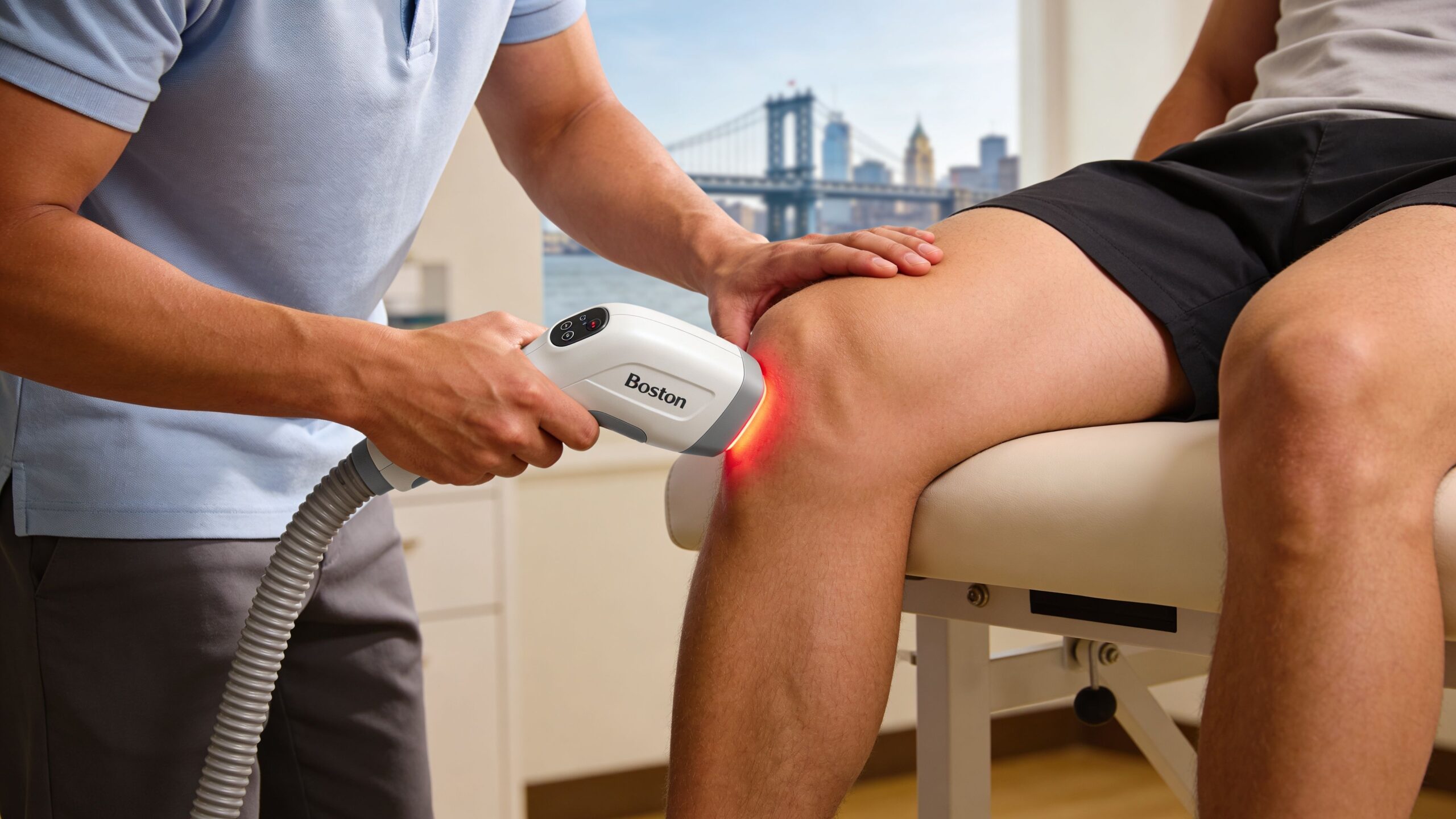
Then both you and the clinician wear protective eyewear. The laser applicator is placed over the target area, and the treatment is delivered directly to the skin or through a very small barrier depending on the region being treated.
What it usually feels like:
- Gentle warmth over the area
- No sharp pain
- A short, focused application rather than a long passive session
Some patients feel very little during the treatment itself. That’s normal.
A quick visual can help if you’ve never seen the setup in action:
After the laser is done
This is the part people often misunderstand. The session doesn’t end with the modality.
In a well-run sports rehab Boston visit, laser is followed by the thing it was meant to support. That may be mobility work, manual therapy, tendon loading, balance training, running drills, or return-to-lift progressions. The point is to use the improved window well.
A laser session by itself can feel pleasant. A laser session that lets you move better right away is much more meaningful.
You can usually return to normal daily activity after the visit unless your therapist has you modifying load for the injury itself. The post-visit plan depends more on the condition than on the laser.
Integrating Laser into Your Complete Rehab Plan
You get through a workday in Back Bay, try to run along the Charles, and the Achilles that felt manageable in the morning tightens up by mile two. Or your shoulder settles at your desk, then lights up again when you lift overhead at the gym. In both cases, the question is not whether laser therapy can be used. The question is whether it helps you do the next piece of rehab better.
That is how we use it in sports rehab. Laser has a specific role inside the plan. It helps calm an irritable area enough to let the visit shift toward the part that restores function: loading, movement retraining, manual work when needed, and a return to the demands that matter in Boston life, whether that is commuting, lifting, tennis, or training for a race.
Where it fits in the rehab sequence
A good rehab program changes as the problem changes. Early on, the limiting factor is often pain, swelling, guarding, or tissue irritability. Later, the limiting factor is usually different. Strength is down. Tendon capacity is low. Balance is off. Mechanics are sloppy. Confidence drops.
Laser therapy tends to fit earlier in that sequence, especially when symptoms are blocking useful exercise. We may use it to reduce irritability enough that the patient can tolerate calf loading, shoulder control work, cervical treatment, or a return to impact progression. Once that window opens, the session has to move on.
Spaulding Rehabilitation describes a phased sports injury rehab approach that starts with evaluation and early symptom management before progressing into strength and functional exercise, as outlined in Spaulding’s sports injury rehab approach.
What that looks like in practice
For a runner with a reactive Achilles, laser can be useful at the point where the tendon is too sensitive to handle the loading plan well. That does not mean we keep treating passively for weeks. It means we use the calmer window to start or progress the work that changes the tendon's tolerance.
That usually includes:
- Targeted manual therapy if ankle stiffness or calf guarding is limiting motion
- Progressive tendon and lower-leg loading to rebuild capacity
- Running modifications so mileage, hills, speed, and footwear are not driving the same flare repeatedly
A different example is the Boston professional who sits through long meetings, clenches during deadlines, and develops combined neck pain and TMJ irritation. Laser may help settle the jaw or upper cervical region enough to make treatment more productive. But progress usually comes from improving neck control, breathing mechanics, jaw habits, and workstation behavior between visits.
Why one-on-one decision making matters
No two patients move through rehab at the same speed.
One visit may call for symptom reduction because the tissue is too reactive. The next may call for heavier loading because the pain is down but capacity is still missing. Sometimes the right decision is less in-clinic treatment and more self-management at home, work, or in the gym.
That is also why laser is not used in isolation. Depending on the problem, it may sit alongside dry needling, aquatic therapy, vestibular rehab, TMJ treatment, gait work, or strength progressions. Joint Ventures Physical Therapy’s sport performance physical therapy services show how rehab and performance work can be matched to the actual demands of runners, field athletes, lifters, and active adults.
What tends to slow progress
Two patterns show up often in sports rehab:
| Approach | Problem |
|---|---|
| Passive treatment only | Symptoms may ease for a short time, but strength, tendon capacity, and movement quality stay behind |
| Exercise progression too aggressive, too soon | Irritable tissues flare, recovery stalls, and the patient loses momentum |
The better middle ground is simple. Use laser when it helps the patient tolerate the work that matters, then spend the visit building the capacity that keeps the problem from coming right back.
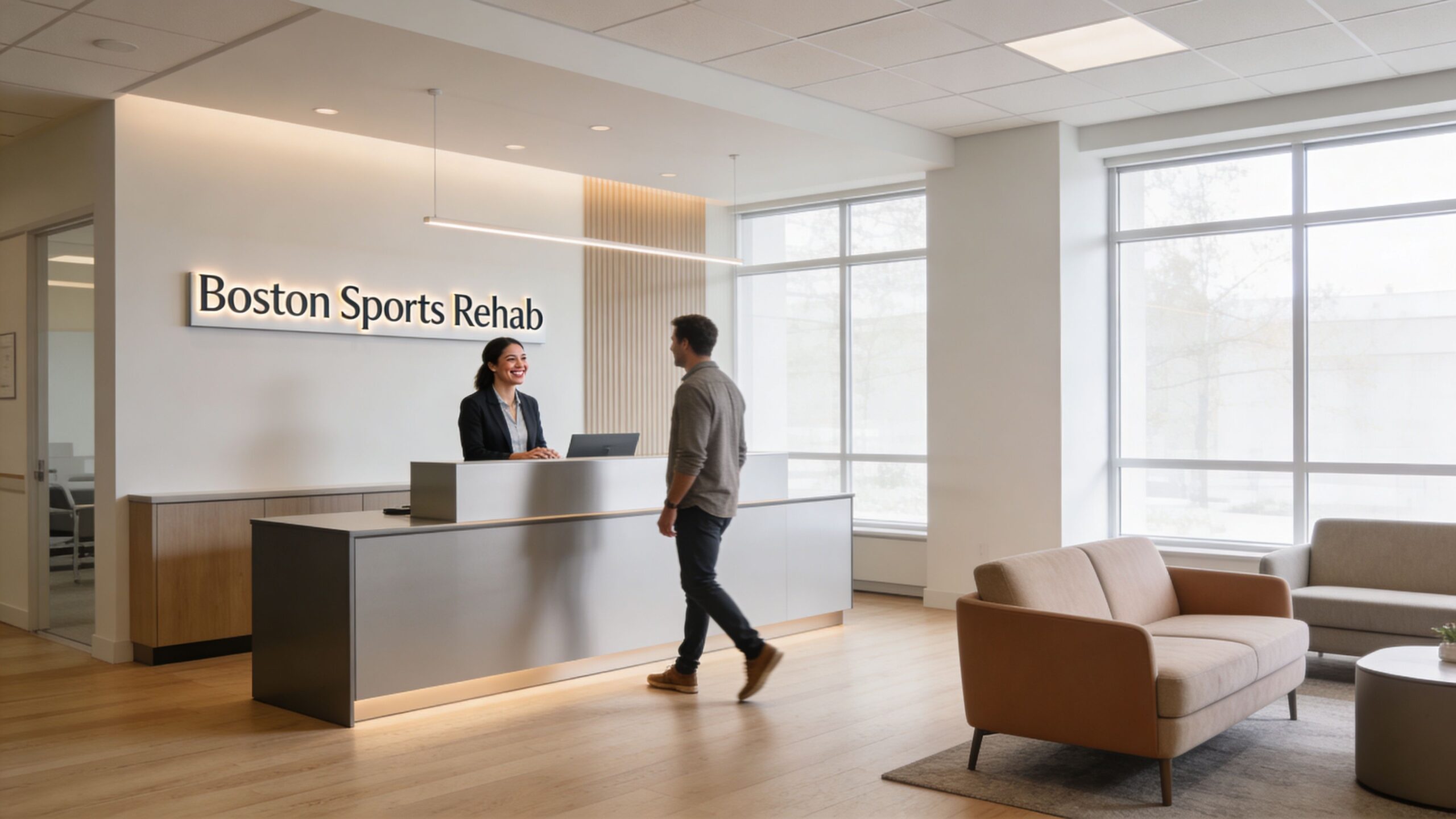
Access Laser Therapy at Joint Ventures in Boston
Convenience matters more than people think. If your plan is solid but the clinic location, schedule, or admin process makes care hard to attend, progress often slips.
Where Boston patients usually look for care
For sports rehab Boston patients often want a clinic that fits the rest of life, not one that adds more friction. That usually means choosing a location near where you already spend time.
Commonly useful options include:
- Back Bay for runners, lifters, and professionals working nearby
- Kenmore Square for students, Fenway-area athletes, and commuters
- Fort Point and Seaport for office workers who want care near work
- Downtown Boston for people coming through the city during the workday
- Brookline and Allston for neighborhood access outside the core business districts
A good local setup is one where you can make appointments consistently before work, after work, or between classes and meetings.
What to ask before you book
You don’t need a perfect script. Just ask the practical questions that affect follow-through.
- Insurance and billing. Ask whether benefits will be verified before your visit and how laser therapy is incorporated into the plan of care.
- One-on-one treatment time. Make sure you understand whether you’ll be working directly with a clinician throughout the visit.
- Fit for your goal. A runner training for Boston, a golfer wanting a Titleist evaluation, and a patient with TMJ symptoms should all ask whether the clinic regularly treats that kind of case.
Why patients choose a local sports rehab clinic
People usually aren’t looking for “physical therapy” in the abstract. They’re looking for a place that can help them get back to running, lifting, working, competing, parenting, commuting, or sleeping without pain driving the schedule.
That’s why local specialization matters. A Boston clinic that understands runners, university athletes, desk-bound professionals, active older adults, pelvic health concerns, vestibular issues, and return-to-sport planning is more likely to build a plan that feels relevant from the first visit.
If laser therapy seems like it might fit your situation, the next step is straightforward. Book an evaluation at the location that’s easiest for you to attend consistently, then let the exam determine whether laser belongs in the plan.
Frequently Asked Questions About Laser Therapy
Is laser therapy painful
Usually, no. Most patients feel mild warmth or very little at all. It shouldn’t feel sharp or aggressive.
How many sessions will I need
That depends on the condition, how irritable the area is, and what else is included in your rehab. A short-lived flare-up and a long-standing tendon problem won’t follow the same schedule. The better question is whether each visit is improving your ability to move, load, and return to activity.
Is laser therapy safe
It can be very safe when a licensed clinician screens for whether it’s appropriate and applies it correctly. Protective eyewear is used, and the therapist decides whether the target area and your medical history make treatment suitable.
Can I get laser therapy by itself
You can ask, but for most orthopedic and sports cases that isn’t the smartest use of it. Laser tends to work best as part of a complete rehab plan that includes assessment, exercise, and progression based on your goals.
Will laser therapy fix my injury faster
It may help calm symptoms and support healing in the right case, but it doesn’t replace strength, mobility, load management, or sport-specific progression. If someone promises that laser alone will solve a stubborn injury, be cautious.
Is this useful only for athletes
No. It can also help active professionals, people recovering from surgery, patients with TMJ symptoms, and others whose pain is getting in the way of work, exercise, or daily life.
If you’re looking for Joint Ventures Physical Therapy in Greater Boston, book an evaluation at the location that fits your commute and schedule. A clinician can assess whether laser therapy belongs in your plan, then pair it with the exercise, manual therapy, performance work, or specialty care you need to get back to running, lifting, working, and living with less interruption.