
Getting a new hip is a huge step toward getting your life back, but the surgery itself is just the beginning. The real work—and the real progress—happens during your recovery, and a dedicated physical therapy plan is what makes all the difference.
We’re here to guide you through that process. Our job is to take the uncertainty of post-op recovery and turn it into a clear, confident path forward. We've helped thousands of people get back to their lives, and we'll do the same for you.
Your Recovery Starts Now
Think of your physical therapist as the coach for your new hip. The surgery is an amazing feat of modern medicine, but it's the focused work you put in afterward that dictates how well you'll be able to move for years to come. Physical therapy isn't just a recommendation from your surgeon; it's the single most important part of your journey back to an active, pain-free life.
Our entire job is to partner with you one-on-one, creating a plan that helps you heal correctly and build back strength that lasts. This is about more than just checking boxes on an exercise sheet. It's a structured approach designed to get you back to doing what you love, whether that's golfing, playing with your grandkids, or just walking through the Public Garden without a second thought.
A Proven Path to Recovery
A well-structured physical therapy program follows a logical progression. We don't just throw exercises at you. We start by protecting the new joint and getting swelling under control. From there, we gradually and safely begin rebuilding strength, restoring your range of motion, and fine-tuning your balance. This systematic approach is critical for making sure you don't push too hard, too fast.
Your recovery is a collaboration. It combines your surgeon's skilled work, your body's natural healing process, and our expert guidance to rebuild your strength and confidence, one step at a time.
This isn’t just our professional opinion; the research is clear. While specific programs can differ—some in groups, some individualized—a large review of multiple clinical trials found that physiotherapy after being discharged from the hospital has clear benefits for patients. The studies looked at plans ranging from five weeks to four months, and all of them pointed to better outcomes with guided, progressive exercise. You can explore the findings of this review to see the data for yourself.
The timeline below shows this simple but powerful path: from surgery back to your active life, with physical therapy acting as the essential bridge between the two.
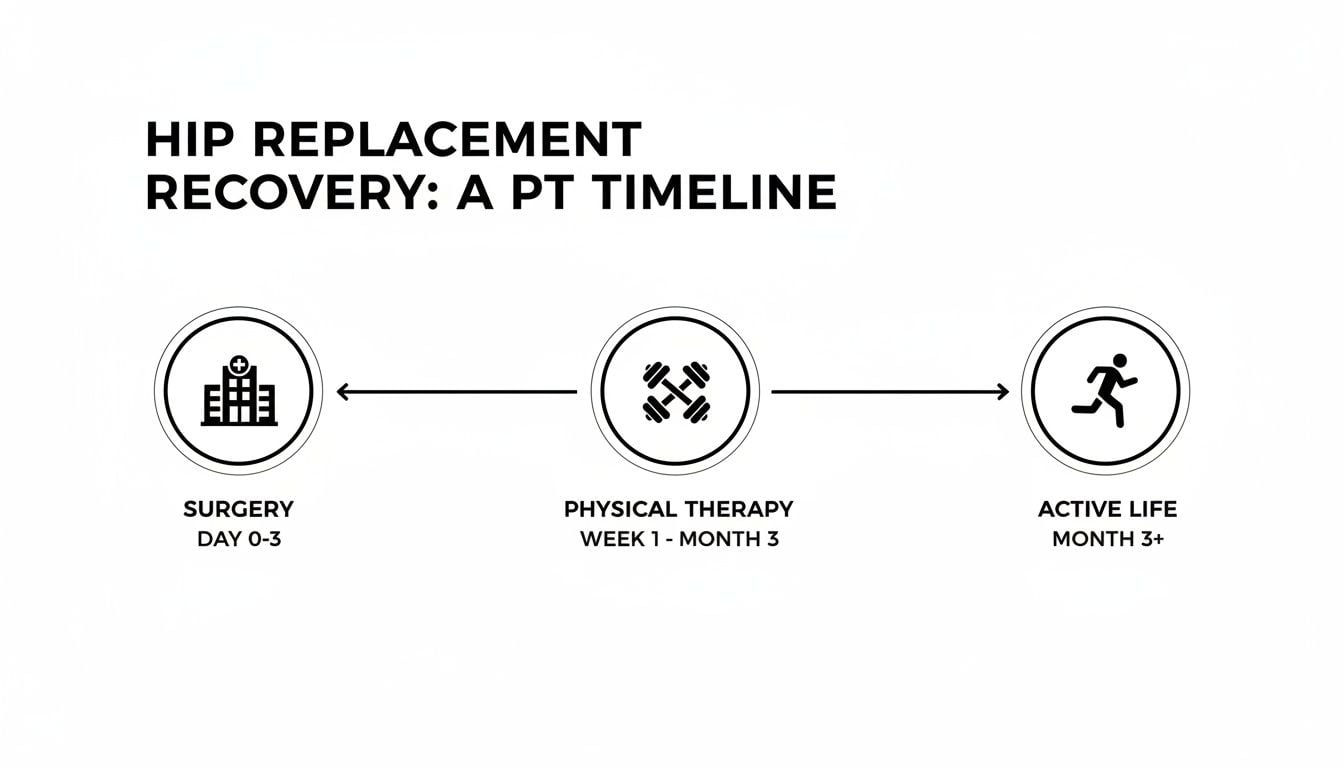
As you can see, physical therapy isn't a quick fix. It's a crucial phase that connects the procedure to your long-term success. Every single session is a step toward reclaiming your independence and getting back to 100%.
Mapping Your Hip Recovery Timeline
After hip replacement surgery, the first question almost everyone asks is, "How long will this take?" It's a completely natural question, but the answer isn't a single date on a calendar. Recovery is a journey, not a race.
Think of it like planning a road trip. You know your final destination—getting back to your life—but the route has specific, important stops along the way.
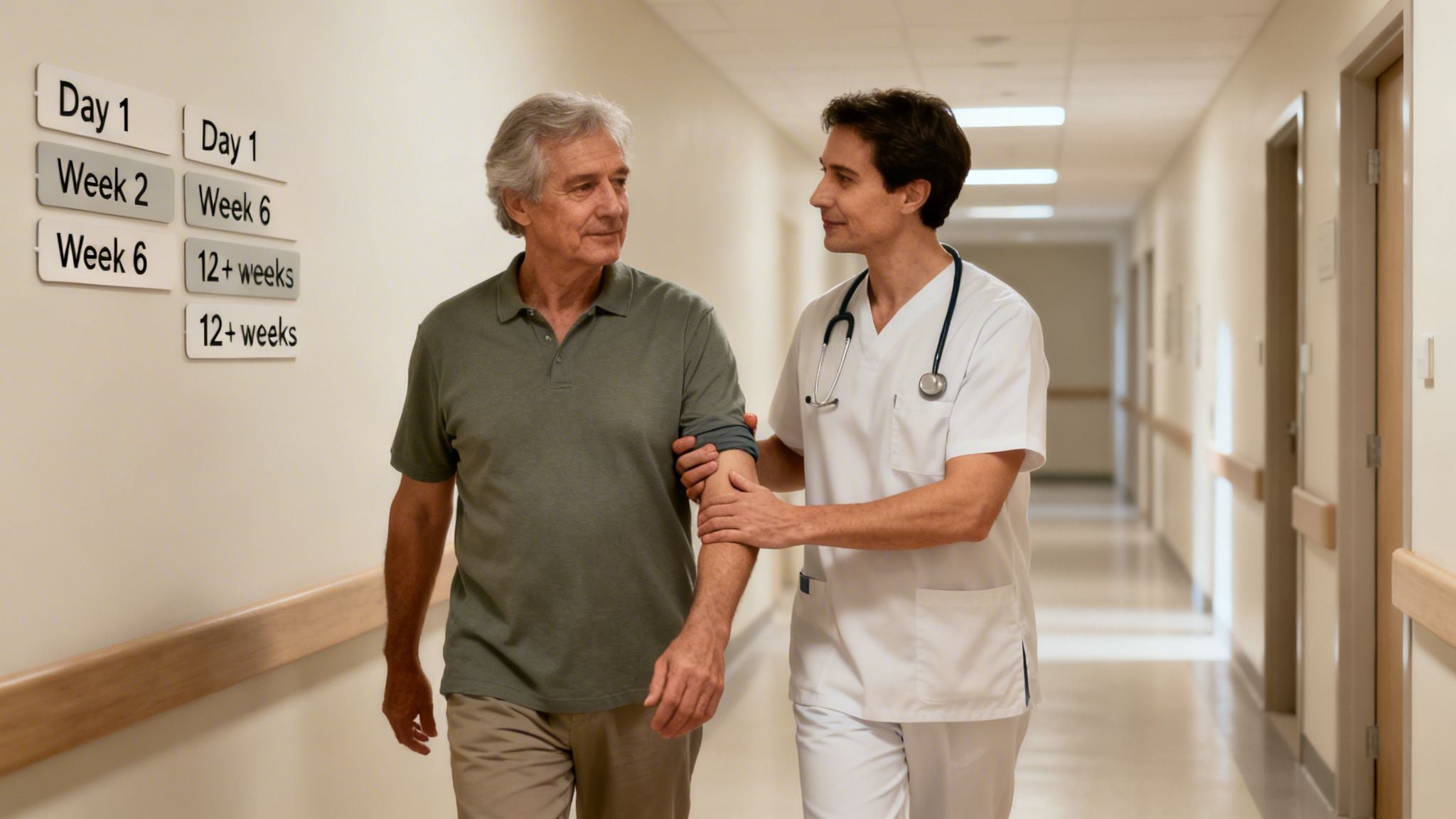
Understanding what’s ahead helps you focus on one step at a time and trust the process. Let's break down your physical therapy after hip replacement into a clear, manageable roadmap, from your first steps in the hospital to your full return to activity.
Here’s a quick overview of what you can expect during each phase of your recovery journey.
Hip Replacement Recovery Phases At A Glance
| Phase | Typical Timeline | Primary Goals | Example Activities |
|---|---|---|---|
| Immediate Post-Op | First few days (in-hospital) | Pain/swelling management, safe walking with an assistive device, basic muscle activation. | Ankle pumps, glute squeezes, walking with a walker. |
| Early Outpatient | Weeks 1-6 | Restore range of motion, build foundational strength, correct walking pattern (gait). | Seated knee extension, bridges, stationary bike, gait training. |
| Strengthening | Weeks 7-12 | Increase strength with resistance, improve balance and endurance, begin functional movements. | Light resistance band exercises, single-leg balance, step-ups. |
| Return to Activity | Week 12 and beyond | Transition to sport- or activity-specific movements, build power and agility. | Squatting, lunges, rotational exercises for golf/tennis, impact prep. |
Each phase builds on the last, creating a solid foundation for a full and lasting recovery. Now, let's look at each one in more detail.
The Immediate Post-Op Phase (The First Few Days)
Your recovery starts almost immediately. Often on the very day of your surgery or the next, a hospital physical therapist will get you up and moving. It might sound a bit much, but this first step is crucial for starting the healing process and preventing complications.
The goals here are simple but vital:
- Manage pain and swelling: Your body just went through something major. Our first job is to help it calm down.
- Activate key muscles: We'll guide you through gentle movements like ankle pumps and glute squeezes to keep blood flowing and prevent clots.
- Start walking safely: You'll use a walker or crutches to get on your feet, learning how to move with your new hip while keeping it protected.
This phase is all about safety and setting the stage for what’s next. We're building your confidence with basic movements and getting your body reacquainted with being upright.
The Early Outpatient Phase (Weeks 1-6)
Once you're home, your outpatient physical therapy begins. This is where you really start to get your independence back. The focus shifts from just activating muscles to actively restoring your hip's function. Think of it as rebuilding a house's foundation—it has to be solid before you can put the walls up.
During this stage, your one-on-one sessions will focus on restoring your range of motion and building foundational strength in the muscles that support your new hip. We'll also spend a lot of time working on your walking pattern, or gait. Many people develop a limp before surgery, and this is our chance to correct it. Our guide on what is gait analysis explains exactly how we break down your walk to make it smooth and efficient again.
This period is all about consistency. The small, steady gains you make each day add up to big improvements in your ability to walk, climb stairs, and get in and out of a chair with ease.
The Strengthening And Return-To-Activity Phases (Weeks 7 and Beyond)
As your new hip heals and your initial strength returns, we'll start challenging you more. This is where the real fun begins. The strengthening phase is about adding resistance, improving your balance, and increasing your endurance. We're moving from just walking to walking with purpose and power.
This progression is a well-established path. In fact, modern rehab programs often follow four distinct pillars: therapeutic exercises, functional transfers, gait training, and education. Research has shown that this multi-faceted approach, delivered from day one up to three months post-op, leads to major improvements in pain, range of motion, and strength.
Finally, the return-to-activity phase is all about getting you back to the life you want to live.
- Want to get back on the golf course? We'll work on rotational movements.
- Hoping to get back to gardening? We’ll practice squatting and kneeling safely.
- Dreaming of walking the beach on the Cape? We'll work on your balance on uneven surfaces.
This is the most personalized phase of your recovery. It’s where your specific goals drive the plan, ensuring your new hip doesn't just work well—it works for your life.
Your Essential Hip Replacement Exercise Plan
Let's get into the movements that will rebuild your strength and get you back to living your life. While every recovery plan we build is 100% unique to the person in front of us, there’s a general playbook we follow. This is your roadmap for understanding the "why" behind each exercise your physical therapist chooses.
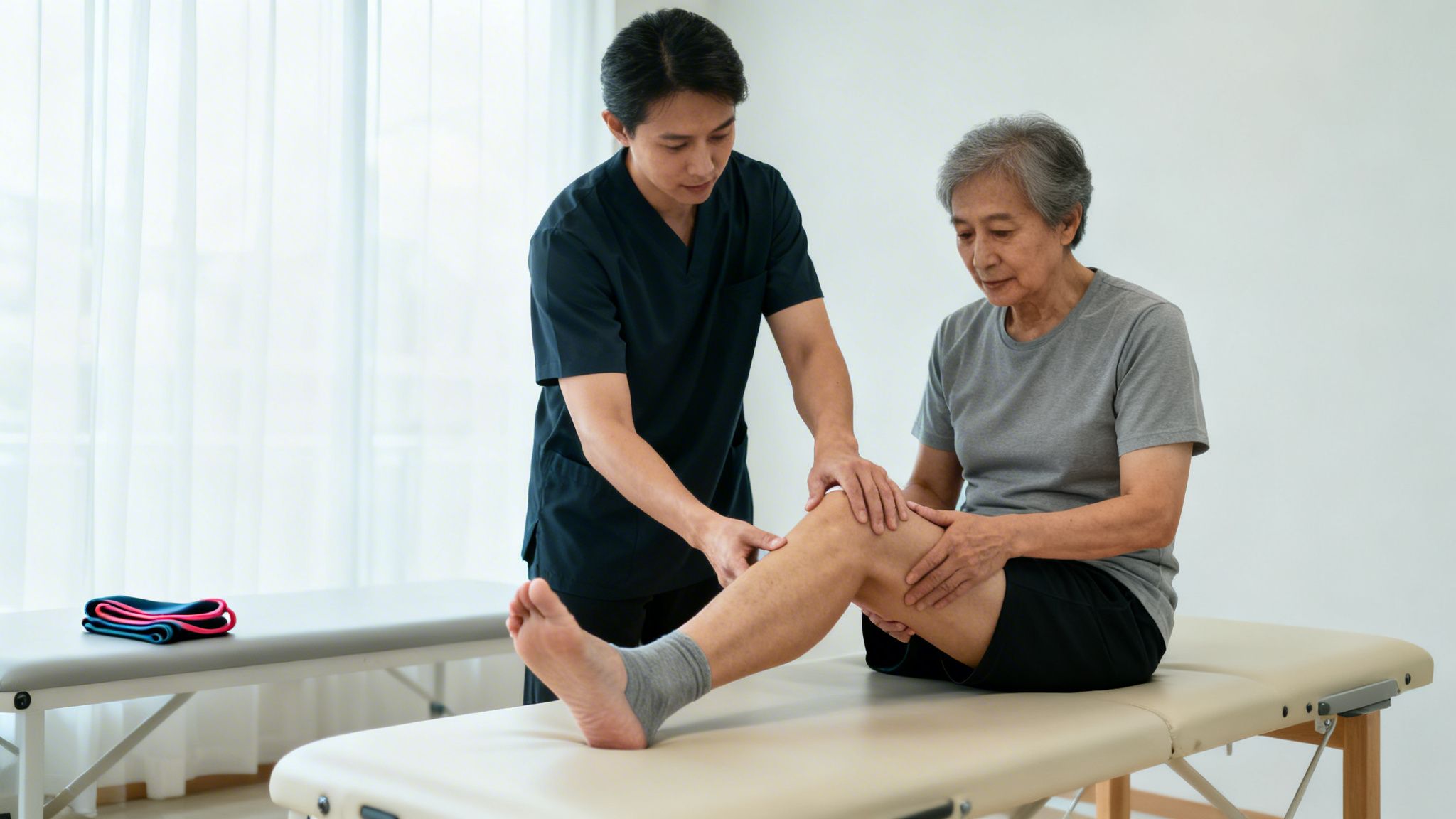
This isn’t a random list. Each exercise serves a specific purpose, and they build on each other as you heal. When you understand the job of each movement, you’ll perform it better and appreciate the incredible progress you're making.
Phase 1 Exercises: Foundational Movements
In the first few days and weeks, our entire focus is on gentle activation and promoting circulation. These aren’t big, powerful movements; they are small, deliberate, and designed to wake up your muscles and prevent serious complications.
Your first exercises will feel simple, but they're critical:
- Ankle Pumps: This is arguably one of the most important things you can do right after surgery. By simply pointing and flexing your foot, you engage your calf muscles, which act like a pump to push blood up your leg. This dramatically reduces your risk of developing a blood clot.
- Glute Squeezes (Glute Sets): Your glutes are the engine for your hip. Gently squeezing your buttock muscles helps re-establish that brain-to-muscle connection. It’s a way to remind those powerful stabilizers how to fire without putting any strain on your new joint.
- Quad Sets: This just means tightening the big muscle on the front of your thigh. This simple isometric move helps maintain muscle tone and supports your knee, which is vital for feeling stable when you start walking.
Think of these as the foundation. We’re laying the groundwork for everything to come.
Phase 2 Exercises: Building Strength and Function
As you transition to outpatient PT, your exercises become more dynamic. We’re moving past simple activation and starting to build real, functional strength. This is where you’ll truly start to feel like yourself again.
This stage is all about translating that early muscle activation into useful motion. We're re-teaching your body how to coordinate movement, preparing you for everyday tasks like getting out of a chair or climbing a set of stairs.
The movements here are designed to restore both strength and range of motion around the hip. A key principle is incorporating low impact strength training exercises to build strength without stressing the new joint.
Common examples include:
- Heel Slides: While lying down, you’ll gently slide your heel toward your glutes, which bends both your knee and your hip. This is one of the safest and most effective ways to restore your hip’s flexion (bending motion).
- Bridges: This is a powerhouse for your glutes and hamstrings. These muscles are absolutely essential for stabilizing your pelvis when you stand and walk. A strong posterior chain is non-negotiable for a successful hip recovery.
- Mini-Squats: We’ll have you hold onto a sturdy counter for support while performing small, controlled squats. This movement directly translates to real-world function, rebuilding the strength you need to get off the toilet or out of a low car seat with confidence.
Mastering these movements has a direct impact on your daily life. For a deeper dive into this topic, our guide on how to improve hip mobility offers some excellent strategies.
Phase 3 Exercises: Advanced Challenges
Once you’ve built a solid base of strength and control, it's time to fine-tune your movement. This phase is about improving your balance, building endurance, and preparing you to return to all the activities you love, whether that’s gardening, golfing, or playing with your grandkids.
At this stage, we start introducing more complex tasks:
- Adding Resistance: We'll often use resistance bands for exercises like side-lying leg lifts. This specifically strengthens the abductor muscles on the outside of your hip, which are critical for preventing a limp and keeping you stable when standing on one leg.
- Balance Drills: Standing on one leg seems simple until you try it after surgery. It requires a complex mix of strength, coordination, and confidence. We guide you through progressive balance work until you feel steady and secure on your feet.
- Stair Climbing Practice: Stairs are a major functional milestone. We break down the mechanics of going up and down, making sure you can do it safely and efficiently. Conquering stairs is a huge mental and physical victory in your recovery.
This entire progression is built around you. Your one-on-one sessions give us the ability to move at your pace, perfect your form, and constantly adjust the plan as you get stronger.
Navigating Hip Precautions And Recovery Red Flags
Your new hip is a marvel of modern engineering, but in those first few weeks after surgery, your body is doing the real work. The muscles and soft tissues that surround the new joint need time to heal and essentially “lock” everything into place. To help them do that, your surgeon will give you a short list of hip precautions.Think of these as temporary rules of the road for your recovery. They aren't forever. But following them to the letter for the first six to twelve weeks is one of the single most important things you can do to prevent a dislocation and ensure a smooth, confident recovery.
Understanding Your Hip Precautions
Your surgeon's specific instructions will depend on the surgical approach they used (like anterior vs. posterior), but the goal is always the same: avoid putting the ball of the new hip in a position where it could pop out of its socket.
The three most common rules you'll hear are:
- Don't bend your hip past 90 degrees. This is all about being mindful when you sit. You’ll need to steer clear of low, squishy couches, chairs, and toilets for a little while.
- Don't cross your legs or ankles. This is a tough one for many people because it’s often a subconscious habit. You'll need to stay very aware of your posture when sitting or even just lying in bed.
- Don't let your foot turn inward. Pay close attention to this when you're standing, walking, or turning around. Always try to keep your toes pointing straight ahead or just slightly outward.
Following these precautions isn't about being fragile; it's about being smart. You're giving your body the best possible environment to heal correctly, setting you up for long-term success and confidence in your new hip.
Setting up your home environment is a game-changer here. A good home safety checklist for seniors can help you spot and remove hazards before they become a problem. Simple things like a raised toilet seat or removing a few throw rugs can make all the difference in keeping you safe and making your precautions easier to follow.
Knowing The Red Flags That Need A Phone Call
Your recovery should feel like a story of steady, forward progress. It's crucial, however, to know the difference between normal healing aches and signs that something isn't right. Being an informed partner in your own health means you can act quickly.
While most soreness is a totally normal part of the healing process, you should never ignore the following signs.
Signs of a Possible Blood Clot (Deep Vein Thrombosis or DVT):
A blood clot is a serious medical issue. It typically presents in your calf, not around your hip surgery. Call your doctor immediately if you notice:
- Significant swelling, pain, or tenderness in your calf.
- Skin on your lower leg that feels unusually warm to the touch.
- Redness or a discolored patch of skin on your calf or shin.
Signs of a Possible Infection:
An infection around the new joint is rare, but it needs to be addressed right away. Look out for:
- Fever or chills that appear a few days or even weeks after your surgery.
- Growing redness, warmth, or swelling right around your incision.
- Any drainage or pus coming from the incision itself.
- A sudden spike in pain that doesn't seem related to your activity.
Your healthcare team is on your side. We would much rather you call with a concern that turns out to be nothing than have you sit at home worrying. Your peace of mind is a huge part of the healing process, so don't hesitate to reach out.
The Joint Ventures Difference In One-On-One Care
When you're recovering from a hip replacement, the type of physical therapy you choose is one of the most critical decisions you'll make. Not all PT clinics operate the same way, and the differences can have a huge impact on your recovery. We've seen it time and again, which is why we built our practice around a promise that you just don't find everywhere else.

That promise is true one-on-one care. When you schedule an appointment with us, you get a full hour dedicated entirely to you and your physical therapist. You won't be passed off to an aide or technician, and you definitely won’t be left doing exercises alone in a crowded gym. It’s your time.
Your Dedicated Partner In Recovery
This one-on-one model changes everything. It gives us the time to actually watch you move, listen to your feedback, and perfect your form on every single exercise. It’s how we catch those tiny movement mistakes before they turn into bigger problems, making sure you're always progressing safely.
When your therapist is 100% focused on you, your recovery moves faster. We can adapt your plan on the fly, answer every question you have, and provide the hands-on care needed to release tight muscles and guide your new hip through its proper range of motion.
This kind of personalized attention is a cornerstone of our orthopedic physical therapy. It builds a real partnership between you and your therapist—and that trust is a key ingredient for a great outcome.
More Than Just Exercises
Because we have a full hour together, we can bring in other powerful treatments that go beyond standard exercises. We don't just follow a script; we use every tool we have to help you heal and get back to your life faster.
For our hip replacement patients, two services are often game-changers:
- Aquatic Therapy: Moving on land can be tough, especially in those first few weeks. Our therapy pools create a buoyant, low-pressure environment where you can walk, stretch, and get stronger without stressing your new joint. It's an incredible tool for rebuilding mobility and confidence with very little discomfort.
- Trigger Point Dry Needling: As your body adapts, you’ll start using muscles that were weak or inactive before surgery. This can lead to stubborn muscle knots and tightness. Dry needling is a highly precise technique our therapists use to release these trigger points, often providing immediate relief from pain and improving how well your muscles work.
We Handle The Headaches
Let's be honest—the last thing you want to think about after major surgery is insurance calls and scheduling conflicts. Our front-desk and billing teams are experts at managing all of it. They'll verify your benefits, handle the pre-authorizations, and find appointment times that work for your life, including early mornings and evenings.
We take care of the administrative work so you can put 100% of your energy where it counts: on your recovery. Our goal is to make the entire process feel supportive and seamless, from your first call to your final session.
Your Hip Replacement Recovery Questions Answered
Over the years, we've helped thousands of people from all over the Boston area get back on their feet after a hip replacement. We've heard just about every question you can imagine. Having a big surgery like this naturally comes with a lot of uncertainty, and getting clear, direct answers is a huge part of feeling confident in the road ahead.
Below, we’re answering some of the most common questions we hear every single day in the clinic. We want to give you the honest, straightforward answers you deserve so you can focus on what matters—getting better.
How Long Will I Need Physical Therapy?
This is usually the first question people ask, and the honest answer is: it depends. Most patients are in formal physical therapy for about 8 to 12 weeks. But that isn't a hard and fast rule; your recovery timeline is completely personal.
Several factors shape how long you'll need our one-on-one guidance:
- Your fitness level before surgery: Patients who were more active beforehand often progress a bit quicker.
- Your personal goals: Are you aiming to get back to walking your dog, or are you hoping to return to the tennis court? Your goals set the finish line for your therapy.
- How your body heals: Everyone responds to surgery differently. We always move at the pace that's right for you.
The first few weeks of physical therapy after hip replacement focus on safety, managing swelling, and getting your basic movement back. As you get stronger, we shift our focus to building real strength and function, getting you ready to graduate from formal PT and confidently manage on your own.
When Can I Drive Again?
Getting your keys back is a major milestone. It means real independence. For most people, driving is back on the table around 2 to 4 weeks after surgery.
There are two non-negotiable requirements you have to meet before getting behind the wheel:
- You must be completely off any narcotic pain medication.
- You must have the strength and reaction time to control the gas and brake pedals without pain or hesitation.
Your surgeon and your physical therapist will work together to give you the official green light. We'll even simulate the movements in the clinic to make sure you're ready and feel confident.
What If My Progress Feels Slow?
It’s completely normal to have good days and bad days. Progress isn't always a straight line—sometimes it looks more like two steps forward, one step back. Feeling "stuck" for a day or two is common. It can be caused by muscle fatigue, a bit of swelling, or simply your body needing a moment to catch up.
It's okay to have an off day. Recovery isn't a race. The important thing is to listen to your body, communicate with your therapist, and trust the process. Slow and steady progress is still progress.
This is exactly why that one-on-one care model is so important. If you hit a plateau, we can immediately figure out why and adjust your plan. Maybe we need to tweak an exercise, focus more on hands-on manual therapy, or even recommend a session in our therapy pool to unload the joint. Open communication is key—always tell us how you're feeling.
Do I Need to Keep Exercising After Formal PT Ends?
Yes, absolutely. This is something we make sure every single one of our patients understands. Think of your formal physical therapy as the training camp. We give you the playbook, teach you the right form, and build your foundational strength.
When you graduate from PT, we'll give you a detailed home exercise program to continue on your own. This is how you protect your new hip. Consistently doing these exercises is the single best way to make sure your hip serves you well for decades to come.
Lifelong exercise is the key to maintaining your strength, mobility, and independence. It’s what allows you to stay active and enjoy all the things your new hip has made possible again. Your comeback story doesn't end when you leave our clinic; it's just getting started.
Ready to start your recovery with a team that puts you first? At Joint Ventures Physical Therapy, we're committed to providing the one-on-one care you need to achieve your goals. Schedule your evaluation with us today and let’s get you moving.