
Ever feel that nagging twinge in your knee on a run, or notice your balance feels a little off? You know something isn't right, but you can't quite put your finger on it. It’s frustrating, and you deserve answers.
This is where gait analysis comes in. Think of it as a detailed breakdown of your unique walking and running patterns—our way of connecting that strange ache directly to how you move so we can build a plan to fix it.
Breaking Down Your Movement: What Is Gait Analysis?
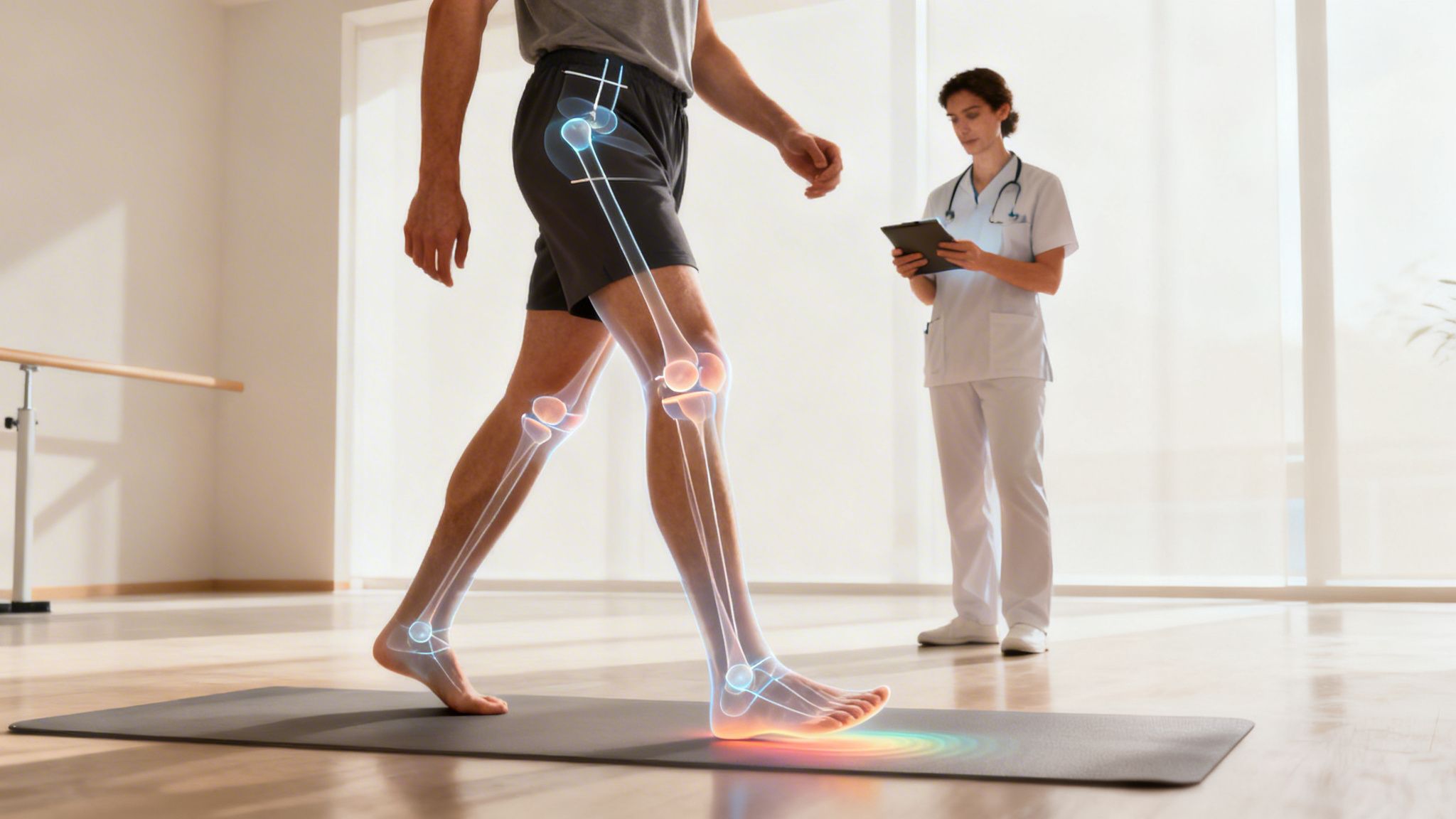
Most of us try to push through minor aches and pains, hoping they’ll eventually go away. But those aches are often your body's way of signaling that something in your movement is out of sync. Ignoring them rarely works.
A gait analysis is how we translate those signals into a clear, actionable plan. And it’s not just a tool for elite athletes. It’s for anyone who wants to move better, feel stronger, and get back to their life without being held back by pain.
At our clinic, we are confident that understanding how you move is the first real step toward feeling better for good. We look past the immediate symptoms to find the root cause, and more often than not, it’s hidden in the subtle mechanics of your gait.
What Does Gait Analysis Really Tell Us?
A gait analysis gives us the tools to deconstruct the incredibly complex sequence of motions you use to walk or run. It provides objective data and expert insights into your body’s unique "movement signature," revealing patterns that are simply impossible to see with the naked eye.
This process helps us finally answer some of those frustrating questions you've been asking:
- "Why does my knee hurt after running just two miles?" We can uncover the root cause, like a hip drop or overpronation, that’s putting extra stress on your knee joint with every single step.
- "Is my balance getting worse?" By measuring your step width, stride length, and symmetry, we can spot stability issues before they become a serious fall risk and give you the tools to improve.
- "How can I recover safely after my hip replacement?" An analysis helps ensure you aren't developing new, compensatory habits that could create a whole different set of problems down the road.
By breaking down your gait cycle—the entire sequence from one heel strike to the next—we can pinpoint specific inefficiencies and asymmetries that contribute to pain or hold back your performance. It’s about seeing the complete picture of your movement.
So, what is gait analysis? It’s a personalized diagnostic tool that lets us stop guessing and start measuring. Instead of settling for generic advice, we gather specific, concrete information about your body's mechanics.
This allows us to build a treatment plan that is 100% tailored to you, helping you get back to the activities you love, feeling stronger and more confident than before.
The Journey from Ancient Art to Modern Science
You might think gait analysis is a recent breakthrough, but the study of how we walk is an ancient practice. For centuries, though, it was more art than science, limited to what the naked eye could see and what an artist could sketch.
The real evolution began when technology finally caught up to our curiosity about human movement. For nearly 2,000 years after Aristotle first made systematic observations about walking, progress was slow. Then, in the late 1800s, photography and video changed everything. For the first time, we could freeze movement in time and study it frame-by-frame, revealing details that were previously invisible.
From Research Labs to Your Local Clinic
This new ability to capture and analyze motion was a huge leap forward, but for a long time, the tools were stuck in research labs. The equipment was expensive, massive, and far too complicated for a typical clinic. The turning point for everyday patients like you happened much more recently.
It wasn’t until the 1970s that more affordable video cameras and early computerized systems became available. That’s when gait analysis finally moved out of the ivory tower and into clinics like ours, becoming a practical tool to help people with real-world problems. This clinical evolution is well-documented in research on the history of gait analysis.
This was a massive shift. It meant physical therapists could stop relying solely on observation and start using objective, visual data to figure out exactly why you’re in pain.
What started as a philosophical curiosity has become a cornerstone of modern physical therapy, allowing us to build precise, data-driven recovery plans for everything from a runner's knee pain to helping someone walk confidently after a stroke.
Having the ability to slow down, measure, and analyze your unique walking pattern gives us incredibly powerful insights. It lets us pinpoint the specific biomechanical flaws causing your pain or holding back your performance. This long journey from ancient art to modern science is exactly why we can offer a level of care that was unimaginable just a few generations ago. We build on that history every single day to help you move better.
How We Analyze Your Gait Step by Step
So, how does a gait analysis actually work in a real-world clinic setting? It’s far more than just watching you walk down a hallway. We approach it like a detective building a case, combining our trained clinical eyes with precise technology to see the full story of your movement.
The entire process begins with a simple but incredibly powerful tool: expert visual observation. Our physical therapists have spent years training their eyes to spot the tiny, almost invisible asymmetries, hitches, and compensatory patterns that show up in your stride. We watch you walk, paying close attention to how your entire body moves as an interconnected system.
Adding Technology for a Deeper Look
While a trained eye tells us a lot, technology helps us confirm what we see and uncover what we can't. This is where we bring in objective data to get a more complete picture.
Here is a breakdown of the different methods used in gait analysis and the specific data each one provides.
Gait Analysis Methods and What We Measure
| Method | What It Tells Us | Best For Identifying |
|---|---|---|
| Visual Observation | Gross movement patterns, asymmetries, and obvious compensations. | Limps, uneven arm swing, poor posture, and overall movement quality. |
| Video Recording | The exact timing and angles of your joints during each phase of your stride. | Subtle foot overpronation, hip drops, or knee tracking issues that happen too fast to see. |
| Force Plates | How much force you generate and absorb through your feet with every step. | Excessive impact forces, poor shock absorption, or imbalances in weight distribution. |
| Wearable Sensors | Precise data on joint motion, stride length, cadence, and symmetry. | Inefficiencies in your running form, subtle limping, or changes in gait over time. |
These tools aren't just fancy gadgets; they give us the raw numbers behind your movement, allowing us to connect the dots between how you move and why you hurt.
Gathering these different pieces of information is critical. It allows us to connect your specific complaint—like that nagging shin splint—directly to a biomechanical issue, such as excessive impact forces or poor foot mechanics. We're not guessing; we're measuring.
The way we integrate these different tools has evolved significantly over time. We've come a long way from simple observation to the highly detailed analysis we can perform today.
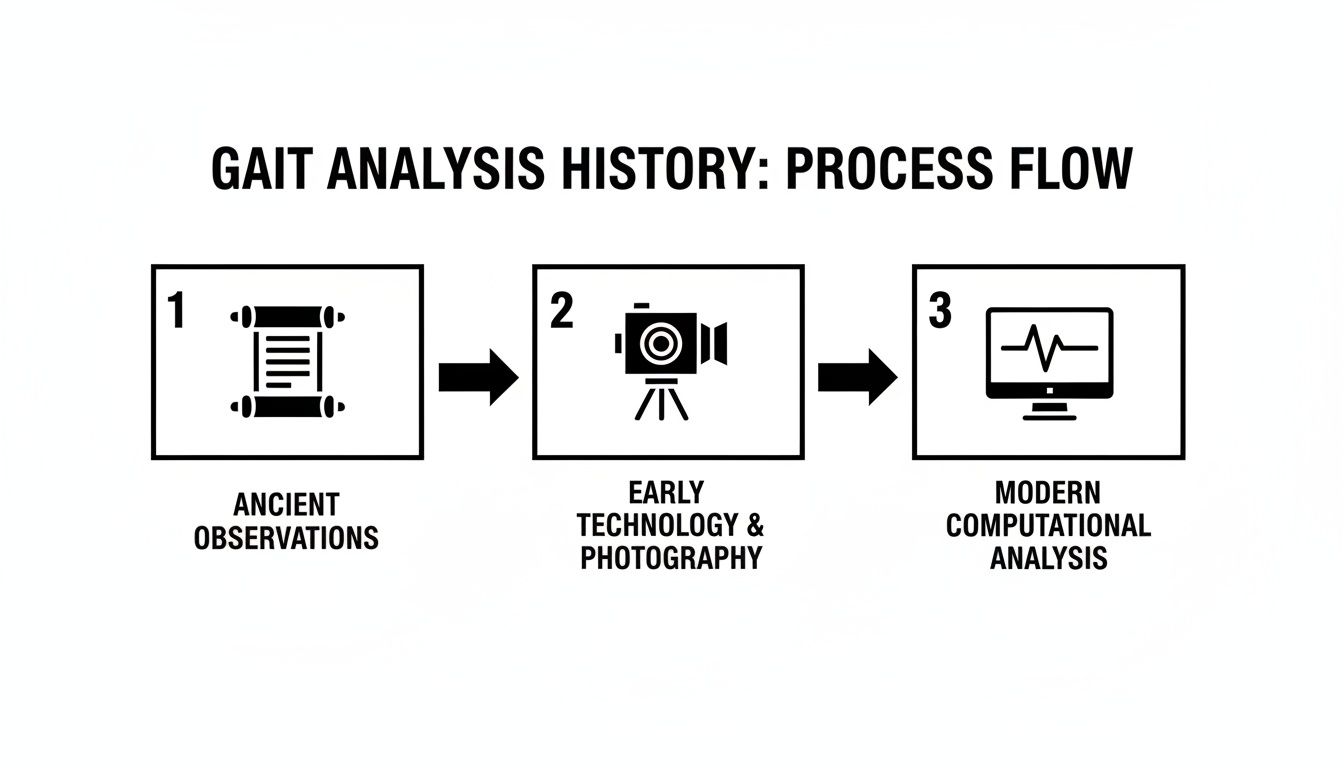
This visual journey highlights the massive leaps we've made in our ability to diagnose movement problems with incredible accuracy.
Putting All the Clues Together
Each method—visual, video, and sensor-based—provides a different clue. One isn't necessarily "better" than another; their real power comes from how we put them together.
For example, a video might show a slight limp, but the force plate data can then tell us you're avoiding pressure on that side by 30%. That’s a crucial piece of objective data that completely changes how we approach your treatment.
This integrated approach is what makes a clinical gait analysis so effective. We don’t just identify the problem; we quantify it. This helps us build a highly targeted treatment plan and, just as importantly, track your progress with real numbers to ensure you’re on the right path back to moving without pain.
Who Can Benefit from a Gait Analysis?
You might be wondering if a gait analysis is really for you. The truth is, the list of people who find answers through this process is surprisingly broad and goes far beyond just competitive athletes. It’s a powerful tool for anyone whose movement feels painful, inefficient, or simply "off."
Of course, runners are common visitors. They come to us looking to finally solve nagging issues like shin splints, plantar fasciitis, or that persistent IT band syndrome. A detailed analysis can uncover the specific mechanical glitches in a stride that lead to these frustrating, recurring injuries.
If you're a runner, you might also want to check out our guide on how to improve running form for more tips.
Beyond the Finish Line
But the benefits extend well past the running track. A huge part of our work is with people navigating life's other physical challenges.
- Post-Surgical Recovery: We frequently see individuals recovering from a hip or knee replacement. A gait analysis helps ensure they aren't developing poor walking habits that could cause new problems down the road.
- Chronic Pain: Many people come to us with chronic low back or hip pain that hasn't responded to other treatments. Often, the root cause is a hidden asymmetry in their walk that’s been creating strain for years.
- Postpartum Care: New mothers experiencing pelvic pain or instability can find immense relief. We can identify how pregnancy and childbirth have altered their movement and create a plan to restore strength and function.
Improving Stability and Confidence
Another critical area is helping people with balance and stability. Gait analysis is excellent for identifying specific weaknesses that increase fall risk.
A key goal for many is simply feeling more secure on their feet. For those seeking enhanced stability, like older adults or even hikers, exploring tools like balance walking poles for stability can be a great addition to their plan.
This is especially true for those with neurological conditions like Parkinson's disease or Multiple Sclerosis (MS). For these individuals, gait analysis isn't about athletic performance; it’s about maintaining independence and safety in their daily lives.
Essentially, if something about the way you walk or run is causing you pain or making you feel unsteady, a gait analysis provides the specific answers needed for a truly effective treatment plan.
Common Findings and Our Approach to Fixing Them
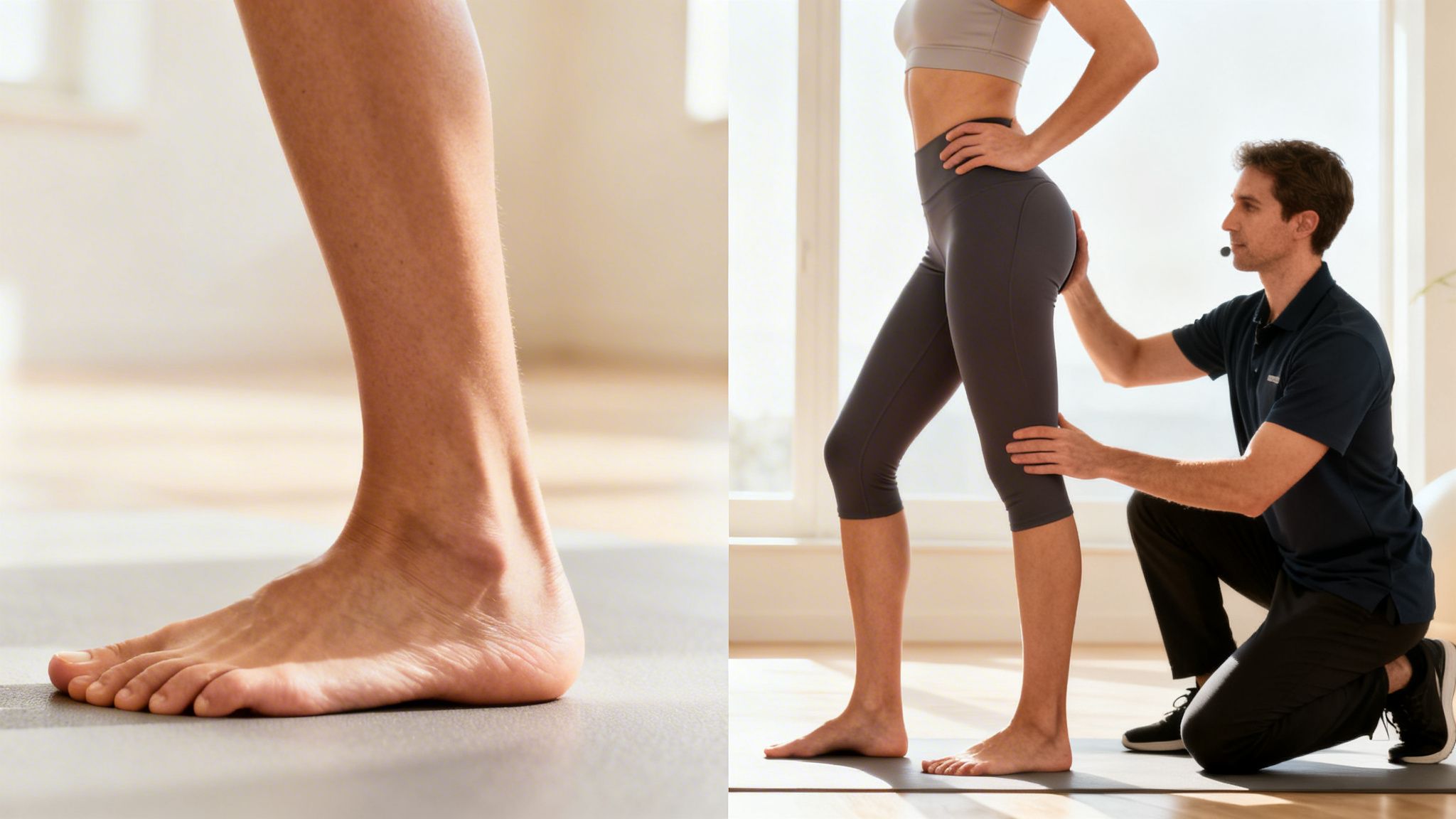
After we've finished the analysis, we get to the most important part of your visit: connecting the dots. It’s one thing to get a diagnosis, but it’s another to truly understand what it means for you.
We make sure you leave knowing not just the “what,” but also the “so what?” and, most importantly, the “what’s next?”
Modern gait analysis has come a long way, especially since its rapid growth in the 1970s and 80s. Today, we can precisely measure key details like your step length, foot angle, and cadence. This level of detail allows us to define movement abnormalities with confidence, as you can see from the evolution of gait analysis techniques.
Identifying the Root Cause
Our job is to sift through that data and pinpoint the specific movement patterns contributing to your pain or inefficiency. We connect what we see on the screen directly to what you’re feeling every day.
A few common culprits tend to show up again and again:
- Overpronation: This is when your foot rolls too far inward after your heel strikes the ground. It's a classic contributor to things like plantar fasciitis and shin splints because it sends disruptive forces right up the kinetic chain.
- Hip Drop (Trendelenburg Gait): If one hip drops noticeably lower than the other when you walk, it's often a telltale sign that your glute muscles aren't firing on all cylinders. This can put extra strain on your lower back, hip, and IT band.
- Shortened Stride Length: This is usually a compensation pattern. Your body is trying to protect an injury or avoid pain. It can also point to tight hip flexors or weak glutes that are limiting your ability to push off powerfully.
Creating Your Personalized Action Plan
Spotting the problem is only half the battle. The next step is building a specific, actionable plan that gets to the root cause of the issue.
Our goal is simple: give you the exact tools you need to fix the problem and keep it from coming back. We don’t do generic, one-size-fits-all programs. Your plan is built for your body, your movement patterns, and your goals.
Depending on what we find, your plan will likely involve a few different strategies working together. If overpronation is the main issue, for instance, we’ll start with specific exercises to strengthen the small muscles in your feet, building up your arch support from the inside out. For more significant cases, we might also explore if you’re a good candidate for our custom orthotics program to give your foot immediate support while we work on the long-term fix.
If we see a hip drop, the focus shifts. We’ll design a targeted program to wake up and strengthen those crucial hip stabilizer muscles. This might include hands-on manual therapy to improve mobility, specific stretches, and drills to retrain your brain-body connection so that better movement becomes your new normal.
What to Expect During Your Gait Analysis
Coming in for a gait analysis can feel a bit uncertain if you’ve never done one before. We get it. Our goal is to make the entire process straightforward, supportive, and focused completely on you.
From the moment you walk in, your appointment is a dedicated, one-on-one session with an expert physical therapist. The first thing we do is simply listen. We'll sit down and have a real conversation about your injury history, your goals, and what you’ve been feeling. This initial discussion is critical—it gives us the context we need to guide the entire physical assessment.
The Analysis Process
Once we have a clear picture of your background, we get you moving. We'll have you walk or run on a treadmill for a few minutes while we capture video from multiple angles. This isn't about performance; it's about observing your natural movement patterns.
To get an accurate look, it’s best to wear comfortable workout clothes that allow for a full range of motion. And definitely bring the shoes you use most often. Whether they’re your daily walkers or your trusted running shoes, they are a key piece of the puzzle.
After we’ve recorded the video, we get right to the good part. There's no waiting around for a report to show up in the mail weeks later.
We’ll pull up the video on a screen and review the findings with you, right then and there. We slow it down, frame by frame, and point out exactly what we see—like a slight hip drop or the way your foot lands—and explain what it all means in plain language.
Creating Your Plan of Care
This collaborative review is where everything clicks. Seeing your own movement on screen helps connect the dots between what you're feeling and the underlying mechanics causing it. From there, we work together to build a personalized plan designed to address the root causes we identified.
Our goal is to make the experience as seamless as possible. You can find more details about our specific approach in our Running Performance Evaluation program. Our administrative team handles all the insurance and billing details for you, so you can focus all your energy on what really matters: getting back to moving with confidence.
Frequently Asked Questions About Gait Analysis
We get it. The idea of a "gait analysis" can bring up a lot of questions. We want you to feel completely confident and clear about what to expect, so we've answered a few of the most common ones we hear around the clinic.
How Long Does a Gait Analysis Take?
Plan on being with us for about 60 minutes. This gives us the dedicated one-on-one time we need to be thorough.
That hour is broken down into a few key parts:
- The Conversation: We start by listening. We need to understand your history, what you've been feeling, and what your goals are.
- The Analysis: This is the movement portion where we observe, record, and analyze how you walk and run.
- The Plan: We’ll walk you through what we found and collaborate with you on a personalized plan to get you moving better.
Is Gait Analysis Covered by Insurance?
For most people, yes. A gait analysis isn't some separate, add-on procedure. It’s a critical diagnostic tool that’s part of a standard physical therapy evaluation.
Because it's used by your therapist to diagnose the root cause of your issue, it's typically covered by most health insurance plans just like any other part of your PT visit. Our administrative team will happily verify your specific benefits before your appointment so there are never any surprises.
Do I Need a Doctor's Referral?
No, you don't. Thanks to Direct Access laws here in Massachusetts, you can schedule an appointment directly with a physical therapist without seeing your doctor first. This lets you get the help you need, sooner.
A big part of our evaluation is understanding the phases of your gait cycle—the standardized pattern your body follows with every step. The stance phase (when your foot is on the ground) makes up about 60% of the cycle, while the swing phase takes up the other 40%. Tracking these details helps us pinpoint asymmetries and measure your progress over time. You can read more on how the gait cycle is used for treatment evaluation and outcome tracking.
Ready to stop guessing and start understanding the root cause of your pain? The expert team at Joint Ventures Physical Therapy is here to provide the clarity and personalized care you need to move better.