At its core, orthopedic physical therapy is a specialized field of healthcare that zeroes in on injuries and conditions affecting your body’s movement system. We’re talking about everything that helps you move—your muscles, bones, joints, ligaments, and tendons. We know you’re not looking for a generic sheet of exercises. You're looking for real answers and a plan that gets you back to your life. That's exactly what we do.
Your Body’s Expert Mechanic
I often tell my patients to think of an orthopedic physical therapist as an expert mechanic for their body. When a check engine light flashes on your car's dashboard, you don't just ignore it. You take it to someone who can pop the hood, run diagnostics, and create a specific plan to fix it.
We do the exact same thing for the human body. Whether you're dealing with a nagging sports injury, recovering from surgery, or wrestling with back pain that just won't quit, our job is to find the root cause. We aren't just treating symptoms; we’re digging in to understand the "why" behind your pain.
A Partnership in Your Recovery
From the moment you walk through our doors, this process is a partnership. We start by listening—and we mean really listening—to your story. How did this happen? What exactly does the pain feel like? And most importantly, what do you want to get back to doing without pain holding you back?
Your goals drive the entire process. Whether it's running the Marathon, lifting your kids without wincing, or just getting through a workday comfortably, our focus is on building a personalized roadmap to get you there.
This one-on-one approach is what makes orthopedic physical therapy so effective. It’s our commitment to you: your treatment plan will be built around your unique body, your lifestyle, and your goals. You can learn more about our philosophy and the different types of physical therapy services we offer.
To give you a better idea, here's a quick look at the wide range of issues we successfully treat every single day.
Common Conditions We Treat with Orthopedic PT
| Category | Specific Examples |
|---|---|
| Spine & Back Pain | Herniated discs, sciatica, spinal stenosis, general low back and neck pain |
| Joint Pain & Arthritis | Osteoarthritis in the knee, hip, or shoulder; rheumatoid arthritis management |
| Post-Surgical Rehab | ACL reconstruction, rotator cuff repair, joint replacements, spinal fusion |
| Sports Injuries | Sprains, strains, tendonitis, runner's knee, tennis elbow, shoulder impingement |
| Overuse & Repetitive Strain | Carpal tunnel syndrome, plantar fasciitis, shin splints |
| Head & Jaw Issues | TMJ/TMD (jaw pain), headaches, dizziness and vertigo |
This is just a snapshot. The principles of orthopedic PT can be applied to almost any issue affecting your muscles, joints, and movement.
Why Orthopedic PT Is So Common
If you feel like you know a lot of people who have needed this kind of care, you're not wrong. Problems with our muscles and joints are incredibly common, making this field a cornerstone of modern healthcare.
In fact, it’s so prevalent that it dominates the global rehabilitation market. One market analysis found that orthopedic care was projected to generate 38.53% of all physical therapy revenue in 2025. That number is a powerful testament to how many people rely on this approach to get back on their feet and move without pain. You can read more about the growth of the physical therapy market in this detailed report.
Ultimately, our goal isn't just to get you out of pain. It's to empower you with the knowledge and tools to move forward with strength and confidence, so you can get back to the life you love.
What to Expect at Your First PT Evaluation
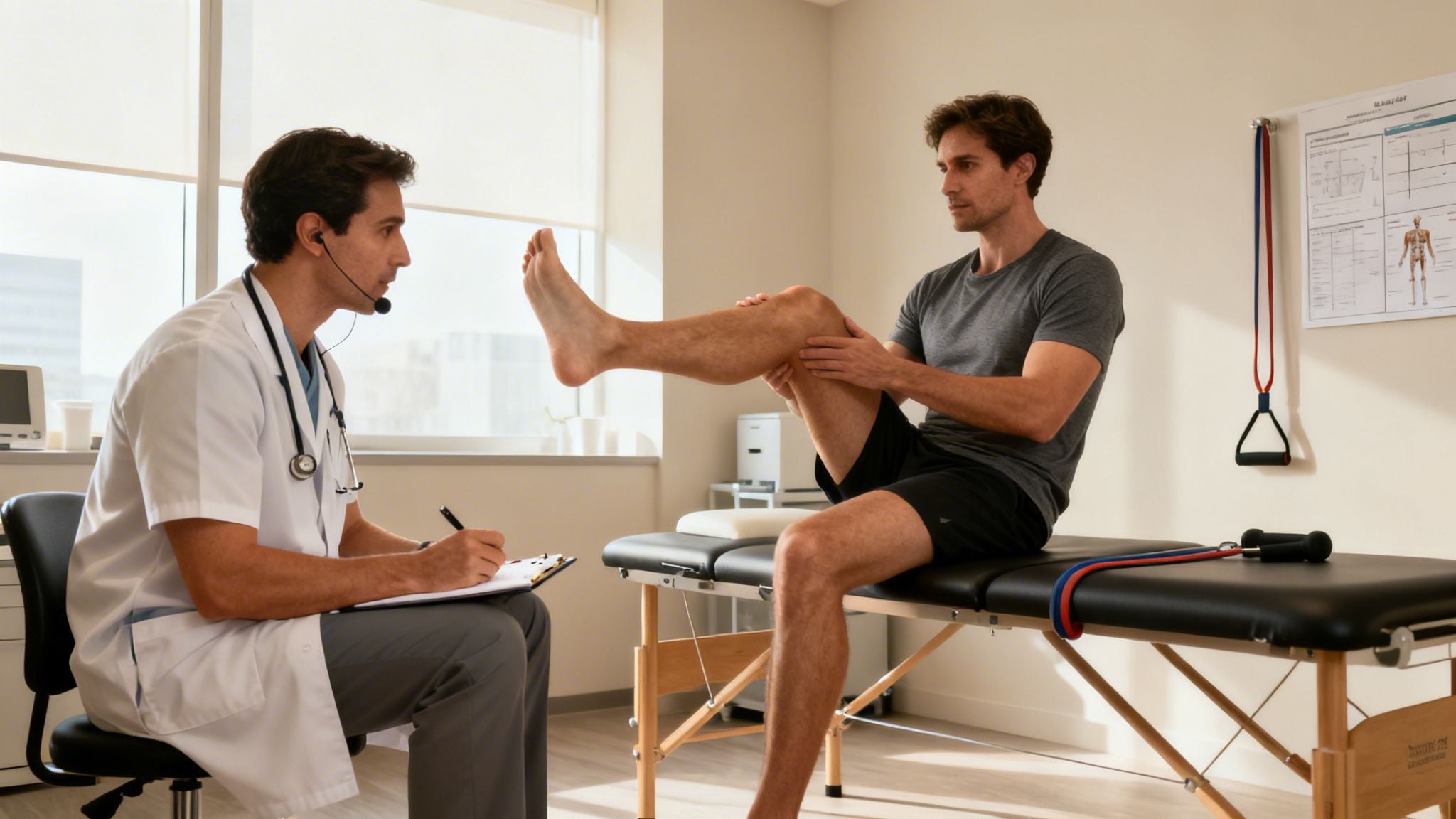
Walking into a new clinic for the first time can feel a little uncertain. We get it. That’s why we want to pull back the curtain and show you exactly what happens during your initial evaluation.
Think of this first one-on-one session not as a test, but as the official start of your recovery. It’s where we lay the groundwork for everything that comes next.
This visit is all about connection and discovery. It always begins with a real, un-rushed conversation. We’re not just looking at a chart; we’re getting to know you.
The Conversation: The Subjective Exam
Your therapist will start by simply asking you to share your story. This is the single most important part of the evaluation because no one knows your body better than you do. We’ll ask questions to help us understand the full picture.
What can you expect to discuss?
- The Injury Itself: How and when did the pain start? Was it a sudden event or something that developed over time?
- Your Pain Experience: What does it feel like—sharp, dull, aching, burning? What makes it better or worse?
- Your Daily Life: How is this issue affecting your work, your hobbies, or even just simple things like sleeping or walking up stairs?
- Your Ultimate Goals: This is the big one. We want to know what success looks like for you. Is it running another race, playing with your grandkids, or simply being able to sit at your desk without pain?
This conversation is a two-way street. It's your chance to ask us questions and feel confident that you’re in the right place. We’re here to listen and make sure you feel heard from day one.
Your story guides our hands and our thinking. Every detail you share helps us form a hypothesis about what’s going on, leading us directly to the root cause of your problem instead of just chasing symptoms.
The Physical Assessment: The Objective Exam
After we talk, we move on to the hands-on portion of your evaluation. This is where your physical therapist puts their detective hat on, using their expertise to assess how your body moves. It’s a systematic process to confirm or adjust the ideas we formed while listening to you.
Your therapist will expertly guide you through a series of tests and movements tailored to your specific issue. This isn’t a workout; it’s a detailed investigation. We’ll carefully look at a few key areas:
- Range of Motion: We will check how much movement you have in the affected joint and the areas around it, both when you move it yourself (active range of motion) and when the therapist moves it for you (passive range of motion).
- Strength Testing: We’ll assess the strength of key muscle groups to identify any weakness or imbalances that could be contributing to your pain or limiting your function.
- Special Tests: These are specific, hands-on tests designed to pinpoint which structure—like a particular ligament, tendon, or muscle—is causing the problem.
- Functional Movement: We might ask you to perform a simple activity that you’ve told us is difficult, like a squat, a step-up, or reaching overhead. This shows us your movement patterns in real-time.
By the end of this comprehensive evaluation, we will have a clear clinical diagnosis. We’ll explain our findings in plain language, making sure you understand exactly what’s happening in your body and how orthopedic physical therapy is going to help.
This collaborative session builds the foundation for a treatment plan that’s 100% designed for you.
How We Build Your Personalized Treatment Plan
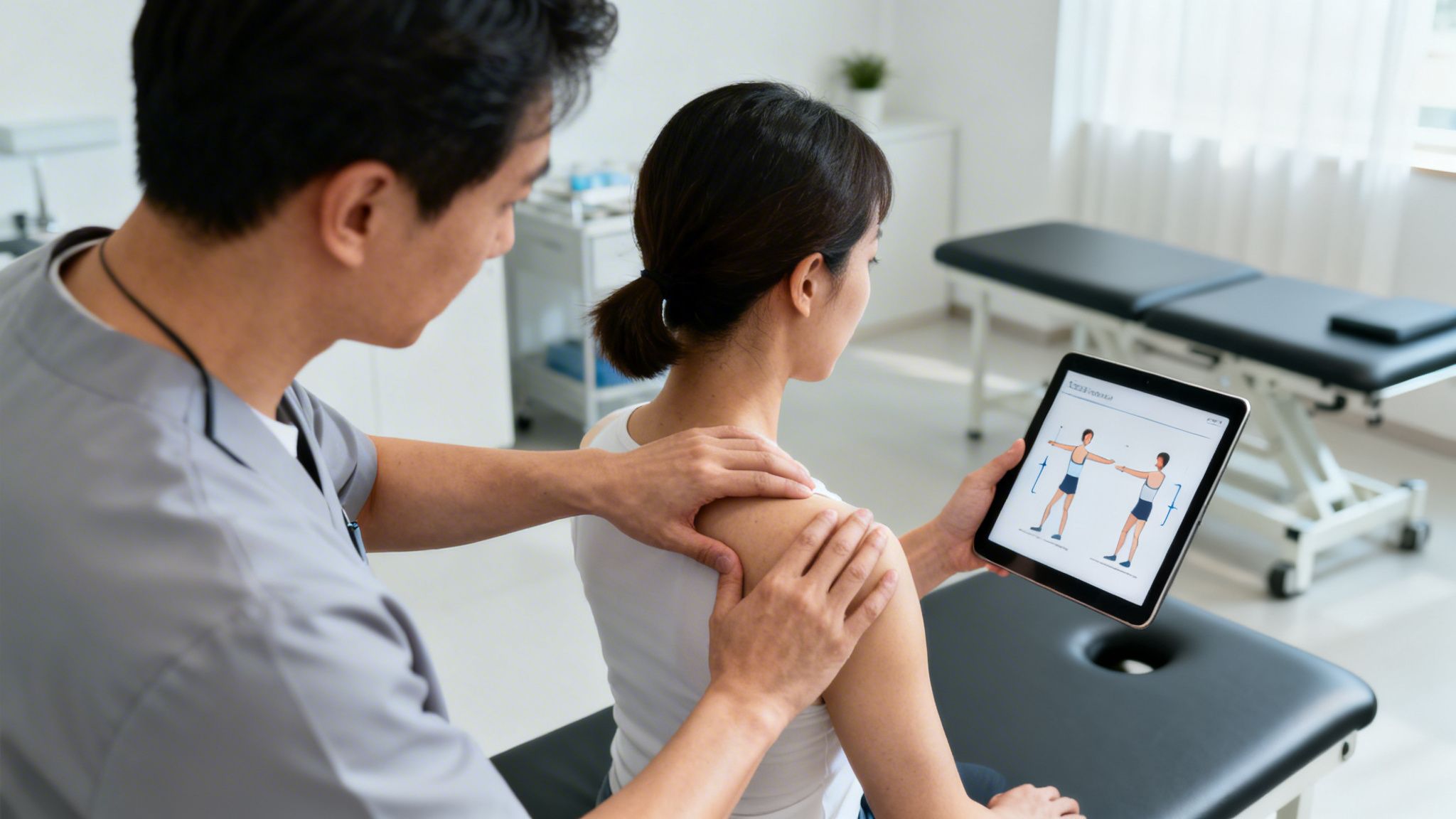
Your initial evaluation gives us a clear picture of what's happening. Now, the real work begins. This is where our one-on-one approach makes all the difference, because a successful recovery is never a one-size-fits-all script. We build a plan specifically for you.
Think of your treatment plan less like a static prescription and more like a dynamic roadmap we navigate together. It's built around three core components that work in tandem: skilled hands-on work, targeted exercise, and powerful education. Your feedback is what keeps us heading in the right direction.
The Power of Touch: Manual Therapy
The first component is manual therapy. This is the specific, hands-on work your physical therapist uses to directly treat your joints and soft tissues—your muscles, ligaments, and fascia. It’s far more than just a massage; these are targeted techniques designed to get a specific result.
We use manual therapy because it allows us to create change—fast. It’s a cornerstone of orthopedic PT for a few key reasons. It helps to:
- Decrease Pain: By calming down irritated nerves and tissues.
- Improve Mobility: By mobilizing stiff joints and releasing tight muscles that are holding you back.
- Reduce Swelling and Inflammation: By improving circulation to the injured area.
This hands-on approach helps us break the cycle of pain and stiffness. It creates a window of opportunity where you can move more freely, which sets the stage for the next, crucial part of your plan.
Building Strength and Resilience: Therapeutic Exercise
With pain more under control and mobility improving, we bring in the second element: therapeutic exercise. This is where we start to rebuild. These aren't random exercises you'd find in a generic online search; every single one is chosen to fix the specific weaknesses and faulty movement patterns we found in your evaluation.
The goal here is simple: restore function and build resilience. We’re not just strengthening the injured part. We're strengthening the entire system around it to make sure this problem doesn’t come back.
Your exercise program will be progressive. That just means it will adapt and become more challenging as you get stronger. We might start with very gentle activation exercises and slowly build toward more complex, functional movements that directly mimic the activities you need and want to get back to. This is how we turn short-term relief into lasting results.
The Missing Piece: Your Role as an Educated Patient
Finally, we have what is arguably the most important element: patient education. We don't just want to tell you what to do. We are committed to making sure you understand the why behind every technique and exercise.
We’ll teach you about your condition, what’s actually causing the pain, and how your body’s healing process works. This knowledge is what gives you control. It empowers you to understand what to do if symptoms flare up and how to modify your day-to-day activities to keep making forward progress.
Your active participation is what makes the plan work. Your feedback helps us fine-tune everything as we go, constantly adjusting based on how your body is responding. This collaborative approach ensures you feel in control every step of the way on your path back to health.
Advanced Therapies for Faster Recovery
Sometimes, manual therapy and corrective exercise are all you need. But for stubborn injuries or complex conditions, a standard approach just won’t get you back to 100%. That’s when we bring in more specialized tools.
At Joint Ventures, we invest heavily in advanced training and specialized services to solve the problems that don't respond to foundational PT alone. These aren’t trends or gimmicks; they're evidence-based therapies designed to target the root cause of your pain and speed up your recovery.
Sports Rehab for the Modern Athlete
Athletes simply operate on a different level. The demands you place on your body—whether you’re a weekend warrior logging miles on the Esplanade or a professional athlete—require a specialized approach to rehab.
We don’t just treat the injury. We dig deeper. Our sports rehab team analyzes your movement patterns to find the biomechanical flaws that caused the problem in the first place. The goal isn’t just to get you back on the field or in the gym; it's to rebuild you into a more efficient and resilient athlete, stronger than you were before.
Pelvic Floor Physical Therapy
Pelvic floor PT is a vital and often misunderstood part of orthopedic physical therapy. It’s a highly specialized service for anyone dealing with issues related to the pelvic girdle—the network of muscles supporting your bladder, bowel, and reproductive organs.
This isn’t just for one type of person. We see:
- Postpartum Women: Dealing with the after-effects of childbirth, like diastasis recti, perineal tearing, or pain.
- Anyone with Pelvic Pain: For chronic pain that impacts the pelvis, abdomen, or lower back.
- Individuals with Incontinence: Helping manage leakage that happens when you cough, sneeze, or exercise.
Our therapists who focus on pelvic health approach these sensitive issues with deep expertise and compassion, creating a safe and private space for you to heal and regain control.
Vestibular Rehab for Dizziness and Balance
Feeling dizzy, unsteady, or off-balance can completely derail your life. It shakes your confidence and makes even simple tasks feel like monumental challenges. Vestibular rehabilitation is a powerful therapy designed to treat problems within your inner ear and brain, the systems that govern your balance.
If the world feels like it’s spinning or you just feel unsteady on your feet, vestibular therapy can feel life-changing. We use specific head, eye, and body exercises to essentially "retrain" your brain to correctly interpret signals from your inner ear, which reduces dizziness and improves your stability.
Trigger Point Dry Needling
Have you ever had a muscle knot that just won't quit, no matter how much you stretch or foam roll it? Those stubborn, painful spots are often trigger points, and they can be a major source of chronic pain, stiffness, and referred pain to other areas.
Trigger Point Dry Needling is a technique our trained physical therapists use to release these knots for good. A PT inserts a very thin, sterile needle directly into the trigger point, which causes the tight muscle to twitch and then, finally, relax. This release can dramatically reduce pain and restore your range of motion, often providing relief when other methods haven't worked. If you're curious, you can learn more about how we use Trigger Point Dry Needling to treat stubborn muscle pain.
Which Specialized Therapy Is Right for You?
Not sure which service fits your needs? This table breaks down which therapy is often the best fit for specific symptoms and goals.
| Specialized Service | Best For Patients Experiencing… | How It Helps |
|---|---|---|
| Sports Rehab | Nagging sports injuries, post-surgical recovery, or a desire to improve athletic performance. | Analyzes movement patterns to correct biomechanics, build resilience, and enhance performance. |
| Pelvic Floor PT | Postpartum issues, urinary incontinence, pelvic pain, or pain with intercourse. | Strengthens and coordinates pelvic floor muscles to restore function and reduce pain. |
| Vestibular Rehab | Dizziness, vertigo, unsteadiness, or balance problems after a concussion or illness. | Retrains the brain and inner ear connection through specific exercises to improve stability. |
| Dry Needling | Stubborn muscle knots, chronic tightness, headaches, and referred pain that won't go away. | Releases tight trigger points in muscles to immediately reduce pain and improve mobility. |
This is just a starting point. Your physical therapist will conduct a full evaluation to determine the best and most direct path to get you feeling better.
This shift toward specialized services is happening for a reason. While the general PT market is projected to grow at 5.7% annually, sports-injury therapy is forecasted to surge at 10.85% per year through 2031. This is driven by a growing demand for advanced care that helps people recover fully from injuries and surgeries. To go along with your clinical care, it's also worth exploring how nutrition can play a role, as certain supplements for faster recovery can support your body's healing process.
Moving Beyond Recovery to Performance and Prevention
Finishing a round of orthopedic physical therapy doesn’t mean our work together is over. For us, getting you out of pain and back to your daily life is just step one.
Our real goal is to help you move beyond recovery and become stronger, more efficient, and more resilient than you were before you got hurt. This is where we shift from reacting to an injury to proactively building a body that’s ready for anything you throw at it.
This flowchart shows how we map out that journey. Depending on your symptoms and goals, the path might lead toward more specialized care designed not just to heal, but to optimize.
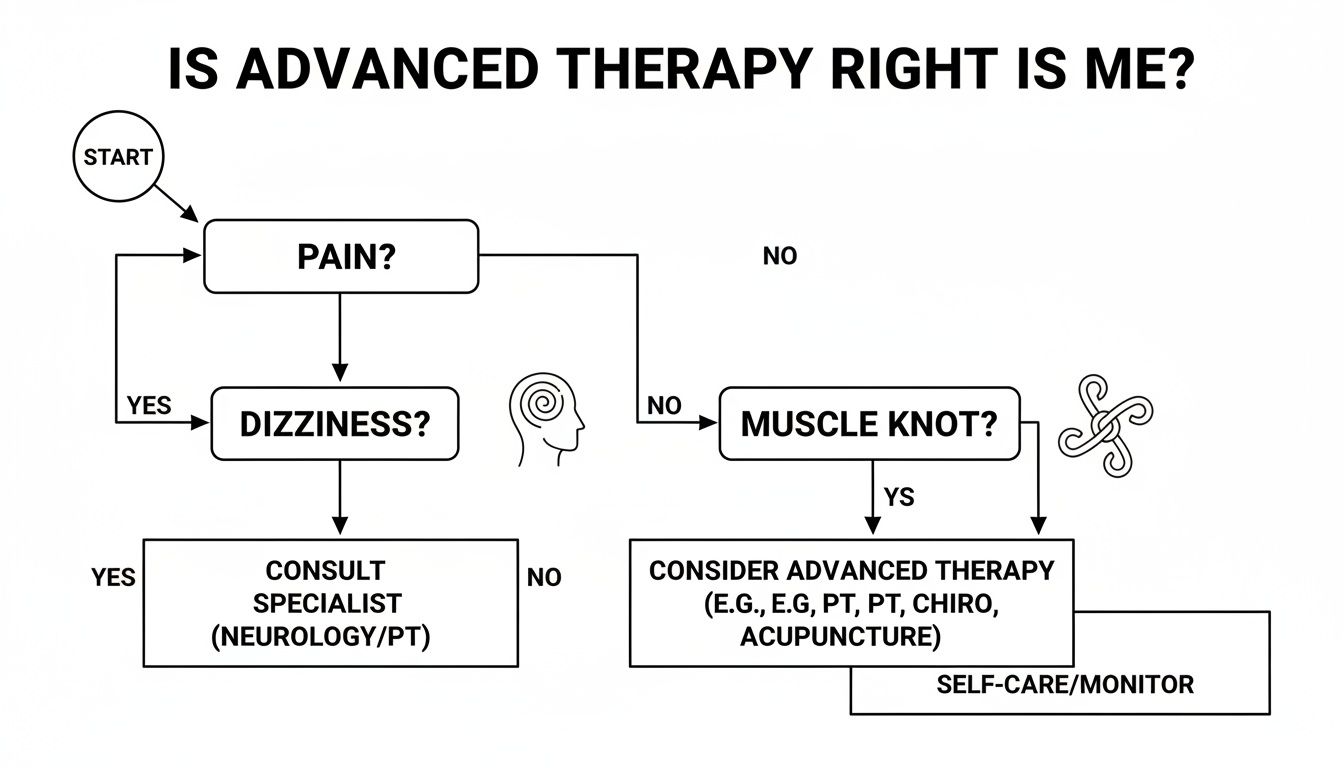
Whether you start with pain, dizziness, or a performance goal, there’s a clear path toward a higher level of function.
Beyond Rehab: The Power of “Prehab”
Everyone talks about "rehab," but we are huge believers in "prehab"—the process of finding and fixing movement imbalances before they cause an injury. Think of it like preventative maintenance for your body.
During a prehab screening, we analyze the way you move. We’re hunting for the subtle asymmetries, weak spots, or hidden restrictions that create a higher risk for injury. It’s always easier to address these things proactively than it is to heal a torn ligament after the fact.
Prehab is an investment in your future. By correcting faulty movement patterns now, you’re actively reducing your chances of getting sidelined down the road. It’s about taking control.
This is absolutely critical for athletes. Our ACL prevention programs, for example, are built to teach athletes how to jump, land, and change direction with safer mechanics, dramatically lowering the risk of this all-too-common knee injury. You can dig deeper into that specific approach in our guide to the ACL Prevention Program.
Unlocking Your Peak Performance
For runners, golfers, and other athletes, tiny flaws in your form don’t just hold back your performance—they’re often the root cause of nagging injuries.
That’s exactly why we offer specialized video analysis to break down your movement, frame by frame.
- Running Evaluations: We analyze your gait to spot issues with your stride, foot strike, or cadence. Fixing these can help you run faster and more efficiently, but most importantly, without pain.
- Golf Performance Evaluations: In partnership with Titleist, we screen for physical limitations that are holding back your golf swing, helping you unlock more power and consistency while avoiding common injuries like golfer’s elbow or low back pain.
Building Your Foundation for Long-Term Health
True prevention goes way beyond the clinic walls. It means looking at every factor that puts stress on your body all day long.
We provide custom orthotic fitting because your feet are the foundation for everything. Poor foot mechanics can send a chain reaction of problems right up through your knees, hips, and back. A custom orthotic gives your body the specific support it needs to stay aligned.
Our ergonomic consultations are also designed to head off the aches and pains that build up from your work environment. We help you dial in your desk, chair, and monitor setup to take the strain off your neck, back, and wrists for good.
We’re not just here to fix you when something is wrong. We’re here to be your long-term partners in health, giving you the expert guidance and tools you need to protect your body for years to come.
Frequently Asked Questions About Orthopedic PT
Starting physical therapy can bring up a lot of questions. That’s completely normal. We want you to feel confident and informed from your first appointment to your last, so we’ve put together straight answers to the questions we hear most often.
Think of this as your guide. Our goal is to make the entire process feel clear and supportive, so you can focus on what matters most—getting better.
Do I Need a Doctor's Referral to Start PT?
This is a great question, and the answer is one of our favorites. In Massachusetts, you do not need a physician's referral to start orthopedic physical therapy. This is because of a law called Direct Access.
Direct Access means you can schedule an appointment with us the moment you feel pain or get injured. You don't have to wait. Getting a head start on treatment often leads to a faster recovery and better results. And of course, we’ll always keep your doctor in the loop on your progress.
What Should I Wear to My Appointments?
The best advice is to dress for movement. We recommend wearing loose, comfortable clothing that won’t restrict you, almost like what you’d wear for a light gym workout.
- For lower body injuries like a knee, hip, or ankle issue: Shorts or loose-fitting pants are perfect.
- For upper body problems in your shoulder, neck, or back: A comfortable t-shirt or tank top works great.
This allows your therapist to clearly see and assess the area without your clothes getting in the way. We have private treatment rooms and changing areas, so your comfort and privacy are always a priority.
How Long Will My Treatment Plan Take?
There’s no one-size-fits-all answer here. Your treatment plan is built entirely around you. The timeline depends on things like the type and severity of your injury, how long you’ve been dealing with it, and what your personal goals are.
After your initial evaluation, your physical therapist will lay out a recommended plan. A typical starting point might be 1-2 visits per week for 4-8 weeks, but that's just an estimate. We constantly track your progress and adjust the plan as you heal and get stronger.
Our focus is always on giving you the tools to succeed long-term. Sometimes, that includes recommending equipment for you to use at home. To help maintain your mobility and independence after therapy, it can be helpful to understand the different types of durable medical equipment available.
Your Path to Healing Starts Here
Deciding to finally address an injury or nagging pain is a huge first step. But the path back isn't one you have to walk alone. Recovery isn't a solo mission—it's a partnership.
Our entire team gets this. From the clinicians guiding your recovery to the administrative staff who handle the insurance and scheduling headaches for you, we are all focused on one thing: getting you back to your life. This is why we insist on dedicated, one-on-one care where the plan is built with you, not just for you.
A Partnership Built on Results
Your recovery is a team effort, and you’re the most important person in the room. We bring the clinical expertise and hands-on treatment; you bring the commitment to your own goals. We'll listen to what you've been through, watch how you move, and map out a plan that actually makes sense for your body and your life.
The goal is always to move you forward. We're not just treating a body part; we're helping a person get back to running, working, playing, and living on their own terms.
We’ll also explain the "why" behind every stretch and exercise. When you understand the purpose of each movement, you gain the control and confidence to manage your health long after you’ve left our clinic. That shared understanding is what makes recovery stick.
If you’re tired of being held back by pain, stiffness, or an old injury that won’t quit, let's work together to change that. We're ready to show you what’s possible when you have the right team in your corner.
At Joint Ventures Physical Therapy, we're committed to providing the one-on-one care you deserve. If you're ready to start your journey to recovery, schedule your first appointment with us today.