
Knee pain in Boston rarely shows up at a convenient time. It starts during a marathon build on the Charles, after a few weeks of stairs at Park Street, or halfway through a workday in the Financial District when standing up from your desk suddenly feels stiff and sharp. Some people notice it after pickup basketball, some after a long flight and a rushed walk to South Station, and some when they try to get back to training after having a baby.
A common initial approach involves waiting a week, stretching a little, maybe foam rolling, maybe skipping a run, then testing it again. Sometimes that calms things down. Often it doesn't, because knee pain is a symptom, not a full diagnosis.
That’s why knee pain physical therapy Boston patients need has to be more specific than generic exercise sheets or a quick look at the painful spot. The right plan identifies what’s driving the pain, what movements keep provoking it, and what your knee needs to tolerate if your goal is getting back to running, lifting, commuting, or moving through the city without thinking about every step.
Is Knee Pain Slowing You Down in Boston
A runner training before work in Back Bay feels the knee on downhills first. Then it shows up on stairs. A consultant working long days downtown notices aching after sitting, then a catch when standing. An active parent in Brookline feels fine walking short distances but dreads kneeling, squatting, or chasing a kid through the park.
That frustration is specific to Boston. This city expects movement. You walk more, climb more stairs, squeeze workouts into narrow windows, and keep going through winter sidewalks, crowded commutes, and packed schedules. When your knee starts limiting that rhythm, it affects more than exercise.

It’s not only about pain relief
A lot of Boston physical therapy marketing talks to people who are already hurt. That matters, of course. But many active adults want help before the problem becomes a setback. They want to know why the same knee tightness keeps showing up every training block, whether their mechanics are putting extra load through the joint, or how to stay durable through a marathon cycle or ski season.
That prevention gap matters for:
- Runners building mileage who want to stay ahead of recurring pain
- Court and field athletes who need better load tolerance, not just rest
- Professionals with long desk days who want to stop stiffness before it becomes a bigger issue
- Active older adults who want to keep hiking, golfing, and traveling without losing confidence in the knee
Practical rule: If your knee pain changes how you move, changes what you avoid, or keeps returning when activity picks up, it deserves a real evaluation.
What usually doesn’t work
The common self-directed cycle is familiar. Rest until it fades. Test it. Flare it. Repeat.
That approach fails when the true driver sits somewhere else, such as hip control, load management, a meniscus irritation, osteoarthritis, or referred pain from tight and overloaded muscle. It also fails when the plan doesn’t match your actual goal. The treatment for “walk comfortably at work” and “run a strong spring marathon” can overlap, but they aren’t identical.
Identifying Your Knee Pain Source in Boston
Knee pain works like a check engine light. The light matters, but it doesn’t tell you which part needs attention. If you treat every knee pain case the same way, you miss the reason it started.
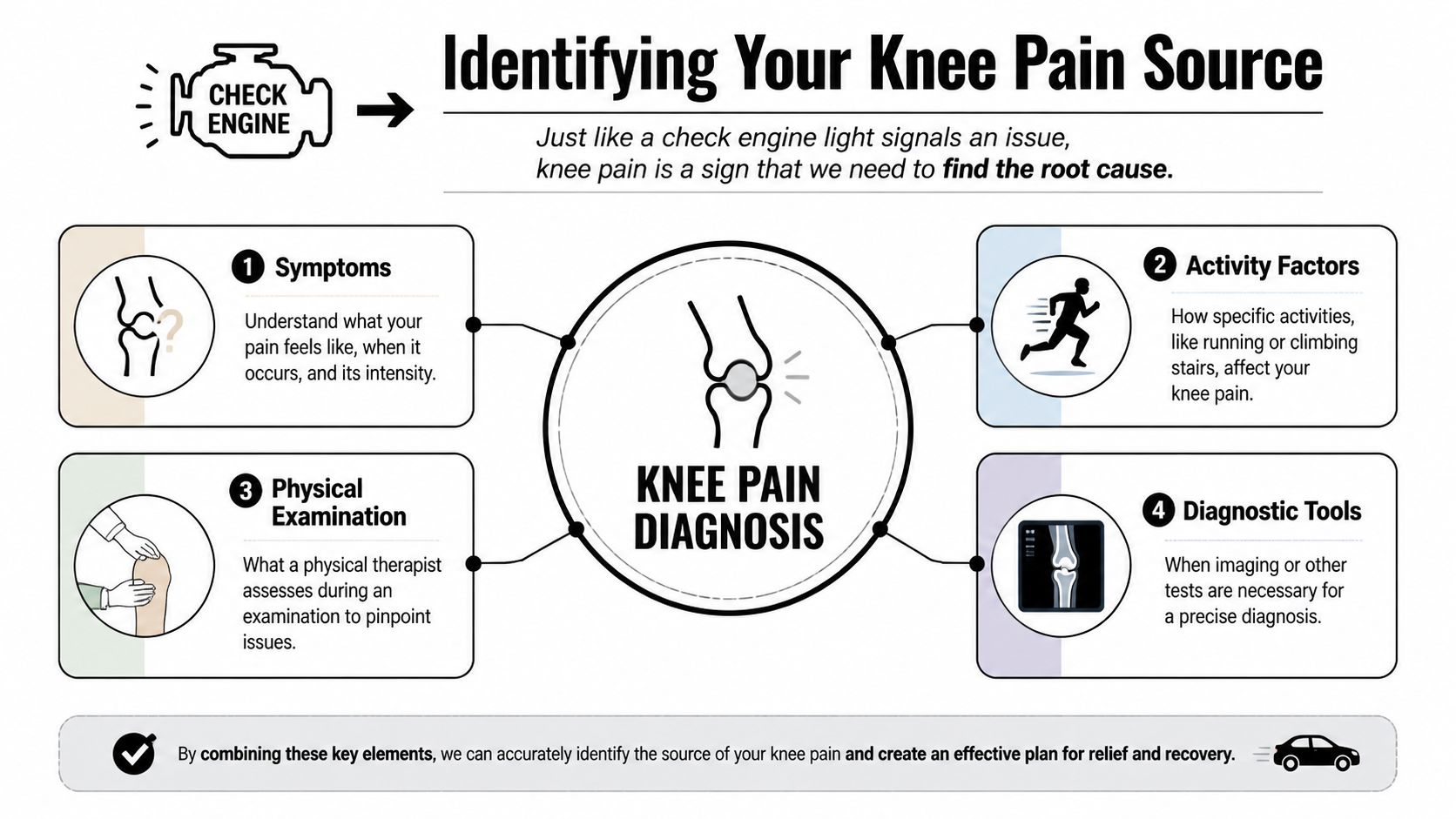
Three broad sources we look for
Some knee pain is mostly joint and tissue related. That includes meniscus irritation, ligament injury, patellofemoral overload, or joint stiffness after surgery.
Some is more degenerative or load-sensitive. In knee osteoarthritis, physical therapy is a common and evidence-based management strategy. In a study of 348 patients with established knee osteoarthritis, 181 patients (52.0%) reported using physical therapy to manage their condition, and evidence-based care including exercise, manual therapy, and education has been shown to improve pain, function, and activity in people with knee osteoarthritis in the published research on PT use and effectiveness for knee OA.
A third category is myofascial and movement-driven. The painful spot is the knee, but the overload may come from the quad, calf, hip, or how your body handles force in a squat, stair climb, or running stride.
What a strong evaluation actually checks
A useful exam looks at more than tenderness. We want to know what the knee does under real demand.
| What we assess | Why it matters |
|---|---|
| Pain pattern | Tells us whether symptoms behave more like load sensitivity, irritation, stiffness, or instability |
| Movement quality | Shows where your body loses control in stairs, squats, landing, or running |
| Strength and mobility | Helps identify what the knee is compensating for |
| Training or work demands | Keeps the plan grounded in Boston life, not generic rehab |
| Need for imaging or referral | Flags when PT should coordinate with an orthopedic specialist |
A gait review can also be useful when symptoms show up during walking or running. If you want a better sense of what clinicians are looking for, this guide on what gait analysis is gives a practical overview.
Knee pain location matters. Knee pain behavior matters more.
Why diagnosis changes treatment
A landmark Mass General Brigham study found that participants with knee osteoarthritis and meniscal tears improved significantly with physical therapy, and those combining home exercise with PT reported substantially improved knee pain at 3, 6, and 12 months in the Mass General Brigham report on home exercise and PT for knee pain. That matters because it reinforces a simple point. The goal isn’t to label every painful knee as “wear and tear” or “runner’s knee” and stop there. The goal is to match the plan to the actual problem.
Understanding Trigger Points and Referral Pain
Some of the most stubborn knee pain doesn’t start in the knee. That surprises patients all the time.
A trigger point is a highly irritable spot in muscle. People often describe it as a knot, but that word doesn’t fully capture it. It’s better to think of it as a small area of muscle that stays guarded, sensitive, and inefficient, then starts spreading stress to nearby structures.
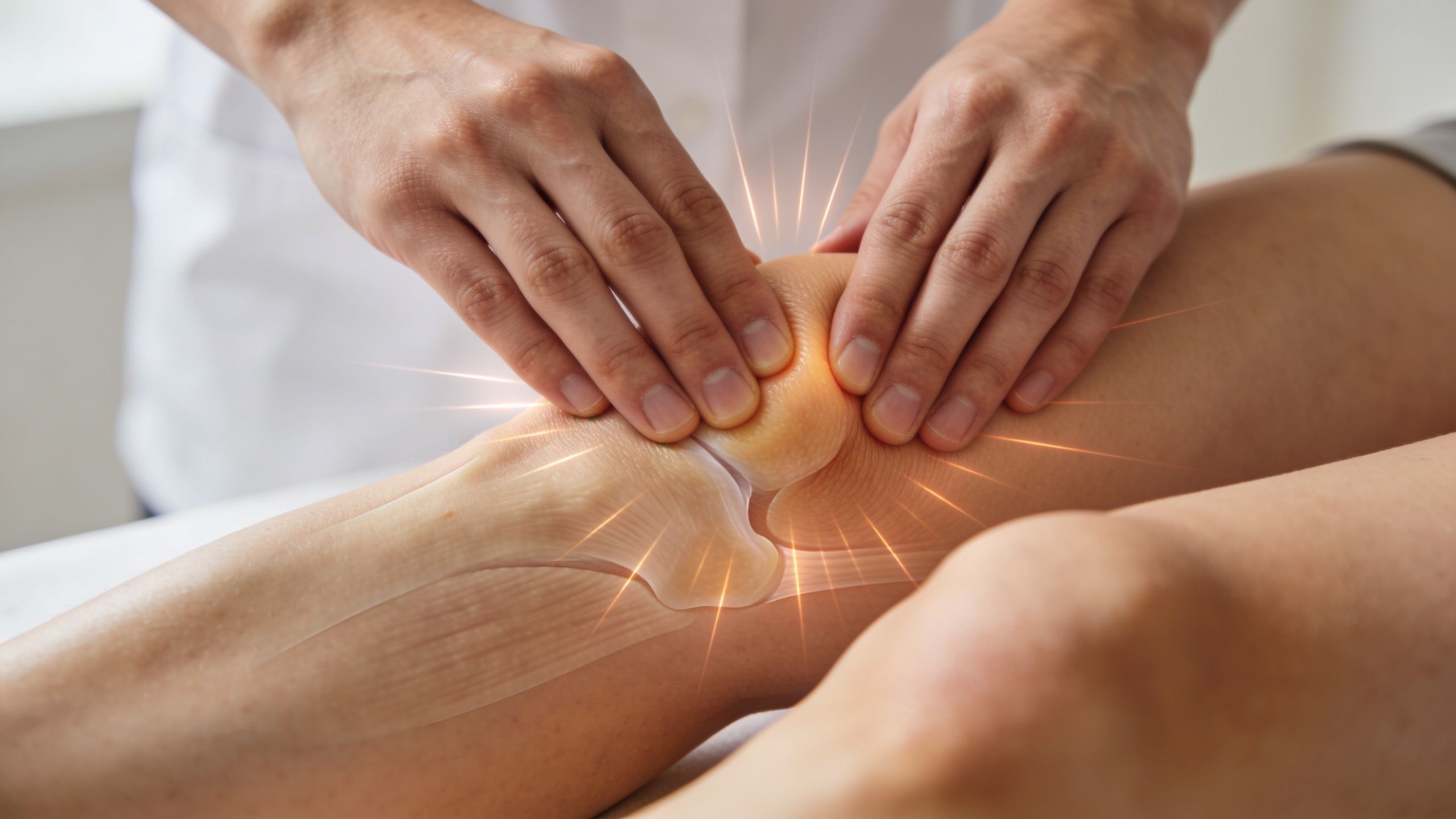
Why pain can show up away from the source
Referral pain works like faulty wiring in a house. The problem starts in one place, but the signal shows up somewhere else. A tight quadriceps muscle can create pain around the kneecap. A hip muscle that isn’t handling load well can make the outside of the knee feel like the issue. A calf that stays overworked can change mechanics enough that the knee starts absorbing force it doesn’t want.
This is one reason quick, symptom-only treatment often falls short. If you only ice the knee, tape the knee, or stretch the knee without addressing the overloaded muscle above or below it, the pain often returns as soon as activity resumes.
What trigger point driven knee pain often feels like
These cases don’t all present the same way, but there are some patterns:
- Pain that seems vague or hard to pinpoint
- Tenderness in the thigh, hip, or calf along with knee symptoms
- Symptoms that return with repetitive activity
- A feeling that the knee is tight, achy, or full, even when joint testing is fairly normal
Patients also notice that certain spots in the muscle reproduce their knee pain almost exactly when pressed. That’s a useful clinical clue.
A visual explanation can help. This short video shows how referred symptoms can behave in real treatment settings.
How we treat it
Trigger points respond best when treatment goes beyond massage alone. The muscle usually needs a combination of unloading, better movement mechanics, and progressive strength work so it stops becoming the bottleneck.
For some patients, dry needling in Boston is part of that plan. It can be a useful option when a guarded muscle keeps limiting motion, strength work, or normal movement quality.
If your knee pain keeps coming back and scans or standard exercises haven’t fully explained it, referred pain should be on the list.
Evidence-Based Knee Pain Treatments We Use
The best knee rehab plans are layered. One tool rarely solves a complex problem by itself. What works is using the right combination at the right time, then adjusting based on how your knee responds in daily life.
Manual therapy helps when motion is the limiter
If the knee is stiff, swollen, guarded, or moving poorly, hands-on care can help restore the motion needed for better exercise quality. That might mean joint mobilization, soft tissue work, patellar mobility work, or targeted treatment to the quad, calf, or hip.
Manual therapy is useful when it helps you move and load better afterward. It’s less useful when it becomes the entire plan.
Therapeutic exercise is the actual engine
Strength and control drive durable change. For knee pain, that usually means some combination of quadriceps loading, hip strength, single-leg control, balance, and movement retraining that matches your sport or daily demands.
Precision matters. Random internet workouts often overload an already irritated knee or underdose the tissues that need to get stronger. If you’re looking for ideas on how to strengthen quads without knee pain, that resource can be a helpful starting point, but the best program still depends on your diagnosis, irritability level, and goals.
Dry needling can remove a major blocker
When trigger points and excess muscle tone are part of the picture, dry needling can make strengthening more productive instead of less comfortable. That’s especially relevant for active adults who keep hitting the same limit in the quad, adductors, hamstrings, or calf.
Data connected to the clinical trial listing for NCT04243096 notes that integrating targeted eccentric quadriceps loading with trigger point dry needling can reduce muscle hypertonicity by 40%. Clinically, that matters because some knees don’t improve until the surrounding muscle stops fighting every loaded movement.
What a modern plan often includes
At one clinic option in Greater Boston, Joint Ventures Physical Therapy provides one-on-one plans that may include:
- Eccentric quadriceps loading when stairs, declines, or deceleration are painful
- Neuromuscular training to improve control during single-leg tasks
- Trigger point dry needling when muscular referral or guarding is limiting progress
- Running or sport-specific analysis when symptoms only appear under higher demand
- Education on load management so patients know when to push and when to back off
| Treatment tool | Best use case | Usually falls short when |
|---|---|---|
| Manual therapy | Motion is restricted and exercise quality is poor | It replaces strengthening |
| Strength progression | Capacity and control need rebuilding | Dosage is too generic |
| Dry needling | Muscle guarding keeps blocking movement | It’s used with no follow-up loading |
| Movement retraining | Form under load is part of the problem | It ignores strength deficits |
Practical Self-Care for Lasting Knee Health
Self-care matters. It just works better when it supports a clear diagnosis instead of replacing one.
A lot of people already know a few knee-friendly basics. They’ve tried foam rolling, stretching, or a few glute exercises. The issue usually isn’t effort. It’s that the right amount, right timing, and right target aren’t obvious when you’re guessing.
What helps between visits
Here are the habits that tend to help most when they’re matched to the right problem:
- Use movement breaks during desk-heavy days. If your knee stiffens after sitting, stand up regularly, walk briefly, and bend the knee through a comfortable range instead of staying in one position for hours.
- Keep easy days easy. Runners often get in trouble by turning every session into moderate work. A painful knee usually tolerates clearer load separation better than constant middle-zone effort.
- Respect swelling and irritability. If the joint is puffy, hot, or increasingly stiff after activity, that’s feedback. Scale the load rather than trying to win an argument with the knee.
- Train the surrounding chain. Hips, calves, trunk control, and foot mechanics all affect how force reaches the knee.
A home program can absolutely move things forward. But guidance matters. As noted earlier in the article, a major NEJM study found that home exercise helps, while in-clinic physical therapy produced slightly better pain relief than home exercise alone. In practice, that matches what we see. People often do better when someone fine-tunes form, progression, and consistency.
A simple way to judge whether self-care is working
This quick framework helps:
| Your response after activity | What it usually means |
|---|---|
| Mild soreness that settles quickly | Often acceptable |
| Pain that changes your gait | Too much load |
| Increasing swelling or reduced motion | The knee isn’t tolerating the plan well |
| Symptoms that keep repeating weekly | You probably need a more specific progression |
If you want ideas to complement a formal plan, these knee injury recovery exercises can help frame what appropriate early work may look like.
The best home program is the one you can perform correctly, consistently, and without provoking the same flare every few days.
Red flags that shouldn’t wait
Some knee issues need medical attention quickly. Seek prompt evaluation if you can’t bear weight, the knee locks and won’t move, swelling comes on quickly after an injury, or you’re dealing with severe pain, fever, or signs of infection.
PT fits best when the goal is restoring movement, strength, confidence, and function. It shouldn’t replace urgent medical care when urgent care is what the knee is asking for.
The Joint Ventures Difference for Knee Pain PT
A lot of Boston patients arrive with two concerns. They want a clear answer for why the knee still hurts, and they want treatment that fits real life.
That second part matters more than many clinics admit. A strong plan on paper does not help much if visits are hard to schedule, insurance questions drag on, or you are not sure whether you need general orthopedic PT, a running assessment, dry needling, or another specialty service. In practice, those barriers are a common reason people put off care until the knee is limiting stairs, commuting, or training.
At Joint Ventures, knee rehab is built around both the clinical problem and the logistics that affect follow-through. That means one-on-one treatment, locations across Greater Boston, and front-desk support that helps verify benefits and sort out authorization requirements before they become a reason to stop.
What makes that different in real care
For knee pain, convenience alone is not enough. The evaluation has to be specific, and the treatment options have to match the person in front of us.
A runner near Fenway may need a gait assessment and training changes, not just quad exercises. A Seaport professional who sits for long stretches may need a plan that addresses stiffness, load tolerance, and a workday setup that keeps the knee from flaring by 3 p.m. A postpartum athlete may need knee treatment that accounts for pelvic floor demands and return-to-impact timing. A golfer may need the knee calmed down without losing rotation or power through the swing.
That range is why specialty crossover matters. Joint Ventures offers services that can directly support knee cases when standard orthopedic care is not enough, including running performance evaluations, trigger point dry needling, pelvic floor therapy, vestibular and balance care, aquatic therapy, hand and upper extremity therapy, concussion baseline screening, workplace ergonomics, and Titleist golf evaluations.
The trade-offs are real
Patients usually feel the difference in a few specific areas:
| If a clinic offers this | What it changes for you | What often happens if it is missing |
|---|---|---|
| One-on-one visits | Your program can be adjusted visit by visit based on irritability, swelling, strength, and goals | Care is more generic and progressions are slower to change |
| Running evaluations and other specialty services | Problems tied to mileage, mechanics, sport, or postpartum recovery can be treated in one place | You may need separate referrals or partial answers |
| Dry needling for trigger point-driven pain | Some patients get faster relief of guarding and referred pain so exercise goes better | Pain can stay harder to calm down between visits |
| Insurance verification and authorization support | Fewer delays at the start of care and fewer billing surprises | People often postpone visits or stop before the plan is finished |
| Multiple Boston-area locations | It is easier to stay consistent around work, school, and commute demands | Missed visits become more common |
Insurance support deserves a plain discussion. Patients ask about cost constantly, and they should. If you are trying to fit PT around work in Back Bay, childcare, or marathon training, unclear benefits and authorization rules can derail treatment before it starts. Helping patients handle those details is part of good care, not a separate administrative issue.
The goal is simple. Make it easier to get the right diagnosis, the right treatment, and a plan you can stick with in Boston.
Take the First Step Toward Knee Pain Relief
You finish a run along the Charles or step off the Green Line in Kenmore, and the knee that was "manageable" last week now catches on stairs, stiffens after sitting, or hurts on the first few steps. That is usually the point when people stop trying random stretches and want a clear answer.
A good evaluation should give you one.
The goal is to identify what your knee is reacting to, what is driving it, and what needs to change first. In practice, that may mean sorting out joint irritation from load sensitivity, meniscus irritation from muscle guarding, or true knee pain from referral patterns coming from the hip or surrounding muscles. Once that picture is clear, treatment becomes more specific and a lot less frustrating.
If your target is the Boston Marathon, a smoother commute into Back Bay, a full workday without pain after sitting, or getting back to squats without hesitation, the first visit should point you in a usable direction right away.
You should leave that session with:
- A working diagnosis that matches your symptoms and exam findings
- Clear activity changes for the next few days or weeks
- A treatment plan built around strength, mobility, pain control, and function
- A realistic return path for running, work, lifting, stairs, or daily movement
Earlier treatment often gives us more room to solve the problem before compensation patterns settle in. It can also make insurance approval and visit planning easier to handle before pain starts disrupting work, training, or both.
If you want a broader educational resource on knee injuries and recovery, earlier in the article we noted Highbar Health as one option. If you want local one-on-one care in Greater Boston, the next move is simpler.
Ready to move past knee pain? Book a one-on-one evaluation with Joint Ventures Physical Therapy at a location that fits your routine in Back Bay, Kenmore Square, Fort Point, Seaport, Downtown Boston, or nearby neighborhoods.