
You might be here because your pain story no longer makes sense.
You train along the Charles, sit through long Seaport workdays, try to keep up with family life, and still wake up feeling like your body is bracing for impact. Maybe you've been told you have fibromyalgia. Maybe you're dealing with endometriosis and pelvic pain that seems to spill into your back, hips, abdomen, and legs. Maybe no one has connected the dots, and you've started wondering whether the problem is you.
It isn't.
Complex pain often behaves like a system problem, not a single injured tissue. In Boston clinics, that matters because people with persistent pain are often also trying to keep working, commuting, parenting, and staying active. They need care that respects both the biology and the reality of daily life. Dry needling Boston searches often start with a simple goal, relief, but the better question is where dry needling fits in a larger plan when the nervous system has become overprotective.
The Hidden Link Between Your Pain and Your Nervous System
A common pattern shows up in active Boston adults with chronic pain. A runner in Back Bay develops ongoing hip and pelvic tension after years of painful periods. A professional in Fort Point starts with neck pain and headaches, then notices sleep gets worse, exercise tolerance drops, and even light pressure feels irritating. Someone with a fibromyalgia diagnosis tries massage, stretching, rest, and strength work, but each flare seems to move to a different area.
Those stories sound different on the surface, but they often share one mechanism. The nervous system starts acting like danger is everywhere. Pain becomes easier to trigger and harder to turn down. Muscles guard. Trigger points build. Breathing changes. The pelvic floor stiffens. Recovery slows.
That doesn't mean the pain is vague or psychological. It means the body has learned a pattern that now needs to be retrained.
At a practical level, physical therapy can be useful for problems that haven't responded to one-dimensional treatment. Trigger point dry needling can help calm irritable muscle tissue and reduce the local signals feeding the system. It works best when it's paired with movement retraining, pacing, pelvic floor treatment when relevant, and a clear explanation of what's happening in your body.
Many people with chronic pain don't need another generic exercise sheet. They need someone who can identify what is driving the flare cycle, then treat that pattern directly.
For people in Boston managing the overlap of fibromyalgia, endometriosis, pelvic pain, or stubborn musculoskeletal pain, that shift is often the turning point.
Decoding Chronic Pain Central Sensitization in Boston
Central sensitization is the clinical term for a nervous system that has become too responsive. The easiest way to think about it is a car alarm that now goes off when a leaf lands on the hood. The alarm isn't fake. It's just reacting too strongly to input that shouldn't require that level of protection.

What it can feel like day to day
In real life, a sensitized system often looks like this:
- Pain spreads: A problem that began in one area starts showing up in several.
- Small inputs feel big: Desk work, poor sleep, stress, or a missed workout can trigger a disproportionate flare.
- Muscles stay on guard: The body behaves as if it can't safely let go, so the neck, jaw, hips, pelvic floor, or back remain tense.
- Recovery becomes inconsistent: One week you tolerate activity well. The next week the same load feels impossible.
Boston patients often describe this as feeling "stuck in high alert." That makes sense. Fast workdays, long commutes, hard training cycles, and the pressure to stay productive can keep the system from settling. Stress doesn't invent pain, but it can turn up the volume on a body that is already protecting too much.
Why dry needling belongs in this conversation
Dry needling isn't fringe care. In a 2020 national survey of physical therapists, 55.0% of 865 American physical therapists reported performing dry needling, and among those practitioners, 78.8% conducted 0 to 3 sessions per day, typically lasting under 15 minutes. That matters because it shows the technique is commonly integrated into routine physical therapy care rather than reserved for unusual cases.
For someone living in Boston with chronic pain, that practical integration matters more than hype. A short, targeted intervention can make a treatment session more productive if it reduces guarding enough for better movement, breathing, or exercise tolerance afterward.
Practical rule: If a treatment briefly lowers pain but doesn't help you move, load, sleep, or function better, it isn't enough on its own.
The goal is retraining, not chasing symptoms
A sensitized nervous system needs repeated evidence of safety. That usually comes from a combination of inputs rather than one perfect technique.
A Boston PT treating complex pain is often trying to do three things at once:
| Focus | What the patient notices |
|---|---|
| Reduce unnecessary threat signals | Less guarding, less irritability, fewer pain spikes from minor triggers |
| Restore options for movement | Easier walking, lifting, running, sitting, or getting through a workday |
| Build confidence in the body | Less fear of flares, clearer pacing, more predictable recovery |
Dry needling can support that process, especially when trigger points are part of the picture. But the bigger win is helping the nervous system stop interpreting everyday movement as a threat.
The Overlapping Pain of Fibromyalgia and Endometriosis
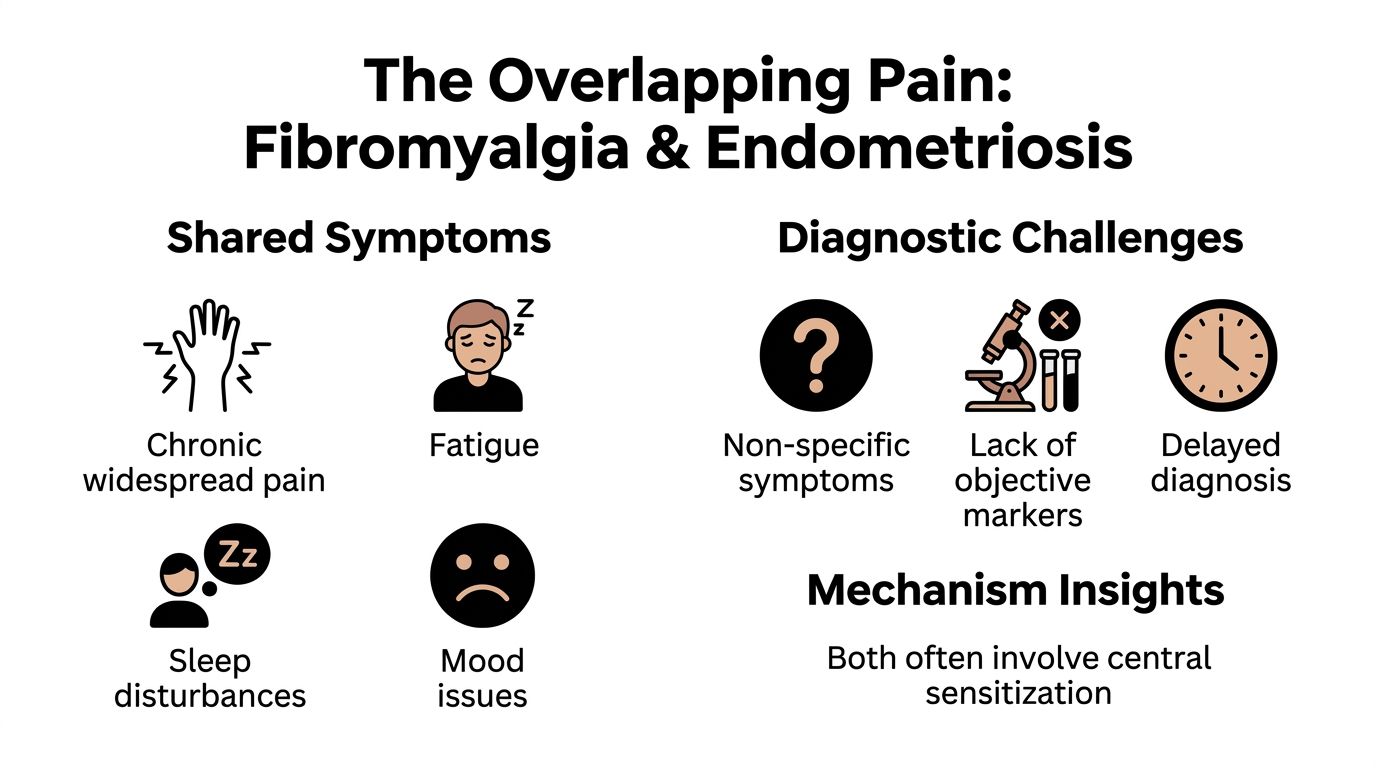
Fibromyalgia and endometriosis are different diagnoses, but many patients experience them in ways that overlap. Both can come with widespread pain, fatigue, disrupted sleep, and long stretches of not feeling believed. Both can also create layers of musculoskeletal tension that make the original diagnosis feel even worse.
Where the two conditions often converge
Fibromyalgia tends to be discussed as a widespread pain condition. Endometriosis is usually framed through the lens of gynecologic symptoms. In practice, patients with either condition may show up with:
- Pelvic and abdominal guarding that changes posture and breathing mechanics
- Hip, low back, glute, and thigh trigger points that refer pain away from the original source
- Jaw, neck, and shoulder tension from chronic bracing
- Exercise intolerance because the body treats normal loading like a threat
- Pelvic floor dysfunction that contributes to pain with sitting, intimacy, bowel movements, or activity
That overlap is one reason a musculoskeletal assessment matters. A physical therapist can't diagnose endometriosis, but a PT can identify the movement patterns, protective muscle behavior, and pelvic floor issues that often ride along with it.
Why diagnosis alone rarely solves the problem
Many patients with endometriosis are told to focus only on hormone management or surgery discussions. Many patients with fibromyalgia are told to manage stress, sleep more, or exercise carefully. Those recommendations can matter, but they often miss the day-to-day mechanics of pain.
When the body has been hurting for a long time, muscles adapt. They shorten, guard, stop coordinating well, and become painful themselves. Trigger points can develop in the abdominal wall, hips, back, and pelvic floor. The nervous system then reads those local signals as more evidence that danger is present.
If endometriosis flare patterns are part of your picture, this overview on managing endometriosis flare-ups can help patients think more clearly about what tends to set symptoms off between medical visits.
For people wondering whether pelvic floor treatment belongs in this conversation, Joint Ventures has a helpful overview of what pelvic floor therapy involves. That piece is useful when symptoms include pelvic pressure, pain with movement, or a sense that the core never fully relaxes.
If pain has become widespread, it doesn't automatically mean the original issue disappeared. It often means the system has layered new protection on top of an older problem.
What a better lens changes
Once the shared pattern is visible, care becomes more coherent. Instead of treating abdominal pain, back pain, fatigue, and muscle tightness as separate mysteries, the treatment plan can target the sensitized system and the specific body regions that keep feeding it.
That is usually the moment patients stop feeling like they are failing treatment and start realizing the treatment model was too narrow.
How Dry Needling in Boston Calms a Sensitized System
When patients search for dry needling Boston, they often want to know one thing first. How can a small needle affect pain that feels so large and so complex?
The answer starts with myofascial trigger points. These are irritable areas within muscle that can stay contracted, refer pain elsewhere, limit movement, and keep sending danger signals into an already sensitive system. In someone with fibromyalgia, endometriosis-related guarding, chronic neck tension, pelvic floor overactivity, or persistent back pain, trigger points often become part of the loop.

What the needle is actually doing
In orthopedic and chronic pain practice, dry needling uses a thin filament needle placed into a trigger point with a specific goal. The goal isn't sedation or distraction. It's to change the behavior of the muscle and the nervous system around it.
In clinical application, dry needling protocols described for Greater Boston care note 0.25 to 0.30 mm filament needle insertion with measurable effects that include increased regional blood flow of 20% to 50%, decreased muscle tightness reflected by a 30% to 60% reduction in endplate noise, increased pressure pain thresholds of 15% to 40%, and immediate muscle extensibility improvement of 10% to 25% after a local twitch response.
That local twitch response matters clinically. It is often the moment an overactive muscle changes state. Not every treatment aims to provoke a dramatic twitch, and not every patient needs aggressive input. But when the right tissue is targeted well, the system often gets a clearer signal that it can stop guarding.
Why this matters for central sensitization
A sensitized nervous system is constantly collecting evidence. Tight, painful tissue is one piece of that evidence. Dry needling can reduce the local "alarm" coming from those trigger points, which gives the body a better chance to tolerate movement, breathing work, pelvic floor relaxation, strength training, or manual therapy afterward.
That is why dry needling works better in context than in isolation.
People who are also exploring broader strategies to calm a chronically activated system sometimes find frameworks like Nervous System Regulation Therapy useful for understanding the behavioral and stress-related side of regulation. In PT, the parallel job is to address the physical tissues and movement patterns that keep reinforcing the alarm.
For a local treatment overview, the service page on trigger point dry needling in Boston outlines how certified PTs use the technique within physical therapy care.
A quick visual explanation can help if you've never seen the technique before.
What works and what usually doesn't
The people who respond best are not always the people with the highest pain tolerance. They are often the people whose treatment plan matches the actual driver of symptoms.
Dry needling tends to work well when:
- Trigger points are clearly contributing: The pain pattern maps to muscle guarding, referred pain, or movement restriction.
- The session has a next step: Needling is followed by exercise, gait retraining, pelvic floor downtraining, or manual work that uses the window of improved mobility.
- The dose fits the person: A sensitized patient often needs precision, not maximal intensity.
Dry needling tends to disappoint when:
- It is treated like a stand-alone fix: Temporary relief fades if no one addresses breathing, loading, sleep, pacing, stress, or movement habits.
- Too many areas are treated too soon: Sensitive systems can flare when treatment is broader than the body can absorb.
- The evaluation is shallow: Needling the spot that hurts is not the same as identifying why that spot keeps overworking.
The best dry needling sessions create a usable change. Less guarding, easier motion, better exercise tolerance, or a calmer pain response over the next day or two.
Your Comprehensive Pain Management Plan at Joint Ventures
The mistake many chronic pain patients have already lived through is getting one good tool delivered in the wrong framework. Dry needling can be effective, but if it isn't tied to a larger plan, it often becomes another treatment that helped for a day and then faded.
That is why a PT-led plan for complex pain needs to be layered. The aim isn't just to reduce symptoms. It's to change the pattern that keeps reproducing them.

Why multimodal care usually wins
Patient education around combined care is still limited. One reason that matters is that guidance on combining dry needling with other therapies remains a notable gap, while emerging studies suggest integrating dry needling into a multimodal plan can lead to up to 40% reduced recidivism for chronic pain conditions. For active adults in Boston, that matters more than a short-term drop in pain.
The practical takeaway is simple. A muscle can calm down today and still become irritable again if the same breathing strategy, pelvic floor tension, strength deficit, running mechanic, workstation setup, or flare behavior remains unchanged.
What a complete plan can include
A good plan isn't a checklist. It is a sequence. Different pieces matter at different times.
Pelvic floor physical therapy
For patients with endometriosis, pelvic pain, pain with sitting, or abdominal and hip symptoms that don't fully respond to orthopedic treatment, pelvic floor work can be central rather than optional. The goal is often to improve tissue tolerance, reduce overactivity, and restore coordination so the pelvis stops acting like a locked-down area.
Pain neuroscience education
Patients do better when they understand what the body is doing. Not because education alone fixes pain, but because fear drops when symptoms become interpretable. If someone understands why a flare happened, they're less likely to stop moving completely or assume damage has suddenly worsened.
Therapeutic exercise with the right dose
The wrong exercise plan can aggravate a sensitized system. The right one restores tolerance gradually. That may mean shorter walking intervals, lower-load strength work, breathing-driven trunk control, or a return-to-run progression that respects symptoms without being ruled by them.
Manual therapy when touch helps, not overwhelms
Some patients need hands-on treatment to reduce guarding enough to move normally. Others flare from too much input. Skilled care adjusts the amount and type of manual work to the person's nervous system, not just the diagnosis. If you're comparing approaches, this overview of manual physical therapy is a useful starting point.
Aquatic therapy and low-threat movement
Water can give painful bodies room to move without the same gravitational load or impact demands. For some patients with fibromyalgia, deconditioning, or severe flare sensitivity, that can be the bridge back to tolerating exercise on land.
What this looks like for Boston patients
At Joint Ventures Physical Therapy, this kind of care may include dry needling, pelvic floor PT, aquatic therapy, running assessment, TMJ treatment, vestibular care, or workplace ergonomics depending on the pattern driving symptoms. The right plan for a marathon trainee in Back Bay won't look like the right plan for a postpartum patient in Brookline or a desk-based professional in the Seaport with jaw, neck, and pelvic floor tension.
Recovery usually starts when treatment stops asking one technique to do every job.
That is the proper role of dry needling in complex pain. Not the whole answer. A sharp tool used at the right moment inside a broader strategy.
Building Your Boston Healthcare Team for Chronic Pain
Complex pain care usually improves when one clinician keeps the musculoskeletal plan coherent while the rest of the team addresses diagnosis, medication, imaging, procedural decisions, hormonal management, or mental health support. In Boston, that often means building a team rather than waiting for one specialist to do everything.
Who should be on the team
The exact mix depends on your symptoms, but many patients benefit from some combination of:
- A gynecologist or endometriosis specialist if pelvic pain, cycle-related symptoms, or abdominal pain are part of the picture
- A rheumatologist when fibromyalgia or systemic pain concerns need medical management
- A pain psychologist or therapist if fear, sleep disruption, trauma, or persistent stress are amplifying symptoms
- A physical therapist to assess movement, trigger points, pelvic floor contribution, breathing mechanics, and load tolerance
The PT often becomes the person tracking how symptoms behave with sitting, lifting, exercise, sleep, work demands, and daily function. That information can help the rest of the team make better decisions.
Why PT can act as the quarterback
Dry needling is one example of why training matters. In Massachusetts, physical therapists may perform trigger point dry needling only after specialized educational and clinical training. For patients, that matters because it sets a clear safety standard around who is using the technique and how it fits into treatment.
A Boston PT working with chronic pain can also help organize the larger picture:
- Track symptom behavior over time: What flares pain, what calms it, what is changing
- Translate body-based findings for other providers: Pelvic floor overactivity, movement avoidance, trigger point referral, breathing pattern issues
- Coordinate next steps: When orthopedic care is enough, when pelvic floor care should take priority, and when medical follow-up is needed
The best team isn't the one with the most specialists. It's the one where each clinician knows their lane and communicates clearly.
If you want deeper educational reading on pain conditions, recovery principles, and anatomy, visit Highbar Health. That is the better place for broader clinical explainers, while local care decisions should stay grounded in what your Boston treatment team is seeing in real time.
Take Control of Your Pain Journey in Boston
Persistent pain can make life in Boston feel smaller. You skip runs, avoid long workdays in the office, brace through the commute, and start planning around flares instead of goals. That pattern can change.
The key shift is understanding that chronic pain from fibromyalgia, endometriosis, pelvic floor dysfunction, or recurring trigger points isn't random weakness. It is a body that has become overprotective and needs the right kind of input to feel safe again. Dry needling can be one part of that process when it's used thoughtfully and paired with movement, education, and condition-specific physical therapy.
If you're looking for dry needling Boston care with a broader chronic pain strategy behind it, schedule an evaluation at a nearby Joint Ventures location in Back Bay, Kenmore Square, Fort Point, Seaport, Downtown Boston, Brookline, or Allston. The first step is figuring out what your pain pattern is asking for.
Frequently Asked Questions About Dry Needling in Boston
Does dry needling hurt and what does it feel like
Most patients don't describe it as a sharp, ongoing pain. They usually describe a quick pinch on insertion, followed by an ache, cramp, twitch, or deep pressure sensation when the trigger point responds. Some areas are barely noticeable. Others feel intense for a few seconds, especially if the muscle has been guarded for a long time.
The goal is not to make the session as aggressive as possible. In chronic pain care, the better approach is usually enough input to create change without provoking an avoidable flare.
How many sessions might I need for fibromyalgia or endometriosis-related pain
There isn't one fixed number that fits everyone. The right answer depends on whether trigger points are a major driver, how reactive your nervous system is, whether pelvic floor dysfunction is involved, and what else is included in the plan.
What matters more than chasing a number is watching the pattern. Are you getting easier movement, less guarding, better tolerance for exercise, or a shorter flare after daily activities? If the answer is yes, the treatment is doing useful work. If relief is brief and nothing functional changes, the plan needs to be adjusted.
What should I expect after a session
Mild soreness can happen after dry needling. Many patients compare it to post-workout soreness. Some feel looser immediately. Others notice the benefit later that day or the next morning when they move differently.
Hydration, light movement, and following the exercise plan from your PT usually help. If your system is very sensitive, your clinician may start with a smaller treatment dose and build gradually.
Why can dry needling help if my pain feels widespread
Because local trigger points can keep feeding a larger pain system. Trigger point dry needling has been shown to affect the chemistry of trigger points by reducing nociceptive substances such as substance P and increasing anti-nociceptive endorphins. In randomized controlled trials, it has also outperformed sham treatment for pain relief with effect sizes of 0.5 to 1.2 and improved muscle activation by 20% to 50% in some patient populations according to this clinical review of trigger point dry needling mechanisms and outcomes.
That doesn't mean one needle fixes a whole-body pain condition. It means reducing the local input from overactive tissue can help calm one part of the larger loop.
Is dry needling covered by insurance in Massachusetts
Coverage depends on your plan and how your benefits are structured. The practical move is to ask before the first visit so there are no surprises. In many clinics, front-desk staff can help verify benefits and explain what your plan does and doesn't cover for physical therapy services.
For most patients, the bigger question isn't just coverage. It's whether the treatment is being used with a clear reason, inside a plan that makes sense for your symptoms and goals.
If you're dealing with persistent pain and want a clearer plan, Joint Ventures Physical Therapy offers 1-on-1 care across Greater Boston for chronic pain, pelvic floor conditions, sports rehab, TMJ, vestibular issues, and trigger point dry needling. Book an evaluation to find out whether dry needling fits your recovery strategy and which Boston location makes the most sense for your schedule.