
A lot of Boston patients arrive with the same story. Their hip started talking back during a run on the Charles, after climbing MBTA stairs, or halfway through a workweek of sitting in the Seaport. They tried stretching, took a few easier days, maybe searched for a few exercises online, and the pain still kept showing up.
That's usually the point where the question changes. It stops being “what stretch should I do?” and becomes “what is this, and why isn't it going away?” That's the right question. Hip pain physical therapy in Boston works best when the first goal is clarity, not just symptom chasing.
Don't Let Hip Pain Sideline Your Boston Lifestyle
If your hip hurts, Boston gets smaller fast. A short walk from Back Bay to the T feels longer. Training plans get cut back. Even a normal day of desk work, commuting, errands, and gym time can start to feel like a series of small negotiations with pain.

For runners, it often shows up as a warning sign that gets easier to ignore than to solve. The hip pinches late in a long run. It burns on hills. It stiffens after sitting, then loosens a bit once you get moving, which makes it tempting to keep pushing. If you've got a shelf full of race medals and you're looking for better ways to display or repurpose your marathon medals, that usually means movement matters to you. Hip pain can take that away surprisingly quickly.
Why self-diagnosis usually stalls people out
Often, the issue isn't a lack of effort. It's the absence of a reliable diagnosis.
The problem with “hip pain” is that it sounds specific when it isn't. Pain on the outside of the hip, deep in the groin, into the buttock, or down the thigh can come from very different drivers. One person needs load reduction and progressive strengthening. Another needs movement retraining. Someone else needs a clinician to rule in the low back as the actual source.
Practical rule: If the same pain keeps returning after rest, foam rolling, or random online exercises, the issue usually isn't that you haven't found the magic stretch. It's that the underlying driver hasn't been identified.
What Boston patients usually want
Most patients aren't asking for a generic sheet of clamshells. They want to know:
- What's irritated
- What activities they can keep doing
- What they should stop doing for now
- How to get back to running, lifting, tennis, golf, or long walks without guessing
That's where specialized, local care matters. In a city with marathon trainees, university athletes, postpartum patients, active older adults, and professionals spending long hours at a desk, the right plan has to match the person in front of you. Hip pain physical therapy in Boston should help you keep living your life here, not just manage symptoms in a vacuum.
Why Your Hip Hurts and Why It Might Not Be Your Hip
One of the biggest mistakes in hip pain care is assuming the pain location tells you the pain source. It often doesn't.
A patient points to the outside of the hip, but the underlying issue is tendon overload. Another points to the buttock and lateral thigh, but the low back is driving it. Someone else feels pain in the front of the hip with stairs or getting out of a car, and the movement pattern matters more than the amount of stretching they've been doing.
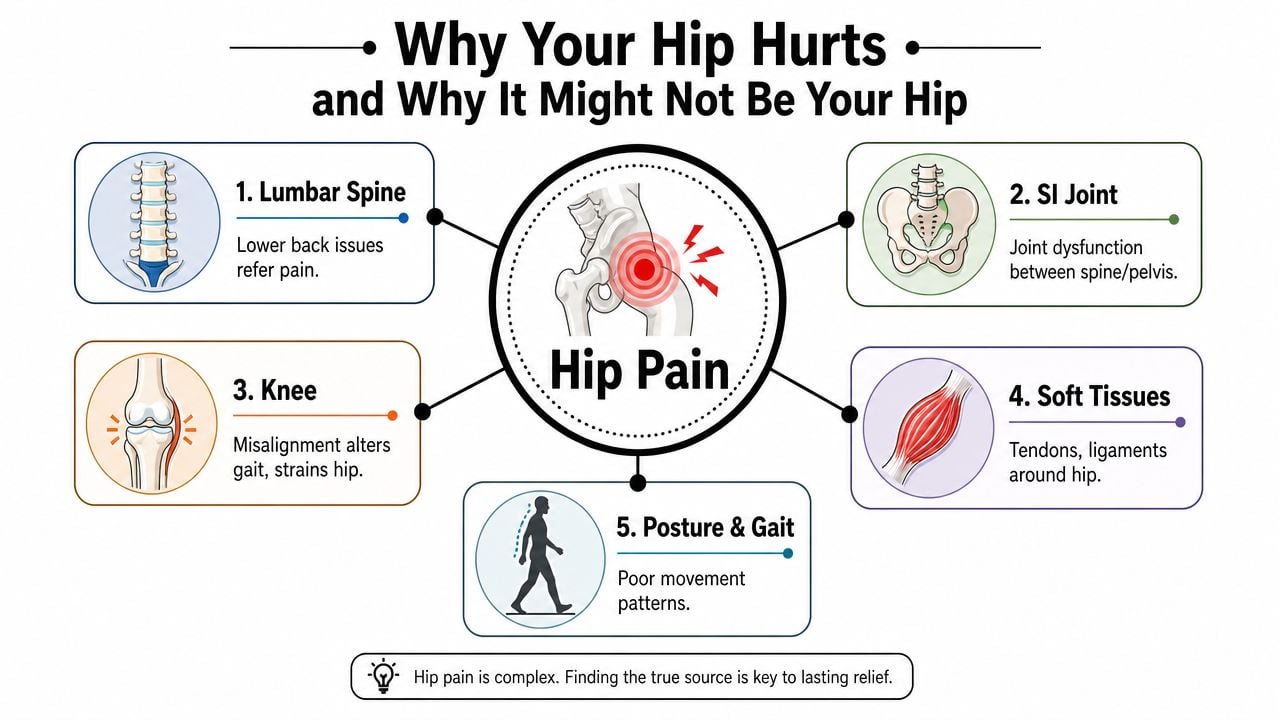
Pain location helps, but it doesn't finish the job
A useful example is greater trochanteric pain syndrome, often felt on the outside of the hip. It accounts for about 10% to 20% of all hip-pain cases patients seek help for, while groin or anterior thigh pain strongly suggests hip osteoarthritis in clinical screening, as described in this review of common causes of hip pain and how physical therapy may help. That's exactly why careful screening matters. The same complaint can reflect tendon overload, joint degeneration, or referred pain from the low back.
If your symptoms also include leg pain, numbness, or pain that changes with your back position, it may help to compare that pattern with common sciatica physical therapy approaches in Boston. Not because every hip complaint is sciatica, but because patients often confuse these patterns.
The common trade-off that gets people stuck
Here's what doesn't work well. Treating every sore hip with the same recipe:
- Random stretching when the tissue is already irritated by compression or overload
- Aggressive strengthening too soon when pain is reactive and the dosage is wrong
- Resting completely until the area deconditions and flares again on return
- Ignoring gait and training habits that keep reproducing the same problem
Pain is real, but it isn't always local. A careful exam has to separate the place you feel it from the structure or movement pattern creating it.
Why differential diagnosis matters in Boston
In a city where one patient is training for the Boston Marathon, another is walking several miles a day between work and transit, and another is trying to get back to recreational sports, “just strengthen your hips” is too blunt to be useful.
Effective hip pain physical therapy in Boston starts with differential diagnosis. Before anyone talks about dry needling, strengthening progressions, or return-to-run drills, the first question is simple. Is this actually coming from the hip?
Your First Visit A 1-on-1 Diagnostic Approach
A strong first visit should feel less like a quick intake and more like a working clinical investigation. If you're coming in with hip pain, the early goal is to narrow the problem, not rush into treatment just to feel productive.
What happens in the evaluation
A proper evaluation includes history, gait observation, range-of-motion testing, and muscle testing so the clinician can address the true cause rather than only treating symptoms, as outlined in this discussion of hip and groin disorder evaluation. That diagnostic step helps determine whether the plan should emphasize mobility, motor control, strength, or load management.
In practical terms, that means your visit should cover the details that matter:
Your symptom history
When it started, what aggravates it, whether it warms up with activity, whether sitting makes it worse, and whether back motion changes the pain.Your movement profile
How you walk, squat, step down, balance, rotate, or transfer weight from side to side.Your tissue tolerance
Which positions and loads reproduce symptoms, and which ones settle them.
Questions that change the plan
The useful questions are rarely glamorous. They're the ones that guide treatment.
| Question | Why it matters |
|---|---|
| Do you feel pain in the groin, outside of the hip, buttock, or thigh? | Location can help narrow likely drivers |
| Does pain increase with sitting, stairs, hills, or running pace? | Triggers help identify load and motion sensitivity |
| Does your back movement affect your symptoms? | This can point away from the hip as the main source |
| Are you trying to return to running, lifting, or just walking comfortably? | Your goal determines the rehab path |
If you've never had a true 1-on-1 PT evaluation, this pace may feel different from what you expect. That's a good sign. A more detailed assessment usually creates a more efficient treatment plan. If you're wondering how that time is typically structured, this overview of how long physical therapy appointments are gives helpful context.
The first visit should answer two questions quickly. What's the likely driver, and what should you do differently this week?
Why this matters for treatment direction
Modern rehab has gotten better at separating hip-focused problems from spine-focused ones. That distinction changes exercise choice, manual therapy decisions, pacing, and even return-to-sport timing. Patients usually feel relief just from getting a clearer answer. Once the diagnosis is sharper, the plan gets simpler.
Your Personalized Hip Pain Treatment Plan
A good plan for hip pain isn't a menu of everything a clinic offers. It's a targeted mix of the right tools for the problem in front of you.
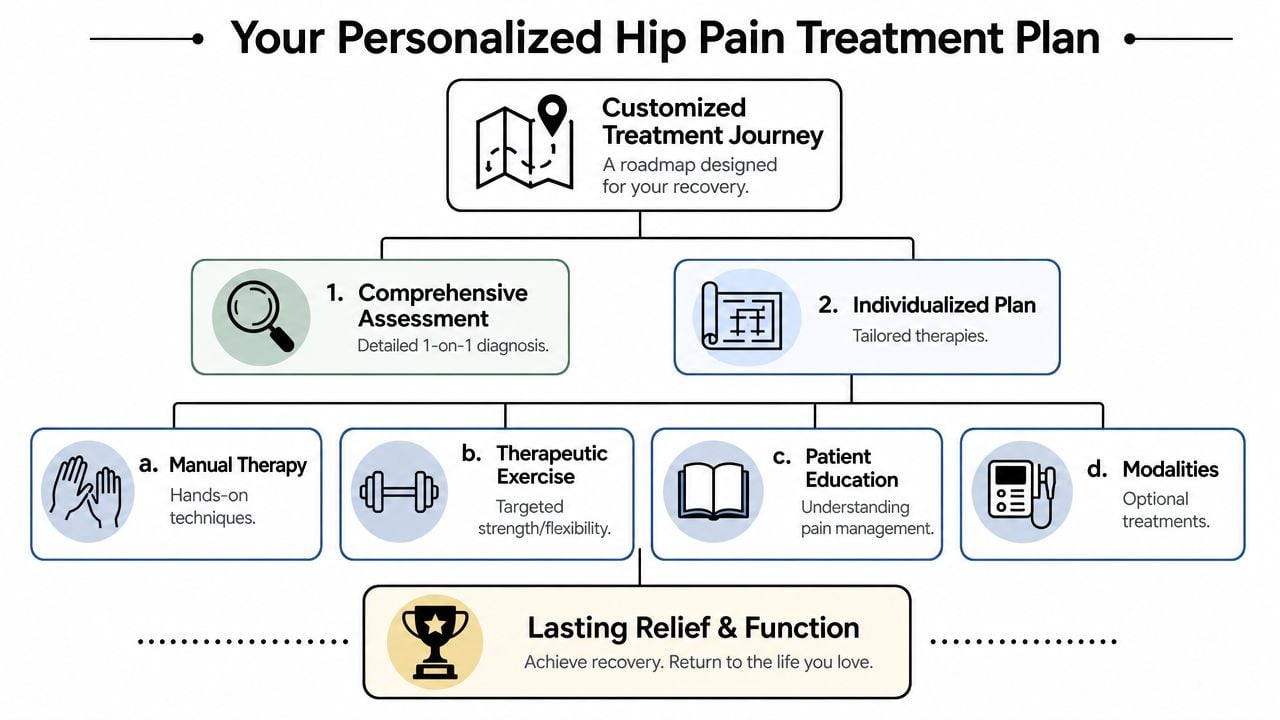
What usually belongs in the plan
Mass General Brigham notes that hip pain can reflect arthritis, labral tears, impingement, muscle or tendon strain, bursitis, and sports or fall injuries, which is why treatment planning starts by identifying the cause before using rehab to improve strength, flexibility, and joint stability through the right mix of interventions in hip care and rehabilitation. That same principle applies in day-to-day outpatient care.
Most personalized plans draw from a few core buckets:
- Manual therapy when stiffness, guarding, or irritability is limiting movement
- Targeted strengthening when the hip and trunk need more load tolerance
- Motor control work when the issue is less about raw strength and more about how you move
- Education and load management so your training, walking volume, sitting time, or gym routine stop feeding the problem
For active adults, expert-led care often goes further. Boston-area clinical guidance highlights progressive early rehabilitation, pool-based cross-training, eccentric hip-flexor work, and neuromuscular re-education as important pieces of hip pain management for a safe return to activity, as described on this Boston physical therapy clinic page.
Where specialty services help
Here's where standard exercise sheets fall short. Some hips calm down with a straightforward loading progression. Others need a more specific route.
Joint Ventures Physical Therapy offers several services that can fit that need, including trigger point dry needling, aquatic therapy, and Running Performance evaluations for patients whose symptoms are tied to mileage, stride habits, or return-to-run planning. Those tools aren't first-line for every person. They're useful when the exam shows a reason to use them.
A few examples:
- Dry needling can be helpful when muscle guarding or persistent soft tissue irritability is keeping someone from tolerating movement well.
- Aquatic therapy makes sense when bodyweight loading on land is too provocative early on.
- Running analysis matters when the pain only shows up with pace, hills, long distance, or asymmetrical mechanics.
For a deeper educational breakdown of rehab concepts, injury recovery, and movement topics, Highbar Health has broader clinical resources at highbarhealth.com.
Here's a practical movement topic many patients overlook. Single-leg capacity matters in hip rehab because daily life and running are full of single-leg loading. This piece on Telomyx on single leg performance is a useful general read if you want to understand why balance, control, and side-to-side differences matter.
A short visual overview can help make the treatment flow easier to picture.
Clinical reality: What works is rarely the fanciest intervention. It's the right diagnosis, the right load, and the right progression.
Managing Hip Pain Outside the Clinic
What you do between visits matters. A well-built home plan should reduce flare-ups, preserve fitness, and keep your week moving forward without turning every activity into a test.
Adjust your Boston routine before you chase harder exercises
If your hip is irritated, your first win often comes from changing how you load it.
- Modify your commute: If stairs are a clear trigger, slow the pace and use the railing instead of powering through every step.
- Break up sitting time: Long desk blocks in Back Bay, Downtown, or the Seaport can stiffen an already sensitive hip. Stand, walk briefly, or change position regularly.
- Warm up before runs: Don't make the first mile your mobility routine. Do a short prep sequence before heading around the Charles or the Reservoir.
- Trim volume before intensity: It's often smarter to shorten the run or workout than to keep the same volume and just hope pain behaves.
Sample exercises that often belong early
These are examples, not a universal prescription. The right dosage depends on your exam findings.
Glute bridge
A good early option when you need hip extension work without a lot of dynamic irritation. The goal isn't just to lift high. It's to control the ribcage, pelvis, and pressure through both feet.
Bird dog
Useful when trunk control and hip stability need to work together. Move slowly. If the lower back takes over, the drill needs to be scaled.
Side-lying hip abduction or supported standing hip work
Sometimes appropriate for lateral hip strength. Sometimes too irritating if the tissue is already sensitive. That distinction matters.
Why precision matters more than variety
A randomized trial with 184 participants conducted from November 2019 to April 2022 found that after 8 weeks, people receiving hip-focused physical therapy for chronic low back pain and hip weakness had a greater immediate reduction in disability than those receiving spine-focused care, with 46% achieving at least a 50% disability reduction compared with 33% in the spine-focused group. Both groups also improved walking speed, with substantial gait-speed improvement in 53% of the hip-focused group and 60% of the spine-focused group, based on this summary of the trial in MedicalXpress coverage of hip-focused physical therapy. The takeaway for patients is straightforward. A focused plan, followed consistently for a defined stretch of time, works better than bouncing between unrelated exercises.
When to call a physician instead of pushing through
Some symptoms need medical evaluation first.
- Sudden inability to bear weight
- Fever with hip pain
- Severe night pain that feels unusual or progressive
- Pain after a fall or traumatic event
- Rapid swelling or obvious deformity
- New neurologic symptoms such as major weakness or worsening numbness
If any of those are present, rehab can wait until the medical picture is clear.
Start Your Recovery at Joint Ventures in Boston
By the time many individuals look for hip pain physical therapy in Boston, they've already spent too long trying to out-stretch, out-rest, or out-tough the problem. What usually changes the trajectory is not more effort. It's better direction.
The value of care in Boston comes down to three things. First, a real differential diagnosis that separates hip joint issues from tendon overload, back-related pain, and movement-based problems. Second, a treatment plan that matches your goals, whether that's getting back to marathon training, lifting, commuting comfortably, or walking without guarding. Third, a care experience that fits city life instead of adding more friction to it.

Care that fits where Boston patients live and work
If you're trying to find care close to your routine, Joint Ventures has locations across Greater Boston, including Back Bay, Kenmore Square, Fort Point/Seaport, Downtown Boston, Brookline, Allston, and surrounding neighborhoods. That makes it easier to schedule care near work, home, class, or the gym instead of putting rehab off for another month.
If you spend time around Fenway, this guide to physical therapy near Fenway Park can help you think through location convenience as part of the decision.
What makes the start easier
Patients also tend to underestimate how much the admin side affects follow-through. Insurance verification, authorizations, and scheduling support matter because they remove the friction that causes people to delay treatment after finally deciding to get help.
A good PT plan should feel clear within the first visit or two. You should know what you're treating, what you're changing, and what progress will look like.
If your hip has been limiting runs, workouts, workdays, or just normal movement around the city, the next step is simple. Get it evaluated by someone who can sort out the source and build a plan around your actual life.
If your hip pain is changing how you move through Boston, book an evaluation with Joint Ventures Physical Therapy. You'll get 1-on-1 care, a focused diagnosis, and a plan built around your goals, whether that's returning to the Charles, training for your next race, or getting through the workweek without pain.