
You get out of bed hoping the leg pain has finally backed off. Then the Red Line ride stiffens you up, you stand at your desk in Back Bay, and the pain shoots from your low back into your glute or down the leg again. For some people it shows up halfway through an easy run on the Charles. For others, it hits after an hour in a desk chair or a lift at the gym that used to feel routine.
That pattern points to a problem that is hard to ignore. Sciatica can change how you sit, walk, train, and sleep. It also creates hesitation. Active adults in Boston often start avoiding long drives, workouts, or even simple daily tasks because they are not sure what will trigger the next flare.
At Joint Ventures, we see this in runners, desk professionals, and recreational athletes who do not want a generic handout or another week of being told to rest and wait. They want a clear explanation for why symptoms are traveling, what movements are safe, and how to get back to normal activity without guessing.
Physical therapy is often the right first serious step. The goal is not only to calm symptoms, but to identify what is driving them and build a plan that fits your body and your routine. That may include hands-on treatment, dry needling in the right case, and progressive exercise that restores movement and load tolerance. It is a more useful path than passive care alone for people who need their body to hold up at work, on the train, and during training.
That Sharp Pain Is More Than Just a Nuisance
A lot of people arrive thinking they have to “push through it.” They've already tried resting for a few days, stretching from a random video, or changing chairs at work. The pain settles a little, then comes back the next time they sit too long, carry groceries up a Beacon Hill walk-up, or pick up training again.
Sciatica rarely stays confined to one part of your day. It follows you into meetings, long drives, gym sessions, and sleep. If you're a runner, it can change your stride and make every step feel guarded. If you work at a desk in the Seaport or Downtown, it can turn basic sitting into a problem you think about constantly.
Why people wait too long
People often dismiss radiating leg pain as “tightness” or assume they just need more stretching. That delay matters. The longer you keep guessing, the more likely you are to bounce between rest and aggravation without a real plan.
If you're trying to sort out whether what you feel is simple back pain or true nerve-related symptoms, this Joint Ventures article on radiating pain and when to see a physical therapist is a useful starting point.
Practical rule: If pain is traveling, changing your movement, or making you avoid normal activity, it deserves a proper evaluation.
Some patients also ask broader questions about recovery habits, including sleep, nutrition, and inflammation. If that's part of what you're trying to understand, this guide for inflammation and metabolic health offers general background that can complement, but not replace, a movement-based treatment plan.
What usually works better than waiting is getting specific. Not just “stretch more,” but understanding which positions help, which movements aggravate, how your symptoms respond over the day, and what your next step should be if you want to get back to work, lifting, or running without a constant threat of another flare.
Why Sciatica Flares Up for Active Bostonians
You can feel fine during most of the workday, then get hit when you stand up from your desk, hurry for the Red Line, or bend to pick up a grocery bag after the commute home. For active people in Boston, sciatica often flares because the body is being asked to switch fast between sitting, loading, twisting, and training without enough capacity to handle all of it.

A runner, desk professional, and recreational lifter can all say they have “sciatica” and still need very different advice. That matters. The pain may come from a similar irritated nerve pattern, but the trigger is often specific to how that person moves, trains, sits, and recovers.
Common Boston triggers
For desk-based professionals, symptoms often build gradually. Long seated stretches can stiffen the hips and low back, and that stiffness tends to show up later when you stand, walk fast, or try to exercise after work.
For active adults, the pattern is usually tied to load management and movement tolerance:
- Running volume jumps: More hills, more mileage, or harder workouts packed too closely together can make the nerve system more sensitive.
- Gym training under fatigue: Squats, deadlifts, kettlebell work, and rowing are not automatically harmful, but form often changes when fatigue rises and symptoms begin traveling down the leg.
- Weekend spikes in activity: Long walks, pickup sports, home projects, and lifting children can irritate an area that was already overloaded during the week.
- Mobility work that misses the underlying problem: Repeated stretching can feel productive, but the wrong exercise can aggravate nerve-related symptoms instead of calming them. Some people do better with guided strengthening and directional movement work, which is why a plan built around symptom response matters more than a generic routine. Our guide to best exercises for lower back pain relief gives a useful starting point.
At Joint Ventures, we see this often in patients who are highly motivated and used to pushing through discomfort. That mindset helps in training. It can slow recovery if every flare is treated like soreness that just needs more stretching, more foam rolling, or a few days off.
A better question is not “what diagnosis do I have?” It is “which positions, loads, and daily habits are keeping this irritated?”
That is also why passive care alone usually falls short for active Bostonians. Heat, rest, and occasional massage may settle symptoms for a day or two, but they do not rebuild tolerance for sitting through meetings, finishing a run on the Esplanade, or lifting in the gym with confidence. Some patients do benefit from movement systems such as Pilates when used thoughtfully in rehab. Physician-led insights on Pilates recovery offer useful context on where that style of exercise can fit.
What deserves urgent medical attention
Most sciatica responds well to conservative treatment, but a few symptoms change the decision right away. Get urgent medical evaluation if you notice:
- Progressive weakness in the leg
- Loss of bowel or bladder control
- New major changes in sensation around the saddle region
Those findings are different from a routine flare-up. They need prompt medical attention, not a wait-and-see approach.
If you want broader educational reading on back pain and recovery, visit Highbar Health. If your symptoms keep returning, keep moving farther down the leg, or keep changing how you work out and get through the day in Boston, it is time for a specific evaluation instead of more guesswork.
Our Evidence-Based Approach to Sciatica Relief
A runner training along the Charles, a desk professional in the Financial District, and a weekend hockey player in Brighton can all say, “I have sciatica,” and still need very different treatment. The irritated nerve matters. The movement pattern, training load, work setup, and stage of recovery matter just as much.
Our approach starts with that distinction. We use an evidence-based plan built around how your symptoms respond to position, motion, and load, then match treatment to the demands of your actual life in Boston. The goal is not short-term symptom control alone. The goal is getting you back to sitting, training, lifting, commuting, and exercising with confidence.
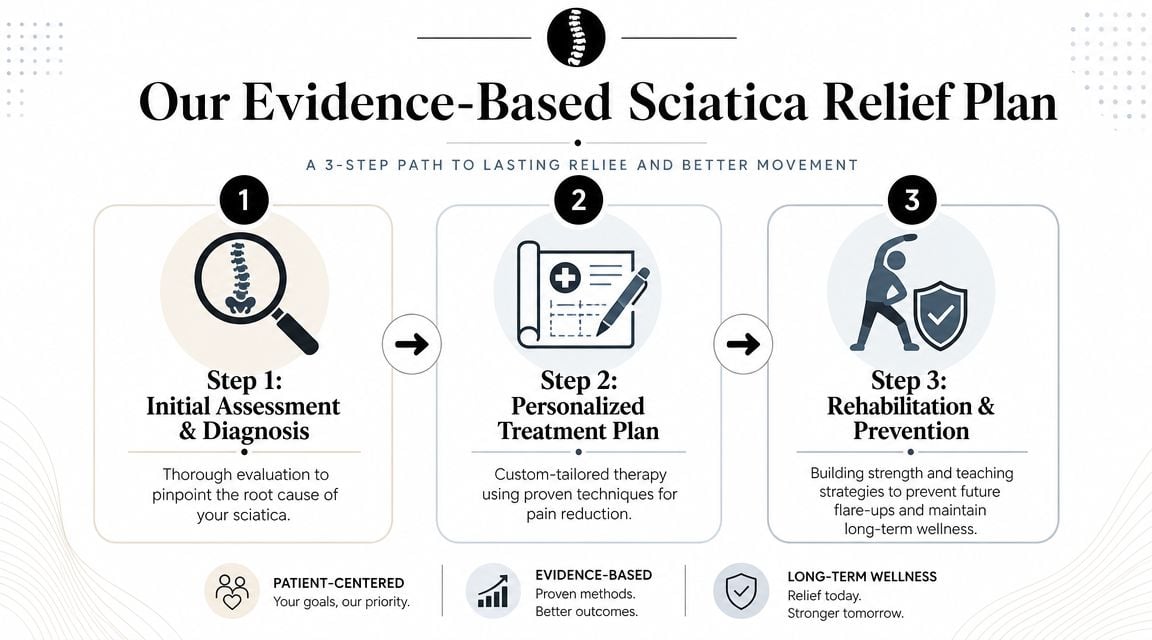
Step one starts with pattern recognition
A strong evaluation looks past the label. We examine what brings symptoms on, what eases them, whether pain stays in the back or travels farther down the leg, how your lumbar spine and hips are moving, and how you tolerate sitting, walking, bending, and getting back to exercise. We also screen for strength, sensation, and reflex changes that may call for closer medical coordination.
That gives us a working map. Some patients improve quickly with repeated movements in one direction. Others need to calm irritability first because even basic sitting or walking is provoking symptoms. If flare-ups keep returning, we look closely at the habits feeding that cycle, including lifting mechanics, training errors, long static postures, and recovery choices.
Hands-on care helps when it serves a purpose
Manual therapy can be useful when stiffness, guarding, or pain is limiting movement. Soft tissue treatment or joint mobilization may help you move more comfortably early on, which creates a better window for exercise. Dry needling can also help in selected cases, especially when overactive glute, hip rotator, or lumbar muscles are adding tension around an already sensitive area.
There is a trade-off here. Passive treatment can help reduce pain, but it does not build sitting tolerance, restore hinge mechanics, or prepare you to return to running hills or deadlifting. Lasting improvement usually comes from combining symptom relief with progressive loading.
A treatment plan may include:
- Manual therapy: To improve mobility and reduce protective muscle guarding
- Dry needling when appropriate: To address muscle tension that is adding to the problem
- Movement retraining: To improve sitting, walking, hinging, lifting, and transitional movements
- Progressive strengthening: To build capacity in the trunk, hips, and legs as symptoms settle
- Load management: To scale work, training, and daily activity up or down without losing momentum
Progression is what makes the plan work
Generic sciatica care often stalls because the program never changes. A few stretches may help early, but active adults usually need more than that. They need a plan that adapts as pain settles, strength returns, and real-life demands increase.
At Joint Ventures Physical Therapy, one-on-one treatment lets us adjust that progression visit by visit. A runner may need changes in stride, hill work, and return-to-mileage decisions. A desk worker may need a strategy for sitting tolerance, commute management, and lifting from the floor without triggering symptoms. A field or court athlete may need rotational control, single-leg strength, and impact tolerance before full return.
If you are getting ready for care, our guide on how to prepare for your first physical therapy appointment can help you know what to bring and what details matter.
The right sciatica rehab plan answers a practical question: what does your body need to handle again, and what progression gets you there safely? That is what evidence-based care should deliver for an active Bostonian.
Safe Home Exercises Your Physical Therapist May Recommend
Home exercises can help. The catch is that the wrong exercise, the wrong dosage, or the wrong timing can keep symptoms stirred up. Sciatica rehab works better when a therapist matches the drill to your current irritability, then adjusts it as your response changes.
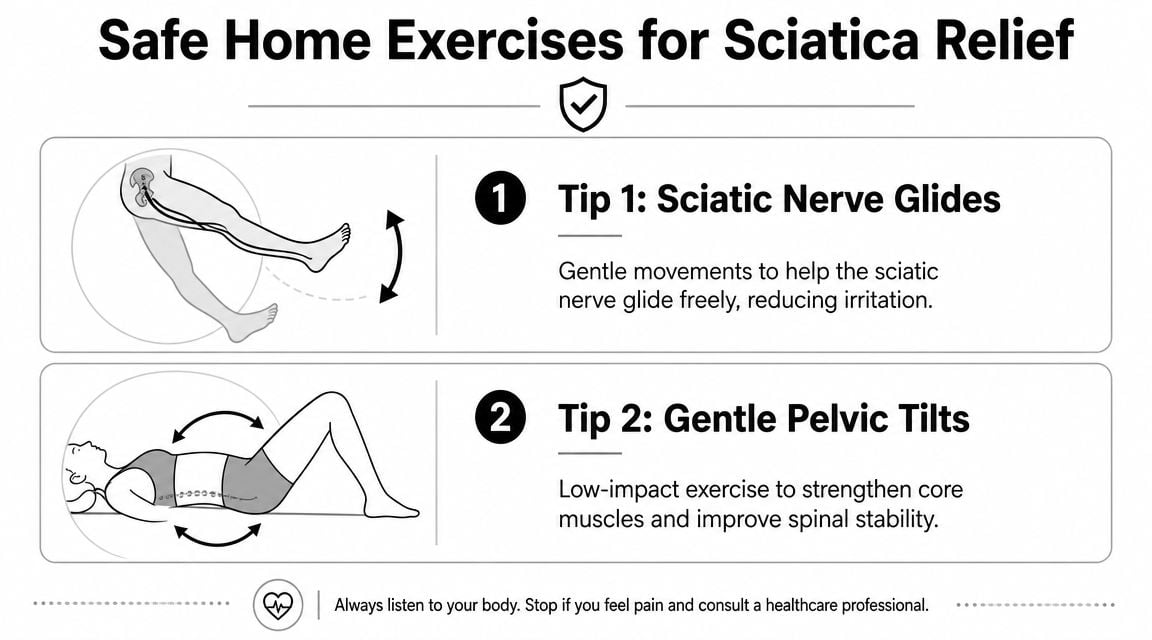
A helpful general rule from sciatica rehab literature is that stretches are often held for 20 to 30 seconds without bouncing or forcing, while nerve glides stay gentle enough to reproduce only low-intensity symptoms before settling, as described in this Peak Therapy guide to sciatica exercise dosage and symptom response.
Two examples patients often use
- Sciatic nerve glides: These are small, controlled movements designed to help the nerve move more freely. They should feel mild, not aggressive. If they make symptoms linger or spread farther down the leg, the dosage or variation may be wrong.
- Gentle pelvic tilts: These can help some patients reconnect with abdominal control and low back movement without high load. They're often useful early, especially when bigger movements feel guarded.
- Basic core or glute activation: Sometimes the right next step is very simple. Learning to engage the trunk and hips without bracing too hard can improve tolerance for standing, walking, and transitional movements.
For readers looking for more movement ideas, our article on the best exercises for lower back pain relief offers additional context.
What people get wrong at home
The most common mistake is chasing a stretch sensation too aggressively. More range does not always mean better progress. Nerves don't like being forced.
A second mistake is copying an exercise that helped someone else. Sciatica can look similar on the surface and still need different movement strategies.
Here's a quick demonstration resource that can help you visualize symptom-friendly movement:
Some patients also benefit from low-load, controlled movement systems during recovery. If you're curious about that angle, these Physician-led insights on Pilates recovery offer a useful perspective on how guided core-focused work can fit into rehab.
Gentle is not the same as ineffective. In sciatica rehab, the right amount often beats the hardest effort.
The goal of home exercise isn't to replace care. It's to reinforce the changes you're making in the clinic, between sessions, with the right form and the right progression.
What to Expect at Your Joint Ventures Visit
Patients often arrive with two worries. First, they want to know whether anyone is going to listen to the full story. Second, they want to know how hard it will be to fit treatment into a Boston schedule that already feels packed.
Your first few steps are straightforward
When you reach out, the front desk helps with scheduling, insurance questions, and the practical details that often slow people down. That matters if you're trying to get seen before a work trip, around school pickup, or between training sessions.
If you want to make the first appointment smoother, this guide on how to prepare for your first physical therapy appointment gives a simple overview.
What happens in the appointment
The first visit is built around understanding your specific pattern. Expect questions about where the symptoms go, what positions aggravate them, how sleep and sitting are affected, what your activity demands are, and whether anything has changed recently in work, lifting, or training.
Then the physical exam fills in the rest. Movement testing, strength, symptom response, and functional tasks help the therapist decide what type of sciatica presentation you're dealing with and how cautious or aggressive the early plan should be.
A visit often includes some combination of:
- Movement testing: To see which motions calm or provoke your symptoms
- Hands-on treatment if needed: To reduce stiffness or guarding
- Exercise instruction: Focused on what you should do now, not ten steps ahead
- A practical plan: What to modify at work, in the gym, during commuting, and at home
Why the visit feels different from generic care
Busy patients in Boston need a plan they can follow. That means the recommendations have to match your life. If you're in the office all day, you need strategies for sitting tolerance, position changes, and commuting. If you run, your plan has to address how and when to return without triggering a setback. If your symptoms flare during lifting, your rehab has to include a path back to load.
A useful PT visit should leave you with fewer questions than you walked in with, and a clearer picture of what to do over the next several days.
Location convenience also matters. With clinics in neighborhoods including Back Bay, Kenmore Square, Fort Point/Seaport, Downtown Boston, and surrounding areas, patients can usually find a site that fits work and home logistics. That doesn't fix sciatica by itself, but it does make consistency easier. Consistency is often what turns short-term relief into lasting progress.
Your Recovery Timeline and Long-Term Success
Recovery from sciatica usually comes in stages, and each stage asks for something different from your body. Leg pain may ease before sitting at your desk feels normal again. Walking around Back Bay may become easier before a run on the Esplanade feels safe. A brief flare after a long commute or a hard week at work does not automatically mean you are back to square one.
For active adults in Boston, the primary goal is not just lower pain. It is getting back to training, working, lifting, and living without constantly calculating every move. That takes more than passive care. It takes a plan that changes as your symptoms calm down and your capacity builds back up.
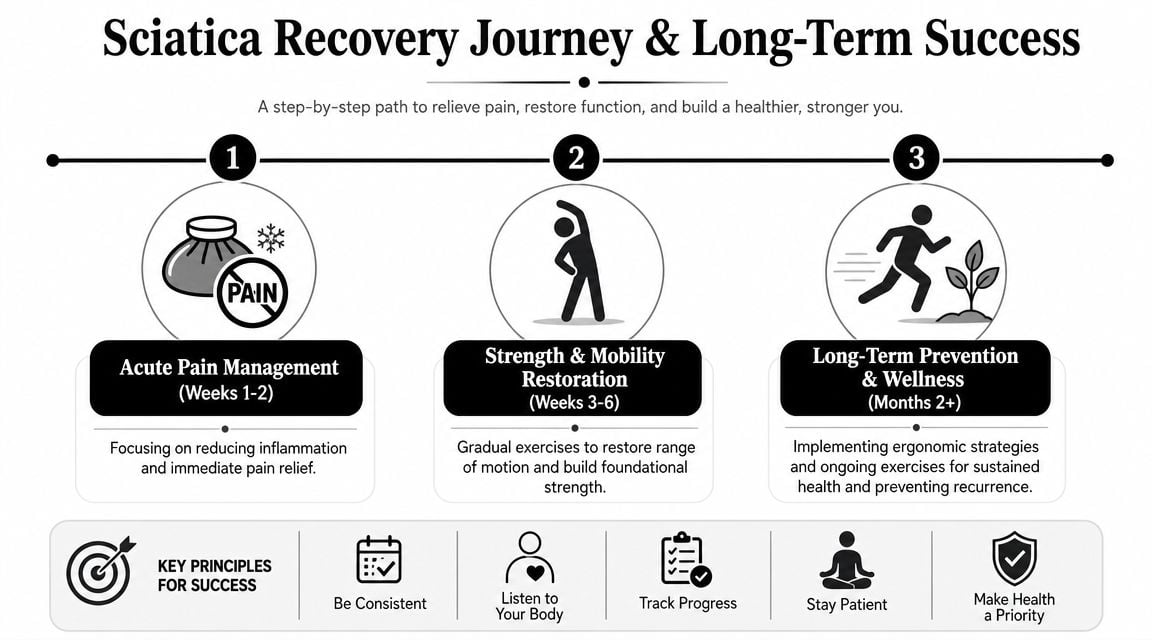
Early phase focuses on calming the nerve and reducing setbacks
At first, progress is usually measured by irritability. Are symptoms less sharp? Do they settle faster? Can you get through a workday, sleep more comfortably, or walk without the pain traveling as far down the leg?
This phase often requires restraint. Runners may need to pause speed work. Lifters may need to reduce load and range. Desk professionals may need more frequent position changes and a better plan for sitting tolerance. At Joint Ventures, we set that early plan based on what your symptoms do, not on a generic timeline.
Middle phase builds capacity for real life
Once symptoms are more predictable, rehab needs to do more than protect your back or leg. It needs to rebuild tolerance. That usually means improving hip and trunk strength, restoring motion where you need it, and loading movement patterns in a way the nerve can handle.
This is often the point where people feel "better enough" and then flare because they return to everything at once. The better approach is graded exposure. A runner might start with controlled return-to-run intervals. A gym-goer may rebuild the hinge, squat, and carry in stages. An office worker may still need to train sitting endurance and commuting tolerance, even if pain at rest is much lower.
A durable plan usually includes:
| Focus area | Why it matters |
|---|---|
| Symptom recovery after activity | Tells us whether your current load is appropriate or still too much |
| Strength and endurance | Helps your body handle work, training, and daily tasks without repeated irritation |
| Activity-specific progression | Prepares you for your actual goals, whether that is running, lifting, tennis, or long days at a desk |
Late phase is about staying active without repeating the same cycle
Long-term success means your body can handle your normal routine again, and you know what to do when symptoms start creeping back. That may mean finishing a long run without leg pain, getting through a full office day without shifting every few minutes, or picking up your kids without bracing and hesitating.
It also means understanding the trade-offs. Pushing too fast can stir things up. Staying too cautious for too long can leave you deconditioned and worried about movement. Good sciatica rehab addresses both problems. We want enough challenge to build confidence and capacity, without feeding the irritation that brought you in.
The patients who do well over time are usually the ones who leave PT with a clear framework. They know their triggers, they know their reset strategies, and they know how to keep strength and mobility work in their routine after the pain is gone. That is what turns short-term relief into a recovery that holds up.
Boston Sciatica PT FAQs
Do I need a doctor's referral to start PT in Massachusetts
Many patients can start physical therapy through direct access, which means you often don't need to wait for a referral before getting evaluated. Insurance rules can vary, so it's smart to confirm the details when you schedule.
Will you help me understand insurance coverage
Yes. One of the biggest barriers to starting care is not knowing what your plan covers, whether authorization is needed, or what the visit structure looks like. A good front desk team should help clarify that before treatment starts so you're not chasing answers on your own.
Which Boston location should I choose
Choose the clinic that gives you the best chance of being consistent. For some people that's near work in Back Bay, Downtown, or Fort Point/Seaport. For others it's closer to home or easier for parking and scheduling. The “best” location is usually the one that makes it realistic to attend regularly.
Can PT help if the pain goes down my leg
Yes. That pattern is one of the main reasons people seek care. The important part is figuring out whether your symptoms behave like an irritable nerve problem, a movement sensitivity, a loading issue, or a more complex presentation that needs medical coordination.
Should I rest until it goes away
Usually not completely. Extended inactivity often leaves people stiffer, weaker, and more hesitant to move. Most cases respond better to the right kind of activity, adjusted to your current tolerance, than to total rest.
When should I get urgent medical care instead of booking PT
If you notice progressive weakness, loss of bowel or bladder control, or other major neurological changes, seek urgent medical attention right away. Those symptoms shouldn't wait.
What if I'm a runner or athlete
Your plan should reflect that. Returning to sport takes more than symptom relief. It requires progression, load management, and testing that matches your sport or training demands.
If sciatica is changing how you work, train, commute, or sleep, it's time to get a plan built for your life in Boston. Schedule an evaluation with Joint Ventures Physical Therapy to get one-on-one care, clear next steps, and a personalized path back to comfortable movement.