
Your wrist starts talking before your day does. You feel it reaching for the Red Line handrail, opening your laptop in the Seaport, carrying groceries up a Back Bay walk-up, or squeezing a stick at an evening skate. For a lot of people in Boston, hand and arm pain doesn’t show up as one dramatic moment. It builds gradually until typing, lifting, gripping, or sleeping becomes harder than it should be.
That’s usually when people start searching for hand therapy Boston. Not because they want a generic rehab program, but because they need their hand, wrist, elbow, and forearm to work again for real life in this city. Boston asks a lot from your upper extremities. Desk work is intense. Recreation is year-round. Sports, commuting, childcare, music, training, and long hours on devices all load the same tissues in different ways.
Good hand therapy meets that reality. It isn’t just about pain reduction. It’s about restoring movement, strength, coordination, endurance, and confidence so you can get back to work, sport, and daily routines without guarding every motion.
Your Hands and Arms Power Your Boston Life
A software engineer in Fort Point notices tingling during a long coding block. A college rower feels forearm tightness that won’t settle down after practice. A parent carrying a toddler and a diaper bag starts getting sharp pain near the thumb side of the wrist. These are different stories, but the same pattern shows up underneath them. A small upper-extremity problem starts limiting a big part of daily life.
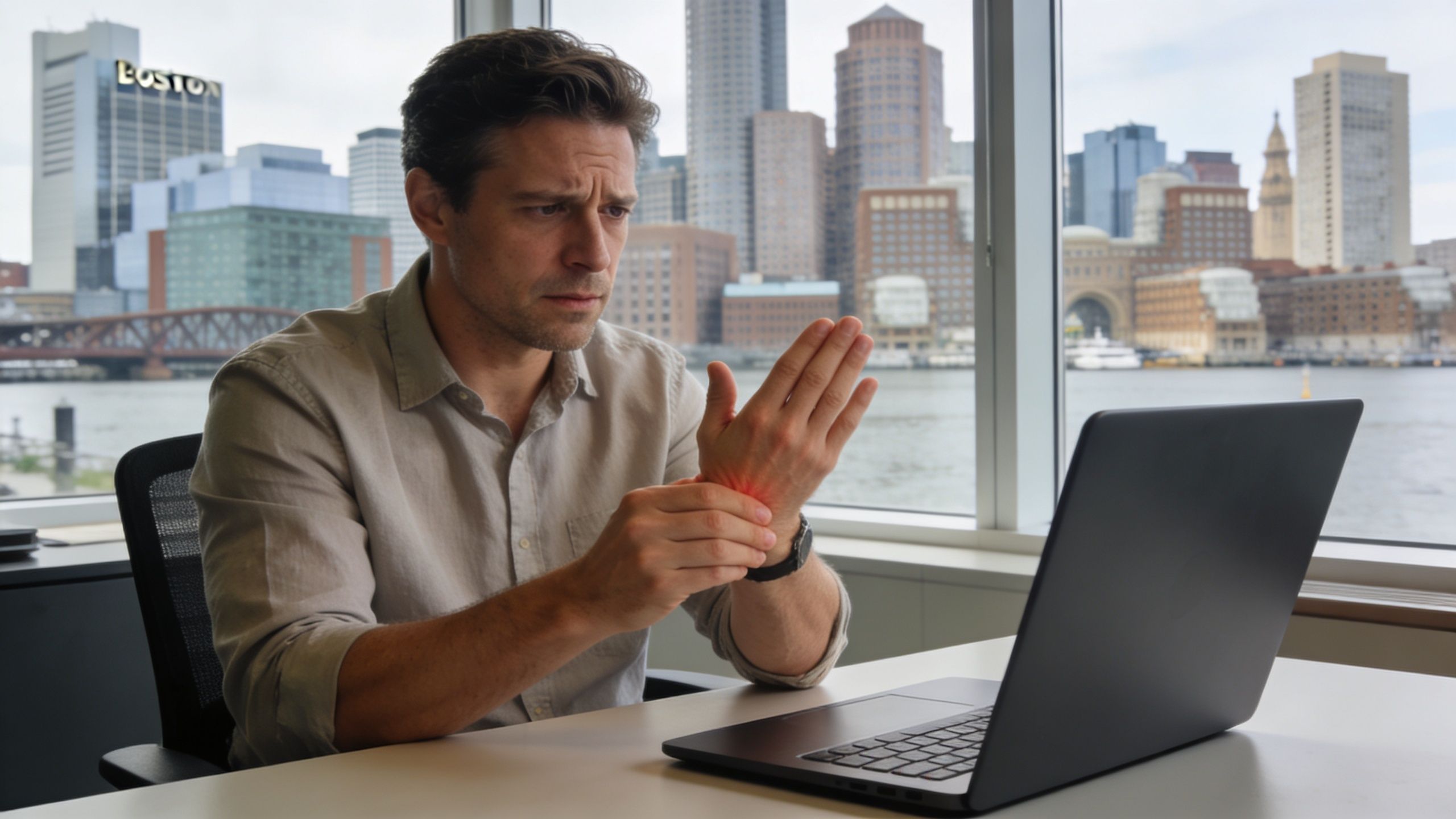
The hand is where many people feel the problem first, but the issue often extends beyond the hand itself. Wrist stiffness can change how you grip. Elbow pain can make lifting awkward. Shoulder positioning can affect what happens all the way down the forearm. In an active city like Boston, those changes matter fast.
What patients usually notice first
Some people come in because of pain. Others come in because they’re dropping objects, waking up numb, or avoiding movements they used to do without thinking.
Common early complaints include:
- Morning stiffness: Your hand feels slow and tight when you first start the day.
- Workday numbness: Typing, mousing, or scrolling brings on tingling or heaviness.
- Grip fatigue: You can still hold things, but not for long.
- Sport-specific pain: Swinging, climbing, rowing, lifting, or shooting starts to feel unreliable.
- Post-surgical uncertainty: The incision may be healing, but function isn’t back yet.
The biggest mistake people make is waiting until they’ve changed how they use the whole arm. By then, the problem is rarely just about one sore spot.
Why this matters in Boston
Boston life rewards hands that can do a lot. You may need precision for keyboard work, endurance for long commutes, power for training, or dexterity for music, labs, and clinical work. When the hand or arm stops cooperating, productivity drops and everyday tasks get frustrating fast.
That’s why hand therapy works best when it’s practical. Treatment should connect directly to what you need to do in Boston, whether that’s managing a workstation in the Financial District, getting back to a local rink, or carrying groceries and a coffee through South Station without pain.
Why Boston is a Hub for Elite Hand Therapy
Where you get treated matters. In Boston, patients benefit from a medical environment that takes upper-extremity care seriously, from surgery through rehabilitation. Massachusetts General Hospital operates one of the largest occupational therapy departments in the country, and its hand and arm occupational therapy service works closely with orthopedic and plastic surgeons while treating complex post-surgical and post-traumatic injuries with advanced techniques such as custom splinting, joint mobilization, physical agent modalities, ergonomic assessment, and patient education, as described by Mass General’s hand and arm occupational therapy program.
That matters because hand rehab is rarely isolated. The best outcomes usually come from a care ecosystem where surgeons, occupational therapists, physical therapists, and hand specialists speak the same language about tissue healing, protection, timing, and return to function.
What Boston patients gain from that ecosystem
Boston’s hand therapy environment is shaped by hospital systems and rehab centers that see a high volume of upper-extremity cases. That creates a strong clinical culture around:
- Post-surgical coordination: Tendon repairs, fractures, and more complex injuries often need tightly timed rehab.
- Specialized tools: Custom orthoses, scar management, edema control, and sensory work are routine, not niche.
- Higher clinical expectations: In a city known for medicine, patients expect precision and clear plans.
- Access across neighborhoods: Care isn’t limited to one downtown hospital campus.
A private clinic in this environment has to be sharp. Patients ask better questions. Referring surgeons expect accurate follow-through. Therapists need to match a high standard of communication and decision-making.
Boston is built for specialized rehab
That’s also why hand therapy Boston searches are different from generic rehab searches. People here often know they want focused care, not a broad ortho program that treats every body part the same way.
For deeper educational content on anatomy, healing timelines, and upper-extremity recovery principles, visit Highbar Health. That’s the right place for the broader clinical background. The local question is simpler. If you need hand therapy in Boston, you should look for a provider that understands both the medical standard of this city and the way Bostonians use their hands every day.
In Boston, specialized care is easier to find than in many cities. The real decision is whether the clinic can translate that expertise into your work, sport, and schedule.
What is a Certified Hand Therapist
A Certified Hand Therapist, or CHT, is not a generalist who happens to treat wrists once in a while. This is a therapist with advanced upper-extremity training and a focused practice in conditions involving the hand, wrist, forearm, and elbow.
Nationally, CHTs are scarce. There are about 6,000 Certified Hand Therapists in the U.S. compared with over 200,000 physical therapists, which is why access to CHTs in Boston is so valuable for people who want expert upper-extremity care, according to salary and workforce data on Certified Hand Therapists in Boston.
What the credential means in practice
A CHT has already built a strong rehab foundation before specializing further. The certification requires deep experience in upper-extremity rehab and a rigorous exam. In day-to-day care, that usually shows up in a few important ways:
- They understand protection versus progression: Not every stiff hand should be pushed. Not every painful wrist should be rested.
- They can fabricate and adjust custom orthoses: Off-the-shelf braces help sometimes. They’re often not enough.
- They know how tissue healing changes the plan: Tendon, nerve, scar, swelling, joint stiffness, and strength deficits don’t all respond to the same approach.
- They treat function, not just symptoms: The goal is using your arm well, not only lowering pain at rest.
Hand therapy is broader than the name suggests
People hear “hand therapy” and assume the treatment starts and ends at the fingers. It doesn’t. Good upper-extremity rehab often looks at the chain from elbow to wrist to hand, and sometimes even farther up based on how you move and load the arm.
That’s one reason patients ask about the difference between OT and PT in this area. If you want a useful breakdown, this explanation of occupational therapy vs physical therapy gives a clear overview of how those roles can overlap and differ.
What a CHT tends to do better than a general approach
A general orthopedic program can be appropriate for some straightforward cases. But certain problems usually respond better when a specialist is directing care.
| Situation | General rehab may miss | CHT-focused approach |
|---|---|---|
| Post-op hand or wrist case | Timing details | Protection and progression based on healing stage |
| Swelling and scar issues | Persistent stiffness | Hands-on edema and scar management |
| Nerve irritation | Symptom chasing | Movement, positioning, and task-specific modification |
| Grip-related return to sport | Generic strengthening | Sport- and task-specific loading |
If your goal is to “do some exercises,” almost any clinic can give you a sheet. If your goal is to regain precise, durable use of your arm, a CHT is often the right match.
Common Conditions We Treat with Hand Therapy
Boston patients don’t all show up with the same story. The Financial District analyst with nighttime numbness is different from the amateur tennis player in Brookline, and both are different from the musician, nurse, climber, or post-op patient trying to get basic function back. What they share is that upper-extremity problems interfere quickly with work and independence.
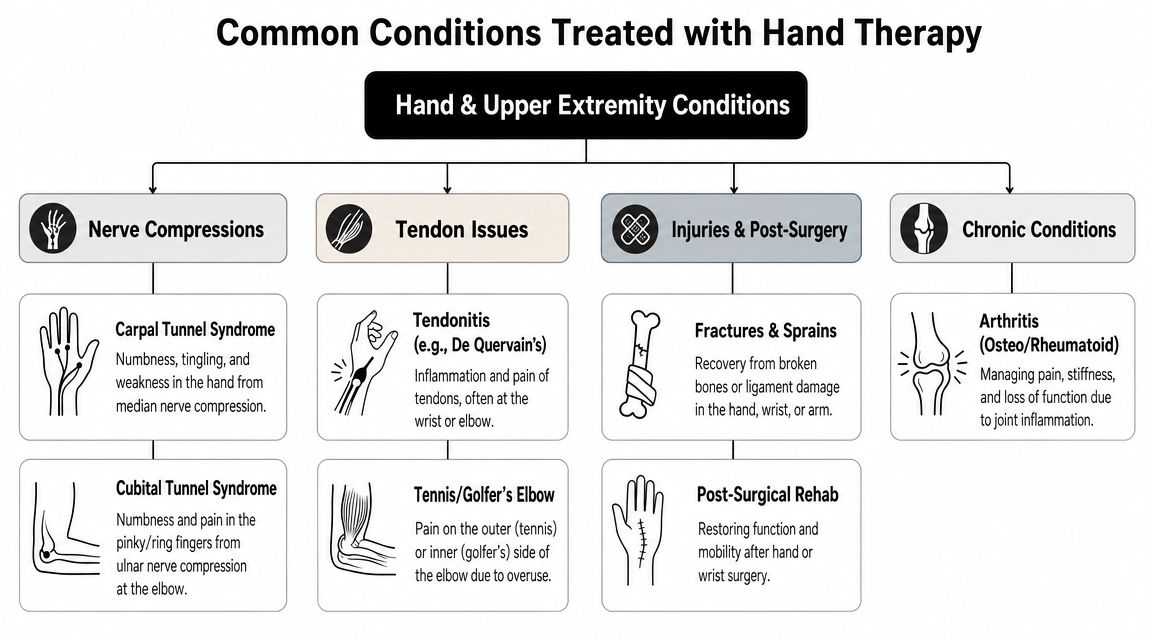
Desk-driven nerve symptoms
A lot of office workers first notice symptoms while typing, using a touchpad, or holding a phone. Their hand may feel numb, clumsy, or weak, especially later in the day or at night. In Boston, that often means long screen hours plus a commute plus home device use. The total load adds up.
Carpal tunnel symptoms are a common reason people look for hand therapy Boston services. When the issue is caught early, the plan often focuses on task modification, splinting when appropriate, mobility, and reducing the positions that keep symptoms stirred up. If you want more background on conservative strategies, this article on treating carpal tunnel syndrome naturally is a useful starting point.
Overuse pain in active Bostonians
Weekend sports and year-round training create a different profile. These patients often report pain with gripping, lifting, twisting, or repetitive wrist motion.
That can include:
- Tendon irritation near the wrist or thumb: Common in parents, lifters, rowers, and people with high-volume hand use.
- Tennis or golfer’s elbow: Often linked to repeated gripping, pulling, racquet sport, or gym volume.
- Forearm overload: A frequent issue in climbing, hockey, CrossFit-style training, and manual work.
If a movement hurts every time, the answer usually isn’t to stop moving forever. The answer is to figure out which tissue is overloaded, what keeps provoking it, and how to dose your return.
Fractures, sprains, and surgery recovery
Specialized hand therapy often matters most when anticipated recovery doesn't materialize. Someone has surgery at a local hospital, gets the cast off or the dressing changed, and expects things to normalize on their own. Instead, the hand stays swollen, the wrist won’t move, or the fingers feel stiff and disconnected.
Common Boston rehab scenarios include:
- Post-fracture stiffness: The bone may be healing, but motion and grip haven’t caught up.
- Tendon repair recovery: These cases need careful progression. Too much force too early can irritate healing tissue. Too little motion can leave the hand stiff.
- Post-surgical scar and edema issues: Even when surgery goes well, scar sensitivity and swelling can limit function.
Arthritis and persistent hand pain
Not every patient is recovering from one event. Some are managing an ongoing condition that affects daily tasks over time. Active older adults in neighborhoods like Back Bay and Beacon Hill often want a plan that keeps them independent, not one that tells them to avoid using the hand.
In those cases, therapy often centers on joint protection, adaptive strategies, targeted motion, and finding the right balance between activity and recovery. The goal isn’t to “win” against every symptom. It’s to make the hand more useful again in the routines that matter.
Your Hand Therapy Journey at Joint Ventures
The first visit should feel clear, not confusing. For hand and upper-extremity cases, a focused evaluation matters because small details change the plan fast. The exact motion that hurts, the direction of stiffness, the location of swelling, your work setup, and your sport all help determine what comes next.
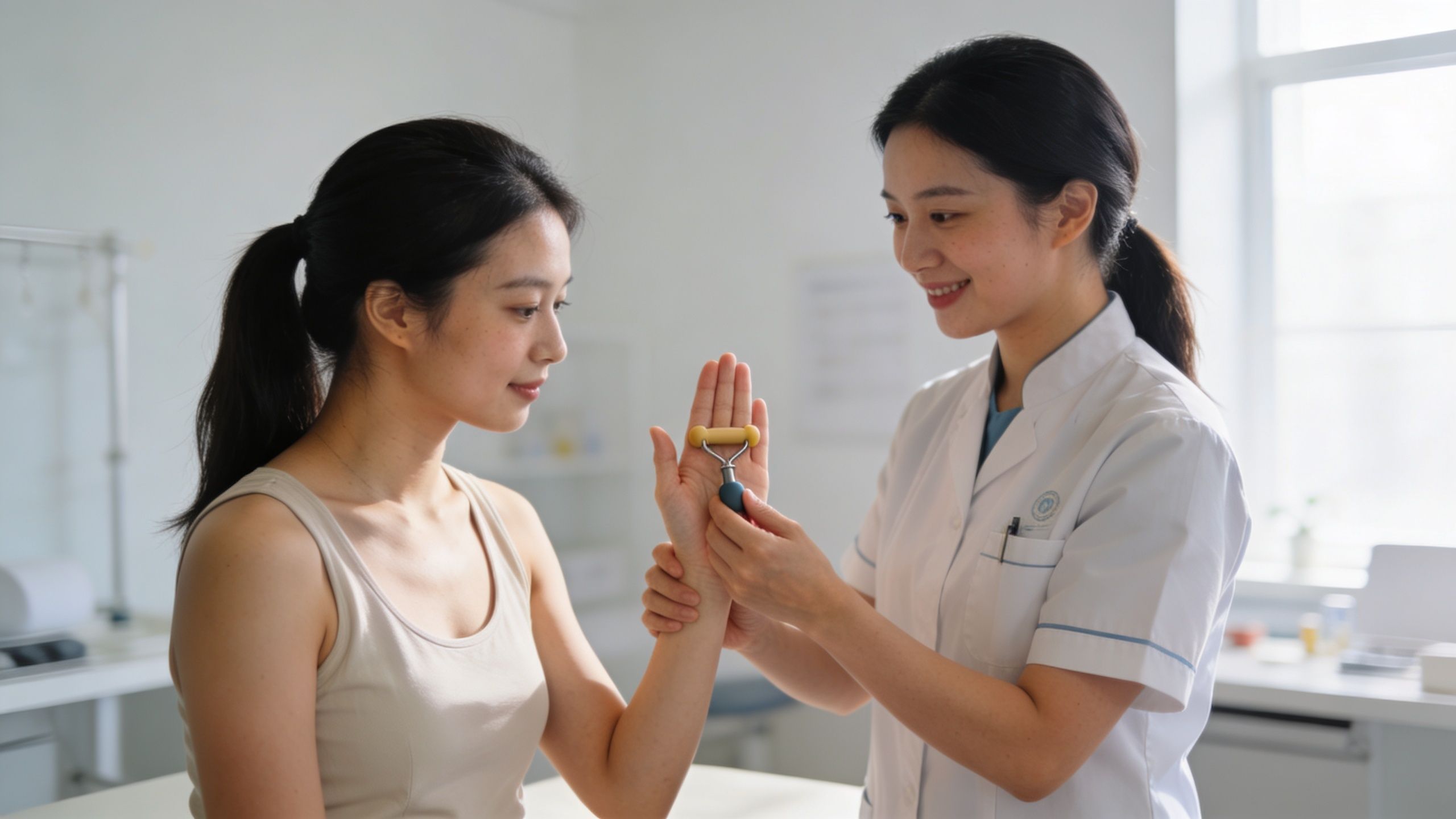
At Joint Ventures’ hand and upper extremity therapy service, care is built around one-on-one visits and individualized plans for the elbow, forearm, wrist, and hand. That format works well for upper-extremity rehab because the details are rarely generic.
What happens at the first appointment
Expect a conversation before a treatment plan. A good hand therapy evaluation usually looks at:
- Your history: How it started, what aggravates it, what you’ve already tried.
- Your function: What you can’t do well right now at work, at home, or in sport.
- Your movement: Range of motion, joint stiffness, tendon glide, grip tolerance, and task-specific mechanics.
- Your irritability level: Some conditions need calming before strengthening. Others need motion right away.
You may also be measured on practical tasks that matter to your case. For a desk worker, that may involve workstation habits and repetitive positions. For an athlete, it may involve gripping, impact tolerance, or return-to-training demands.
What treatment can include
Hand therapy is often a mix of protection, guided movement, and progressive loading. Depending on the condition, treatment may involve:
- Custom orthotic fabrication: Useful when a structure needs support, positioning, or protection.
- Targeted mobility work: To restore motion in stiff fingers, wrist joints, and soft tissue.
- Edema and scar management: Especially important after injury or surgery.
- Strength and dexterity progression: Built around what you need your hand to do.
- Ergonomic advice: Practical changes for typing, mousing, lifting, commuting, or equipment setup.
Practical rule: If the plan doesn’t connect directly to the way you use your hand in daily life, it probably won’t stick.
What tends to work and what doesn’t
What works is a plan that matches tissue healing and your actual goals. That means the right amount of motion at the right time, plus enough home practice to keep progress moving between visits.
What usually doesn’t work is guessing. Resting indefinitely often leaves people weaker and stiffer. Pushing aggressively because the hand feels tight can backfire, especially after surgery. Specialized protocols such as controlled early motion and custom splinting can produce 85% excellent outcomes in post-surgical cases and restore 90% to 95% of functional dexterity within 8 to 12 weeks for many post-fracture or tendon repair patients, according to Newton-Wellesley Hospital’s hand therapy overview.
Find Hand Therapy Near You in Greater Boston
Convenience matters more than people expect. Hand therapy usually works best when you can get to appointments without turning every visit into a cross-city project. That’s especially true if you’re balancing work, classes, training, parenting, or post-op follow-ups.
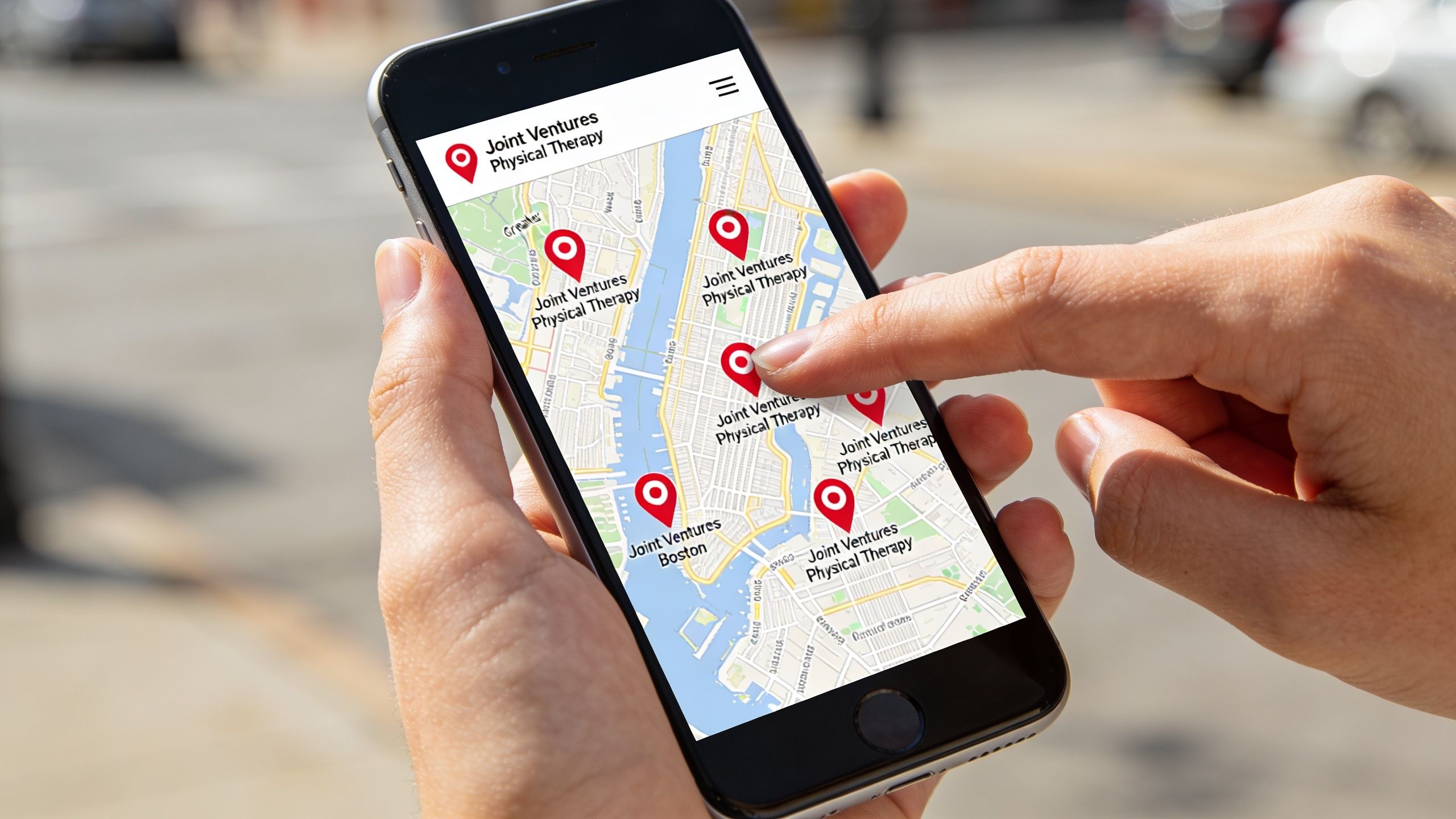
Boston-area locations that fit real schedules
If you’re looking for hand therapy Boston options near where you already spend your time, these neighborhoods make treatment more manageable:
- Back Bay: Convenient for people working near Copley, living in Back Bay, or commuting in from the western side of the city.
- Kenmore Square: A practical choice for students, university staff, Fenway-area residents, and anyone who wants easy T access.
- Fort Point and Seaport: Useful for professionals working in the Seaport and nearby waterfront offices.
- Downtown Boston: A strong fit for people near the Financial District, Government Center, or South Station.
- Brookline and Allston: Helpful for residents, students, and active adults who want neighborhood access without heading downtown.
Choose the clinic that matches your day
A lot of patients choose based on one simple question. Can I get there consistently?
That’s the right question. The best clinic on paper won’t help much if your schedule makes follow-through difficult. For upper-extremity rehab, regular attendance and a plan you can carry into your workday make a real difference.
If you’re ready to stop guessing and get a focused plan, book a hand therapy evaluation at the location that’s easiest for your commute, neighborhood, or workday routine.
Frequently Asked Questions About Hand Therapy
Do I need a doctor’s referral for hand therapy in Massachusetts
Sometimes yes, sometimes no, depending on your insurance and the reason for care. If you’re coming in after surgery, your surgeon may already have specific therapy orders. It’s worth checking your plan benefits and any referral requirements before the first visit so there are no surprises.
Is hand therapy covered by insurance
Many plans cover medically necessary therapy, but benefits vary. Coverage can depend on your diagnosis, whether you need authorization, how many visits are allowed, and whether your plan requires a referral. The practical move is to verify benefits before you start.
What’s the difference between occupational therapy and physical therapy for a hand injury
Both can play an important role in upper-extremity rehab. In hand therapy, the line often overlaps more than people expect. The main thing that matters is whether the clinician has specialized experience with the specific problem you have and whether the treatment plan matches your goals.
When should I start instead of waiting it out
If pain, numbness, weakness, swelling, or stiffness is changing how you work, train, sleep, or use your hand day to day, it’s reasonable to get evaluated. Waiting can let compensation patterns settle in and make recovery more frustrating than it needs to be.
What should I bring to the first visit
Bring any surgical paperwork, imaging reports if you have them, your brace or splint if you’re using one, and a clear sense of what you need your arm to do again. That last piece matters. Hand therapy works best when the plan is tied to your actual life in Boston.
If hand, wrist, elbow, or forearm pain is getting in the way of work, training, commuting, or everyday tasks, schedule an evaluation with Joint Ventures Physical Therapy. You’ll get a focused plan built around your goals, your routine, and the Boston location that makes follow-through realistic.