
A concussion can make Boston feel much louder, brighter, and faster than it did a week ago. The Green Line screeches. Your laptop feels harsh after ten minutes. Walking through Back Bay or crossing a busy Seaport intersection suddenly takes more concentration than it should.
That disconnect unsettles people. You may look fine, yet feel off balance, foggy, headachy, or strangely wiped out by normal tasks.
The good news is that recovery usually isn't about sitting in a dark room and waiting. In Boston, where work, school, training, and commuting all demand focus, the right plan is active, structured, and specific to the systems that are driving your symptoms. That's where concussion physical therapy in Boston can be useful.
Navigating Life in Boston After a Concussion
A common story sounds like this. You bump your head in a rec league game, get hit during a pickup run near Fenway, or take a fall on icy sidewalks in winter. The next morning, you try to push through your normal routine. By the time you're on the T, the noise feels sharp, your eyes don't love the movement, and answering emails in a downtown office leaves you with a pounding headache.
For students, it shows up differently but just as clearly. A busy university library feels overstimulating. Reading takes longer. Looking from notebook to screen to professor becomes tiring in a way that's hard to explain to anyone who hasn't felt it.
These symptoms are real, and they don't mean you're weak or overreacting. They usually mean one or more systems involved in balance, vision, neck function, and exertion tolerance aren't handling demand well yet.
Concussion recovery works better when treatment matches the symptom pattern instead of assuming every concussion should be managed the same way.
That's why concussion physical therapy isn't passive. A good rehab plan gives you a way to test what triggers symptoms, identify why those triggers happen, and rebuild tolerance in a controlled way. If you're a runner, that may mean a staged return to aerobic work. If you work in finance, tech, law, healthcare, or academia, it may mean a strategy for screens, meetings, commuting, and cognitive load. If you're a student-athlete or parent in Massachusetts school sports, it may also fit into the return-to-play process after medical clearance for monitored rehab progression.
In Boston, recovery isn't just about getting rid of symptoms on the couch. It's about getting back to class, the office, the gym, your commute, and the life you live here.
Recognizing Post-Concussion Symptoms and Red Flags
The first challenge after a concussion is sorting out what feels normal, what points to post-concussion symptoms, and what needs urgent medical attention. In a city like Boston, that can be confusing because everyday life is already stimulating.
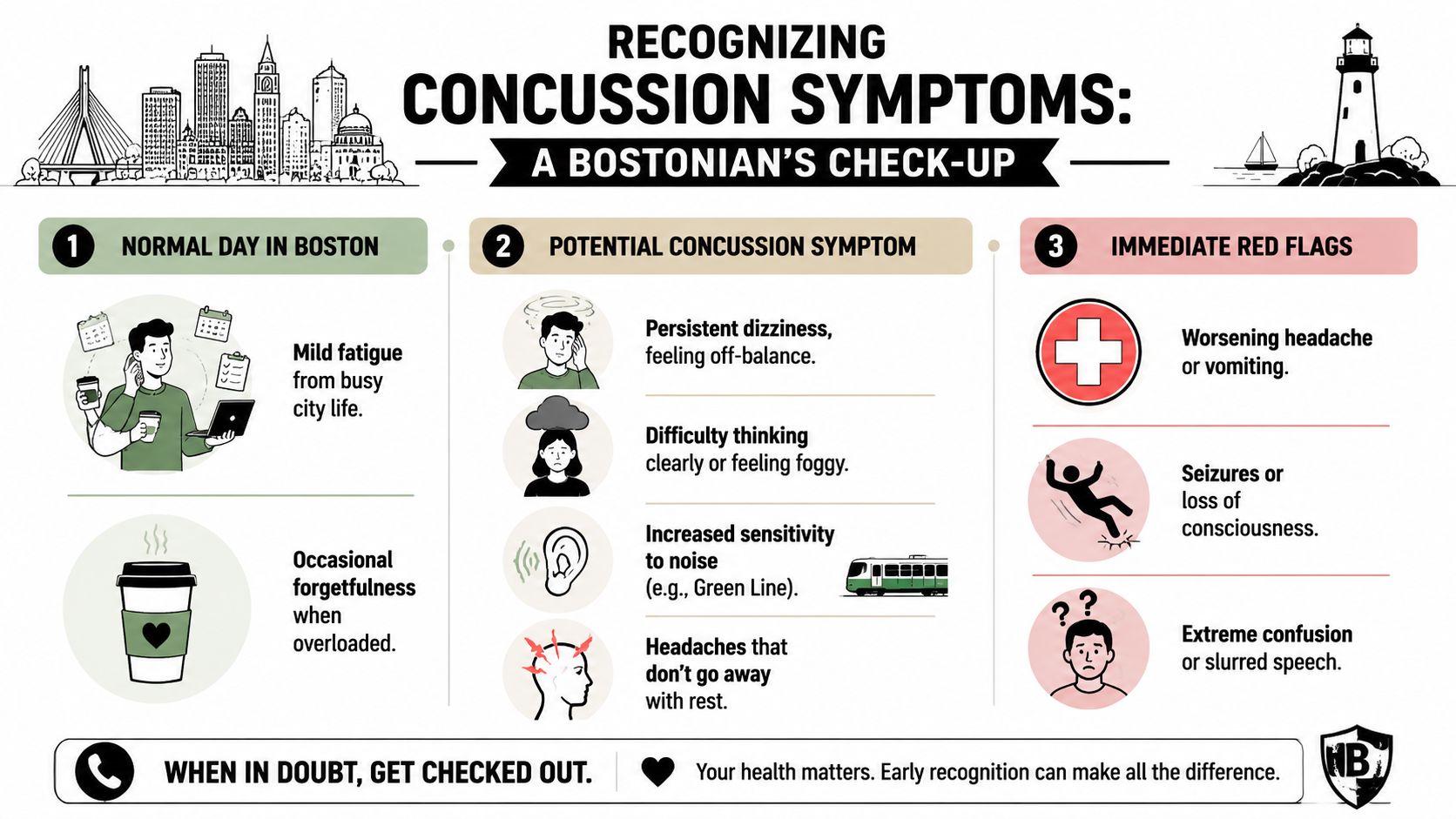
What symptoms often feel like in daily life
A concussion doesn't always announce itself dramatically. Sometimes it feels like you're just "not quite right."
- Dizziness or disequilibrium. You feel unsteady on crowded sidewalks, escalators, or when turning your head quickly in a grocery store or station.
- Headache. Screens, fluorescent office lighting, noise, or a full day of concentration make your head throb.
- Brain fog. You reread the same paragraph, lose your train of thought in meetings, or struggle to keep up with fast conversation.
- Noise sensitivity. The T, gym music, restaurant noise, or a loud classroom suddenly feels overwhelming.
- Light sensitivity. Bright winter glare, office lighting, and phone screens bother you more than usual.
- Visual strain. Scrolling, reading, or shifting focus between near and far targets increases symptoms.
- Fatigue. Normal work, school, or errands leave you spent.
- Neck pain or jaw tension. Some post-concussion headaches have a strong cervical or TMJ component, not just a "brain" component.
If dizziness is one of your main complaints, our guide to how vertigo is treated in physical therapy can help you understand one part of the picture.
Red flags that need immediate medical care
Some symptoms should never be watched casually at home.
- Worsening headache or repeated vomiting
- Seizures or loss of consciousness
- Extreme confusion or slurred speech
If any of those are happening, seek emergency care right away.
A short overview can also help if you're still trying to understand whether your symptom pattern fits concussion recovery:
Why early action matters
Clinical research from Massachusetts supports early, structured rehabilitation. A Boston-area sports medicine source states that physical therapy can begin as early as 48 hours after injury, and that about 90% of concussions recover within 4 weeks when appropriately managed in Boston Sports Medicine's post-concussion guidance.
That doesn't mean every symptom needs the same treatment on day two. It does mean prolonged rest alone usually isn't the whole answer. If headache, dizziness, fogginess, or motion sensitivity is interfering with work, school, training, or commuting, getting assessed early often gives you a clearer path.
The Pillars of Modern Concussion Physical Therapy
Good concussion rehab starts with one idea. You don't treat "concussion" as one single problem. You screen the systems most likely to be involved, then build treatment around what you find.
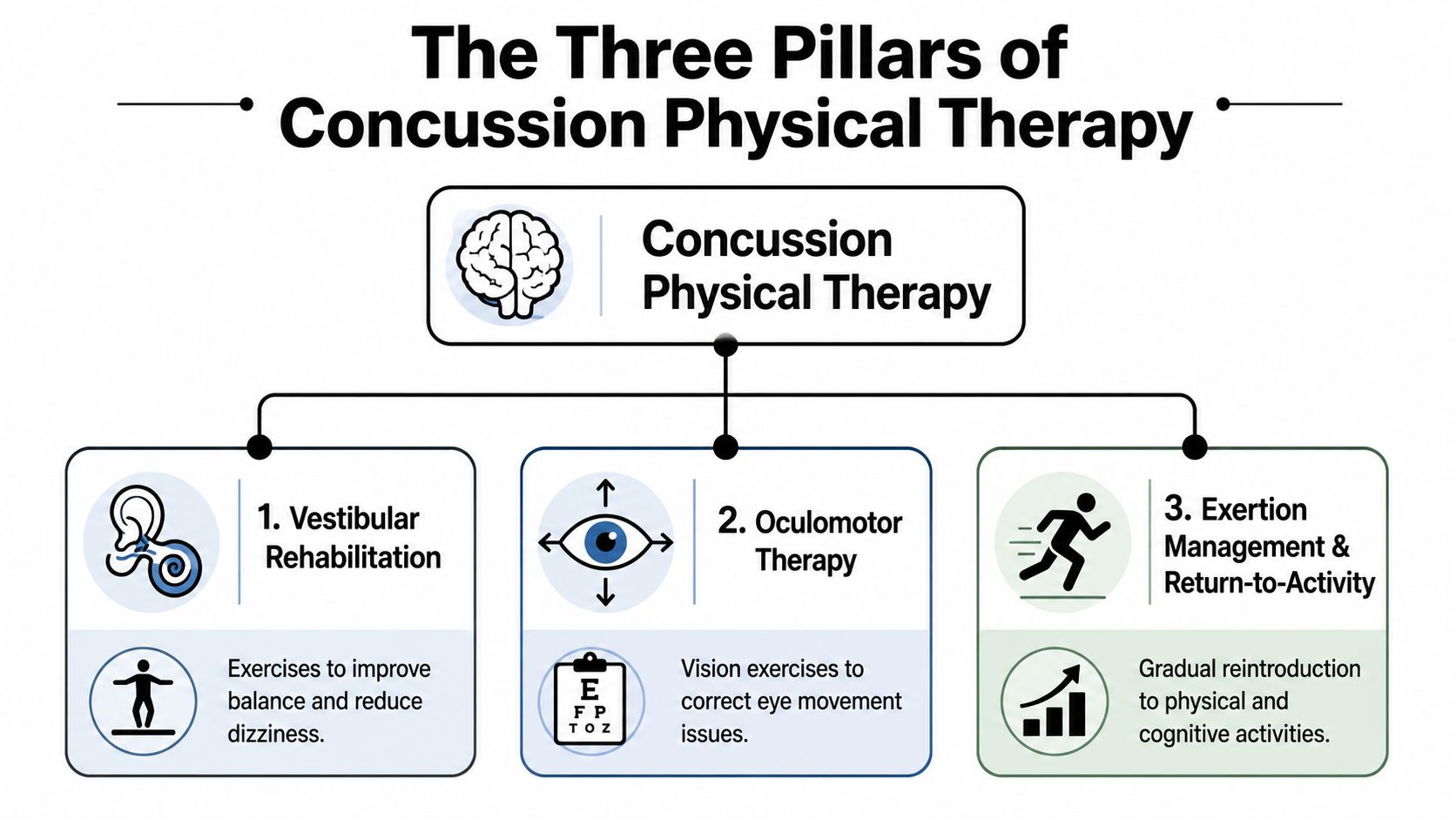
A clinical practice guideline recommends a multisystem evaluation that screens cervical musculoskeletal function, vestibulo-ocular function, autonomic dysfunction and exertional tolerance, and motor function, with symptoms and functional limits tracked over time in the concussion rehabilitation guideline. That's why modern concussion physical therapy in Boston should feel more like a focused systems check than a generic exercise sheet.
Vestibular and oculomotor rehab
If stores, traffic, scrolling, or head turns make you dizzy, the vestibular and visual systems need attention. This part of rehab looks at eye tracking, gaze stability, motion sensitivity, balance, and how your brain handles movement in visually busy spaces.
Some people say, "I only get symptoms when I move." That's often the clue. The problem may not be rest. The problem may be that your system isn't coordinating movement and visual input well yet.
A related issue is positional dizziness. If symptoms are triggered by rolling in bed, looking up, or changing position, clinicians may also need to consider benign paroxysmal positional vertigo. For a local overview of this area of care, see our page on vestibular therapy in Boston.
Graded exertional training
Many patients are afraid activity will set them back. Total shutdown, though, often isn't the right long-term strategy.
The same concussion guideline supports symptom-guided progressive aerobic exercise once symptoms stabilize to a moderate or lower level of irritability. In plain English, that means clinicians use movement and cardio carefully, not recklessly. The goal is to rebuild exertion tolerance without pushing you into a crash.
Practical rule: The right exercise dose should challenge the system enough to promote recovery, but not so much that symptoms spiral for the rest of the day.
This matters for Boston patients because returning to life here requires stamina. You need enough tolerance for stairs, sidewalks, campus walks, workouts, and long workdays. Exertion intolerance is treatable. It isn't a sign that you should avoid movement forever.
Cervical and TMJ treatment when they matter
Not every post-concussion headache is coming from the same source. Neck stiffness, jaw clenching, upper cervical irritation, and postural overload can all keep symptoms alive.
That's why treatment may include manual therapy, mobility work, postural retraining, and targeted exercise for the neck and jaw. If your headache ramps up with reading, computer work, or driving, the cervical contribution matters. If you wake up with jaw soreness or feel temple pressure, TMJ may be part of the picture too.
When PT is one piece of a bigger plan
Sometimes PT is the right first step. Sometimes it should sit alongside medical follow-up, neurocognitive testing, or specialist evaluation. If your concussion came from a crash, assault, or other accident, practical legal and injury distinctions may matter too. This accident victims' TBI legal guide offers a plain-language explanation of how concussion and traumatic brain injury terms are commonly discussed.
The key trade-off is simple. A generic clinic may give you exercise. A better concussion PT process identifies whether dizziness is vestibular, whether headaches are partly cervical, whether exertion is the main limiter, and whether someone else should join the care team.
Your Recovery Timeline Return to Sport Work and School
A common Boston recovery story looks like this. You can get through a short walk on the Esplanade, but a Red Line commute, two hours of screen time, or a pickup run on the weekend brings the headache and dizziness right back. That does not mean you're stuck. It usually means your brain and body can handle some load, just not that much load yet.
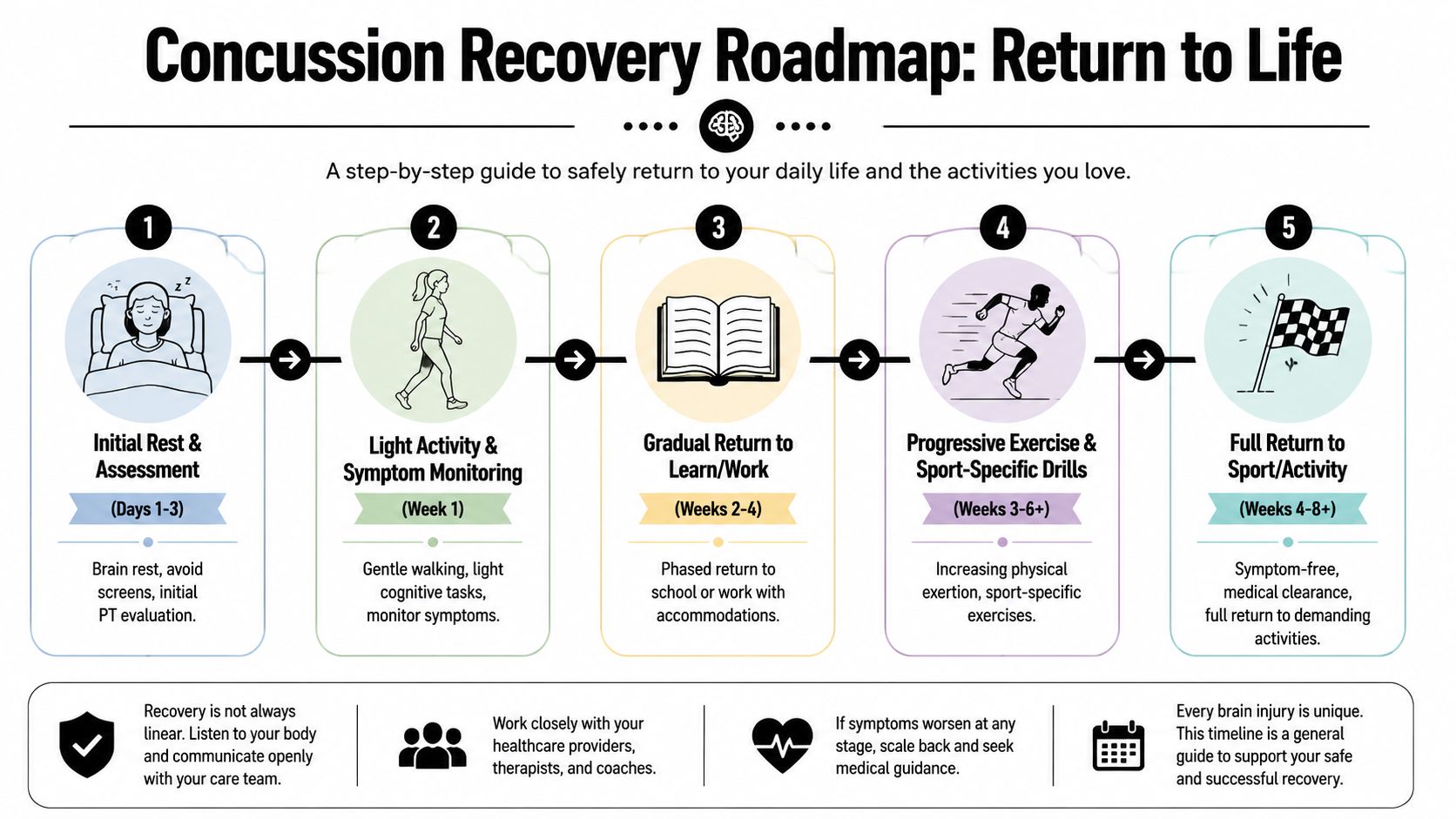
What progression usually looks like
Recovery after a concussion is rarely linear. One person tolerates walking before reading. Another gets through a workday before they can exercise without a symptom spike. The right question is not, "How fast should I be back?" The better question is, "What level can I handle today without paying for it tonight or tomorrow?"
| Phase | Focus |
|---|---|
| Early phase | Set a baseline, reduce large symptom flares, start light activity when appropriate |
| Middle phase | Build tolerance for screens, reading, walking, class, work, and commuting |
| Later phase | Add harder exercise, job-specific tasks, and sport-specific movement with symptom checks |
For families and student-athletes in Massachusetts, school sports return-to-play has a formal process. The state's Sports-Related Concussion Law took effect in 2010 and requires medical clearance before return to play, as outlined in the Massachusetts concussion law implementation study.
Return to school, work, and sport each stress you differently
A college student in Boston may be limited most by lectures, note-taking, and campus walking. A financial district professional may hit their limit with meetings, screens, and the commute. An athlete may feel fine at rest and still flare with sprinting, heading drills, or lifting.
Those are different demands, so they need different progressions.
In clinic, I want to know what your real week looks like. Green Line ride. Laptop time. Gym session. Practice. Lab. Long day on your feet at the hospital. Recovery goes faster when the plan matches your actual life instead of a generic checklist.
If you're dealing with a broader injury recovery process, this resource on TBI recovery timeframes and support may help you frame the bigger picture.
A true milestone is getting through your normal Boston day without a delayed symptom rebound, not just feeling decent while sitting still.
Why progression needs structure
A good day can be misleading. Symptoms often stay quiet during the activity and flare later, which is why return decisions should be based on repeated exposure to the right amount of physical and cognitive demand.
That matters for athletes, but it also matters for anyone trying to resume full work, school, or training. The goal is to expand capacity in steps. If symptoms rise mildly during an activity and settle quickly, that usually tells us the dose was reasonable. If a workout, class block, or workday causes a bigger crash later, the dose was too high and needs to be adjusted.
For active adults and student-athletes, our overview of sports rehab in Boston gives more context on how rehab is built around performance demands rather than rest alone.
The trade-off is straightforward. Returning too aggressively can keep the cycle going. Returning too cautiously can leave you deconditioned, anxious about symptoms, and behind at school, work, or sport. The right concussion PT plan threads the middle. It gives you a progression you can follow, with clear markers for when to push, when to hold, and when to bring another provider into the picture.
How to Choose the Right Concussion PT Clinic in Boston
Not every PT clinic is set up for concussion care. Some are excellent for post-op knees or general back pain but don't routinely assess dizziness, oculomotor problems, exertion intolerance, or cervical contributions to headache.
That's why your first question shouldn't be "Who does physical therapy near me?" It should be "Who can tell me which system is driving my symptoms, and who will coordinate care if PT alone isn't enough?"
What to look for in a clinic
Use this checklist when comparing options in Back Bay, Kenmore, Downtown, Fort Point, Brookline, or near your campus or office.
- A true symptom-specific evaluation. Ask whether they assess vestibular, visual, cervical, balance, and exertion factors rather than treating every concussion the same way.
- One-on-one treatment time. Concussion rehab requires observation and adjustment. Busy handoffs make that harder.
- Experience with real Boston use cases. Student-athletes, runners, desk-based professionals, and active older adults all stress the system differently.
- A plan for return to life. You want more than "rest and see." You want guidance for work, school, transit, exercise, and screens.
- Referral judgment. The clinic should know when symptoms point beyond PT alone.
When PT is enough and when you need co-management
Many clinic pages often fall short in a particular area. They tell you they treat concussion, but not when you should also involve other specialists.
Top Boston medical systems describe concussion care as multidisciplinary. BMC and Spaulding both frame care this way, and a high-quality PT clinic should help patients coordinate referrals to neurology, neuro-ophthalmology, or ENT when symptoms are complex or persistent, as reflected in BMC's sports concussion clinic overview.
Here's a practical perspective:
| Symptom pattern | PT may be the right first step | Referral co-management may be needed |
|---|---|---|
| Dizziness with motion or head turns | Often yes | If symptoms are unusual, worsening, or not fitting a vestibular pattern |
| Headache with neck stiffness | Often yes | If headaches are severe, changing, or medically concerning |
| Visual strain and screen intolerance | Often yes | If symptoms suggest more specialized ocular evaluation |
| Persistent or confusing symptoms | Sometimes | Often worth broader team input |
A good concussion clinic doesn't try to own every problem. It helps you get the right problem to the right provider.
That mindset matters in Boston because access to specialists exists here, but patients still need someone practical to help them find their way through the system.
Why Bostonians Choose Joint Ventures for Concussion Care
When patients look for concussion physical therapy in Boston, convenience matters, but the treatment model matters more. You need enough clinical depth to sort out dizziness, headache, balance problems, visual strain, and activity intolerance, and enough local access to make visits realistic during a busy week.
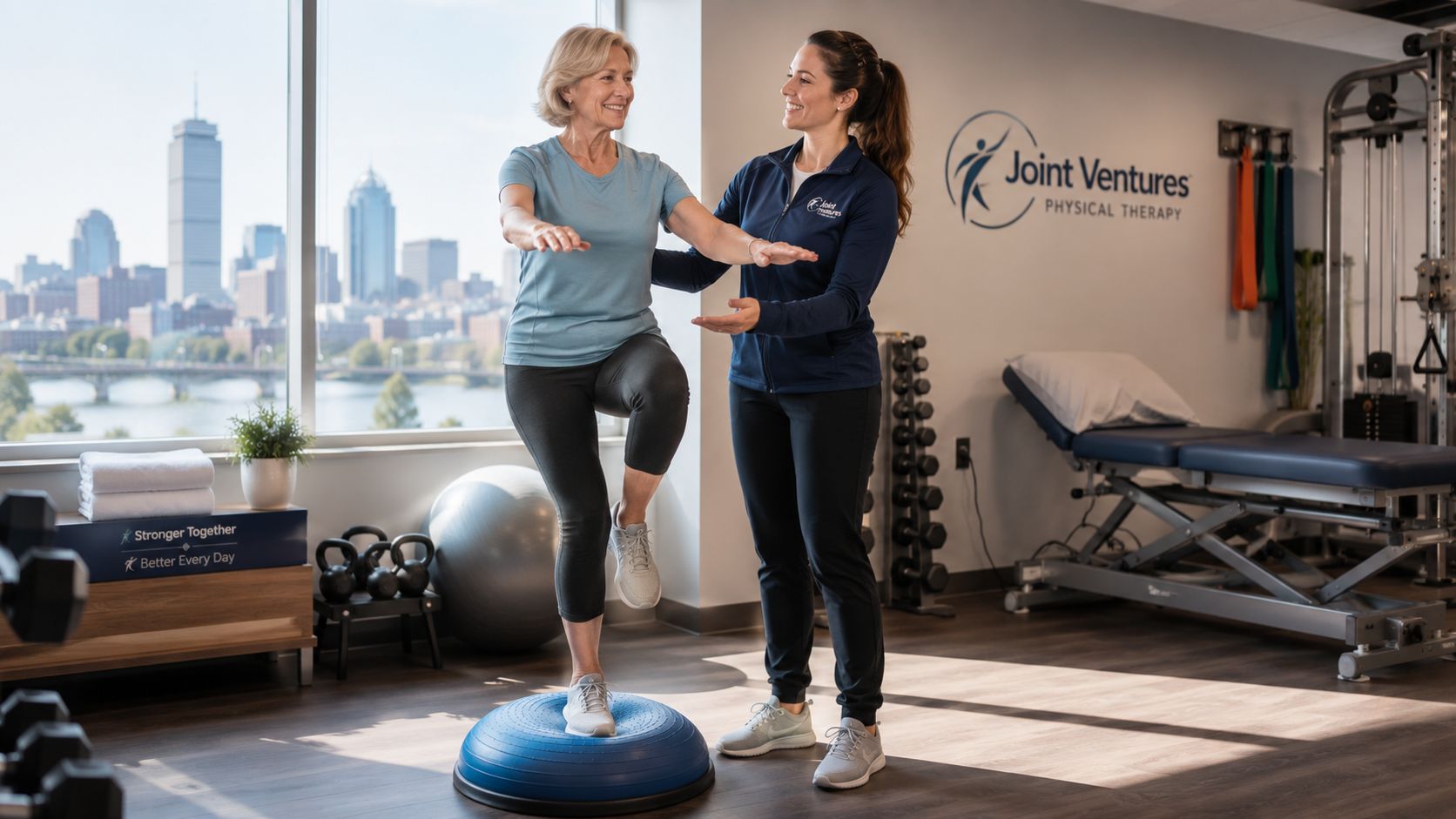
Joint Ventures Physical Therapy offers 1-on-1 physical and occupational therapy across Greater Boston, including Back Bay, Kenmore Square, Fort Point and Seaport, Downtown Boston, and surrounding neighborhoods. For a concussion patient, that means care can fit around classes, work, or training instead of turning treatment into another stressor.
Why that model fits concussion care
Concussion rehab often changes week to week. A patient may start with heavy dizziness and end up limited more by screens or exercise. One-on-one visits help the therapist track those shifts and adjust the plan.
The clinic's broader service mix also matters. Vestibular and balance care, TMJ treatment, dry needling, sports rehab, concussion baseline screening, and workplace ergonomics all connect naturally to common post-concussion problems seen in Boston patients. A desk-based professional may need screen and posture strategies. A runner may need graded exertion progression. A student-athlete may need baseline screening history and return-to-sport coordination.
How that fits the Boston medical landscape
Evidence-based concussion programs in Boston commonly combine vestibular therapy and objective testing. Spaulding Boston's sports concussion clinic describes a program that includes full medical, musculoskeletal, neurological, vestibular, and cognitive assessment with ImPACT testing in its sports concussion clinic program description. That approach matters because untreated dizziness or oculomotor issues can delay return to sport and daily life.
A community PT clinic doesn't need to replicate a hospital system to be useful. It does need to recognize those standards, treat what falls within PT, and connect patients into broader co-management when needed. That's the right fit for a city where some patients need neighborhood access and others need referral pathways into more specialized evaluation.
For deeper educational content about recovery principles, symptom drivers, and rehab strategy, Highbar Health houses broader clinical resources at Highbar Health. That's the right place if you want a more detailed educational deep dive beyond this local Boston guide.
Take the First Step Toward Your Recovery Today
If you've been trying to tough this out on your own, you don't need to keep guessing. Headache, dizziness, brain fog, and exercise intolerance usually respond better to a plan than to avoidance.
The right next step is simple. Get evaluated by a clinician who can determine whether your symptoms are being driven mainly by vestibular issues, neck involvement, visual strain, exertion intolerance, or a combination. Once that picture is clear, recovery tends to feel much less chaotic.
For people in Boston, that means choosing care that fits your actual life. Your commute. Your school schedule. Your office setup. Your training goals. Your timeline for getting back to normal without rushing the process.
If you want local care near Back Bay, Kenmore Square, Downtown, or Fort Point and Seaport, schedule an evaluation with a Boston-area PT team that understands concussion rehab and the referral network around it. Taking action early can make the next few weeks more organized, less frustrating, and much more productive.
If you're ready to start, book an evaluation with Joint Ventures Physical Therapy and get a clear, local plan for concussion recovery that fits your Boston routine.