
You’re walking through Back Bay, turn your head to check traffic, and the sidewalk suddenly feels like it tilts. Or you step onto the escalator at South Station and your body reacts as if the ground is moving after you’ve already stopped. That kind of dizziness is unsettling in a way that’s hard to explain to anyone who hasn’t felt it. It can make a normal Boston day feel unpredictable.
That’s usually the point when people start searching vestibular therapy Boston and realize the market is crowded. Boston has excellent hospital systems, specialty clinics, and rehab networks. It also has a lot of general PT options that list dizziness on a service menu without offering the depth needed for a real vestibular case.
The good news is that vestibular rehabilitation achieves success rates as high as 90% for treating vertigo and balance disorders, and over 40% of Americans will experience dizziness severe enough to seek medical care at some point, according to Spaulding Rehabilitation Network’s balance and vestibular overview. The hard part isn’t deciding whether treatment exists. It’s figuring out who in Boston is equipped to treat your specific version of dizziness well.
The First Step When the World Feels Unsteady
A lot of people wait too long because they hope the problem will pass on its own. Sometimes it does. Often it doesn’t. What I see more often is a Boston professional, runner, college student, or active older adult trying to work around symptoms for weeks. They stop turning quickly, avoid crowded T stations, skip workouts, and start planning life around not getting triggered.

The first practical move is simple. Stop treating dizziness like a vague inconvenience and start treating it like a problem that needs the right exam. Vestibular symptoms can show up as vertigo, motion sensitivity, visual overwhelm, balance problems, nausea with head movement, or that strange floating feeling people often describe when they walk through busy places like Downtown Crossing.
What to do in the first few days
- Write down your triggers. Note whether symptoms hit when you roll in bed, look up, turn your head, walk in crowds, ride in a car, or exercise.
- Track pattern, not drama. You don’t need perfect notes. You need enough detail that a clinician can connect symptoms to movement.
- Think safety early. If you’re an older adult or caring for one, this practical guide for caregivers to prevent falls is useful because dizziness and near-falls often show up together.
- Book a vestibular-focused evaluation, not a generic PT slot. That distinction matters.
Practical rule: If your symptoms are changing how you move through Boston, they’re significant enough to have assessed.
For a local primer on one common dizziness complaint, this guide on how to treat vertigo gives a helpful overview before your first appointment.
Why Boston patients need to be picky
Boston has the advantage of deep clinical talent. It also has the downside of choice overload. A clinic may be excellent for post-op knees and still be the wrong place for vestibular rehab. That’s not a criticism. It’s just how specialization works.
If you want good vestibular care, don’t ask only, “Can this office see me?” Ask, “Do they regularly evaluate dizziness, BPPV, concussion-related symptoms, neck-related overlap, and balance loss in active adults?” The right answer should sound specific. If it sounds vague, keep looking.
Decoding the Credentials Your Boston Therapist Needs
A PT license is the starting point, not the finish line. For vestibular therapy Boston patients should look for clinicians who do this work routinely and can explain their process in plain English. Dizziness is too nuanced for a casual side specialty.
A landmark Boston study still matters here. The 1993 Massachusetts General Hospital Institute of Health Professions trial gave early rigorous support for vestibular rehabilitation in bilateral vestibular hypofunction. In that study, patients receiving customized vestibular rehab showed functional gains including an 8% increase in walking speed, a 10% larger maximum moment arm, and a 17% decrease in double-support duration, while the control group improved less than 1% during the control phase, according to the PubMed record for the study. Good Boston clinicians still build on that evidence-based tradition. They don’t improvise with random balance drills.
What matters more than letters after the name
The credential itself matters less than whether the therapist can show vestibular depth. Ask whether they routinely perform:
- Positional testing for BPPV
- Oculomotor screening
- Gaze stabilization progressions
- Balance and gait retraining
- Return-to-activity planning for work, sport, and commuting
A therapist who treats vestibular cases regularly should be able to describe how they separate a crystal problem from a motion sensitivity problem, and how they modify treatment if neck pain, jaw tension, or concussion symptoms are also in play.
Boston patients often need crossover skills
Many searches often go wrong when people assume dizziness sits in its own silo. In real practice, it often overlaps with other systems.
A BU or Northeastern student near Kenmore Square might have post-concussion dizziness plus exercise intolerance. A Financial District professional may have head-motion sensitivity plus stiff neck mechanics from long desk hours. Another patient may have TMJ symptoms, jaw clenching, and dizziness that worsen together. These cases need a therapist who can think across categories rather than follow a canned vestibular worksheet.
The best vestibular therapist for you may not be the person with the longest resume. It’s the person who can connect your dizziness to the rest of your movement and daily life.
What to ask when reviewing bios
When you read clinic bios, skip the polished adjectives and look for signs of actual fit.
- Case mix: Do they mention vertigo, dizziness, concussion, balance disorders, TMJ, or neck-related symptoms?
- Care model: Will you see the same clinician consistently?
- Session style: Is treatment one-on-one or split across multiple patients?
- Progression mindset: Do they mention home programs, sport return, workplace ergonomics, or functional goals?
If you’re the type who likes to verify how any service provider presents expertise, even outside healthcare, this page to view our qualifications is a useful reminder of what transparent credentials communication looks like.
For a local service overview, vestibular physical therapy at Joint Ventures outlines the types of problems a Boston vestibular practice may address.
Your Interview Script Questions to Ask a Potential PT
Many callers contact a clinic and ask two questions. Do you take my insurance, and when can I get in? Those are fair questions, but they won’t tell you whether the clinic can handle your case.
A better call sounds more like a mini interview. You’re not being difficult. You’re checking fit before you commit your time, co-pays, and energy.
Start with condition-specific questions
Lead with your actual symptom pattern, not just the word “dizzy.”
Try questions like these:
- “Do you evaluate BPPV before starting a broader vestibular program?”
You want to hear that they assess positional vertigo directly, not that they’ll “see how it goes.” - “How often do you treat patients with vertigo, motion sensitivity, concussion-related dizziness, or balance loss?”
Frequency matters. Regular exposure sharpens decision-making. - “If my neck or jaw seems related, can the therapist address that too?”
This matters for TMJ overlap, post-concussion cases, and desk workers with neck-driven aggravation. - “Do you work with active adults or athletes returning to running, lifting, or field sports?”
A therapist may be competent for basic balance work and still not be the right fit for a runner training along the Charles or a soccer player returning to cutting drills.
Ask how they structure treatment
Quality differences show up fast. Some clinics give vestibular patients careful progression. Others hand over a generic printout and hope compliance carries the day.
Here are useful questions:
- “Will I have one-on-one time with the same therapist each visit?”
- “How do you decide when to progress exercises versus pull back?”
- “What do you want me to feel during home exercises, and what would be too much?”
- “How do you teach home exercises so I know I’m doing them correctly?”
A strong answer should include education, symptom monitoring, and progression based on response. It shouldn’t sound like “push through whatever happens.”
Don’t ignore logistics
Practical barriers sink a lot of good plans. Boston schedules are messy. Commutes are long. Parking matters. Early and late visits matter.
Ask:
- “How soon can I start?”
- “What neighborhoods do you serve most often?”
- “Do you help with authorization and insurance questions before the first visit?”
- “If I work near Seaport, Back Bay, or Downtown, which location makes follow-through easiest?”
A convenient location isn’t a luxury for vestibular rehab. It often determines whether patients can stay consistent enough to improve.
Vestibular Therapist Interview Checklist
| Category | Question to Ask | What to Listen For |
|---|---|---|
| Experience | Do you routinely treat vertigo, dizziness, and balance disorders? | Clear examples, not vague reassurance |
| Screening | Do you check for BPPV before broader exercises? | A direct yes, with positional testing mentioned |
| Complexity | Can you handle concussion, TMJ, or neck overlap if those are part of the picture? | Integrated thinking rather than referral by default |
| Care model | Will I work one-on-one with the same clinician? | Consistency and uninterrupted treatment time |
| Exercise dosing | How do you decide what’s enough challenge without overdoing it? | Individualized progression and symptom guidance |
| Home program | How will you teach and update my exercises? | Demonstration, review, and clear expectations |
| Return to activity | Can you build this around commuting, work, running, or sport? | Functional planning tied to your life |
| Operations | Can your staff help me understand scheduling and insurance steps? | Organized front-desk process |
Bring notes to the call. Dizziness is hard to summarize on the spot, and people often forget their most important trigger once someone answers the phone.
Before your evaluation, this local guide on how to prepare for your first physical therapy appointment can help you show up with the right information.
Red Flags and Green Lights in Vestibular Therapy
A weak vestibular plan usually falls apart in ordinary ways. Positional vertigo gets missed. Exercises are technically correct but prescribed at the wrong intensity. The home program is too vague to follow. Visits are spaced so far apart that nothing builds.

The first few appointments should feel specific. If a patient in Back Bay tells me rolling in bed triggers spinning, I want positional testing early. If a Seaport office worker gets dizziness after screens, neck strain, jaw tension, and visual load may matter as much as balance work. If a college athlete near Fenway is coming off concussion, the plan should connect vestibular rehab to exertion, reaction time, and return to play.
One common reason treatment stalls is starting broad balance work before anyone has ruled in or ruled out BPPV. Another is poor follow-through at home because the exercises were either poorly taught or pushed so hard that the patient avoids them. A useful patient-facing explanation appears in this review of why vestibular therapy doesn’t work for some patients.
Green lights to look for
These signs usually point to a clinic that understands vestibular care instead of treating dizziness like generic deconditioning:
- Testing drives treatment. The therapist checks eye movements, positional triggers, gait, balance, and cervical factors before building the plan.
- Symptom response changes the dose. Temporary provocation can be appropriate. Being wiped out for the rest of the day after every session usually means the program needs adjustment.
- Home exercises are taught, not handed over. You should leave knowing the goal, the dose, and what level of symptom increase is acceptable.
- Overlap conditions are addressed directly. In Boston, that often means concussion, cervicogenic dizziness, TMJ involvement, motion sensitivity, or visual intolerance from heavy screen use.
- The session stays one-on-one and attentive. Small details matter in vestibular rehab. Miss those details and progress slows.
Red flags that should make you pause
Some problems sound harmless on the phone and become obvious only after treatment starts.
- “We’ll do some general balance work first.” That is too broad if no one has checked for positional vertigo.
- The visit leans on passive care. Heat, soft tissue work, or modalities can reduce irritability in the right case, especially with neck or jaw involvement, but vestibular recovery usually depends on active retraining.
- You never get a clear explanation. If the therapist cannot tell you what an exercise is targeting, patients tend to stop doing it.
- The home program is overloaded from day one. More exercises do not mean better care. Better dosing means better care.
- Every dizzy patient gets the same sequence. A runner, an older adult worried about falls, and a post-concussion student should not all get an identical plan.
Feeling somewhat challenged is normal in vestibular rehab. Feeling confused visit after visit is a delivery problem.
A quick visual overview can help if you’re sorting through what modern vestibular treatment may involve:
Why this matters more in Boston
Boston patients often need more than “less dizzy.” They need to handle the Red Line, crowded sidewalks, open office lighting, fast head turns in traffic, gym classes, and long screen-heavy workdays. That changes what good care looks like.
A strong therapist will be candid about trade-offs. Sometimes the fastest improvement comes from treating BPPV directly. Sometimes pushing harder backfires and the better call is a slower exposure plan. Sometimes the vestibular system is only part of the problem because the neck or TMJ is feeding symptoms. That layered clinical reasoning matters in a competitive market where plenty of clinics say they treat dizziness, but fewer can handle the sport-specific and specialty-specific overlap well.
If you’re interested in how healthcare organizations think about communication and growth more broadly, Jackson Digital strategies for medical growth is a useful outside example of why clear messaging matters. In vestibular care, the patient experience improves when the clinic communicates clearly from the first phone call onward.
Matching Your Goals to the Right Boston PT
The right therapist isn’t just the one who understands vestibular rehab. It’s the one who understands what you need your body to do again.
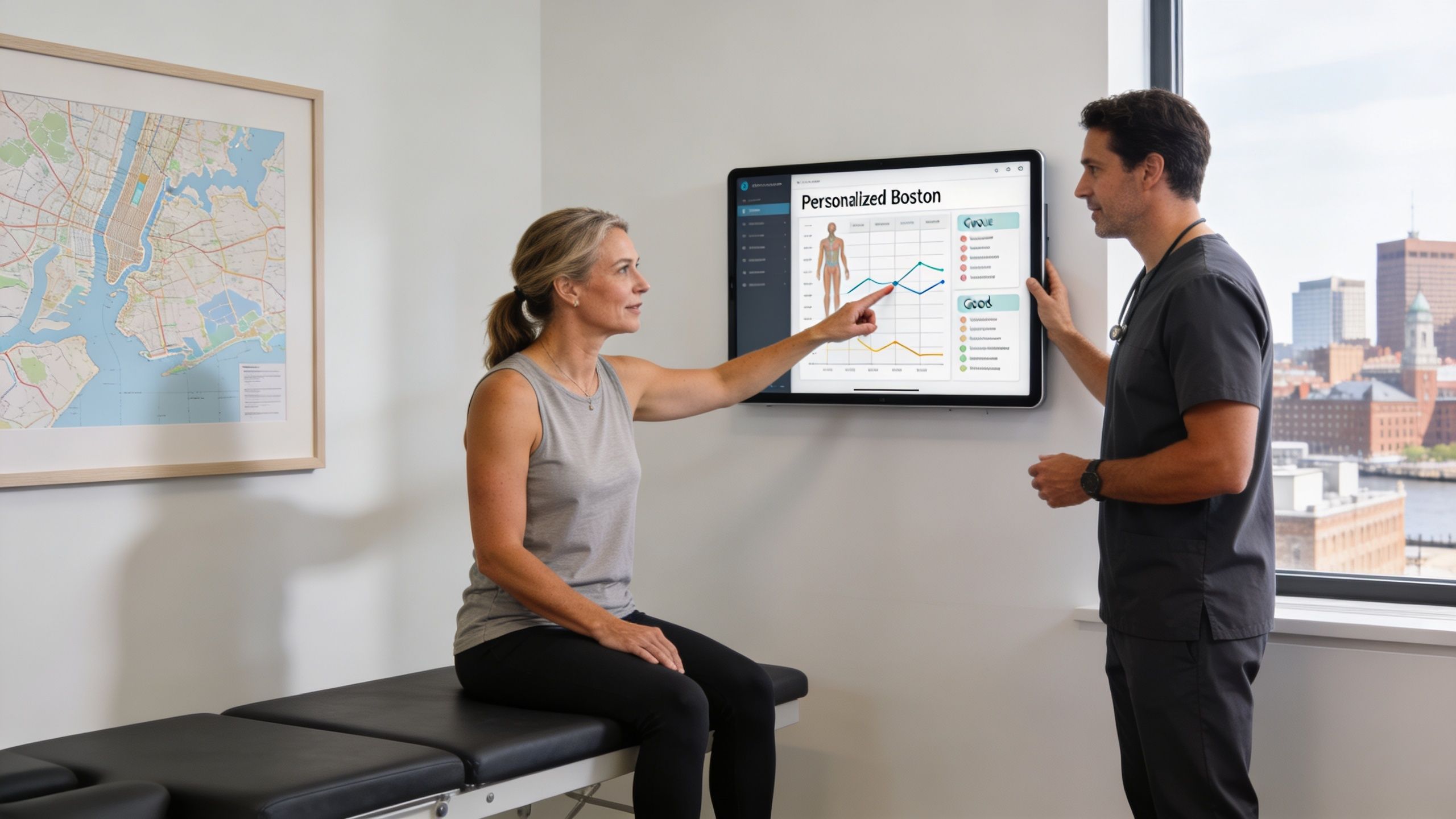
A marathon runner in Boston doesn’t need the same plan as a retiree in Brookline who’s worried about curbs, stairs, and night walking. A Seaport professional with screen-heavy days and neck tension doesn’t need the same program as a college athlete coming back from concussion. The label may be “dizziness,” but the goals are not the same.
If you’re an athlete or runner
This is the group most likely to get underserved by generic balance rehab. For athletes, the overlooked question isn’t only whether dizziness improves. It’s whether treatment reconnects to performance.
Recent 2025 data indicates that 70 to 80% of post-concussion athletes regain full vestibular function within 8 to 12 weeks with sport-specific protocols, according to Spaulding’s Boston outpatient balance and vestibular page. If you’re an athlete, ask whether the clinic can bridge vestibular care with dynamic return-to-play testing, concussion baseline screening, and movement tasks that look more like your sport than a clinic hallway.
For Boston runners, that may mean tying symptom progress to treadmill tolerance, turning speed, visual complexity, and confidence on uneven outdoor routes. For field and court athletes, it may mean integrating head turns, acceleration, cutting, and reactive balance under speed.
If you’re a desk-based professional
This group often assumes vestibular therapy is only for spinning vertigo. It isn’t. Busy visual environments, head-turning between screens, elevator rides, long workdays, and neck stiffness can all shape symptom behavior.
Look for a therapist who asks about:
- Commute triggers
- Screen tolerance
- Desk setup and posture habits
- Neck and jaw tension
- Work schedule limits that affect adherence
A Financial District or Back Bay patient may need vestibular work plus ergonomic changes and manual treatment for related stiffness. If your symptoms flare after a day at the laptop, that’s useful data, not a side note.
If you’re an active older adult
For this group, the question is often confidence. People stop walking as much, avoid stairs, and become less steady because they no longer trust quick head movement or uneven surfaces.
The right fit here is a therapist who combines balance work with realistic home planning. That may include strategies for busy sidewalks, dim lighting, and community mobility, not just clinic exercises. Some patients also do better when part of the plan uses a lower-load environment such as aquatic therapy before progressing back to land-based challenges.
Your goal should shape the care plan. If the therapist can’t tell you how your sessions connect to your actual life in Boston, the match is probably off.
If you want the deeper educational side of vestibular disorders, concussion recovery, or running injury mechanics, that content belongs at Highbar Health, which houses broader clinical education while local clinic decisions stay grounded in neighborhood access, scheduling, and service fit.
Making Your Final Choice and Starting Therapy
Once you’ve narrowed your list, stop trying to find a perfect website. Book the evaluation that looks most aligned and use the first two visits as your real test.
You should leave the initial evaluation with three things. A working explanation of what the therapist thinks is driving your symptoms. A plan that makes sense for your lifestyle. A clear home assignment that feels doable, even if it’s challenging.
What a good start usually feels like
The first visits aren’t always dramatic. Sometimes the win is that someone identifies the problem accurately and gives you a plan that fits. Sometimes you feel a little more symptomatic at first because vestibular rehab is active retraining, not passive relief.
Green lights early on include:
- You feel heard and not rushed
- The therapist can explain why your symptoms happen with certain movements
- The home program is specific and manageable
- Adjustments happen quickly if the first dose is too much
- Your goals stay central, whether that’s walking safely, working comfortably, or returning to sport
A long-term mindset matters too. Relapse rates for conditions like BPPV can be up to 40% within a year, according to Boston PT Wellness on vestibular rehabilitation. That’s why good care doesn’t end with “you’re better, goodbye.” It often includes home exercise follow-through and occasional tune-up visits if symptoms recur or your activity demands change.
Don’t wait for the problem to become your routine
People adapt to dizziness in quiet ways. They stop looking up. They avoid quick turns. They hold railings. They skip workouts. Then those workarounds start to feel normal.
If that sounds familiar, it’s time to move. Pick the clinic that offers vestibular-specific evaluation, consistent one-on-one attention, and a plan tied to how you live in Boston. Then start.
FAQs About Vestibular Therapy in Boston
Should I see a PT or an OT for vestibular problems
Either may be involved depending on the clinic and the problem. For many dizziness and balance cases, a physical therapist handles the core vestibular evaluation and movement progression. Occupational therapy can be especially useful when symptoms affect daily tasks, visual tolerance, work function, or upper-extremity and cognitive overlap. In some practices, both disciplines coordinate.
Is it normal to feel worse after vestibular exercises
A temporary increase in symptoms can be normal if the exercise is meant to help your system adapt. What shouldn’t happen is uncontrolled flare-up that leaves you wiped out for the rest of the day without a plan to adjust. Good vestibular care includes clear boundaries around what level of aggravation is expected and what means the dose is too high.
Can vertigo improve quickly
Yes, sometimes. Positional vertigo can respond quickly when the actual issue is identified and treated correctly. Other patterns, especially chronic dizziness, motion sensitivity, concussion-related symptoms, or mixed neck and vestibular cases, usually need a more progressive plan.
What if I also have TMJ symptoms or neck pain
Bring that up at the first visit. Don’t treat it like a separate side complaint. Jaw tension, neck stiffness, and vestibular symptoms can interact, and your therapist should factor that into both the exam and the exercise plan.
How do I choose between Boston locations
Choose the location you can realistically attend consistently. For many people, the best clinic is the one that fits their workday, commute, and follow-through. Convenience supports adherence, and adherence often determines whether good treatment works.
If you’re looking for vestibular therapy Boston patients can access close to work, home, or training routes, Joint Ventures Physical Therapy offers one-on-one care across Back Bay, Kenmore Square, Fort Point/Seaport, Downtown Boston, and nearby neighborhoods. Book an evaluation, ask the hard questions, and start with a plan that matches your symptoms and your life.