
Boston runners usually don't need more motivation. They need better information.
You might already be doing the work. Early miles along the Charles. Tempo efforts on the Esplanade. Long runs that include bridges, turns, and the kind of rolling terrain that exposes every small inefficiency. But your watch says fitness is improving while your body says something else. Maybe your pace stalls late in runs. Maybe the same calf, hip, or knee issue keeps showing up every training block. Maybe you're strong enough to finish, but not efficient enough to race the way you want.
That's where a running performance evaluation in Boston becomes useful. Not as a generic treadmill video. Not as a one-note “you overpronate” conversation. As a focused look at how you run, what your body can support, and what changes will matter for your training in this city.
Your Next PR Starts with a Smarter Stride
A lot of Boston runners wait too long to get objective feedback.
They'll swap shoes, change routes, add workouts, and search for strength routines. They'll piece together tips from group runs in Back Bay, training partners in Brookline, and social clips about cadence. Some of that helps. Some of it just adds noise. If you're trying to run the Boston Marathon, build speed for local races, or to handle city mileage without recurring setbacks, guessing is expensive.
The most common pattern is familiar. A runner feels decent on flat weekday miles, then starts noticing form drift on hills, bridges, or longer efforts. Another runner gets through most of a cycle well, then breaks down once race-specific training ramps up. A newer parent may feel ready to run again, but impact tells a different story than motivation. In all of those cases, the issue usually isn't effort. It's that the body and training load aren't being matched well enough.
Why general advice stops helping
Good runners often hit a point where broad recommendations stop moving the needle. “Strengthen your glutes.” “Increase cadence.” “Try different shoes.” Those ideas aren't wrong. They're just incomplete if no one has identified your actual limiting factor.
A runner with stable hips but poor trunk control needs a different plan than a runner with strong mechanics and low tissue capacity. A marathon trainee with great treadmill form at easy pace may still lose efficiency when fatigue shows up outside Fenway or heading into longer weekend miles.
For athletes who also care about body composition and recovery habits, a broader science-backed plan for health-conscious individuals can support the work you're doing in the clinic and on the road.
Practical rule: If your form only looks good when you're fresh, your form problem may actually be a capacity problem.
Many runners start with self-review, which is reasonable. If you want a simple primer before booking an assessment, Joint Ventures has a useful guide on how to improve running form. But the runners who improve fastest usually move beyond self-diagnosis and get a full evaluation that connects mechanics, strength, and training decisions.
What Is a Running Performance Evaluation
A running performance evaluation is a clinical movement assessment built around how you run. It looks at efficiency, mechanical stress, compensations, and whether your body can support the type of mileage and pace you want to handle.
That's different from filming yourself for a few seconds at the gym. A phone clip can show that something looks off. It usually can't tell you why it's happening, what matters most, or whether the problem is technique, strength, mobility, or load management.
What the process usually includes
A typical running analysis often includes a 5- to 10-minute treadmill run with video capture, and that kind of objective review matters because 50% to 75% of runners sustain an injury over a 2-year period, according to Boston Children's guidance on running gait analysis. In practice, that means a serious runner shouldn't treat gait review as a luxury. It's part of smart training.
During a true assessment, a Doctor of Physical Therapy isn't just watching your feet. They're looking at how your whole system behaves under repeated impact. They want to know where you waste force, where you absorb too much load, and where fatigue is likely to expose a weak link.
What it is not
It's not a shoe-store jog and a quick recommendation.
It's not a generic handout that tells every runner to land softer or run taller.
It's also not only for injured runners. Boston has plenty of motivated runners who aren't in pain but know they're leaving speed and durability on the table. For them, the value is performance. For others, it's breaking the stop-and-start cycle of training, flare-up, rest, repeat.
A good evaluation answers practical questions like these:
- Efficiency question: Are you spending extra energy because of stride timing, posture, or poor control through the hips and trunk?
- Load question: Is your current form putting too much repeated stress into one area?
- Capacity question: Can your body support your current program, or are you outrunning your strength and tissue tolerance?
- Planning question: Which change should come first so you don't waste weeks chasing the wrong fix?
The point isn't to make your running look pretty on video. The point is to help your body handle speed, volume, and fatigue better.
That's why a running performance evaluation in Boston makes sense for athletes training through crowded sidewalks, variable terrain, cold-weather stiffness, and race goals that don't leave much margin for bad decisions.
Key Components of Your Running Analysis
The strongest evaluations aren't built on one clip and one opinion. They combine movement observation, physical testing, and performance context so the recommendations precisely fit the runner.
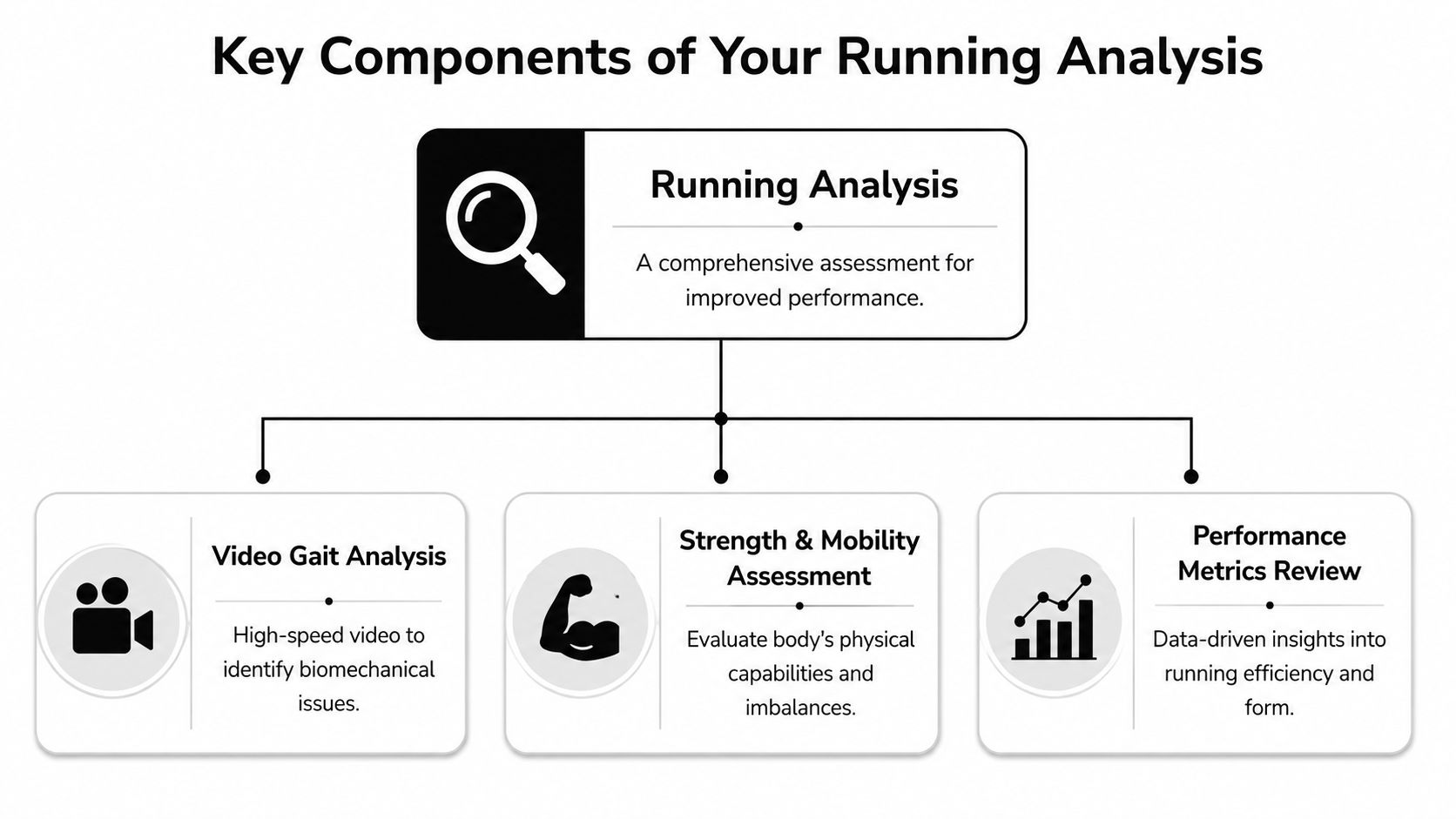
Video gait analysis
Video gives the first layer of evidence. It slows down movement that's too fast to judge accurately in real time and helps identify repeatable patterns.
A thorough evaluation should assess the full kinetic chain, not just the feet. Motion sensors and video can help identify proximal control deficits in hip stability, trunk lean, and posture, which influence force distribution and performance, as described in this overview of gait and running analysis for athletic performance.
That matters because runners often focus on foot strike when the underlying issue is higher up. If the pelvis drops, the trunk shifts, or the runner overreaches from the hip, the foot is often just expressing a problem that started elsewhere.
Strength and mobility assessment
Off the treadmill, the evaluation should test whether your body has the raw capacity to support the pattern you're trying to change.
That may include:
- Single-leg control: Can you stabilize and produce force without collapsing through the hip or trunk?
- Mobility where it matters: Are ankle motion, hip extension, or thoracic rotation limiting your stride options?
- Force transfer: Do you lose stiffness and control when impact moves up the chain?
A runner may look efficient at conversational pace and still fail the strength tests that predict breakdown when training gets harder. That's why movement quality and physical capacity have to be assessed together.
If you want more background on what clinicians are analyzing when they watch your stride, this primer on what gait analysis is gives useful context.
Performance metrics and practical inputs
The last piece is connecting mechanics to decisions you can use this week.
That includes your current schedule, race goals, typical surfaces, recent training block, and footwear habits. Sometimes the biggest win isn't a form cue. It's changing when you do quality work, how you progress mileage, or whether your current recovery and support habits match your workload. Some runners also benefit from guidance around joint comfort and recovery support outside the clinic, and resources like AloeCure's runner joint support can help them think through that piece.
| Component | What the clinician looks for | Why it matters |
|---|---|---|
| Running video | Timing, posture, control, stride behavior | Shows where efficiency drops and load concentrates |
| Physical testing | Strength, mobility, balance, control | Reveals whether your body can support the desired change |
| Training review | Goals, volume, surfaces, shoes, symptoms | Prevents good advice from failing in the real world |
Who Should Get a Running Evaluation in Boston
Not every runner needs the same type of feedback. Boston's running scene is full of very different athletes training in the same parks, neighborhoods, and race corridors. The right evaluation should reflect that.

The marathon-focused runner
If you're building toward the Boston Marathon or another long race, small inefficiencies get expensive late. The issue may not show up on easy weekday runs through the South End or Beacon Hill. It shows up when long-run fatigue magnifies every weakness.
These runners usually benefit from a review that connects form to durability. Not because they're doing something dramatic wrong, but because marathon training punishes repeated minor errors.
The newer runner who wants a better foundation
Boston has a large group of newer runners training for charity teams, first half marathons, or local road races. They often don't need a complex overhaul. They need a clean starting point.
For them, the evaluation helps answer simple but important questions. Are they progressing too quickly for their current strength? Are they using a stride pattern that makes hills and volume harder than they need to be? Are they building habits that will keep them healthy once mileage grows?
The runner who keeps getting hurt
This is the runner who says, “I can train for a few weeks, then something always flares.”
That person usually doesn't need more grit. They need someone to identify whether the recurring issue is coming from mechanics, programming, or a body part that's absorbing too much work because another area isn't doing its job.
If your injury keeps changing locations, the root problem may be your movement strategy rather than the painful tissue itself.
Student athletes and fast recreational runners
College athletes and performance-minded adults in Boston often live in a narrow margin between productive training and overload. They may already have strong fitness and still be limited by one repeatable inefficiency.
For them, a detailed evaluation can be the difference between “in shape” and “racing well.” The goal isn't to rebuild everything. It's to identify the one or two changes that produce cleaner force application and better repeatability at speed.
Postpartum runners and other special populations
This group is often underserved in mainstream running content. Many public running-analysis pages focus on generic mechanics, but postpartum runners need more than a standard form review. A more complete assessment should include load tolerance, pelvic floor function, and symptom response, which are often overlooked but are important for safe return to running, as noted by Boston-area running analysis guidance.
That's an important distinction. A runner can look solid on video and still not be ready for speedwork, downhills, or mileage progression if the underlying issue is symptom response, fatigue, or tissue capacity.
What to Expect During Your Visit at Joint Ventures
A good first visit should feel structured, specific, and useful from the start. You shouldn't leave with vague impressions. You should leave with a clearer picture of how you run and what to do next.
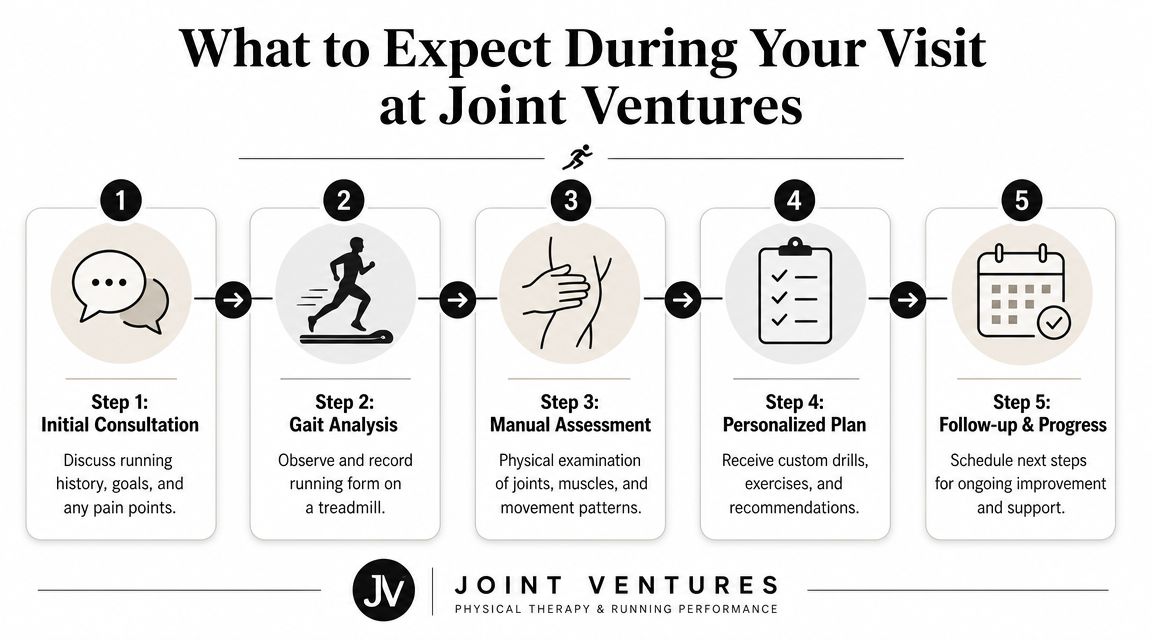
Step one is conversation, not treadmill footage
The visit starts with your running story. What are you training for? What's felt off? What surfaces do you run on most in Boston? Where do symptoms show up, and when do they show up?
That first conversation matters because the same stride pattern means different things in different runners. A slight overstride in a fresh 5K runner is not the same problem as that same pattern in a marathon trainee whose hips fall apart after ninety minutes.
At Joint Ventures Physical Therapy, that evaluation is typically delivered in a 1-on-1 format with a PT who can connect the treadmill findings to strength, mobility, and sport-specific planning rather than treating the video as a standalone tool.
Then the run begins
You'll usually warm up and run on a treadmill at a pace that reflects your current training. The point isn't to impress anyone. The point is to show your normal pattern.
The clinician studies cadence behavior, trunk position, pelvic control, contact timing, and how your stride changes as you settle in. In many cases, they'll compare what happens at easier running versus a slightly more demanding effort if that's relevant to your goals.
If you're wondering how visit timing and scheduling usually work in this type of setting, this page on how long physical therapy appointments are gives a helpful overview.
A quick look at the process can help make that first visit feel more familiar:
Off the treadmill is where the plan gets precise
After the run, the PT tests the body behind the pattern. That may include hip strength, ankle motion, calf capacity, single-leg control, trunk stability, and mobility that affects stride mechanics.
Many runners finally get an answer that makes sense. The video may show one thing, but the testing explains why it's happening. Sometimes the fix is a cue. Sometimes it's a strength deficit. Sometimes it's changing the way training is layered over the week.
A useful running evaluation also has to tie into outcomes. In a 2025 study of endurance runners, changes in running training frequency in the final 4 months before a race explained 36.6% of the variance in official race times, and runners who increased cross-training improved race times by about 1.2 minutes, according to the published analysis of pre-race training patterns. That doesn't mean every runner needs the same plan. It means targeted adjustments, especially late in a training cycle, can matter a great deal.
Good running analysis doesn't end with “here's what we saw.” It ends with “here's what you change first, and here's why.”
Your Plan for a Faster Future and How to Book
The best outcome from a running evaluation isn't just insight. It's a plan you can use on your next run.

You should leave with practical next steps. That usually means specific drills, strength priorities, movement cues, and guidance on how to integrate changes without blowing up the rest of your training week. In some cases, the recommendation is to progress. In others, it's to simplify, unload one area, or rebuild capacity before adding speed.
What you should walk away with
A useful running performance evaluation in Boston should give you more than observations:
- A movement summary: What your stride is doing well and where efficiency is leaking
- A short priority list: The few changes most likely to affect performance or symptom reduction
- Home work that fits real life: Drills and exercises you can maintain between runs
- Training guidance: How to use the findings without overcorrecting or changing everything at once
That's especially valuable in Boston, where runners often train around work commutes, packed calendars, and seasonal weather that can hide or expose different problems.
Making the logistics easy
Access matters. Joint Ventures serves runners across Back Bay, Kenmore Square, Fort Point/Seaport, Downtown Boston, and nearby neighborhoods, which makes it easier to fit an evaluation around work, school, or marathon prep. Early and late hours help busy professionals. Concierge-style front-desk and billing support can help with insurance verification and authorizations so the process feels straightforward.
If you want more detailed educational content on mechanics, injury recovery, and performance principles, that's better suited to Highbar's broader library. For a deeper dive into running biomechanics and injury science, visit our educational partners at Highbar Health.
If you've been training hard but not progressing the way you should, don't settle for another cycle of guessing.
If you're ready to get clearer on your stride, your limiting factors, and the changes most likely to improve your running, book a running evaluation with Joint Ventures Physical Therapy. With convenient Greater Boston locations and 1-on-1 care, it's a practical next step for runners who want better performance and fewer setbacks.