
Typing hurts. Opening a jar hurts. Carrying your laptop from the Seaport to South Station feels strangely difficult. A lot of Boston patients come in expecting rehab to be about pain only, then realize the bigger problem is function. They can get through the day, but not well. Work slows down, workouts get modified, and basic routines start taking more effort than they should.
That's where occupational therapy becomes practical, not abstract. In rehab, “occupation” means the tasks that fill your day and matter to you. Keyboard work, meal prep, gripping the T, getting dressed for the office, lifting a child, returning to the gym, or managing a hand injury without losing independence.
If you're searching for occupational therapy in Boston, you probably don't need a textbook definition. You need to know whether OT fits your problem, what a good care plan looks like, and how to choose the right setting in a city with a lot of options.
Regaining Your Life in Boston One Task at a Time
A software engineer in Fort Point can still code with wrist pain. But by the end of the day, every shortcut key is slower, every Slack message is more irritating to type, and the commute home feels longer because even holding a phone becomes noticeable. An OT evaluation usually starts there. Not with a vague question about discomfort, but with the exact task that keeps breaking down.

Another common Boston example is the active adult training along the Charles who develops elbow or hand symptoms and suddenly can't grip a water bottle, carry groceries, or tolerate strength work. The injury may sound small. The daily disruption usually isn't.
What OT is trying to restore
Occupational therapy is built around getting you back to the jobs of living. That includes self-care, household tasks, work demands, and the fine-motor control that many people don't think about until it starts failing.
A good OT plan doesn't just chase pain reduction. It connects treatment to what your day requires.
- For work: typing, mousing, handwriting, tool use, lifting, repetitive gripping
- For home: dressing, bathing, cooking, opening containers, laundry, carrying bags
- For activity: returning to the gym, running, yoga, climbing, or other upper-extremity demands
Practical rule: If your biggest problem is not just pain, but trouble doing meaningful daily tasks efficiently, OT is often the right conversation.
For families working on hand use and dexterity at home, even simple play-based ideas can help reinforce clinic work. This roundup of fine motor skills development activities is a useful example of how everyday tasks can support coordination and control outside formal therapy.
What Occupational Therapy Really Means in Boston
People often confuse OT with PT because both are forms of rehab. The difference gets clearer when you look at what each clinician is trying to solve.
PT often works on the body's capacity to move. OT focuses on using that body well in real tasks. If PT is like a mechanic improving the engine, OT is closer to a driving instructor helping you handle Boston traffic, turns, hills, and daily demands.
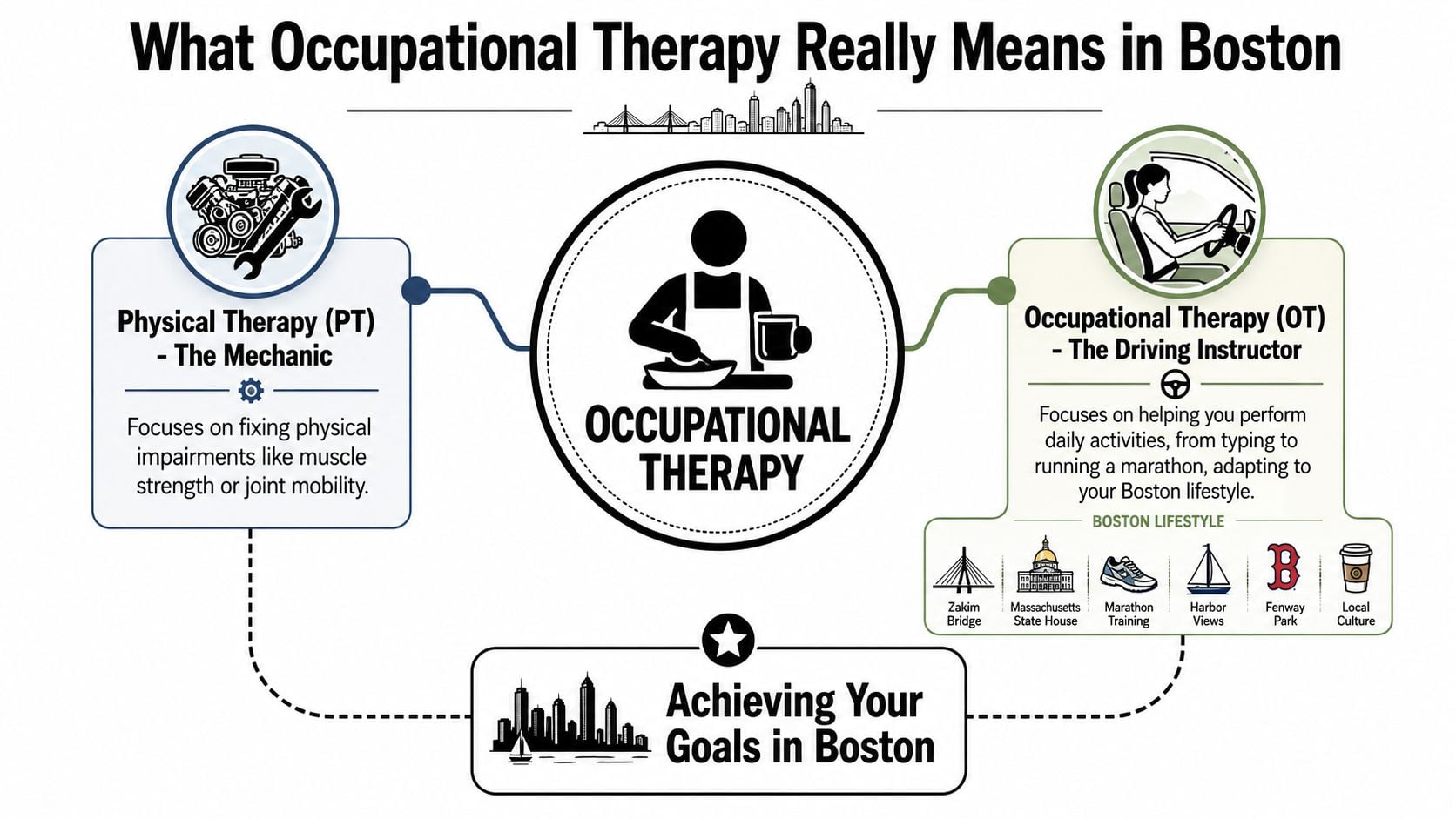
In Boston hospital systems, OT is clinically structured around restoring upper-extremity function and task-specific independence. Treatment integrates biomechanical retraining with activity analysis to improve performance in daily activities like dressing, household tasks, and return-to-work demands, as described by Boston Medical Center's occupational therapy program.
How that looks in real life
A patient after hand surgery may need strength, yes. But strength alone doesn't tell you whether they can button a shirt, carry a backpack, prepare meals, or get through a full workday at a keyboard without flaring symptoms.
That's why OT sessions often look more task-specific than people expect.
| Focus area | What the therapist looks at |
|---|---|
| Hand and wrist use | Grip, pinch, coordination, fatigue, swelling, symptom triggers |
| Daily routines | Dressing, bathing, cooking, commuting, workspace setup |
| Work demands | Typing tolerance, mouse use, tool handling, lifting, sustained positions |
| Strategy | Task modification, pacing, positioning, adaptive methods |
OT is broader than many adults realize
Pediatric OT also shapes how many people understand the field. In Boston-area practice, specialty care may target fine and visual-motor skills, hand-eye coordination, bilateral coordination, motor planning, executive functioning, sensory integration, self-regulation, interoception, and self-care independence. For parents who want a plain-language primer, this overview of the basics of sensory integration is a helpful starting point.
If you're still sorting out the difference between disciplines, our guide on occupational therapy vs physical therapy breaks down which starting point usually makes more sense based on the goal you're trying to get back to.
Good OT doesn't ask only, “Can this joint move?” It asks, “Can you live your day the way you need to?”
Common Conditions We Treat with Occupational Therapy
Boston has a long history in this profession. The Boston School of Occupational Therapy was founded in 1918 and later affiliated with Tufts University, helping establish the city as a long-standing hub for OT education, research, and evidence-based practice, as noted in the history of the Boston School of Occupational Therapy. That matters because local patients often have access to clinicians who think in a very functional, task-driven way.
The downtown professional with hand and wrist symptoms
This is the person whose job depends on output. They spend hours at a keyboard, on a phone, or moving between meetings and commuter routines. The pain may be in the wrist, thumb, elbow, or forearm, but the complaint is usually more specific than that. “I can't type normally.” “I'm dropping things.” “I can work, but only for short stretches.”
OT treatment here often focuses on hand use, fine-motor control, symptom management, workstation strategy, and building back tolerance for repetitive tasks.
If that sounds familiar, our local guide to hand therapy in Boston may help you narrow down whether you need general rehab or a more focused upper-extremity plan.
The student-athlete with a hand injury
Around Fenway, the Longwood area, and the university neighborhoods, a lot of younger patients don't just want pain relief. They want return to sport, return to class, and return to normal hand use all at once. A finger fracture, tendon irritation, or post-op hand issue can affect lifting, catching, writing, and basic school tasks in ways that surprise people.
These patients usually do best when therapy bridges the gap between healing tissue and actual performance demands.
The child or family working on daily function
Pediatric OT in Boston often addresses much more than handwriting. A child may need support with visual-motor skills, self-regulation, dressing, feeding routines, or sensory processing. Families often ask what tools are useful at home versus what just creates clutter. For that reason, a practical guide to sensory toys for autism can be a helpful companion resource when parents are trying to think through purposeful options.
Your First Occupational Therapy Visit and Care Plan
A first OT visit should feel focused, not rushed. In a city with a lot of rehab options, that matters. Healthgrades reports 954 specialists practicing Occupational Therapy in Boston, MA, with 947 results within 10 miles and an overall average rating of 4.3 stars on its local directory for occupational therapy providers in Boston. That volume means access exists. It also means you need to know how to tell a generic visit from a useful one.
What happens at the evaluation
The first session usually starts with your actual task problem, not just the diagnosis on the referral. If you say, “My wrist hurts,” that's only the start. The better question is what the wrist problem is preventing you from doing.
Expect the evaluation to cover:
Your functional goals
Work tasks, home tasks, sport, hobbies, parenting, or post-op milestones.Your symptom pattern
What movements trigger symptoms, what eases them, and what time of day things get worse.How you perform the task now
This may include gripping, reaching, coordination, dexterity, posture, endurance, and compensations.What your environment adds to the problem
Desk setup, commute demands, tool use, home setup, or sport equipment.
What a plan of care should include
A strong plan is specific enough that you can explain it back in one minute. It shouldn't sound like “we'll strengthen it and see.” It should sound more like “we're reducing strain at the wrist, rebuilding fine control, and increasing your tolerance for keyboard work and lifting.”
Common OT tools may include:
- Task-specific practice: rehearsing the exact activity that matters, such as typing, gripping, dressing, or kitchen tasks
- Splinting or support options: especially for some hand, thumb, or wrist presentations when protection matters
- Ergonomic changes: keyboard position, mouse setup, desk height, bag carry strategy
- Home program work: targeted exercises and fine-motor drills that match your stage of recovery
The right care plan feels personal very quickly. If you leave your first visit without a clear functional target, ask more questions.
What usually doesn't work
Patients tend to stall when therapy becomes too generic.
- Only chasing pain: If treatment never connects to the task that matters, progress doesn't transfer well.
- Too much exercise, not enough analysis: A stronger hand still may not function well if gripping strategy, pacing, or positioning stay unchanged.
- No home carryover: Short clinic visits help most when your therapist gives you practical ways to use the work during your normal week.
How to Choose the Right OT Provider in Boston
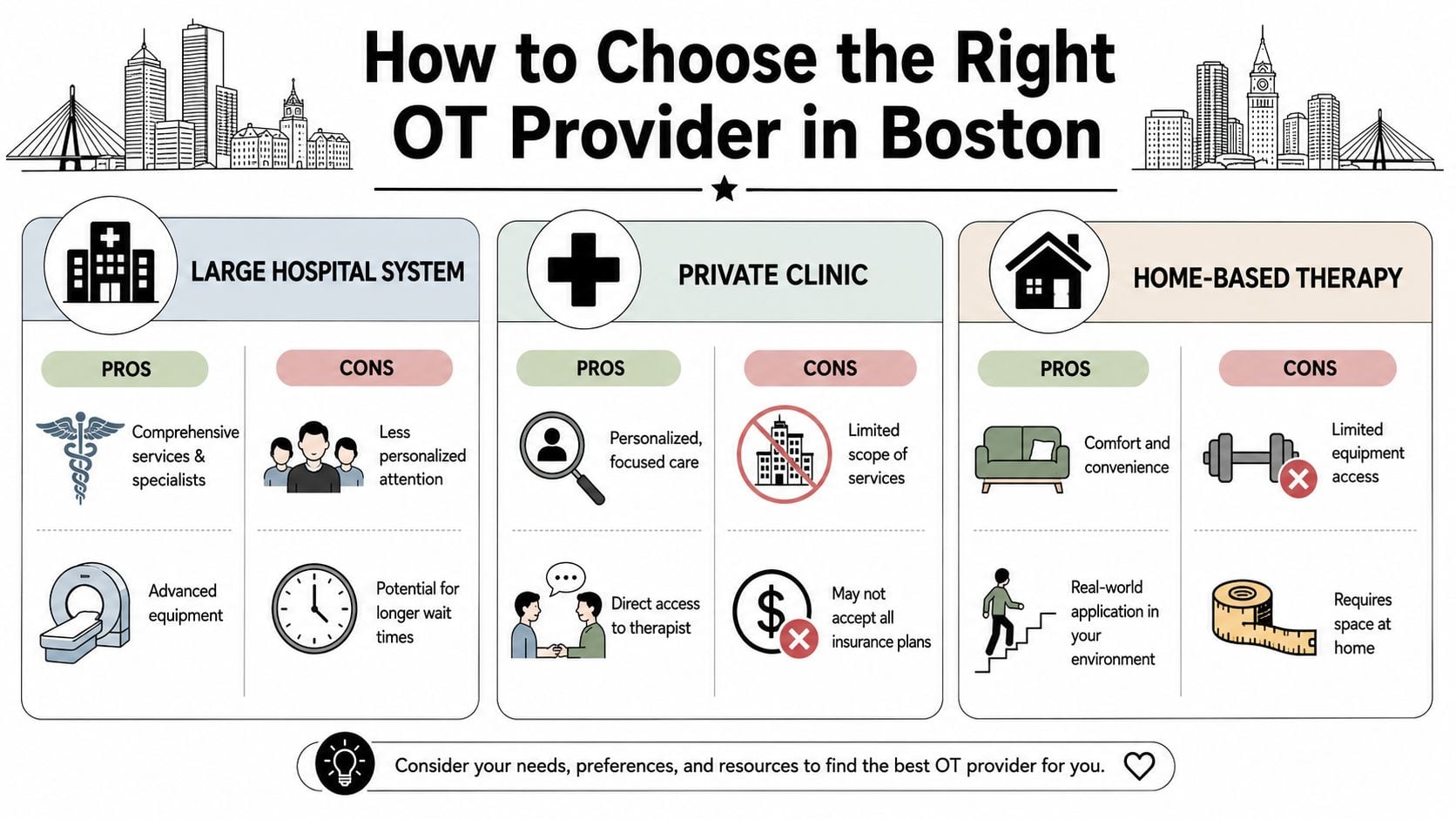
Many Boston patients get stuck. They know they need help, but they aren't sure whether to book with a hospital outpatient department, a private clinic, or a home-based service. The choice affects scheduling, referral steps, environment, and sometimes the kind of cases the clinic handles most often.
Spaulding's local OT information reflects a common patient question in this market. People often struggle to choose between hospital-based OT and private practice, with key differences around referral pathways, appointment wait times, and specialization for needs like hand injury versus broader post-op rehab, as seen on Spaulding Rehabilitation's occupational therapy page.
Hospital outpatient vs private clinic vs home-based care
| Setting | Often a good fit for | Main trade-off |
|---|---|---|
| Hospital outpatient | More medically complex cases, broad system access, patients already in that network | Scheduling and referral steps can feel heavier |
| Private clinic | Focused orthopedic and functional rehab, more direct communication, flexible scheduling | Scope varies by clinic and specialty area |
| Home-based OT | Patients who need care in their home environment or have difficulty traveling | Less equipment and fewer clinic-based tools |
Questions worth asking before you book
The fastest way to choose well is to ask practical questions, not marketing questions.
Do I need a referral first
Some settings make this clearer than others. Ask before you schedule.Who will I see each visit
You want to know whether care is one-on-one, shared, or rotated.Is this clinic a good fit for hand and upper-extremity problems
That's different from asking whether they “treat OT.”What does the first evaluation include
The answer should mention goals, task analysis, and a care plan, not just paperwork.How do they handle work-related or return-to-function goals
Boston patients often need treatment that fits desk work, commuting, parenting, and active hobbies all at once.
What modern care should look like
A thoughtful clinic may use telehealth for check-ins, home-program progression, or follow-up when travel is hard. Technology can help with access and progress tracking. It shouldn't replace hands-on care when fine-motor retraining, post-surgical recovery, or complex upper-extremity work requires in-person assessment.
If a provider can't explain why your setting, visit structure, and treatment style fit your specific goal, keep looking.
Why Choose Joint Ventures for Your Occupational Therapy
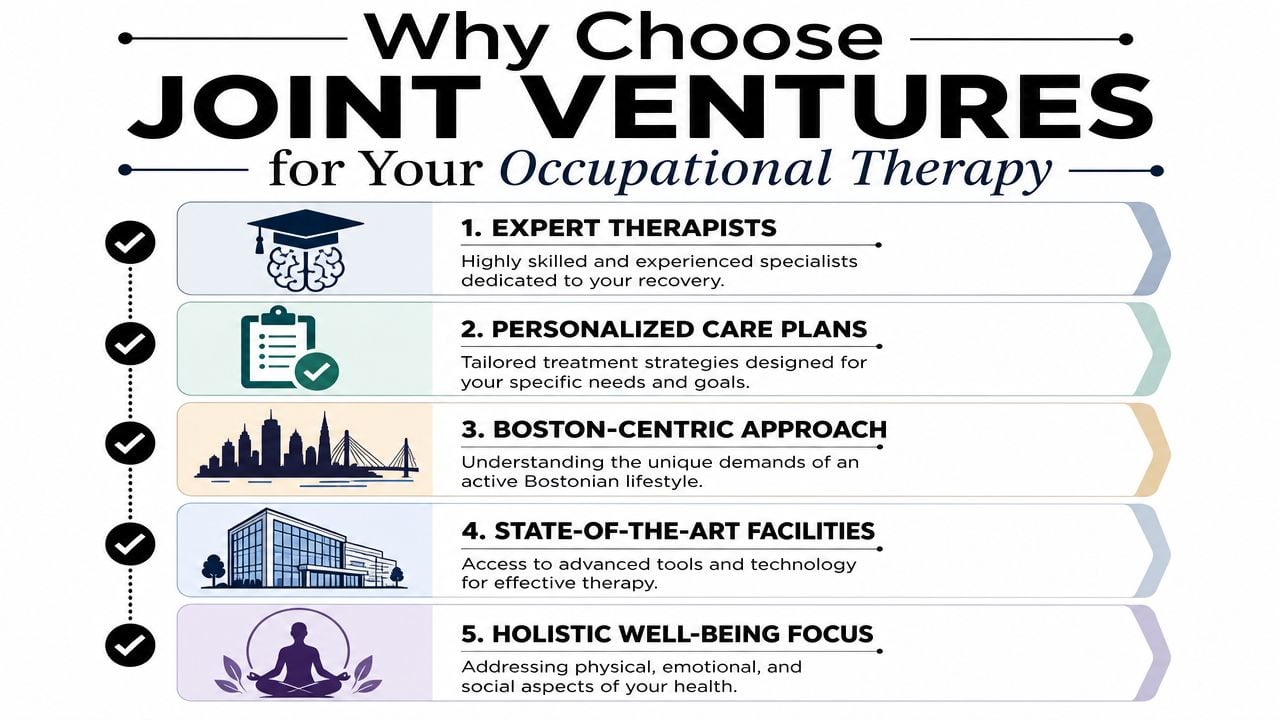
For many Boston patients, the right answer is a setting that can stay closely tied to function. That usually means enough one-on-one time to look at the actual task, not just the diagnosis code.
Joint Ventures Physical Therapy's occupational therapy service is one local option for patients who want individualized OT in Greater Boston, including support for hand and upper-extremity issues, return-to-work demands, and practical daily function. That matters for people commuting through Back Bay, working in Downtown Boston, or trying to fit rehab around a full schedule.
What tends to matter most
Boston patients usually care about three things once they start comparing providers.
- Time with the clinician: enough attention to evaluate the task itself
- Access: locations that work with real Boston routines and commutes
- Specificity: a plan tied to hand use, upper-extremity recovery, work setup, or daily independence
Technology helps when it's used for the right reason
Modern OT care increasingly incorporates telehealth and wearable devices. Used well, those tools can support remote follow-ups and progress tracking. For complex fine-motor retraining or post-surgical cases, hands-on in-person care is still often the better fit, as discussed in this MGH Institute perspective on innovative technologies in occupational therapy.
For readers who want deeper clinical education beyond this local Boston guide, Highbar Health has broader rehab resources at highbarhealth.com.
If you're looking for occupational therapy in Boston and want care built around the tasks you need to get back to, book with Joint Ventures Physical Therapy. We'll help you sort out whether OT is the right fit, what type of provider makes sense for your situation, and how to build a plan that matches your work, home, and activity goals.