
Finding physical therapy near Fenway Park typically isn't a casual pursuit. You're trying to figure out how to get care that fits a real Boston schedule. Maybe your knee started barking after a run along the river, your neck locked up after a week bent over a laptop, or your shoulder hasn't felt right since the gym. In this part of the city, the problem usually isn't whether help exists. It's whether you can get to it consistently.
That matters more around Fenway and Kenmore than people admit. A clinic can look close on a map and still be a hassle on a workday, impossible on a game day, or inconvenient enough that you start missing visits. In physical therapy, missed visits slow progress. Good rehab depends on access, timing, and a plan you can stick with.
Why Quality Physical Therapy Matters in the Fenway Neighborhood
Fenway is one of those Boston neighborhoods where a lot of different lives overlap in a tight footprint. Students, hospital workers, runners, desk-based professionals, active adults, and recreational athletes all move through the same few corridors. Their injuries don't look identical, but the demand is similar. They need care that's close, organized, and built for people who can't put life on pause.

Fenway is more than a landmark
Fenway Park opened in 1912, which makes it a 100+ year part of Boston's sports ecosystem, as noted in this Fenway-area sports medicine context. That history still shapes the area. People around Fenway don't just want pain relief. They want to get back to class, back to lifting, back to marathon training, back to league play, or back to walking without irritation.
This is one reason physical therapy near Fenway Park isn't only about convenience. It's tied to a neighborhood with a longstanding sports and performance culture, where access, speed, and continuity of care matter.
Practical rule: In a dense neighborhood, the clinic you can reach reliably is usually the clinic that gives you the best chance of finishing your plan of care.
What works and what doesn't
What works in Fenway is simple:
- A location you can reach before work, after class, or between responsibilities
- Care that accounts for active goals, not just symptom management
- A clear schedule that doesn't force you to guess when appointments are available
What doesn't work is choosing a place only because it's technically nearby, then realizing the route is annoying enough that every visit becomes a negotiation.
For operators and clinic teams thinking about patient flow, scheduling, and service coordination, there are useful ideas outside healthcare too. This guide on how to automate wellness business operations is a good example of how access and consistency often come down to the systems behind the scenes, not just the treatment itself.
Your Go-To Clinic Joint Ventures in Kenmore Square
A Fenway patient leaves work near the ballpark at 5:30, looks at the traffic on Brookline Avenue, checks the Green Line, and realizes the key question is not which clinic is technically closest. It is which clinic can fit into a Boston weekday without turning every visit into a hassle.
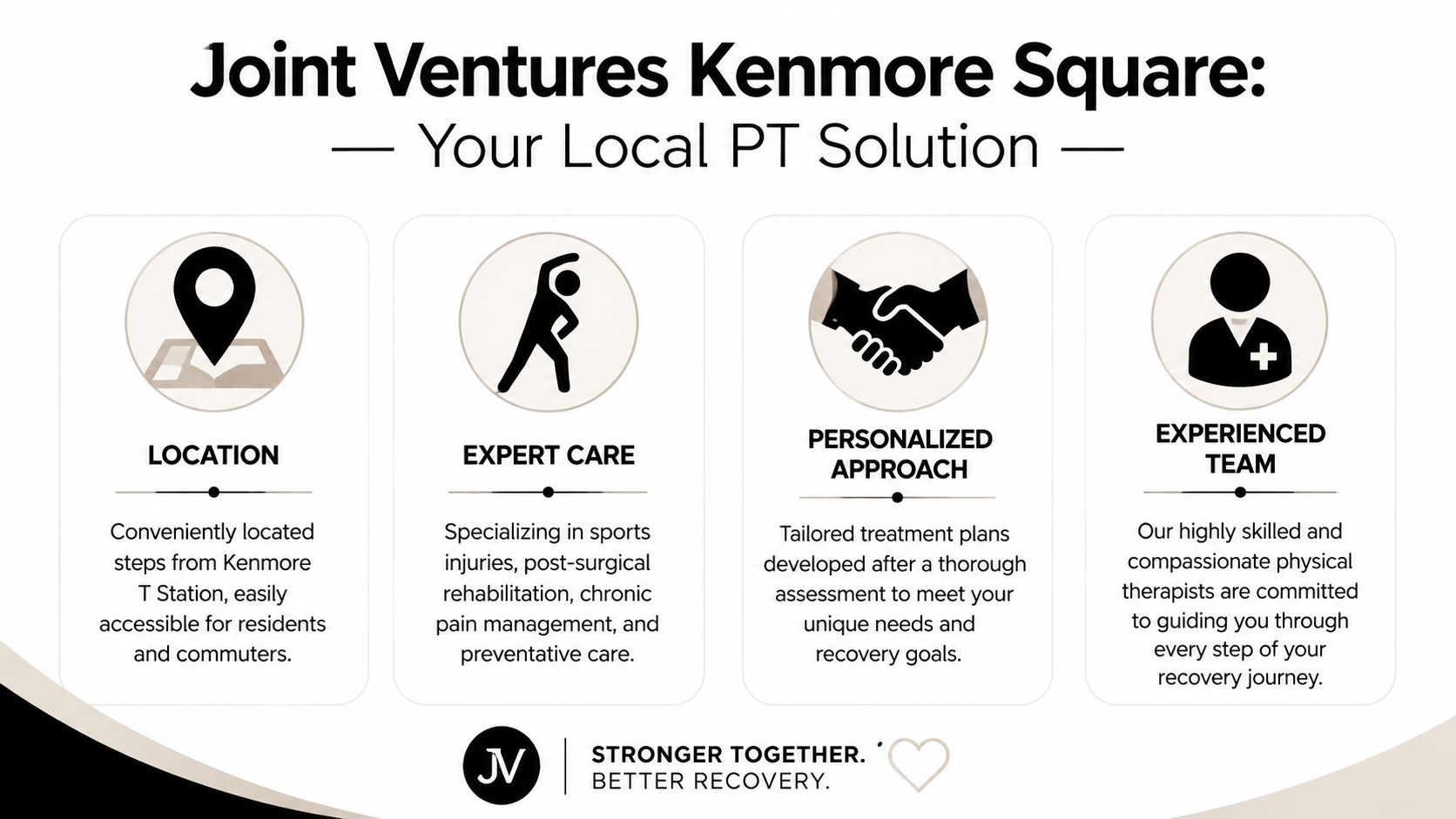
For that reason, Joint Ventures in Kenmore Square stands out for Fenway patients. The clinic is at 660 Beacon Street, Suite B01, close enough to make sense for people coming from Fenway, BU, or nearby parts of Back Bay and Brookline.
The location details that actually matter
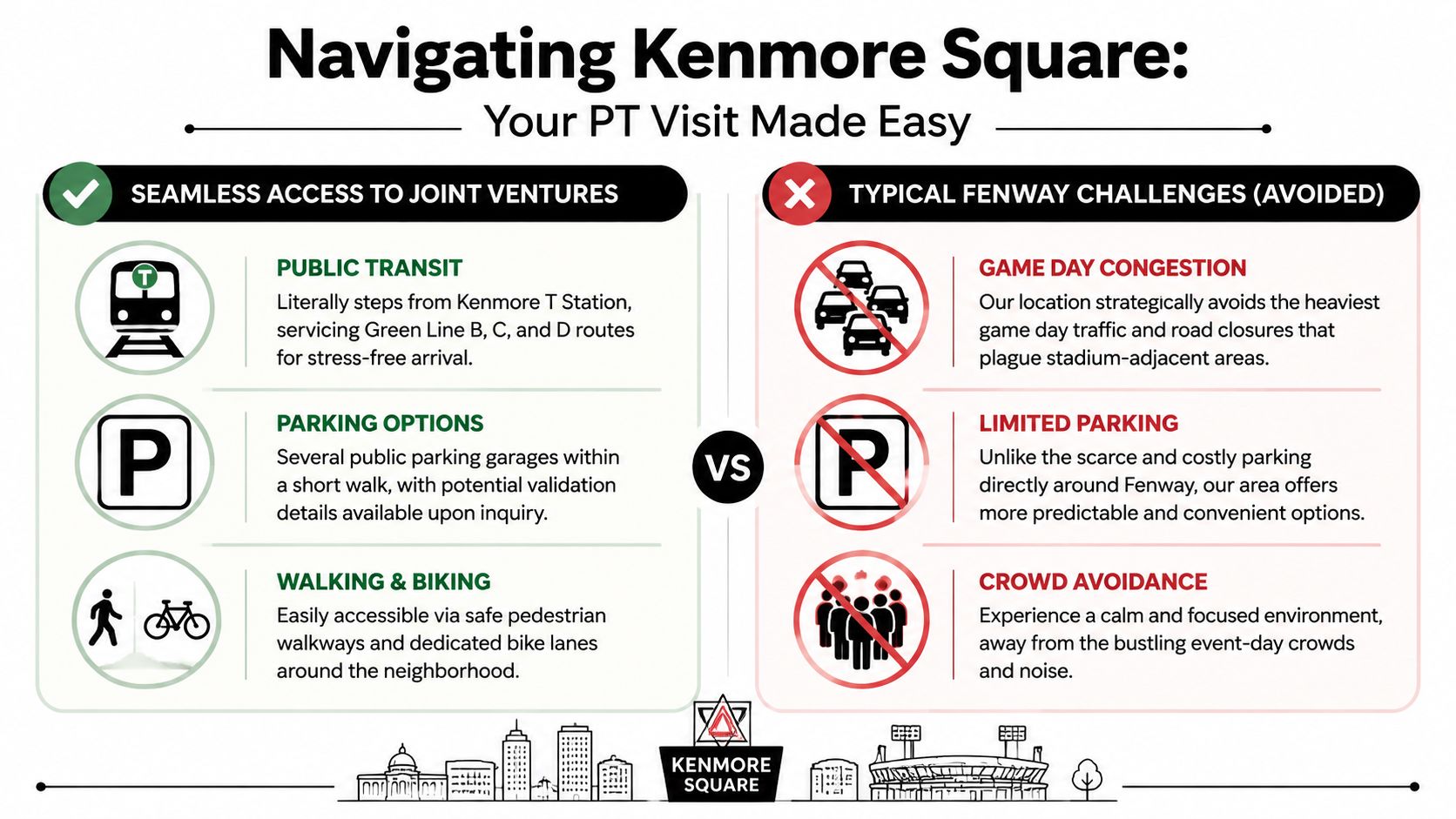
Fenway is easy on a map and harder in real life. Game-day traffic, event congestion, and packed trains can turn a short trip into an annoying one. Patients do better when the clinic is on a route they already use and when appointment times work before work, after work, or around class.
The current hours matter because they give people real options:
| Practical question | What to know |
|---|---|
| Where is it? | 660 Beacon Street, Suite B01 |
| What area does it serve well? | Kenmore, BU, Fenway, and nearby Boston neighborhoods |
| When can you book? | Monday and Wednesday 10:40am to 7:20pm, Tuesday and Thursday 7:20am to 4:00pm, Friday 6:40am to 4:00pm |
Those details are listed on the Kenmore Square physical therapy clinic page. Early morning and later evening availability can be the difference between finishing a care plan and canceling half your visits.
That trade-off is real. A clinic may look convenient online, but if the only openings are mid-day, many Fenway patients will miss visits once work deadlines, labs, or commuting delays pile up.
Why that setup works for Fenway patients
Joint Ventures Physical Therapy has multiple Boston-area locations, which helps if your schedule shifts between neighborhoods during the week. That matters for people who work in one part of the city, train in another, and live somewhere else entirely.
In practice, Fenway patients usually need three things:
- A clinic they can reach by a familiar route
- Hours that fit around work, school, or training
- A consistent care team inside a larger Boston practice
Athletes dealing with lower-body soreness often learn the same lesson outside the clinic. Recovery only works when it fits the schedule well enough to repeat, which is also a point covered in the Vanta Sports football guide.
Near Fenway, convenience is not a small detail. It is often what keeps treatment on track.
Specialty Services for Fenway's Active Population
Fenway patients aren't all the same, so generic rehab tends to miss the mark. This neighborhood includes runners, college athletes, lifting-focused gym members, hybrid workers with desk pain, new parents, and active older adults who want steady balance and confidence. The right clinic has to handle more than basic post-injury exercise.
Match the service to your actual problem
If your goal is return to sport, broad orthopedic care may not be enough on its own. You want clinicians who regularly work with movement quality, loading decisions, progression, and sport-specific return planning.
For runners in Boston, that often means looking for dedicated running support, performance analysis, and a rehab plan that respects training goals instead of just telling you to stop everything. If that's your situation, this Boston Marathon injury physical therapy article is a useful local read.
A few examples of what matters near Fenway:
- Sports rehab: useful for field, court, lifting, and endurance athletes trying to return without rushing.
- Running performance: especially relevant in Boston, where many patients aren't just trying to get out of pain. They're trying to keep training.
- Concussion baseline screening: important for athletes and teams who want a clearer starting point.
Specialty care for work, parenting, and daily function
Not every Fenway patient is training for an event. Plenty are dealing with issues that build slowly from routine life.
A desk-based professional may need workplace ergonomics and treatment for recurring neck or jaw tension. Someone with headaches or jaw symptoms may need TMJ-focused care rather than a generic shoulder-and-neck handout. A postpartum patient may need pelvic floor physical therapy with a clinician who treats that area directly and comfortably.
Good specialty care doesn't force your problem into a generic template. It matches the treatment to the way you actually live.
Other services that can be especially relevant in this area include:
- Vestibular and balance care for dizziness, motion sensitivity, or steadiness concerns
- Hand and upper extremity therapy for people whose work depends on typing, lifting, gripping, or fine motor control
- Occupational therapy when the challenge is function, not just pain level
- Aquatic therapy for patients who need a lower-impact path back to movement
- Trigger point dry needling when it's an appropriate fit within a larger rehab plan
- Titleist evaluations for golfers who want movement-based insight tied to performance
Think beyond symptom relief
A lot of people wait too long because they assume PT is only for major injuries or post-op recovery. In Fenway, that's rarely the full picture. Patients also come in because something feels off, training has stalled, dizziness is limiting confidence, or an old issue keeps flaring.
If your sport is field-based, it also helps to understand recovery habits outside the clinic. This Vanta Sports football guide offers a practical look at cooldowns for football athletes and can help frame what good recovery support should include.
The bigger point is simple. The best fit near Fenway usually isn't the nearest generic clinic. It's the place that can treat the specific way you move through work, sport, and city life.
Navigating Your Visit Parking Transit and Access
Most Fenway-area PT searches should prioritize a key question. Not "closest clinic," but "Which clinic can I get to without making my week harder?"
Transit usually wins in this corridor
The key logistical fact here is straightforward. The Kenmore Square clinic is steps from the Kenmore Green Line station, as described on the Kenmore Square location page. In a game-day corridor, that matters a lot.
Driving near Fenway can work sometimes. It also creates the exact kind of unpredictability that makes patients reschedule, arrive stressed, or skip care altogether. Transit tends to be more repeatable, and repeatable is what rehab needs.
The real trade-offs
Here's the honest version of the Fenway access decision:
| Access mode | Usually works well when | Common issue |
|---|---|---|
| Green Line and walking | You're coming from work, school, or another neighborhood stop | Crowded trains at peak times |
| Driving | You're coming from farther out and timing is flexible | Traffic, event flow, and parking stress |
| Bike or walk | You're already local and weather is cooperative | Less practical if you're flared up or post-op |
If you need weekly PT, choose the route you can repeat on your most chaotic day, not your easiest one.
How to make appointments easier to keep
A few practical habits help in this area:
- Book around your normal route: If you already pass through Kenmore, don't add an unnecessary detour.
- Avoid last-minute planning: Fenway traffic is manageable until it isn't.
- Use early or later weekday slots when possible: Those times often fit better around work and class obligations.
The point isn't that parking never works. It's that transit access can be the difference between starting PT and sticking with it when your schedule is already full.
What to Expect From Your First Appointment and Beyond
A lot of patients delay booking because they aren't sure what the first visit will feel like. That's understandable. It's common to want to avoid another rushed healthcare appointment where they repeat their story, leave with generic exercises, and still don't know the plan.
This process should feel clearer than that.
The first visit
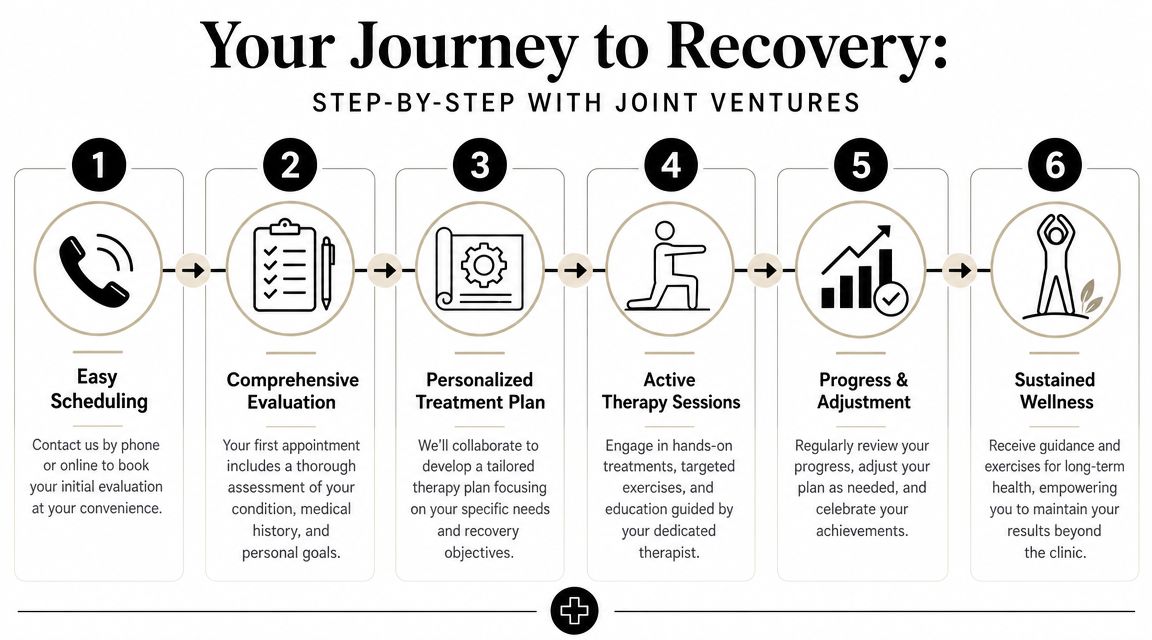
Your first appointment is where the clinician learns how the problem started, what makes it worse, what you've already tried, and what you need to get back to. For one person that's running. For another it's sitting through a workday, carrying a child, sleeping comfortably, or getting through a commute without pain.
A strong first session usually includes:
- A real conversation about symptoms, history, and goals
- A movement assessment based on the issue you're dealing with
- A treatment plan that makes sense for your schedule and priorities
If you'd like a practical preview, this guide on how to prepare for your first physical therapy appointment answers common questions before day one.
To get a feel for the care experience, this short video is worth watching.
What happens after evaluation
The next phase should feel organized, not vague. You should know what you're working on, what progress looks like, and how visits fit into the rest of your week.
That often includes:
- Hands-on treatment when appropriate
- Targeted exercise, not random volume
- Education you can use outside the clinic
- Plan adjustments if your symptoms or goals change
Recovery goes better when the plan is specific enough to follow and flexible enough to adapt.
The administrative side matters too
Patients often underestimate how much scheduling, insurance verification, and authorizations affect the overall experience. If that part feels disorganized, even good treatment can become frustrating.
A solid clinic experience supports both sides of care. The clinical side should be personalized. The administrative side should make it easier to start, continue, and finish your plan without unnecessary friction.
For deeper condition education and broader rehab resources, visit Highbar Health. That's the right place for more detailed educational content that goes beyond the local Fenway focus.
Start Your Recovery Near Fenway Park Today
A good treatment plan only helps if you can show up for it. In Fenway and Kenmore, that means choosing a clinic that fits real life. Red Line and Green Line transfers, game-day traffic, limited parking, and workdays that start early or run late all affect whether care stays consistent.
That is why convenience matters in a practical sense. The right clinic is one you can reach before work, on a lunch break, or after a long day without turning the trip into another source of stress. For many patients near Fenway Park, Joint Ventures in Kenmore Square works because the location is straightforward, the scheduling is usable, and the clinical services cover more than one type of problem.
If pain is changing how you commute, train, sit at work, sleep, or get through a normal week, get it evaluated now. Waiting usually means more compensation, more frustration, and a longer path back to full activity.
Book your evaluation online or call the clinic and ask for an appointment time that matches your Boston schedule, not an ideal one.
If you're ready to stop working around pain, book with Joint Ventures Physical Therapy. Their Greater Boston locations make care accessible for patients near Fenway, Kenmore, Back Bay, Downtown, Fort Point/Seaport, Brookline, and surrounding neighborhoods.