
You trained through dark winter mornings, long runs along the Charles, hill work that left your quads barking, and the nervous energy of race week. Then you turned onto Boylston, heard the crowd, crossed the line, and got your medal. A few hours later, walking downstairs, getting out of a hotel bed, or trying to make your way through Back Bay can feel worse than you expected.
That swing from pride to pain is common after Boston. It doesn't mean you did something wrong. It means you asked a lot from your body on a demanding course.
Boston Marathon injury physical therapy is different from generic sports rehab because the problems are different. Downhills punish the quads early. The Newton Hills expose strength deficits late. Camber, crowding, pace surges, and travel all matter. Recovery works best when someone looks at the race you just ran, the body you brought to the start line, and the way you want to get back to running in Boston.
You Crossed the Finish Line on Boylston What Now
The finish line scene tells the truth about marathon running. It's celebration and medical care at the same time. The Boston Marathon deploys approximately 100 physical therapists at the finish line to help the approximately 30,000 athletes in the race, with many clinicians coming from local universities like Northeastern, according to Northeastern's reporting on the Boston Marathon medical response.
That team isn't there for a few sore calves. They handle everything from dehydration and cramping to stress injuries and exertional heat illness. In other words, pain after Boston is not unusual, and it shouldn't be brushed off just because “everyone hurts after a marathon.”
What's normal and what deserves attention
Normal post-race soreness usually feels broad, stiff, and symmetrical. Your quads may feel trashed from the downhills. Your calves may tighten up after the long push into Boston. Stairs are often humbling for a day or two.
Pain that changes the conversation tends to look different:
- Sharp joint pain: especially at the knee, ankle, hip, or foot
- A limp that won't settle: not just stiffness, but altered walking
- Pain that spikes with weight-bearing: especially on one side
- Swelling that keeps building: rather than gradually easing
- A sense that something “gave” during the race: followed by weakness or instability
Practical rule: If your body feels globally beat up, that's usually marathon soreness. If one structure feels angry, precise, and worse with every step, treat it like an injury until proven otherwise.
The Boston-specific piece
Boston runners often don't realize how much the course shapes the aftermath. The early downhill running from Hopkinton can leave the front of the legs overloaded before you even reach the tougher miles. Then the late-race hills ask for hip control and calf capacity when fatigue is already high.
If you're staying in Back Bay, trying to manage curbs, stairs, and the walk back from post-race celebrations can expose problems fast. If you live in Kenmore, the Fenway area, the Seaport, or Brookline, you may notice the issue most when routine walking still doesn't look or feel normal the next morning.
The first priority is simple. Don't guess. Separate expected soreness from a problem that needs a plan.
Your First 72 Hours Post Marathon Care in Boston
The first three days matter because they shape the next three weeks. During this window, a lot of runners either help the recovery process or make it harder by doing too much, doing nothing, or chasing outdated advice.
Research on marathon runners found that more than half of injured runners sought medical care, with physical therapy the most used service in that group, as reported in this marathon injury study in PMC. That fits what clinicians see every spring in Boston. Plenty of runners need more than rest.
What to do right away
Complete bed rest sounds appealing, but it usually backfires. Short, easy movement helps circulation and keeps stiffness from taking over.
A smart first-day approach in Boston often looks like this:
- Walk briefly and gently: a short flat walk is better than planting yourself in bed all day
- Keep hydration steady: sip consistently rather than trying to “catch up” all at once
- Eat real meals: tissue recovery needs fuel, not just celebratory snacks
- Use position changes often: don't stay folded into one posture for hours
- Choose supportive shoes: hotel slippers and worn-out sandals are a bad idea after a marathon
If you want a simple consumer-friendly resource on ways to prevent muscle pain after hard training or racing, that guide is a reasonable companion to the basic recovery steps above.
What doesn't work well
Runners often make one of two mistakes. They either stretch aggressively because everything feels tight, or they shut down completely because everything feels sore. Neither is usually the best move.
Here's the trade-off:
| Approach | Why runners do it | Common problem |
|---|---|---|
| Aggressive stretching | It feels like tightness is the main issue | Irritated tissue often dislikes being pulled hard |
| Total inactivity | Rest feels protective | Stiffness and soreness can linger longer |
| Easy movement with symptom monitoring | It respects fatigue without feeding it | Usually the best middle ground |
Don't confuse “tight” with “needs more stretching.” A muscle can feel tight because it's overloaded and guarding.
Red flags that shouldn't wait
Some symptoms deserve prompt medical attention, not a wait-and-see approach.
- Heat illness concerns: confusion, severe weakness, or feeling progressively worse
- Inability to bear weight: especially if it's getting harder, not easier
- Marked asymmetrical swelling: one area clearly worsening
- Persistent dizziness or near-fainting: particularly after travel, walking, or showering
- A pain pattern that feels focal and sharp in bone or tendon: not diffuse muscle soreness
For everyone else, the best move in that first window is active recovery, basic symptom control, and a plan to get assessed if walking mechanics still look off or pain remains localized.
Your First Physical Therapy Assessment at Joint Ventures
A good marathon evaluation doesn't start with a generic exercise sheet. It starts with the race itself. Where did the pain begin. What changed after the Newton Hills. Did symptoms build gradually, or did you feel a sudden shift somewhere between Heartbreak and Kenmore Square.
The first visit should connect race demands, training history, and current function. That means listening first, then testing.
What gets assessed beyond the pain spot
The problem area matters, but it is rarely the whole story. A runner with lateral knee pain may be showing a hip control issue. A runner with calf pain may have limited ankle motion, poor big toe mechanics, or a stride pattern that kept asking too much from the same tissue mile after mile.
A thorough assessment usually includes:
- Race and training review: where symptoms started, what workouts were hardest, what changed late in the build
- Walking and movement observation: how you load the injured side getting on and off a step, squatting, or balancing
- Hands-on tissue and joint exam: not just for tenderness, but for how structures tolerate load
- Strength testing: especially hips, calves, and trunk control
- Return-to-run decision making: not based on hope, but on what your body can currently do
Why gait analysis matters
For runners, one of the most useful tools is video analysis paired with functional testing. Boston physical therapists use high-speed video and functional screens to identify issues such as excessive knee valgus greater than 5° or gluteal weakness, and targeted gait retraining and strengthening have been associated with a 60% to 80% reduction in bone stress injury recurrence in the source material summarized here: prepare for your next marathon with physical therapy.
That matters after Boston because symptoms often show up at the end of a long chain of fatigue. The knee may hurt, but the driver can be higher up. The calf may feel strained, but the stride pattern may be loading it too long and too hard.
If you want to see how clinicians think through mechanics changes, this guide on improving running form is a useful next read.
The first session should answer two questions clearly. What did the marathon irritate, and why did your body choose that spot?
What a strong evaluation gives you
You should leave the visit with more than reassurance. You should know what to stop, what to keep doing, and what signs mean you're ready to progress.
That clarity matters in Boston runners because motivation can hide bad decision-making. Plenty of marathoners can tolerate pain for a while. A key skill is knowing when pain is productive soreness and when it's a warning that your comeback plan needs structure.
A Phased Rehabilitation Plan for Boston Runners
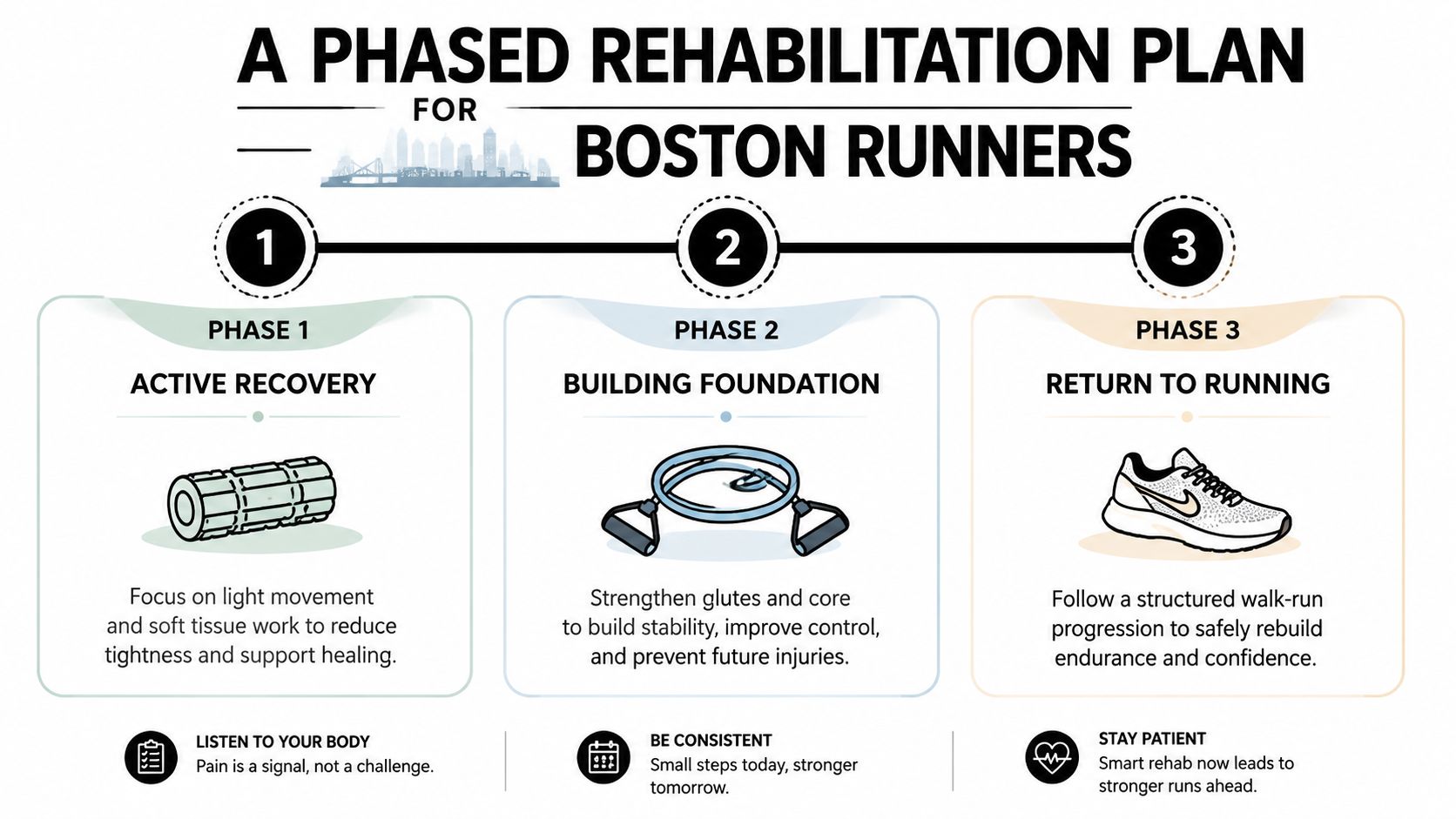
Most post-marathon injuries don't need heroics. They need sequence. The body usually recovers best when treatment matches the stage you're in, rather than throwing every tool at the problem on day one.
Phase one settles the tissue
Early rehab is about calming symptoms without making the runner feel fragile. That often means reducing irritation, restoring comfortable motion, and getting normal walking back first.
What tends to help:
- Relative load reduction: cutting the aggravating activity while keeping some movement in place
- Manual therapy: used to improve motion and reduce guarding, not as a standalone fix
- Aquatic therapy: especially useful when land impact is too provocative but the runner still benefits from movement
- Targeted mobility work: enough to restore motion, not random stretching in every direction
What usually doesn't help is chasing pain with endless foam rolling, hard massage, or testing the injury every day with “just a little jog.”
Phase two rebuilds the engine
Once pain is less reactive, the work shifts to capacity. Many runners become impatient at this stage because they feel better before they're ready. Symptoms improve faster than load tolerance.
Rehab in this phase often focuses on:
| Priority | Why it matters for Boston runners |
|---|---|
| Hip strength | Helps control the leg when fatigue sets in |
| Calf capacity | Supports propulsion and late-race durability |
| Trunk control | Reduces energy leaks and compensations |
| Single-leg stability | Exposes side-to-side differences hidden during easy jogging |
This is also where specialty tools can be useful. Trigger point dry needling can help when a guarded muscle is blocking progress, but it works best when paired with active exercise. Dry needling without strength work may give temporary relief and not much else.
Recovery works when treatment moves from pain relief to load tolerance. Many runners stop after the first part and wonder why the same issue returns.
Phase three earns the return to running
The first run back shouldn't be a guess. It should be the result of meeting clear movement goals. If walking is still altered, hopping is painful, or single-leg control is poor, running usually just re-creates the problem at higher speed.
A sensible return often includes:
- Walk-run intervals on flat, predictable ground
- Spacing runs out enough to assess next-day response
- Keeping one variable stable while another changes, such as duration before speed
- Monitoring location-specific pain rather than vague soreness
Boston runners often want to test themselves on the Esplanade, the Chestnut Hill area, or the hills they struggled with in training. That's understandable. It's usually too early. Flat routes first. Then volume. Then terrain. Then speed.
Phase four protects the next build
The final phase is less about rehab tables and more about habits. Long-term success comes from carrying lessons forward. The issue isn't just “healed or not healed.” It's whether your training system changed.
That may include gait work, shoe review, strength maintenance, pelvic floor support when relevant, or periodic tune-ups during future builds. The strongest return is the one that leaves you better prepared for your next training block than you were for the last one.
Treating Common Post Marathon Injuries
Pain after Boston is rarely random. The course has a pattern. Long downhills early into Newton late means the tissues that absorb braking, control rotation, and manage push-off often take the biggest hit.
Runner's knee and IT band irritation
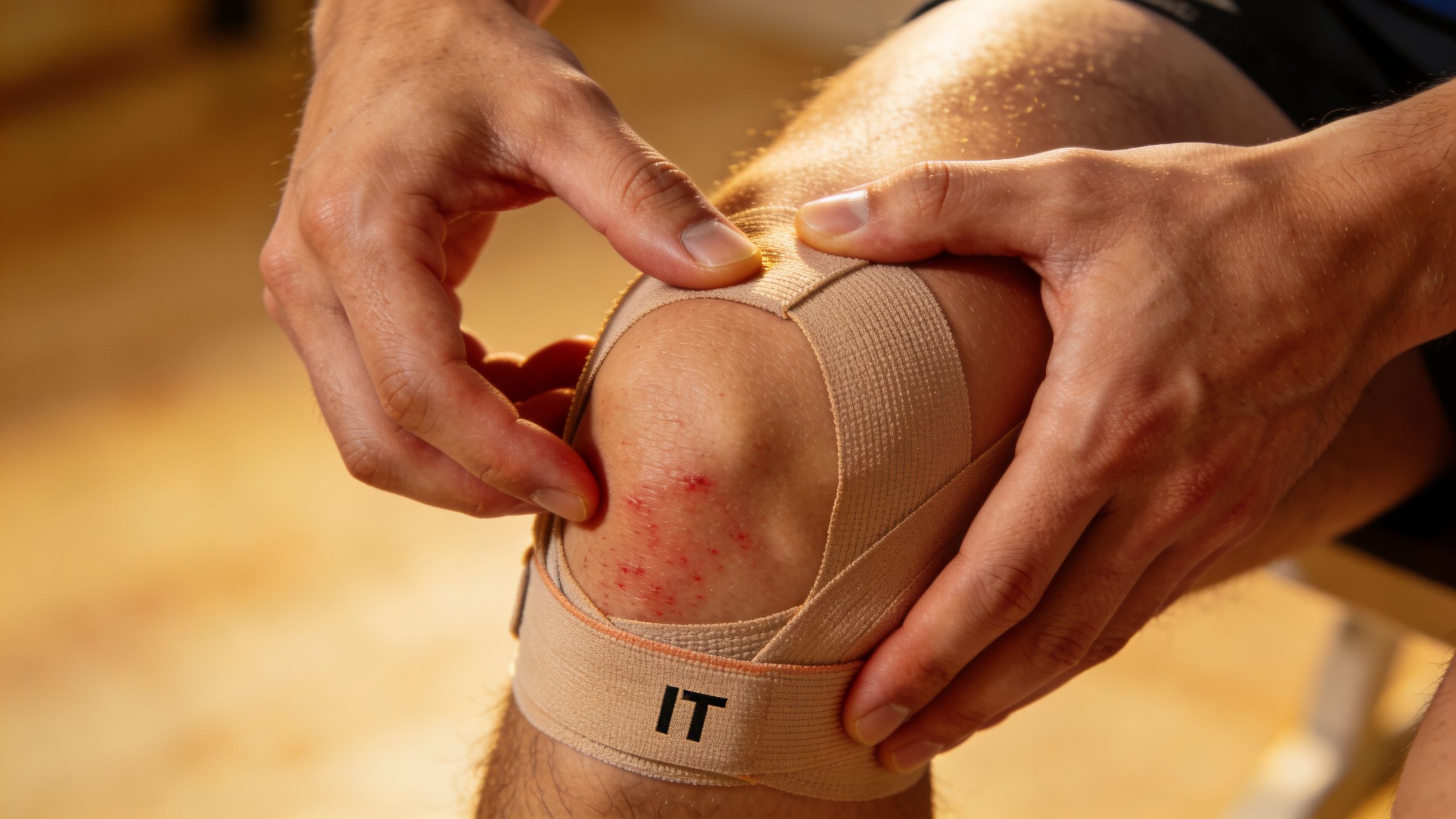
A lot of runners feel this one on the T ride home or the next morning walking downstairs. Pain shows up around the kneecap or along the outside of the knee, and it often gets worse with descents, stairs, or sitting too long after the race.
Boston sets this up well. The early downhill miles ask the quads to brake over and over, then fatigue later in the race makes it harder to keep the hip and femur controlled. The knee ends up handling more motion than it should.
Treatment needs to match that chain, not just the sore spot. In the clinic, that usually means:
- Reducing the movements that keep provoking symptoms: especially descents, deep knee loading, and rushed return-to-run plans
- Restoring hip strength and single-leg control: because lateral knee pain often reflects poor control higher up
- Checking cadence and stride mechanics: small gait changes can reduce irritation without shutting training down for long
- Using trigger point dry needling when muscle guarding is driving the problem: often in the lateral quad, TFL, or gluteal muscles
Stretching the IT band harder rarely solves persistent symptoms. The better question is why the area got overloaded in the first place.
Runners who want more detail on that approach can review our guide to running injury physical therapy in Boston.
Achilles and calf overload
This is one of the most common problems I see after Boston, especially in runners who handled the first half well and then started losing push-off late. Once the calf complex fatigues, the Achilles often absorbs the consequences over the next 24 to 72 hours.
Post-marathon Achilles pain is tricky because rest helps, but too much rest can leave the tendon more irritable when loading resumes. Tendons usually respond better to progressive calf loading than to complete shutdown. A clinical practice guideline from the Journal of Orthopaedic & Sports Physical Therapy on midportion Achilles tendinopathy supports tendon-loading exercise as a central part of treatment.
That trade-off matters. Calm it down enough to walk normally and handle stairs, then build load back in a graded way. We also look at ankle mobility, calf endurance, and whether the runner is trying to test Heartbreak Hill too soon in the return.
A video can help clarify how these issues often connect to mechanics and training decisions:
Postpartum runners need a different lens
Postpartum runners are often told their symptoms are separate problems. Hip pain. Back tightness. Leaking. Heaviness. Trouble tolerating hills or faster running. In practice, those issues frequently interact.
If impact symptoms, pressure, or incontinence show up during a training build or after the marathon, standard strengthening alone may miss the main driver. Pelvic floor rehab can change how load is managed through the trunk and pelvis, and that affects running tolerance. A clinical review in Sports Health on postpartum return to running describes the need for a graded return that accounts for pelvic health, strength, and impact readiness.
For some runners, aquatic therapy is also useful early on. It lets them rebuild aerobic work and running motion with less impact while symptoms settle. That can be a smart bridge for a runner who is not ready for full ground reaction forces but is not starting from zero either.
If a postpartum runner has recurring hip pain or leaking with training, that is often part of the injury picture, not a side issue.
Beyond Rehab From Recovery to Your Next PR
The best outcome after a marathon injury isn't just getting back to baseline. It's coming out of rehab with a better system than the one that led into the problem. That's how runners stop repeating the same pattern every training cycle.
A lot of athletes think of physical therapy as the place you go when something breaks down. That's too narrow. For runners in Boston, it can also be where you sharpen mechanics, identify workload blind spots, and build the strength that holds up when the course gets hard.
What changes long-term results
Three things usually separate short-term relief from lasting progress:
- Performance testing, not guesswork: especially for runners who keep hitting the same wall
- Periodic tune-ups during training: before pain turns into missed mileage
- Specialty support when the case is more complex: including pelvic floor rehab, aquatic therapy, vestibular care, or dry needling when it fits the problem
The value of this approach is simple. You don't wait for the warning signs to become a shutdown.
Why Boston runners benefit from an ongoing plan
Boston is full of runners who stack ambitious goals onto busy lives. They commute, sit at desks, travel, train early, and try to squeeze long runs into packed weekends. That environment rewards consistency, not dramatic resets.
A runner who understands their mechanics, knows their weak links, and checks in before a problem escalates usually trains with fewer interruptions. That's how recovery becomes performance.
For runners thinking ahead to another build, this guide on Boston Marathon physical therapy training offers a strong next step. For broader educational content on running injury anatomy, rehab principles, and performance topics, visit Highbar Health.
If your post-race pain isn't settling, or you want a smarter plan before your next training cycle, book with Joint Ventures Physical Therapy. With 1-on-1 care across Back Bay, Kenmore Square, Fort Point/Seaport, Downtown Boston, Brookline, Allston, and nearby neighborhoods, the team can help you move from Boston Marathon injury physical therapy into stronger, more confident running.