If you're trying to figure out how to loosen tight muscles, we get it. And we can tell you right now, the answer is rarely just "stretch more." As clinicians, we know that lasting relief comes from a smarter approach—one that combines the right techniques for immediate relief with long-term strategies to fix what’s causing the problem in the first place.
Look, true relief comes from addressing the root cause, not just chasing the symptom. We're here to help you do just that.
Why Your Muscles Feel Constantly Tight
That nagging tightness in your neck after a long day at the desk, or the stubborn ache in your low back that just won’t quit—it's a frustration we see every single day in our clinics. You’ve probably tried stretching, and maybe it helps for a minute, but the relief feels temporary, and that tightness always seems to creep back in.
Here’s the thing: that "locked up" feeling is your body sending you a signal. It’s a message that something in your daily routine, your posture, or even your stress levels is creating an imbalance. Our job is to help you decode that message.
The Real Reasons Behind Muscle Tightness
Constant muscle tension is almost never caused by just one thing. It's usually a perfect storm of habits and circumstances that leave your muscles overworked, fatigued, and stuck in a shortened state.
Here are the most common culprits we see:
- Repetitive Strain: Think about sitting for eight hours, staring down at your phone, or performing the same movement at the gym over and over. These sustained positions force certain muscles to stay "on" for far too long, and they get exhausted.
- Muscle Weakness and Imbalance: This is a big one. A tight muscle is often a weak or tired muscle. When key stabilizers like your core or glutes aren't pulling their weight, other muscles have to overcompensate. That tightness you feel is just an overworked muscle screaming for help.
- Dehydration and Nutrition: Your muscle tissue is roughly 75% water. When you're dehydrated, the connective tissue around your muscles loses its pliability, contributing to stiffness and a higher risk of cramps.
- Chronic Stress: Mental stress creates a very real physical response. Your body pumps out hormones like cortisol and adrenaline, triggering the "fight or flight" response and causing your muscles to tense up. If you're always stressed, your muscles never get the signal to stand down.
Sometimes, that constant tightness is simply because you're pushing too hard without enough recovery. Learning how to avoid overtraining is a crucial piece of the puzzle for long-term muscle health. It's also helpful to know if what you're feeling is true tightness or a taut, overstretched muscle—we break down the key differences between tight vs. taut muscles in another post.
Here's a hard truth: stretching alone is often not the long-term solution. While it feels good, science shows that for most people, stretching primarily increases your tolerance to the stretching sensation rather than physically elongating the muscle tissue. True, lasting change requires a consistent plan over weeks or months to counteract the effects of repetitive strain and build strength where you need it most.
When you feel that familiar ache setting in, your first instinct might be to stretch it out—but that's not always the best first move. Here’s a quick guide to a better first action for some of the most common trouble spots.
Your First Move for Common Tight Spots
| Common Tight Area | Your First Action and Why It Helps | What You Might Be Feeling |
|---|---|---|
| Neck & Shoulders | Gentle Movement (Chin Tucks & Shoulder Rolls): Restores blood flow and reminds the muscles how to move out of a tense, static posture. It’s about coaxing them, not forcing them. | A constant, dull ache or stiffness after sitting or looking down. |
| Low Back | Positional Breathing (90/90 Breathing): Calms the nervous system and relaxes deep spinal muscles that static stretching often can’t reach. It’s a reset button for your entire system. | A persistent ache or “locked up” sensation, especially after sitting or standing for a while. |
| Hips & Glutes | Foam Rolling or Lacrosse Ball: Directly targets trigger points and reduces the “knotted” feeling in these large, powerful muscles. It’s like a focused, self-administered deep tissue massage. | Deep aching in the buttock, sometimes with radiating discomfort down the leg. |
| Hamstrings | Dynamic Warm-Up (Leg Swings): Prepares the muscles for movement by increasing blood flow, which is often more effective than holding a cold, static stretch. It tells the muscle it’s time to move, not time to be pulled on. | A “pulling” sensation behind the knee or in the back of the thigh. |
Taking a moment to move gently, breathe, or apply pressure can be far more effective than forcing a tight, irritated muscle into a deep stretch. It sets the stage for the more targeted work to come.
Effective Self-Massage and Stretching Techniques
Once you understand why your muscles feel tight, the next step is knowing exactly what to do about it. This is where you can take control with the same hands-on techniques we teach our patients to get lasting relief.
Forget aimless stretching or just rolling around on a foam roller and hoping for the best. Effective relief requires a strategy.
This flowchart breaks down how daily stressors lead to muscle tightness and how targeted relief methods can break that cycle for good.
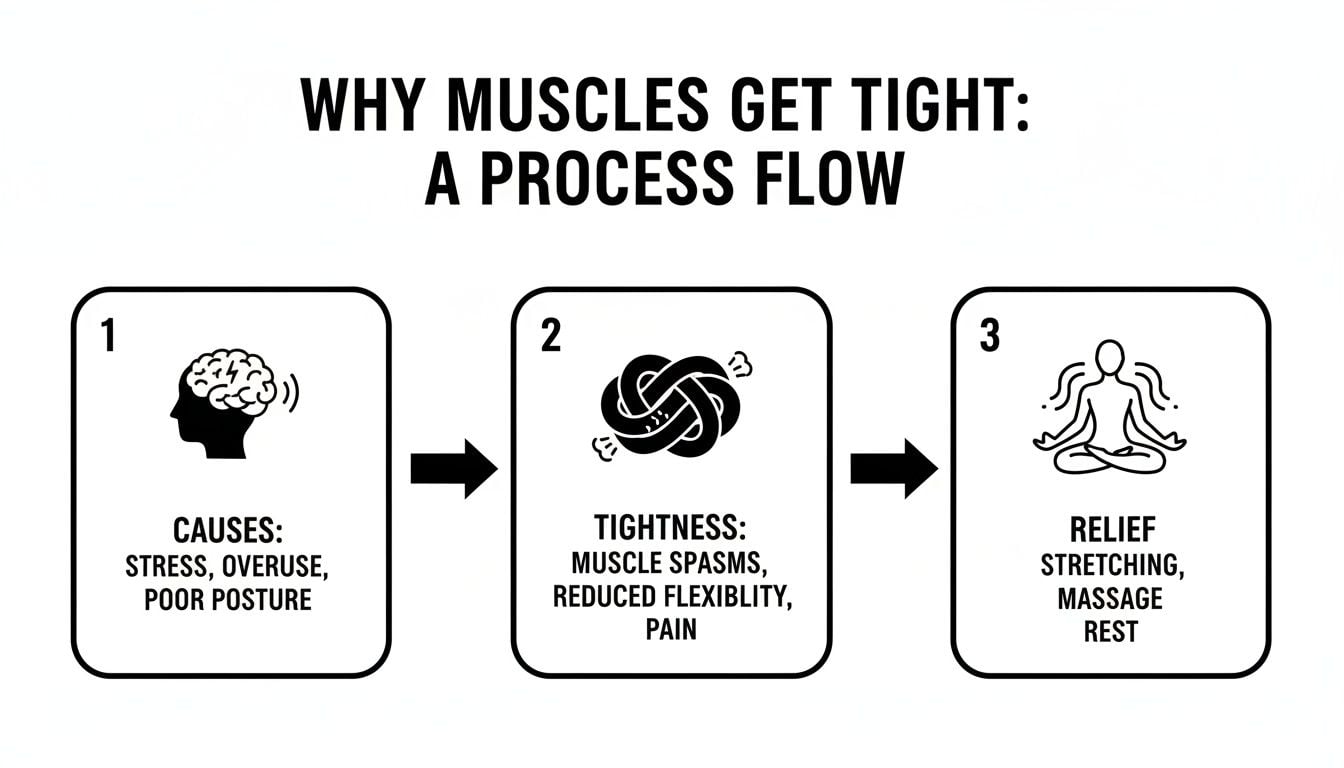
As you can see, breaking the cycle requires a proactive approach. It's about counteracting the causes with a smart combination of stretching and self-massage.
The Right Stretch at the Right Time
Not all stretches are created equal, and timing is everything. We see it all the time in the clinic: using the wrong stretch can be ineffective or, even worse, irritate an already angry muscle.
Here's the simple breakdown we use with our patients:
- Dynamic Stretching (Before Activity): Think movement-based stretches like leg swings, arm circles, or torso twists. These are your go-to for a warm-up. They actively move your muscles through their full range of motion, increasing blood flow and preparing your body for exercise.
- Static Stretching (After Activity): This is the classic "hold a stretch" you're probably familiar with. The key is to do it when your muscles are already warm, like after a workout. Holding a position for a sustained period helps calm the nervous system and can lead to real improvements in flexibility.
Targeted stretching can be a game-changer. For instance, knowing how to effectively stretch butt muscles can alleviate a surprising amount of discomfort—from nagging low back ache to sciatica-like symptoms.
How to Stretch for Lasting Results
So, how long should you actually hold a stretch? People tend to either rush through them or hold them for way too long. The sweet spot is grounded in clinical evidence.
Holding a static stretch for 15 to 30 seconds is enough to improve your range of motion. Interestingly, a lot of that benefit comes from increasing your nervous system's tolerance to the stretch sensation, not just from physically lengthening the muscle tissue itself.
Clinician's Tip: Remember to breathe. It sounds obvious, but we constantly remind patients to take slow, deep breaths while they stretch. Holding your breath makes your body tense up, which is the exact opposite of what you’re trying to achieve. Try to exhale as you deepen the stretch.
Self-Myofascial Release: Getting to the Knots
Sometimes, a stretch just can’t get to the heart of the problem—that deep, stubborn "knot" that won't let go. That’s where self-myofascial release (SMR) comes in.
Using tools like foam rollers and massage balls lets you apply direct, targeted pressure to these trigger points, encouraging the muscle to finally release. Think of it as giving yourself a focused deep-tissue massage. The goal isn’t to roll back and forth quickly; it’s about finding a tender spot and applying sustained pressure.
Common SMR Targets and Techniques
Here are a few of the most effective techniques we show our patients:
- Upper Back & Shoulders: Lie on a foam roller placed horizontally across your shoulder blades. Support your head with your hands and slowly roll up and down. When you find a tender spot, pause and hold for 20-30 seconds, breathing into the pressure.
- Hips & Glutes: Sit on a massage ball or foam roller and cross one ankle over the opposite knee in a "figure four" shape. Gently roll over your glute muscle until you find a trigger point, then settle into that spot with gentle, sustained pressure.
- Calves: Sit on the floor with a foam roller under one calf. Use your arms to lift your hips off the floor, then roll slowly from your ankle toward your knee. To increase the pressure, you can cross your other leg on top.
This focused pressure helps break up adhesions and sends a signal to your nervous system that it's okay to let that muscle relax. If you want to understand more about the physiology, you can read more about the effects of stretching and SMR.
Building Strength to Prevent Future Tightness
It seems counterintuitive to use exercise to fix a muscle that feels tight as a drum. But based on years of clinical experience, we know that strengthening is one of the most powerful long-term solutions for loosening tight muscles.
Think of it this way: a tight muscle is often just a weak or fatigued muscle that's being overworked. When your primary stabilizing muscles aren't strong enough to do their job, smaller, secondary muscles have to jump in and compensate.
That chronic overwork leads to the nagging, persistent tension you can’t seem to shake. Building a solid foundation of strength creates a more resilient system that doesn't need to rely on tightness for stability.
The Powerhouse Muscles for Stability
You don’t need a complicated bodybuilding routine. To prevent future tightness, we focus on what we call the 'powerhouse' muscle groups. These are the unsung heroes that provide the framework for healthy, efficient movement.
- The Core: This isn't just your six-pack abs. It's the entire 360-degree support system around your midsection that stabilizes and protects your spine.
- The Glutes: Your gluteal muscles are the true engine for your lower body. Strong glutes support your pelvis and take immense strain off your lower back and hamstrings.
- The Upper Back: The muscles between your shoulder blades—your rhomboids and mid-traps—are essential for maintaining good posture and preventing that 'hunched forward' tension in your neck and shoulders.
When you strengthen these three areas, you build a support system that finally allows other chronically tight muscles, like your hip flexors and hamstrings, to relax.
Why a Strong Core Unlocks Your Hips
One of the biggest "aha!" moments for our patients is realizing their tight hip flexors are a direct symptom of a weak core.
When your deep abdominal and spinal muscles aren't engaged, your body searches for stability somewhere else. The hip flexors, located at the front of your hips, will often grip and tense up to provide that missing stability and protect your lower back.
You can stretch your hip flexors all day, but if you don't address the underlying core weakness, they’ll just tighten right back up.
Our favorite saying is, "Motion is lotion." This is especially true for preventing stiffness. Consistent movement and strengthening keep your joints lubricated and your muscles balanced. For people who sit most of the day, just getting up to walk and perform a few core exercises every hour can be a game-changer for hip and back health.
Simple Exercises to Build Resilient Strength
Here are a few foundational exercises we give patients to build a stronger, more balanced body. The key is to focus on perfect form over the number of reps or the amount of weight.
1. The Plank
This is the ultimate core-strengthening exercise. It trains your entire trunk to work as a single, stable unit.
- How to do it: Start on your forearms and toes, keeping your body in a perfectly straight line from your head to your heels. Squeeze your abs and glutes, and don't let your hips sag.
- The Goal: Hold for 20–30 seconds with perfect form. A shorter, perfect plank is far more effective than a longer, sloppy one.
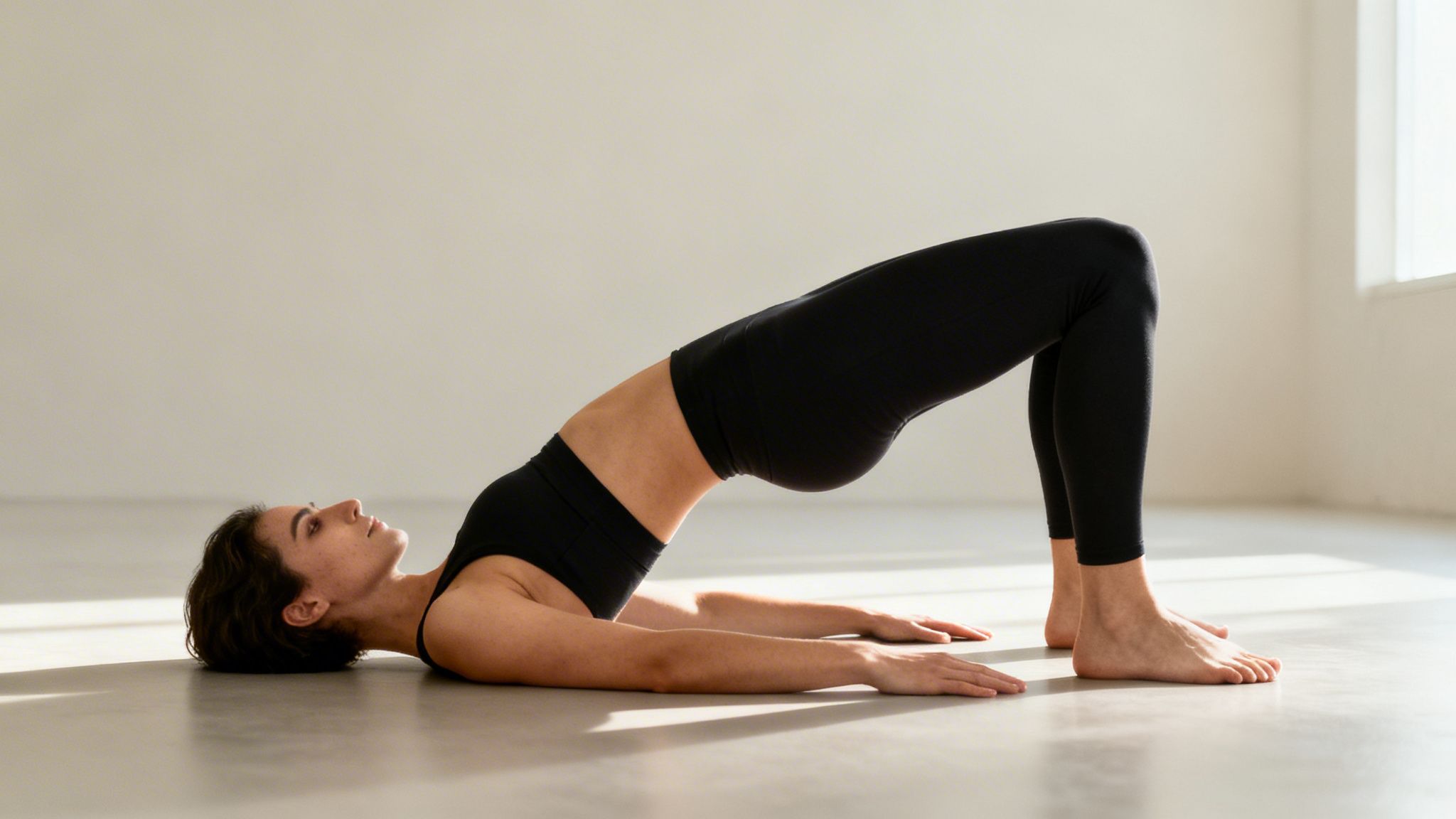
2. The Glute Bridge
This is the best exercise to "wake up" and strengthen your glutes, taking pressure off your hamstrings and lower back.
- How to do it: Lie on your back with your knees bent and feet flat on the floor. Squeeze your glutes to lift your hips toward the ceiling until your body forms a straight line from your shoulders to your knees.
- The Goal: Perform 10–15 reps, focusing on a powerful squeeze at the top of the movement.
3. The Bent-Over Row
This exercise directly targets those crucial upper-back muscles that combat poor, rounded posture. You can use dumbbells, a resistance band, or even just your body weight to start.
- How to do it: Hinge forward at your hips, keeping your back completely flat. Pull the weights or band toward your chest, actively squeezing your shoulder blades together at the top.
- The Goal: Aim for 10–12 reps, concentrating on that mind-muscle connection with your back.
By incorporating these simple strength exercises into your routine, you're not just temporarily loosening tight muscles—you're fixing the root cause and building a body that is far less prone to tightness in the first place.
How Daily Habits Contribute to Tight Muscles
You can stretch every day, but if your daily habits are working against you, that feeling of tightness will always creep back in. It's like trying to bail out a boat that has a hole in it.
Lasting relief isn’t just about the 10 minutes you spend on a foam roller. It’s about the other 23 hours of the day.
We see this all the time in the clinic: patients who are diligent with their exercises but unknowingly sabotage their own progress with simple, repetitive movements. Let's look at the hidden culprits in your daily life that keep your muscles wound up.
The Problem with Posture
When we talk about posture, most people immediately think of someone hunched over a keyboard. That's a huge part of it, but it's so much more than your desk setup.
It’s how you stand in line at the coffee shop, how you crane your neck to look at your phone, and even how you carry groceries.
These sustained positions create a predictable pattern of muscle strain. For instance, spending hours with your head tilted forward to look at a screen can put up to 60 pounds of extra pressure on your cervical spine. Your neck and upper back muscles have to work overtime just to hold your head up, leading to that all-too-familiar burning tightness.
The same thing happens when you sit for long periods. Your hip flexors stay in a shortened, tight position while your glutes become inactive and weak. It’s no surprise that this is one of the most common issues we treat.
The advice we give nearly every patient is simple: Your next posture is your best posture. Don't get stuck trying to hold one "perfect" position. The goal is to move frequently. Set a timer, get up, walk around, or just shift in your chair every hour.
Simple Ergonomic Fixes for Big Results
Making small tweaks to your environment can have a massive impact on muscle tension. You don't need a fancy, expensive setup; you just need to make your space work for you, not against you.
-
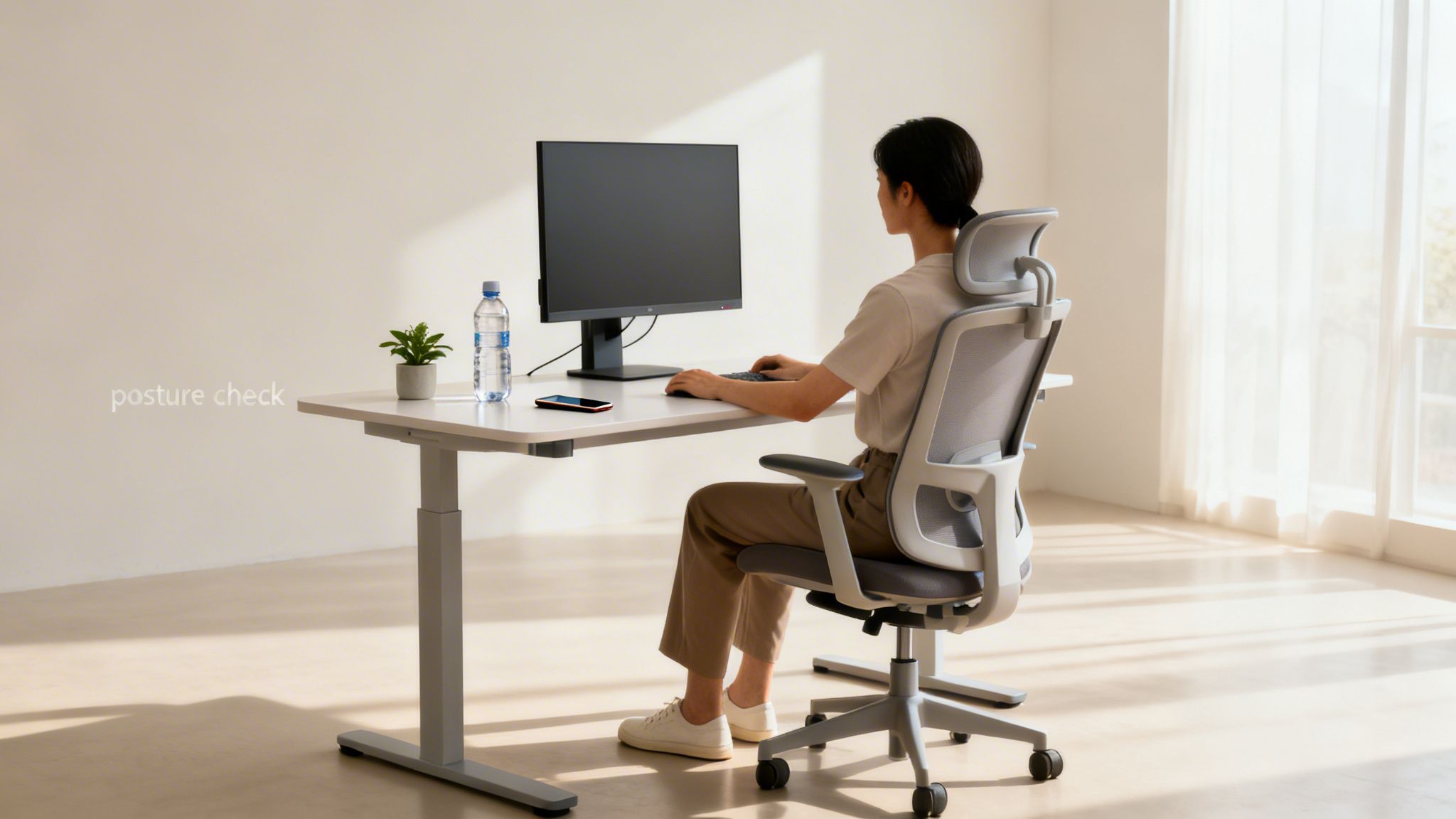
At Your Desk: Your monitor should be directly at eye level so your head can rest in a neutral position. Your feet should be flat on the floor with your knees at a 90-degree angle. This simple alignment takes the strain off your low back and hip flexors.
-
On Your Phone: Instead of looking down, bring your phone up to eye level. You'll instantly feel the load come off those overworked neck muscles.
-
While Standing: Try not to lock your knees or let your pelvis tilt forward. Gently engage your core and keep a soft bend in your knees to stay in a more balanced, supported stance.
The Surprising Power of Your Breath
Here’s a secret weapon we teach in the clinic: your breath is one of the fastest ways to tell your body to relax. When you're stressed or in pain, you tend to take shallow, rapid breaths from your chest.
That type of breathing pattern keeps your nervous system in a low-grade "fight or flight" mode, which in turn tells your muscles to stay tense and guarded. Learning to breathe from your diaphragm sends a powerful signal to your brain that it's safe to let go.
A Quick Diaphragmatic Breathing Exercise
This isn't just a relaxation trick; it directly influences your body's muscle tone.
- Lie on your back with your knees bent. Place one hand on your chest and the other on your stomach.
- Breathe in slowly through your nose for a count of four. The goal is to feel the hand on your stomach rise, while the hand on your chest stays relatively still.
- Exhale slowly through your mouth for a count of six. Feel your stomach gently fall as you press the air out.
- Repeat for 2-3 minutes. You'll notice your whole body start to feel heavier and more relaxed.
Try this before bed or during a stressful moment at work. You'll feel an immediate shift in your muscle tension.
Knowing When to See a Physical Therapist
While all the self-care strategies we’ve covered are great first-line defenses, there comes a point where even the best efforts at home fall short. As clinicians, we see it all the time: knowing when to ask for help is the key to stopping a minor ache from becoming a major problem.
Think of it this way: you can manage a little muscle soreness on your own, but you need a professional when you can’t figure out why it keeps coming back. Listening to your body and recognizing its signals is the smartest thing you can do for your long-term health.
Red Flags Your Body Is Sending
So, how do you know if your muscle tightness has crossed the line from a simple annoyance into something that needs a professional eye? We coach our patients to watch for a few specific "red flags." These are signs that something more is going on under the surface.
If you’re experiencing any of the following, it’s time to stop guessing and get a proper evaluation:
- Persistent Numbness or Tingling: That "pins and needles" sensation, especially if it travels down an arm or leg, often points to nerve involvement. This isn’t something a foam roller can fix.
- Noticeable Muscle Weakness: If one side feels significantly weaker than the other, or you suddenly struggle to lift something you used to handle easily, it’s a sign the nerve signals to your muscles may be compromised.
- Pain That Disrupts Your Sleep: Aches bad enough to wake you up at night are a major clue. Your body is supposed to be recovering during sleep, not fighting off pain.
- No Improvement After a Few Weeks: If you’ve been diligently stretching, rolling, and strengthening for 2-3 weeks with zero change in your symptoms, your efforts are likely missing the root cause. You need a more targeted plan.
- Sharp, Shooting, or Electric Pain: This kind of pain feels very different from a dull muscle ache. It often signals a more acute issue that needs a real diagnosis.
Ignoring these signs can lead to a much longer and more complicated recovery. It’s always better to get it checked out early.
What to Expect at Your First PT Visit
The idea of physical therapy can feel intimidating if you've never been. Let's clear that up. A visit with one of our therapists is a partnership. We're here to listen, investigate the "why," and build a game plan with you.
Your first appointment is all about discovery. We act as detectives to figure out the root cause of your tightness. We’ll talk about your health history, daily routines, goals, and exactly what you're feeling.
A common misconception is that physical therapy is just for post-surgical rehab. In reality, a huge part of our work is what we call orthopedic physical therapy—diagnosing and treating musculoskeletal issues like chronic tightness, joint pain, and movement imbalances before they require more serious interventions.
After we talk, we’ll move into a thorough physical evaluation. This isn't a workout; it's a series of specific movements and tests to assess your:
- Range of Motion: How well your joints are actually moving.
- Strength: Looking for imbalances or specific weak points.
- Movement Patterns: Observing how you squat, bend, or reach to spot compensations.
- Tissue Quality: Gently feeling the muscles to find specific trigger points and restrictions.
This hands-on assessment gives us the roadmap for your recovery. If you want to dive deeper into this specialty, our article on orthopedic physical therapy breaks down what it is and how it helps with a huge range of conditions.
Your Personalized Treatment Plan
Based on what we find, we'll build a treatment plan that’s 100% unique to you. Cookie-cutter programs don't work because your body, your history, and your goals are different from everyone else's.
Your plan will be a combination of in-clinic treatments to accelerate healing and a home exercise program to empower you for the long run.
Your care might include:
- Manual Therapy: Skilled, hands-on techniques where your therapist mobilizes joints and releases soft tissue restrictions that you can't get to on your own.
- Trigger Point Dry Needling: A highly effective technique using a thin filament needle to release stubborn muscle knots, often providing immediate relief and improved movement.
- Therapeutic Exercises: A targeted set of strengthening and mobility drills designed to correct the specific imbalances we found in your evaluation.
Our goal is simple: give you the expert guidance and targeted care you need to finally understand—and solve—your muscle tightness for good. Taking that first step to see a professional is a powerful move toward lasting relief.
Common Questions About Muscle Tightness
As clinicians, we hear the same questions about muscle tightness every single day. It’s a confusing topic, made worse by a lot of conflicting advice online.
Let's clear up a few things. Here are the straightforward answers to the questions we get asked most often in the clinic.
Soreness vs. Tightness: What Is the Difference?
This is probably the number one question we get, and the answer is critical. Knowing the difference tells you whether you need simple rest or a more specific plan.
It’s not just about words; they are completely different signals from your body.
- Muscle Soreness (DOMS): Think of this as the generalized, achy feeling you get a day or two after a tough workout. It’s spread across the whole muscle you worked, feels tender, and goes away on its own in a few days as your body repairs itself.
- True Muscle Tightness: This is a much more localized and persistent feeling of restriction. People describe it as a “knot,” a “band,” or a sense that a muscle just refuses to let go. It can stick around for weeks and often limits your range of motion, even when you haven't been exercising.
The key difference is this: soreness is a normal, temporary response to exertion. Problematic tightness is a chronic state of muscle contraction. It almost always points to an underlying imbalance, weakness, or repetitive strain that needs to be addressed.
Can My Diet Really Affect My Muscles?
Absolutely. What you eat and drink has a direct and significant impact on your muscle health. We see it all the time—patients who are great about their exercises but ignore nutrition, then can't figure out why they still feel stiff and cramp up.
Your muscles are about 75% water. Even slight dehydration can make your fascia—the connective tissue wrapping your muscles—less pliable and more “sticky,” which creates that restricted feeling.
Your muscles also need a precise balance of electrolytes like potassium, sodium, and magnesium to contract and relax correctly. An imbalance, often from a poor diet or sweating a lot without rehydrating, can lead to cramps and that "locked-up" sensation. Simple things, like adding a banana for potassium or leafy greens for magnesium, can make a real difference.
How Often Should I Stretch to See a Difference?
When it comes to stretching, consistency will always beat intensity. We often see people go all-out in an hour-long stretching session once a week, then wonder why they don't see any lasting change.
Lasting changes in muscle length take time. Your nervous system has likely spent months or years learning to hold a muscle in a shortened, guarded position. Re-educating it requires gentle, frequent input, not brute force.
Here’s the simple truth: daily, gentle stretching for 5-10 minutes is far more effective than infrequent, intense sessions.
Think of it less like a workout and more like daily hygiene for your muscles. It's about consistently reminding your body what it feels like to move through a full, relaxed range of motion. It often takes 4 to 6 weeks of this kind of consistent practice to notice measurable, lasting improvements.
Be patient with your body. That tightness didn't develop overnight, and it won't disappear overnight, either. But with a smart, consistent approach, you can absolutely teach your muscles how to loosen up for good.
If you've tried these strategies and are still struggling with persistent tightness or pain, it might be time for a professional eye. At Joint Ventures Physical Therapy, we specialize in getting to the root cause of your discomfort. We’re here to listen and build a personalized plan that helps you move and feel better. Schedule your 1-on-1 evaluation with one of our expert clinicians today.