
If you’re dealing with dizziness, vertigo, or a persistent feeling of being off-balance, you’re in the right place. That disorienting, frustrating sensation isn’t something you just have to live with. We're here to help you understand what's going on and what we can do about it.
Vestibular Rehabilitation Therapy (VRT) is a specialized, exercise-based form of physical therapy designed to get your brain and inner ear working together again. It’s a proven, non-invasive way to reduce dizziness, improve your balance, and help you feel steady on your feet.
Your Body's Inner Compass

Think of your vestibular system as your body's internal GPS. This incredible network, housed in your inner ear, constantly communicates with your eyes and brain to keep you upright and your vision stable as you move. When everything is in sync, you don’t even think about it.
But when part of that system gets disrupted—whether from an illness, injury, or age-related changes—the signals get scrambled. Your brain receives conflicting messages from your inner ear and your eyes, which is what triggers that feeling of dizziness, unsteadiness, or the room spinning. That’s where we come in.
What's the Goal of VRT?
Vestibular Rehabilitation Therapy is a specialized type of neurorehabilitation that focuses on restoring balance and minimizing dizziness. It's not a passive approach where you wait for symptoms to fade. Instead, VRT is an active process that uses specific exercises to retrain your brain to compensate for the conflicting signals it's receiving.
The core principle behind VRT is neuroplasticity—your brain's amazing ability to adapt and rewire itself. We act as guides, using targeted movements and exercises to help your brain relearn how to process sensory information correctly, effectively recalibrating your internal compass.
This process is highly personalized. Your physical therapist acts a bit like a detective, first working to pinpoint the specific cause of your symptoms. From there, we design a treatment plan with clear goals:
- Reduce vertigo and dizziness: We work to calm that spinning or off-kilter feeling.
- Improve gaze stability: This helps you keep your vision clear and focused, even when your head is moving.
- Enhance your balance and confidence: The ultimate goal is to help you move through your day without fear of falling.
A Proven Approach to Restoring Balance
While the idea of "exercising your inner ear" might sound new, VRT has a solid history. The practice was formalized in the 1960s in France as a structured way to help patients recover from post-surgical balance problems.
Over the decades, clinicians have refined these techniques into a data-backed, gold-standard protocol for treating a wide range of vestibular disorders. It’s an evidence-based approach that helps people get back to their lives.
Recognizing the Signs You Need Vestibular Therapy
It’s easy to dismiss a dizzy spell as just feeling tired or a little off. But when those moments start happening more often, or with more intensity, your body is sending a clear signal that something isn’t right with your internal balance system.
The most unmistakable sign is vertigo — that jarring, powerful sensation that you, or the room itself, are spinning. This often strikes when you roll over in bed, look up at a high shelf, or tilt your head back. It’s a hallmark symptom of a condition we treat every day called Benign Paroxysmal Positional Vertigo (BPPV).
But not all vestibular issues are that dramatic. You might just feel a persistent sense of unsteadiness or imbalance. It can feel like you’re walking on a boat deck or an uneven path, even when you're on solid ground. This can make simple things like navigating a crowded grocery store or walking in a dimly lit room feel surprisingly difficult.
Beyond Obvious Dizziness
The signals from a struggling vestibular system can be sneakier than you’d think, showing up in ways that don't immediately scream "inner ear problem." These are important clues we look for during an evaluation.
Pay attention to these less obvious symptoms:
- Gaze Instability: Does your vision feel blurry or jumpy when your head is moving? For example, trying to read a street sign while walking might feel impossible because the words won't stay still.
- Motion Sensitivity: Do everyday movements—like riding in a car, scrolling on your phone, or even watching an action movie—leave you feeling nauseous or disoriented? This happens when your brain gets overwhelmed by the sensory input.
- Brain Fog or Trouble Concentrating: When your brain is constantly working overtime just to figure out where you are in space, it has less capacity for other tasks. This can lead to a frustrating mental fatigue that makes focusing feel like a chore.
It's important to remember that dizziness is a significant issue. In the United States, balance problems are on the rise, with about 36.8 million people reporting issues in 2016, a substantial jump from 24.2 million in 2008. This isn't just a minor inconvenience; it's a widespread health concern.
When to Seek Immediate Medical Care
While vestibular rehabilitation is the go-to solution for most balance disorders, some symptoms are red flags for a more serious medical emergency, like a stroke. It is absolutely crucial to know the difference.
Please seek immediate medical attention at an emergency room if your dizziness is accompanied by any of these "red flag" symptoms:
- A sudden, severe headache unlike any you've had before
- Sudden double vision or loss of vision
- New weakness or numbness on one side of your face or body
- Trouble speaking or slurring your words
- Difficulty walking that is sudden and severe
These are not typical signs of an inner ear problem. The top priority is to rule out a serious neurological event.
Once you’ve been medically cleared, a physical therapist specializing in vestibular therapy can step in to address the underlying balance issue. If you're experiencing any of the other symptoms we discussed, it’s a sign that it’s time to schedule an evaluation with a vestibular specialist.
What to Expect at Your First VRT Evaluation
Walking into any new medical appointment can be a little unsettling, especially when you’ve been dealing with something as disorienting as dizziness. We get it. That's why we want to pull back the curtain and show you exactly what your first vestibular rehabilitation therapy evaluation with us looks like.
The whole visit is built around one thing: understanding your unique story. This isn’t a rushed, in-and-out appointment. It’s a dedicated, one-on-one session where you have our undivided attention.
It All Starts with a Conversation
Before we do a single test, we just talk. We need to hear everything. What does the dizziness feel like? When did it start? What activities make it worse, and what—if anything—makes it better? Your story gives us our most important clues.
We’ll ask you about:
- The nature of your symptoms: Is it a true spinning feeling (vertigo), general unsteadiness, lightheadedness, or something else?
- Triggers and timing: Does it pop up when you roll over in bed, walk through a crowded grocery store, or turn your head too fast?
- Impact on your life: How is this affecting your work, your hobbies, and just your ability to feel like yourself from day to day?
This conversation is the foundation for your entire treatment plan. It helps us form a working hypothesis so we can choose the right tests to figure out what’s really going on.
Gentle Tests to Find the Root Cause
After we’ve listened to your experience, we move on to the physical assessment. This isn’t some strenuous workout; think of it as clinical detective work. We use a series of specific, gentle tests to look for objective signs that tell us how your inner ear, eyes, and brain are communicating.
Your physical therapist’s job is to connect your subjective feelings of dizziness to objective, measurable findings. This evaluation is how we build the bridge between what you're experiencing and a clear path toward getting better.
Some of the key tests we might perform include:
- Eye Movement and Gaze Stability Tests: We’ll have you track our finger or a small target with your eyes. Then, we’ll observe how your eyes react as you move your head. This lets us assess the vestibulo-ocular reflex (VOR), the critical connection that keeps your vision clear and stable when you’re in motion.
- Positional Testing for BPPV: If we suspect Benign Paroxysmal Positional Vertigo (BPPV), we’ll perform maneuvers like the Dix-Hallpike test. This involves slowly and carefully guiding you from a seated to a lying-down position to see if we can reproduce that spinning sensation. It might sound intimidating, but it’s a slow, controlled movement that gives us definitive answers. For more on this, we wrote a guide on how to treat vertigo and BPPV that breaks it down.
- Balance and Gait Assessment: We'll simply watch you stand and walk to see how your body is maintaining its balance. We might ask you to stand with your feet together, try standing on one leg, or walk while turning your head. This shows us which systems you rely on most for stability—your inner ear, your vision, or the sense of touch in your feet.
We explain every test before we begin, so you’ll always know what we’re doing and why. Our goal is for you to leave this first visit with two things: a clear understanding of what’s causing your symptoms, and a real sense of confidence that you’re finally in the right hands.
The Core Exercises That Retrain Your Brain
Once your evaluation points us to the root cause of your dizziness, we can start the real work: retraining your brain. Vestibular rehabilitation isn't a one-size-fits-all program. It's a highly specific set of exercises designed to target your unique symptoms and get your brain and inner ear communicating properly again.
Your brain is incredibly adaptable. When it gets faulty signals from your vestibular system, it can learn to compensate, but it needs the right guidance. VRT provides that guidance, using targeted movements to help your brain recalibrate and learn to trust your body’s sense of balance once more.
Our process is straightforward and built entirely around you.
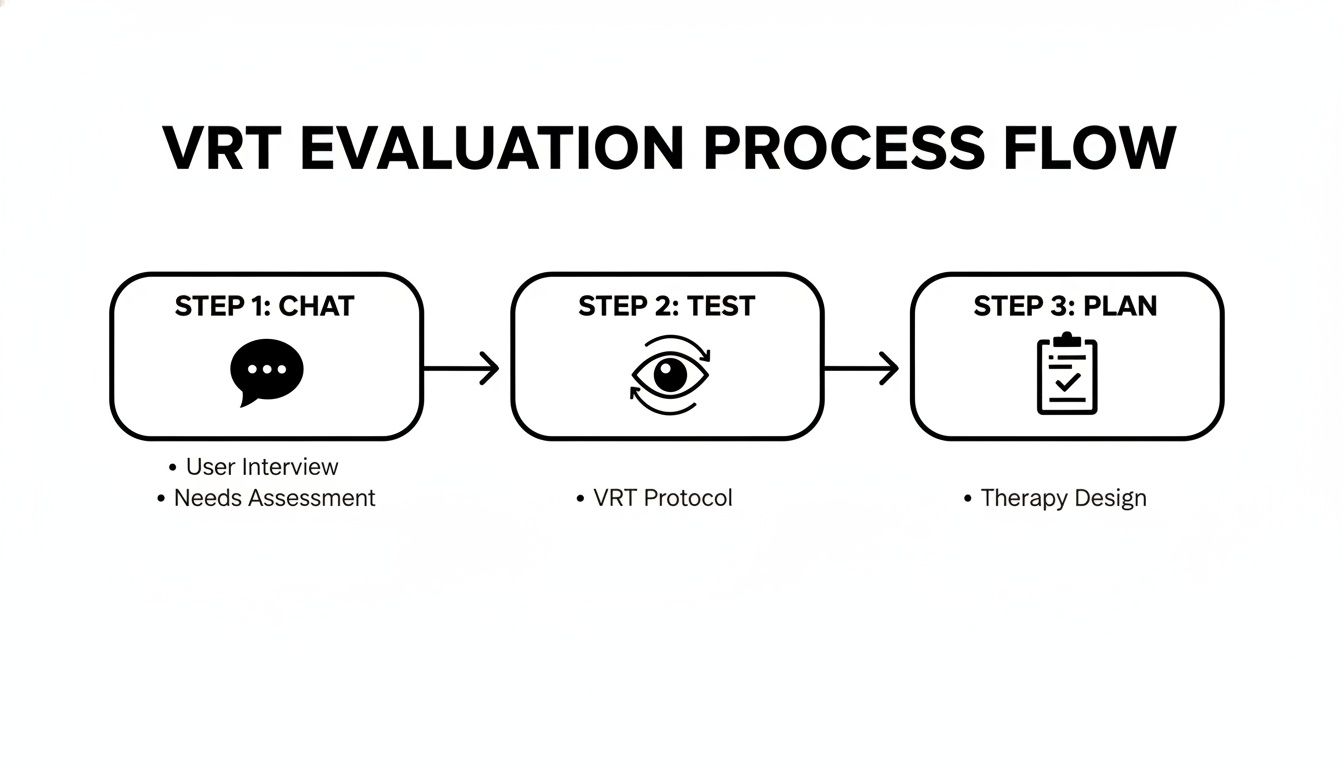
It all starts with a detailed conversation, moves into specific testing, and finishes with a clear plan of action.
Canalith Repositioning for BPPV
If we diagnose you with Benign Paroxysmal Positional Vertigo (BPPV), our primary tool is the Canalith Repositioning Maneuver (CRM). This condition is caused by tiny calcium crystals that break loose and float into the fluid-filled canals of your inner ear, sending chaotic "spinning" signals to your brain.
A CRM is a series of precise, gentle head and body movements we guide you through on the treatment table. The goal is simple: use gravity to guide those rogue crystals out of the canal and back where they belong.
For most people with BPPV, the relief is almost immediate. It’s one of the most satisfying treatments we perform, with an 80-90% success rate, often in just one or two sessions.
Gaze Stabilization Exercises
Does the world seem to jump or blur when you move your head? That’s a good sign your vestibulo-ocular reflex (VOR) is off-kilter. The VOR is what allows your eyes to stay locked on a target while your head is in motion—think of reading a street sign as you walk past it.
Gaze stabilization exercises are designed to retrain and strengthen that reflex. We might have you:
- Focus on a fixed point (like a dot on the wall) while you gently turn your head side-to-side or nod up-and-down.
- Keep your eyes on a target as you walk toward or away from it.
These drills essentially rebuild the high-speed connection between your inner ear and your eyes, sharpening your vision during everyday movements.
Habituation Exercises
Sometimes, dizziness is predictable. It might be triggered by a quick head turn, bending over to tie your shoes, or walking through the visually "busy" aisles of a supermarket. If you've started avoiding these things, habituation exercises are the key.
The logic is straightforward: we systematically expose you to the very movements or visual triggers that cause mild dizziness, but in a controlled and repetitive way.
For instance, we might practice quick head turns or repeated bending motions in the clinic. At first, you’ll feel a familiar, mild sense of unease. But with repetition, your brain starts to adapt. It learns the signal isn't a threat and begins to tune out the dizziness response, desensitizing your nervous system so you can move freely and without fear.
Balance and Gait Training
Ultimately, the goal is to get you moving confidently and reduce your risk of falling. That’s where balance and gait (walking) training comes in. These exercises challenge your stability in a safe environment, helping your body relearn how to stay upright in dynamic situations.
Based on your evaluation, we’ll create a custom progression that could include:
- Standing on different surfaces, from a firm floor to a soft foam pad, to force your body to adapt.
- Walking while turning your head, which mimics real-world tasks like looking for traffic while crossing a street.
- Stepping over small obstacles to improve your coordination and reaction time.
As you get stronger, the exercises get harder, building your confidence one step at a time. Because dizziness can also be linked to issues in the neck, we often blend these exercises with other techniques. You can learn more about how we address this in our post on neck exercises for vertigo.
How Effective Is VRT and How Long Will It Take
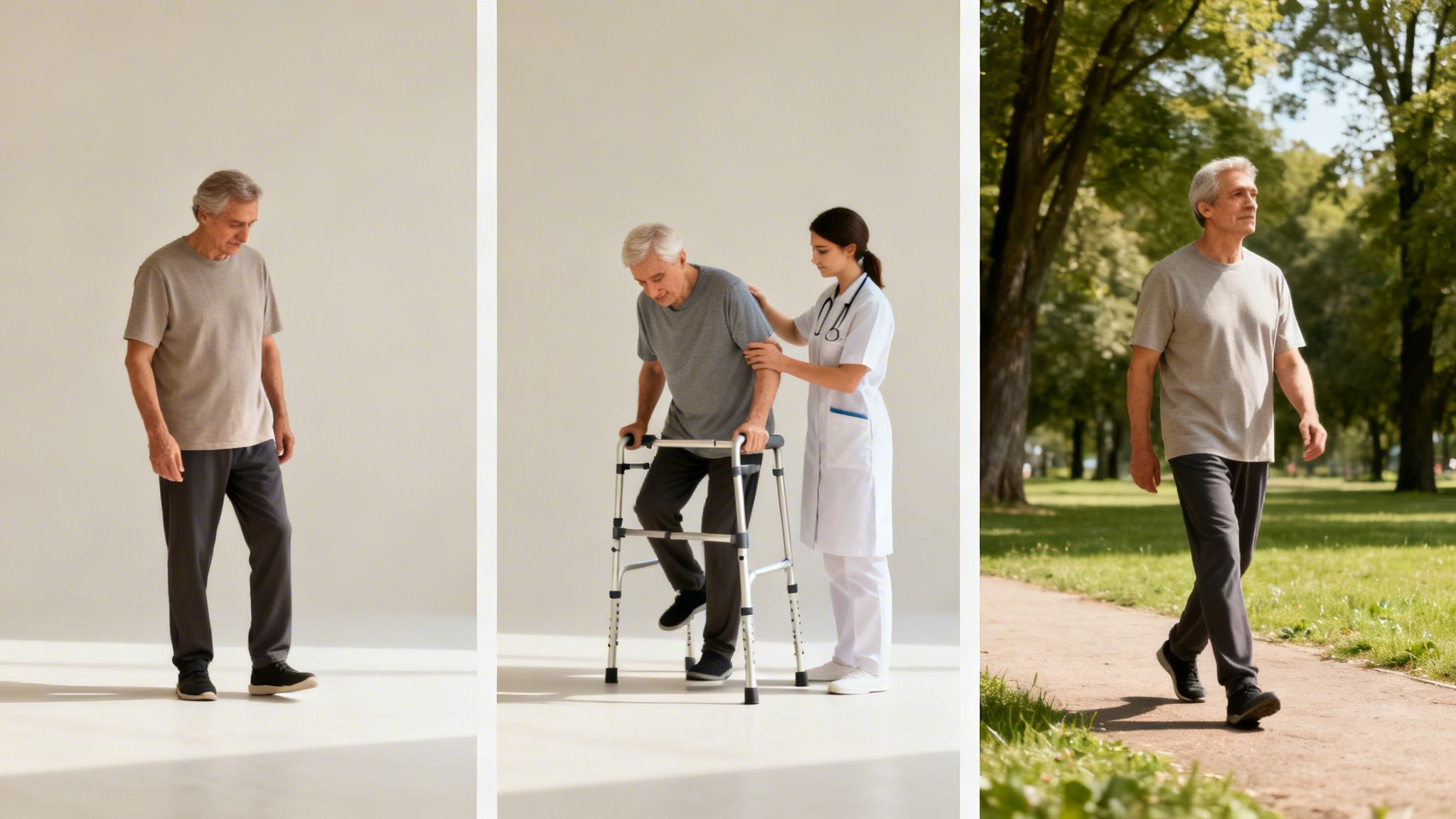
When you decide to put your time and energy into therapy, you want to know two things: Is this going to work? And how long will it take? They're the most important questions, and we believe in giving you clear, honest answers.
The great news is that vestibular rehabilitation isn't a "wait and see" approach. It's a highly effective treatment backed by a mountain of clinical research, delivering real, measurable results for the vast majority of people.
We aren't just talking about small improvements, either. The data shows that between 33% and 86% of patients with peripheral vestibular issues see clinically meaningful gains in their balance, gaze stability, and overall sense of dizziness.
Setting Realistic Timelines for Recovery
Your recovery timeline depends almost entirely on your diagnosis. The path to feeling better isn't the same for everyone, and a good physical therapist will set clear expectations from day one.
Some conditions respond incredibly quickly. For Benign Paroxysmal Positional Vertigo (BPPV), the most common cause of vertigo, the results are often dramatic and fast.
Thanks to canalith repositioning maneuvers, the success rate for BPPV is remarkably high. Research points to an 89% success rate for resolving vertigo with a single repositioning treatment. Most patients walk out feeling significantly better than when they walked in.
For other, more chronic or complex vestibular conditions, the journey requires more patience and consistency.
Your Commitment to the Process
If your diagnosis is something other than BPPV—like vestibular neuritis or concussion-related dizziness—recovery is a process of retraining your brain. This takes consistent effort over several weeks, not just a single session.
Here’s a general idea of what that looks like:
- Initial Phase (Weeks 1-2): You’ll likely see your therapist 1-2 times per week. The focus here is on mastering your home exercise program and making sure you’re doing every movement correctly and safely.
- Adaptation Phase (Weeks 3-6): As your brain starts to adapt, your sessions might become less frequent. Your therapist will progress your exercises to keep challenging your balance system, ensuring you continue to improve.
- Independence Phase (Weeks 6-8+): By this point, most patients have seen significant improvement. The goal is to build your confidence and give you the tools you need to manage any lingering symptoms and prevent future issues.
Your hard work truly pays off here. The exercises might feel a little strange at first, but each repetition is a step toward building a more resilient balance system. For older adults especially, this focused work is crucial for maintaining independence, which is why we often incorporate principles from our guide on the best balance exercises for the elderly.
Ultimately, our goal is to empower you. We'll work with you to set realistic milestones, celebrate your progress, and give you the confidence to get back to moving through life on solid ground.
Answering Your Questions About Vestibular Therapy
We've covered a lot of ground, but you probably still have some questions floating around. That’s completely normal. Let's get straight to the most common ones we hear from patients who are right where you are now.
Will The Exercises Make My Dizziness Worse?
This is a great question, and the honest answer is: sometimes, yes, a little bit at first. Some of the habituation and gaze stability exercises we use are designed to intentionally bring on your symptoms in a mild, controlled way.
Think of it like this: to get your brain to adapt, we have to show it the exact signal it’s misinterpreting. By repeating these specific movements in a safe, one-on-one setting, we're teaching your brain that the signal isn't a threat. Over time, it learns to tune out the dizziness. We'll be right there with you, making sure any symptoms are temporary and stay at a manageable level.
How Is VRT Different From Regular Physical Therapy?
While all physical therapy works to restore function, vestibular rehabilitation is a highly specialized field. It requires dedicated post-graduate training to really understand the intricate connections between your inner ear, your eyes, and your brain.
A typical PT session might focus on strengthening a muscle after a sprain or improving joint mobility. By contrast, a PT specializing in what is vestibular rehabilitation therapy uses a completely different toolkit, including:
- Specific Diagnostic Tests: We use maneuvers like the Dix-Hallpike test to pinpoint the exact cause of your vertigo.
- Gaze Stabilization Drills: These are exercises that retrain the vestibulo-ocular reflex (VOR) so you can keep your vision clear when you move your head.
- Habituation Exercises: We create custom movements designed to desensitize your brain to your specific dizziness triggers.
It’s this specialized approach that allows us to treat the root cause of balance disorders—not just the symptoms that show up downstream.
What If VRT Isn't The Right Solution For Me?
Your well-being is our top priority. If you aren't making the progress we expect, we don't just keep you coming back for more of the same. We see ourselves as part of your broader healthcare team.
Our commitment is to find the right path for you. If your progress stalls, we'll collaborate directly with your physician or help connect you with the appropriate specialist, like a neurologist or ENT, to ensure you get the best possible care. You're never on this journey alone.
Managing your overall health can also play a huge role in your recovery. For tips on getting more restful nights, you can learn more about how to improve sleep quality naturally.
Ready to stop spinning and start living with confidence? At Joint Ventures Physical Therapy, we offer expert, one-on-one care to get to the root of your dizziness and build a plan that works for you. Schedule your evaluation with us today.