
If you’ve ever felt the world suddenly tilt and spin around you, you know how unsettling—and frankly, scary—it can be. One minute you’re fine, the next you’re grabbing onto something stable, waiting for the spinning to stop.
When folks come to us after searching for an "Epley maneuver near me," this is the exact experience they describe. We want you to know two things right off the bat: you're not alone, and for many, there's a surprisingly simple mechanical fix for this very mechanical problem. Effective, rapid relief is available from experts who deal with this every single day. We've got your back.
Understanding That Sudden Dizzy Spell
That intense, room-spinning sensation is the hallmark of true vertigo, and its most common cause is Benign Paroxysmal Positional Vertigo (BPPV). It sounds complicated, but we promise, the reason behind it is surprisingly straightforward.
Inside your inner ear, you have tiny calcium crystals known as otoconia, or "ear rocks." Their job is to help your brain understand where your head is in relation to gravity. BPPV happens when some of these crystals get knocked out of place and drift into one of the inner ear's fluid-filled semicircular canals—a part of your balance system where they simply don't belong.
What Triggers BPPV Vertigo
Now, every time you move your head in a certain way—like rolling over in bed, tilting your head back to look up, or bending over to tie your shoes—those loose crystals get swished around in the canal fluid.
This movement sends a barrage of false, chaotic signals to your brain, creating a powerful but brief illusion of motion. It feels like the world is spinning, but it’s really just a signaling problem. BPPV accounts for up to 30% of all dizziness complaints that specialists see, which means our team is incredibly familiar with diagnosing and treating it. You can learn more about our approach in our detailed guide on how to treat vertigo.
But how do you know if you have BPPV versus just feeling a bit woozy or off-balance? The symptoms are actually quite distinct, and knowing the difference is the first step toward getting the right help.
BPPV vertigo feels like the room is spinning around you, while general dizziness is more of a lightheaded or unsteady feeling. The key difference is that false sensation of motion.
It’s a crucial distinction, so let's break down the key differences to help you figure out what you might be experiencing.
BPPV Vertigo vs General Dizziness
This table clarifies the key differences between the specific symptoms of BPPV and more general feelings of dizziness to help you identify the cause.
| Symptom | BPPV Vertigo | General Dizziness |
|---|---|---|
| Sensation | A distinct feeling of spinning or rotational movement. | A feeling of being lightheaded, woozy, or off-balance. |
| Triggers | Caused by specific head movements (e.g., rolling in bed, looking up). | Can be constant or come on without a specific trigger. |
| Duration | Episodes are intense but short, typically lasting under 60 seconds. | Can last for minutes, hours, or even be a persistent feeling. |
| Associated Signs | Often accompanied by involuntary eye movements (nystagmus). | Usually not associated with specific eye movements. |
If the "BPPV Vertigo" column sounds a lot like what you've been going through, don't worry. It confirms you're likely dealing with a very treatable condition, and a proven solution is right around the corner.
How the Epley Maneuver Resets Your Inner Ear
We know what causes the problem: those tiny “ear rocks,” or crystals, have drifted into the wrong part of your inner ear. The good news is that because this is a physical problem, it has a physical solution.
The Epley maneuver is a non-invasive treatment that uses a specific series of movements to fix this mechanical issue. It’s not a drug and it’s not a surgery. A trained physical therapist will carefully guide your head and body through four distinct positions. The entire goal is to use gravity to our advantage.
We’re essentially rolling those loose crystals out of the sensitive canal where they’re causing all that trouble. We guide them back to a part of the ear called the utricle, where they belong and can be safely reabsorbed by your body.
Think of it like a guided reset for your body's internal balance system. It's a precise, hands-on technique that tells your brain the spinning is over.
This simple flowchart shows how loose crystals in the inner ear lead to that disruptive vertigo sensation.
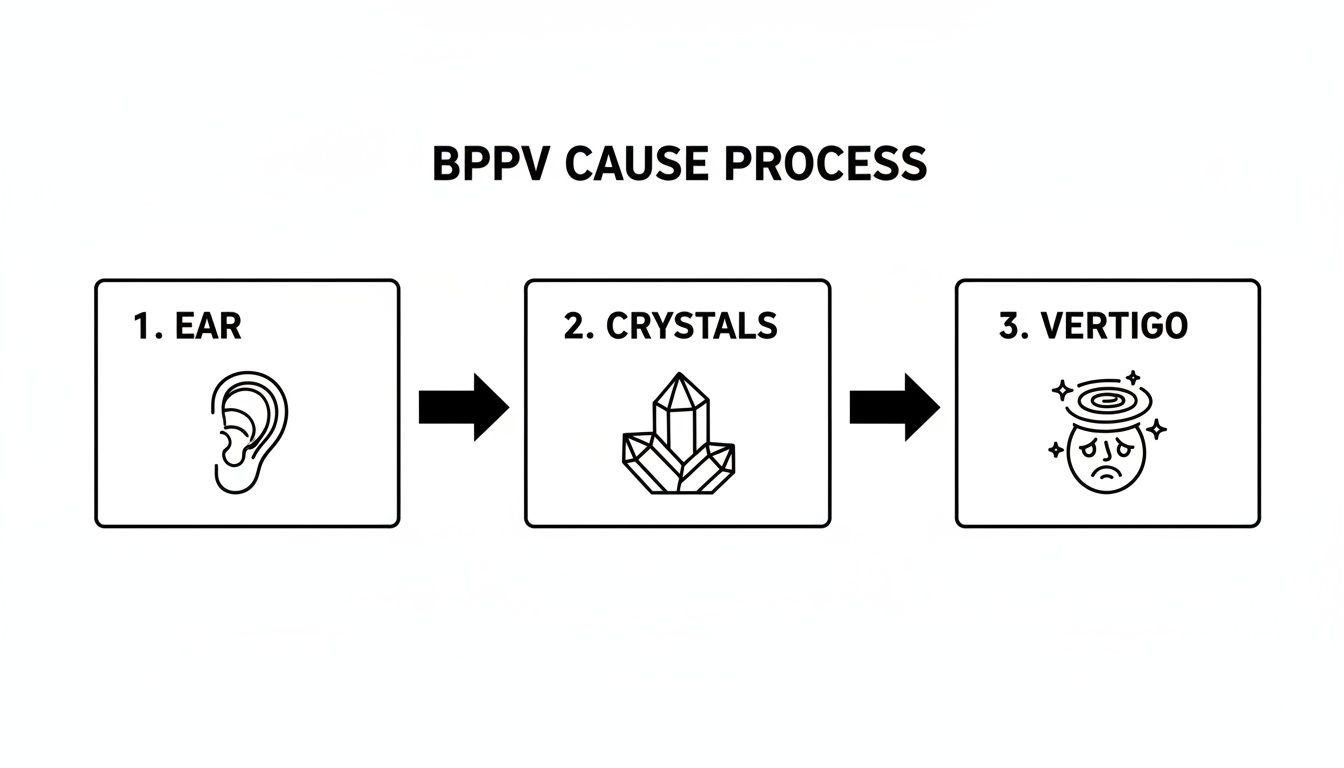
As you can see, the problem starts with a mechanical issue in the ear, and the Epley maneuver provides the mechanical fix.
A Proven Method for Rapid Relief
This isn't some new-age trend; it's an evidence-based procedure our vestibular specialists perform every single day. The Epley maneuver was introduced by Dr. John Epley in 1992 and quickly became the gold standard for treating the most common form of BPPV. It’s a method with decades of proof behind it, helping people just like you get their lives back from vertigo.
The success rates are nothing short of remarkable. In fact, one comprehensive study demonstrated a 92.5% cure rate within the first week of treatment alone. With our expert guidance, finding an "Epley maneuver near me" means you’re on the fast track to feeling steady again. To understand the data further, you can read the full research on its effectiveness.
Why a Professional Diagnosis Matters Most

You’ve probably seen the videos online. A quick search for the Epley maneuver pulls up countless tutorials showing you how to do it yourself. While we understand the temptation to try a quick fix at home, getting professional help is always the safest and most reliable path to lasting relief.
When you’re searching for an “Epley maneuver near me,” you aren’t just looking for a set of instructions. You’re looking for an expert who can get you results, safely and effectively.
The most critical piece of the puzzle is getting an accurate diagnosis. A physical therapist doesn't just guess it's BPPV; we confirm it. More importantly, we figure out which ear is affected and which specific semicircular canal is causing the problem. Your inner ear has three of these canals, and performing the maneuver for the wrong one simply won’t work. In fact, it can often make you feel much worse.
The Risks of a DIY Approach
Trying to treat BPPV yourself without a proper diagnosis is like trying to unlock a door with the wrong key. You can jiggle it around all you want, but the door isn't going to open. You might even break the key in the lock.
Here are some of the biggest risks of going it alone:
- Incomplete Repositioning: You might move the crystals part of the way, but not get them fully out of the canal. This leads to lingering symptoms or a frustratingly quick return of your vertigo.
- Making Symptoms Worse: If you perform the maneuver on the wrong side or for the wrong canal, you can actually shift the crystals into a more problematic spot, making the vertigo even more intense.
- Misdiagnosing a More Serious Condition: Not all dizziness is BPPV. Vertigo can be a symptom of other issues that need very different medical attention. A professional evaluation rules these out first, which is a crucial safety step we never skip.
Our clinicians are highly trained in diagnostic tests like the Dix-Hallpike maneuver. This lets us pinpoint the exact source of your vertigo with precision. That professional assessment is the foundation for any effective treatment.
A correct diagnosis is not just the first step—it's the most important one. Treating the wrong problem, or the right problem incorrectly, is a recipe for frustration and prolonged discomfort.
Adapting the Treatment to You
A "one-size-fits-all" video can't possibly account for your individual needs. Many people have other issues to consider, like neck stiffness, arthritis, or a previous injury that makes the standard Epley positions unsafe or just plain painful.
We are experts in modifying the treatment to fit your body, ensuring it's both safe and effective. Our deep understanding of vestibular physical therapy allows us to tailor every single movement.
For patients to find a qualified clinic, search visibility is key. To ensure patients can easily find your practice when they search for specialized treatments, understanding how specialized SEO strategies for medical practices drive growth is crucial. For lasting relief from vertigo, your best bet is to trust an expert who does this every single day.
What to Expect at Your Vertigo Treatment Appointment
We understand that when the world is spinning, the last thing you want is more uncertainty. Coming into a clinic, especially when you’re already feeling off-balance, can be daunting. So, let's walk you through exactly what happens during a vertigo assessment. Our goal is simple: to figure out what’s going on and get you feeling stable again.

The entire visit is designed to be calm, clear, and supportive. From the moment you walk in, our team is there to guide you, so you can focus on one thing—getting better.
Your Initial Conversation and Assessment
Every appointment starts with a conversation. This isn't just a formality; it's the single most important part of our diagnostic process. Your physical therapist will sit down with you and, more than anything, listen.
We need to hear your story, in your own words. We’ll ask specific questions to get a clear picture of what you're feeling:
- When did the spinning sensation first start?
- What movements seem to set it off? Getting out of bed? Looking up?
- How long do the episodes usually last? A few seconds? A few minutes?
- Can you describe the feeling? Is it true spinning, or more of a lightheadedness?
Your experience gives us the clues we need to solve the puzzle. This detailed history is often what points us directly toward or away from a BPPV diagnosis.
The Diagnostic Phase: Pinpointing the Problem
Next, we move to the physical assessment to confirm our hypothesis. If we suspect BPPV, we'll perform a simple but powerful test called the Dix-Hallpike maneuver. Don't worry, your therapist will explain every single step before you begin.
For the test, we’ll gently and safely guide you from a seated position to lying down with your head turned. This specific movement is designed to briefly provoke your vertigo if BPPV is the cause. It might feel unpleasant for a moment, but that spinning sensation is actually the "green light" we're looking for. It confirms the diagnosis and tells us which ear—and which specific canal—is the problem.
Think of the Dix-Hallpike test as our compass. It points us directly to the source of the issue, which is critical for making sure the Epley maneuver is performed correctly for maximum effect.
Performing the Epley Maneuver
Once BPPV is confirmed, we can often move right into the treatment: the Epley maneuver. Your physical therapist will be right there with you, calmly guiding you through each of the four positions. The whole thing is surprisingly quick, usually lasting just a couple of minutes.
We’ll hold you in each position for about 30 to 60 seconds. The goal is to use gravity to gently guide those loose crystals out of the canal and back into the part of the inner ear where they belong. We'll talk you through the entire sequence so you feel secure and know what's happening. Many of our patients feel an immediate sense of relief right after the maneuver is done.
Afterward, we'll give you a few simple instructions to follow for the next day or two. Things like sleeping with your head slightly propped up can make a big difference in ensuring the crystals settle in the right place and the treatment is a lasting success.
Just How Effective Is the Epley Maneuver
When you’re hit with that disorienting, world-spinning feeling of vertigo, you want one thing: a solution that works. And fast.
The Epley maneuver isn't just some hopeful technique; it's a procedure we trust because we see the results in our clinic every single day. It’s backed by decades of clinical evidence, but more importantly, it delivers real-world success for our patients.
The statistics speak for themselves. For the overwhelming majority of people with BPPV, this simple repositioning technique brings complete relief, often after just one or two expertly guided sessions. When you're searching for an "Epley maneuver near me," you're looking for that kind of reliability.
Success Rates and Real-World Results
So, how effective is it, really? A broad review of studies shows the Epley maneuver has a success rate between 68% and 90% after a single treatment. That’s an incredible number, and it’s why physical therapists consider it the gold standard for treating BPPV.
We are committed to evidence-based practice because we're committed to getting you better, faster. The data shows the Epley maneuver is one of the most direct paths to relief.
But it’s not just about stopping the spinning. It’s also about dialing down the intensity of the dizziness. One review directly compared the Epley to another method, the Semont maneuver. While both worked, the Epley was significantly better at decreasing the severity of the dizziness. You can see the data for yourself in this study on BPPV treatments.
Why It's Our Go-To Treatment
At Joint Ventures, we believe in using what’s proven to be most effective, and the Epley maneuver’s track record is undeniable. It’s a non-invasive, drug-free solution that gets right to the heart of the matter.
This isn't about just managing symptoms—it's about fixing the mechanical problem. We use a precise sequence of head and body movements to guide those tiny "ear rocks" back where they belong, resolving the very thing causing your vertigo.
For our patients, that means a quick return to feeling steady, confident, and back in control of their lives.
Your Questions About BPPV Treatment Answered
We get it. Dealing with vertigo is unsettling, and it’s natural to have a lot of questions. You want clear, straightforward answers from people who see this every day. Here are some of the most common questions we hear from patients just like you, along with our honest, practical responses.
How Long Does the Maneuver Take and Is It Painful?
This is often the first thing people ask, and thankfully, the answer is reassuring. The Epley maneuver itself is incredibly quick—usually taking just 2 to 5 minutes from start to finish.
Now, as for pain: the procedure isn't painful. But, and this is important, it is designed to briefly trigger your vertigo symptoms. That momentary spinning feeling is actually how we know the treatment is working. It tells us the crystals are on the move. Your physical therapist is right there with you the entire time, guiding you and making sure you feel secure. The sensation passes quickly once you’re upright again.
What if It Doesn’t Work on the First Try?
While the Epley maneuver is highly effective, it doesn't always resolve things 100% on the first go. Sometimes a few stubborn crystals get left behind, or the brain simply needs a little more time to adjust to the new normal.
If you still have symptoms after your first visit, don't get discouraged. This happens to a small number of people and is completely normal. Your therapist will reassess you at your next visit and can safely repeat the maneuver. We’ll stick with you until the problem is fully resolved.
Don't worry if you're not at 100% after the first visit. BPPV has a recurrence rate of about 15% within one year, but the great news is the treatment is just as effective the next time. We're here to see you through it.
Can I Drive Myself Home After the Appointment?
Your safety is our absolute top priority. Because the treatment can leave you feeling a little "off" or unsteady for a few hours while your brain recalibrates, we strongly recommend having someone drive you home after your first Epley maneuver appointment.
Even if you feel a huge wave of relief right away, it’s best to play it safe. Plan for a ride, and give your body the time it needs to settle into feeling stable again.
How Do I Know if This Treatment Is Right for Me?
The Epley maneuver is a specific tool for a very specific problem: BPPV. The only way to know for sure if this treatment is right for you is to get a professional evaluation from one of our vestibular physical therapists.
A thorough assessment is non-negotiable. If your dizziness is constant rather than in brief spells, or if you have other neurological symptoms like a severe headache, weakness, or trouble speaking, you need to see your doctor right away. Our therapists are experts in diagnosing different types of dizziness and will only recommend the Epley maneuver if they are confident it's the correct and safest treatment for your specific situation. This diagnostic step is also critical because certain neck conditions might require us to modify the maneuver. If you're looking for more ways to support your recovery, you might find our guide on neck exercises for vertigo helpful. We’ll make sure your treatment plan is built just for you.
At Joint Ventures Physical Therapy, we’re here to help you get steady and feel like yourself again. If you're tired of the spinning, book an appointment with one of our vestibular specialists today. Find out more at https://jointventurespt.com.