
Boston rewards active people. You might be logging miles along the Charles for a spring race, rushing from a desk in Back Bay to a strength class, rowing with your college team before sunrise, or trying to get your knee calm enough to climb the T stairs without thinking about it. Then pain shows up, training gets inconsistent, and the question becomes simple: how do you get back without guessing?
That's where sports rehab fits. Not as a generic set of stretches. Not as “rest until it feels better.” In a city like Boston, rehab needs to match real goals. Marathon runners want to run well again. Court and field athletes want to cut, jump, and trust their body. Busy professionals want treatment that respects both performance and schedule.
If you're sorting through options for care, this guide will help you understand what good sports rehab in Boston should look like, what to expect from the process, and how to choose a clinic that can move you toward full return instead of partial recovery.
Get Back to Your Active Boston Life
A familiar Boston story starts with a small warning sign. A runner feels calf tightness on a route through the Esplanade but keeps training. A weekend hockey player tweaks a shoulder and assumes it will settle down. A college rower notices hip pain during harder sessions and starts changing technique to work around it. For a while, life keeps moving.
Then the compensation catches up.
The stride shortens. Sleep gets worse because the shoulder aches. Squats feel uneven. The injury stops being something you manage and starts shaping your day. That's usually when people start searching for answers, and it's why sports rehab in Boston matters so much for this city's active population.
When rest stops working
Most athletes and active adults don't need more vague advice. They need a plan that connects symptoms to movement, training demands, and a real return goal.
Sports rehab works best when it answers practical questions like these:
- What's driving the pain: Is the problem force tolerance, mobility, movement strategy, or training load?
- What can you keep doing safely: Stopping everything rarely helps if a better modification can keep you moving.
- How do you build back up: Returning to sport takes progression, not hope.
For a local overview of how therapy and rehab support that process, Joint Ventures has a useful article on sports therapy and rehab in Boston.
The right rehab plan should make your next step obvious. You shouldn't leave the first visit wondering whether to rest, push through, or just wait.
Why local care makes a difference
Boston patients often aren't trying to “be active someday.” They're trying to get back to a race calendar, a season, a league, a lifting program, or a commute that already demands a lot from their body.
That local reality changes the standard. Good sports rehab in Boston should feel connected to how people here move, train, and live. It should help you return with confidence, not just reduce pain enough to get by.
What Sports Rehab Means in Boston
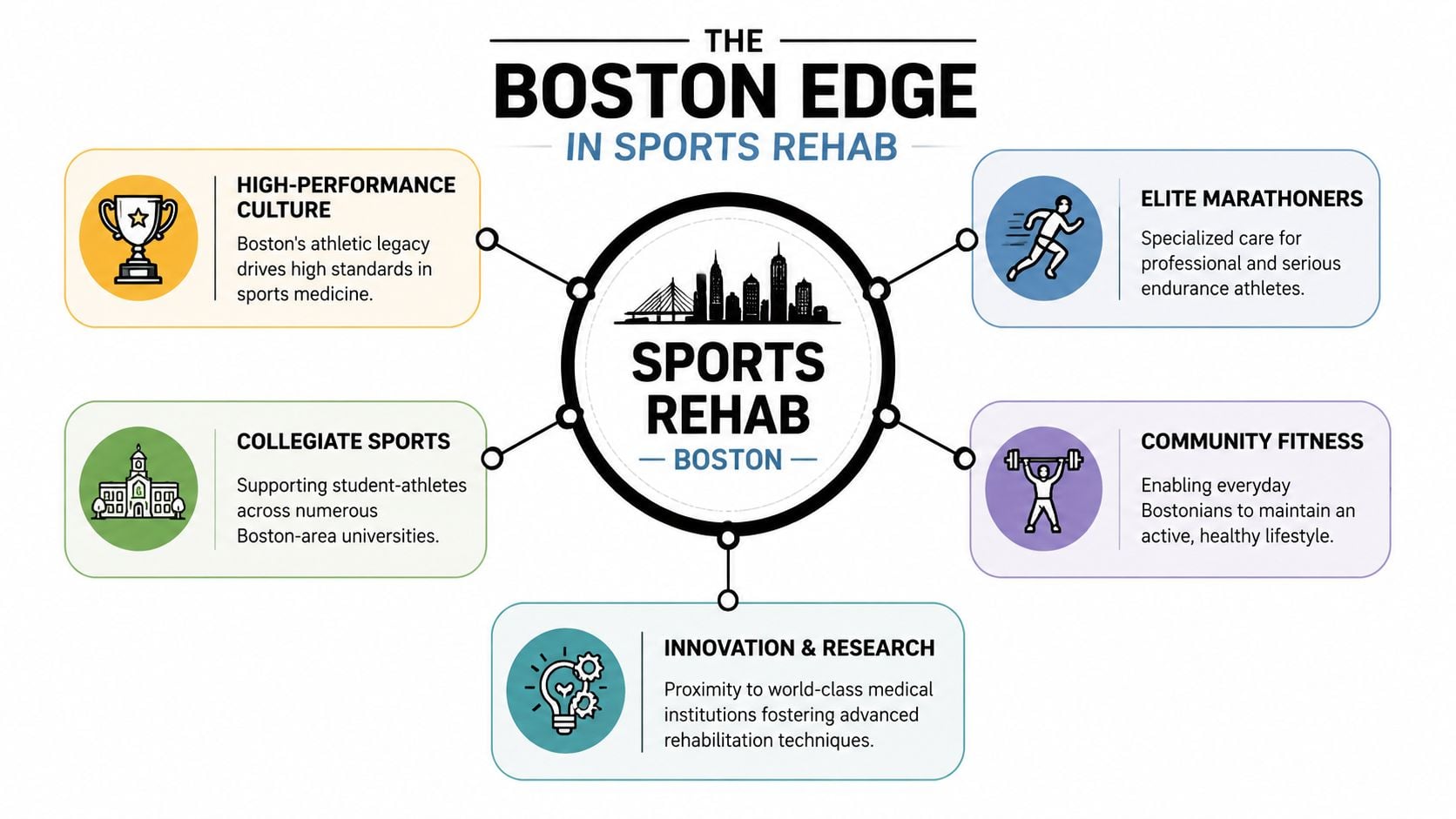
In Boston, sports rehab usually starts with a clear performance question. Can a Marathon runner build mileage without the shin pain returning? Can a college rower on the Charles pull hard again without rib or low back symptoms? Can a recreational tennis player in Back Bay serve, sprint, and recover the next day?
Boston's medical system has treated athletic injury as a specialty for years. Mass General's Sports Physical Therapy Service outlines a dedicated sports physical therapy model tied to orthopedic and sports medicine care. For patients, that history matters because it raised expectations. Local runners, rowers, lifters, court sport athletes, and active professionals usually want more than a sheet of exercises. They want a plan built around the way they train and the level they need to return to.
More than general physical therapy
General orthopedic PT can work very well for many injuries. Sports rehab asks a more specific set of questions. What does your sport demand from your body? Which movements or loads are breaking down right now? What has to improve before practice, lifting, racing, or weekend competition makes sense again?
That often includes:
- Biomechanics: how you absorb force, rotate, land, push off, cut, and decelerate
- Sport-specific goals: returning to running, rowing, lifting, golf, court movement, or field play
- Progression strategy: deciding when to restore motion, when to build strength and tendon capacity, and when to test higher-speed or higher-impact work
For runners, that process may include a running performance evaluation in Boston to look closely at stride mechanics, loading patterns, and capacity before mileage climbs again.
Why Boston patients often need a higher standard
Many Boston patients come in with a deadline or a demanding routine. A spring head race. A fall college season. A lifting cycle. A return to long runs through the Fens or hill repeats near Summit Ave. In those cases, pain reduction is only one part of the job.
Good sports rehab has to measure whether the body can handle the next step.
| Standard PT mindset | Sports rehab mindset |
|---|---|
| Reduce symptoms | Restore capacity for sport |
| Treat the painful area | Evaluate the movement system around it |
| Progress by time alone | Progress by function and response |
| Stop when daily life improves | Continue until sport demands are covered |
Those differences affect outcomes. If rehab never gets specific about force tolerance, movement quality, and return-to-sport criteria, patients often feel fine in the clinic but struggle when they get back to hard training. That gap is exactly why strong sports rehab in Boston should include objective testing, clear progression rules, and true 1-on-1 clinical attention.
Your Sports Rehab Journey From Evaluation to Recovery
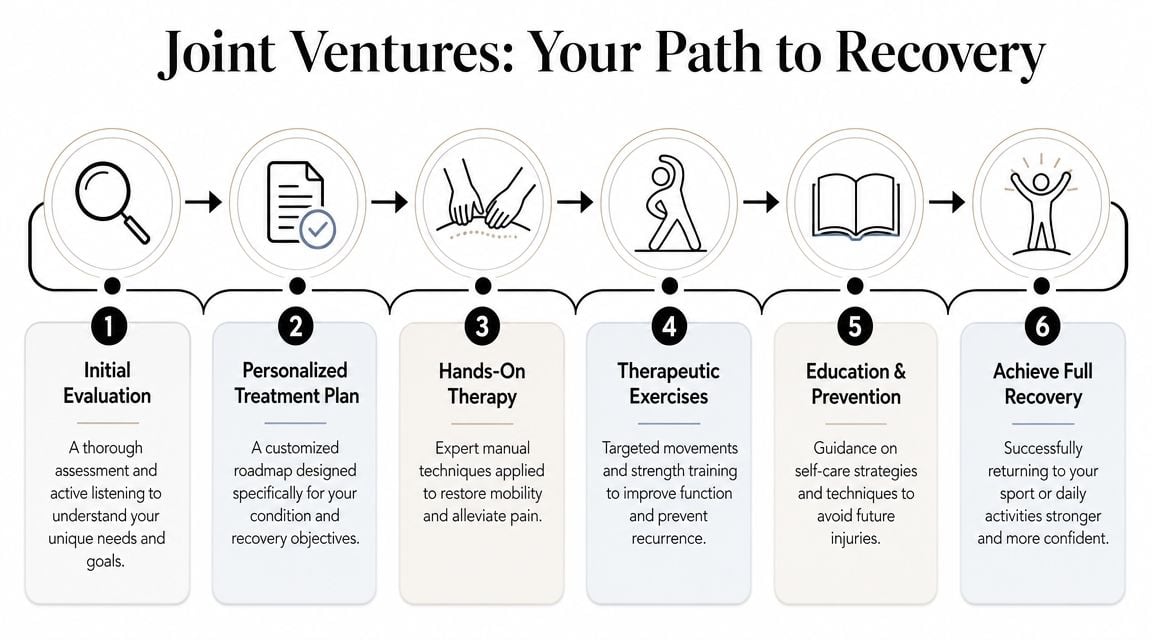
The first visit should not feel rushed. A solid sports rehab evaluation starts with your story, because training history, symptom behavior, sport demands, and previous injuries change the plan. A Boston Marathon runner with shin pain needs a different conversation than a college basketball player after ankle surgery or a Seaport professional trying to return to recreational tennis.
Early in care, objective testing matters. Spaulding notes in its sports injury rehab guidance that biomechanical assessment should quantify alignment, joint function, strength, range of motion, and flexibility before loading progression. Those measurements help clinicians individualize rehab and reduce re-injury risk.
A visual overview helps many patients understand the progression.
What happens in a strong first phase
The early part of rehab should answer three things quickly:
- What's limiting you now
- What your short-term training rules are
- What the path back looks like
That process usually includes some mix of hands-on treatment, exercise selection, movement retraining, and load management. Good care also explains why each piece is in the plan. If you're dealing with a running injury, a more focused running performance evaluation in Boston can help connect symptoms to stride mechanics and training demands.
A short video can make the rehab path feel more concrete.
What good progression looks like
Rehab should change as your body changes. Early sessions may focus on calming symptoms and restoring movement. Later sessions should challenge strength, speed, coordination, and sport-specific control.
Watch for this pattern:
- Pain settles, but performance doesn't return: The plan may be too general.
- Exercises never progress: You may be underloaded.
- You're being pushed too fast: Your testing and symptom response may not be guiding the plan.
A strong rehab process stays personal. One-on-one care makes that easier because the therapist can adjust in real time instead of moving patients through a preset template. That's especially important for runners, rowers, and field athletes whose symptoms change with volume, intensity, and technique.
Go Beyond Recovery With Performance Services
Pain going down is not the same as being ready. That's one of the biggest mistakes in sports rehab Boston patients run into. They feel better, resume training, and then hit the same wall because the rehab process never restored the capacities their sport requires.
That gap shows up most clearly around return to sport. Spaulding's Boston outpatient sports rehab page emphasizes gait retraining, safe progression back to activity, and individualized plans. That aligns with what performance-minded patients ask every day: not whether they feel okay on a random Tuesday, but whether they're ready to run, cut, jump, accelerate, and compete again.
Why performance should be part of rehab
The best rehab plan doesn't end when you can get through daily life. It ends when your body can tolerate the movements, loads, and repeat efforts your sport demands.
That's where performance services help. They can identify mechanics and training issues that plain symptom treatment misses.
Examples include:
- Running performance evaluations: useful for recurrent running injuries, pacing-related breakdowns, and return-to-run planning
- Golf assessments such as Titleist-based movement screens: helpful when mobility limits swing mechanics or symptoms keep returning
- Concussion baseline screening and progression support: relevant for athletes who need clearer return decisions
- Wellness and tune-up visits: useful when you're not injured but know something feels off
For athletes who also want to support training with better nutrition habits, this guide to simplifying calorie tracking for runners is a practical outside resource. It's especially relevant when recovery stalls because workload and fueling aren't aligned.
What objective return looks like
You want criteria, not vibes.
A strong performance-minded plan should include some combination of movement observation, strength testing, flexibility review, impact tolerance, gait or sport-mechanics review, and staged progression back into training. That's the philosophy behind sport performance physical therapy in Boston, where the goal is not only symptom reduction but higher-quality movement under real demand.
Athletes usually know when they're being underprepared. If rehab never challenges the skills that matter in your sport, confidence stays low even when pain improves.
Find Specialized Treatment for Complex Conditions
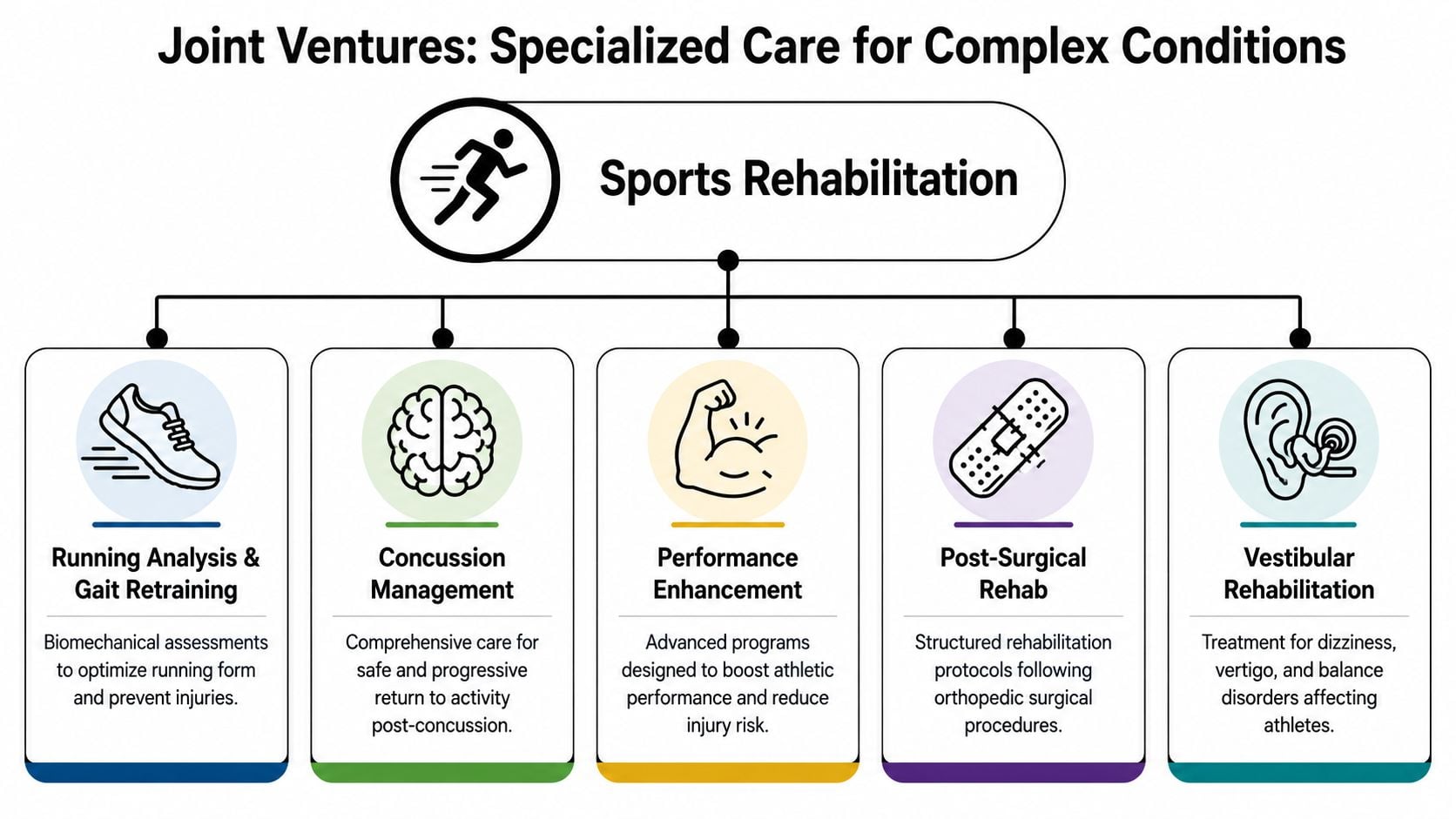
Some cases don't fit neatly into “sprain, strengthen, return.” Boston patients often come in with layered problems. A runner has hip pain and pelvic floor symptoms after returning postpartum. A desk worker develops jaw pain, neck tension, and headaches that get worse during training. A field athlete feels recovered after surgery but can't tolerate impact.
That's where specialty services matter. Not because every patient needs every tool, but because complex problems often need more than a standard template.
When lower-impact loading changes the timeline
Aquatic therapy can be especially useful when land-based loading is still too irritating. Boston Sports Medicine describes aquatic therapy as a way to reduce joint loading through buoyancy while still allowing resistance-based exercise, which can help restore movement and conditioning earlier with less symptom provocation than land-based training.
That makes it a practical option for several Boston-area patients:
- The runner with acute orthopedic pain: pool work can maintain movement and conditioning while impact tolerance rebuilds
- The post-surgical athlete: earlier controlled exercise may be possible before full land progression
- The patient with chronic pain or mobility limits: water can make normal movement feel possible again
Other specialty tools that can matter
Not every athlete needs advanced services, but the right one at the right time can change the pace of progress.
A few examples seen often in practice:
| Situation | Specialty service that may help | Why it matters |
|---|---|---|
| Neck and upper-quarter tension affecting training | Trigger point dry needling | Can reduce guarding and improve tolerance for movement when paired with exercise |
| Postpartum return to lifting or running | Pelvic floor PT | Helps connect core, pressure management, and impact readiness |
| Dizziness, motion sensitivity, or balance issues | Vestibular rehab | Supports safer movement and return to exercise when symptoms affect head turns or visual environments |
| Hand, wrist, or elbow symptoms limiting sport or work | Hand and upper-extremity rehab or OT | Useful when grip, fine control, or repetitive strain is part of the problem |
| Jaw pain with clenching, posture issues, or headaches | TMJ-focused care | Important when symptoms are driven by more than the jaw joint alone |
Some patients don't need a harder program. They need a more specific one.
This is also where one-on-one treatment has value. Complex symptoms often involve details that get missed in busy clinics. The movement pattern that only shows up during fatigue. The rowing stroke that shifts under load. The postpartum symptoms that appear only on downhill running. Precision matters.
How to Choose the Right Sports Rehab in Boston
You finish a run along the Charles, or step out of a rowing session on the river, and realize the pain is no longer a one-off problem. At that point, the right clinic is not just the one with an open appointment. It is the one that can tell you why the issue started, what needs to change, and how they will measure whether you are ready to get back to sport.
Boston has plenty of rehab options. The difference is in the process. A good sports rehab clinic should do more than reduce pain for a few weeks. It should evaluate how you move, connect that to your sport, and build a plan with clear progression points. For a Marathon runner, that may mean load tolerance, cadence, and single-leg control. For a college rower, it may mean hip drive, trunk timing, and symptom response under repeated effort.
A practical checklist
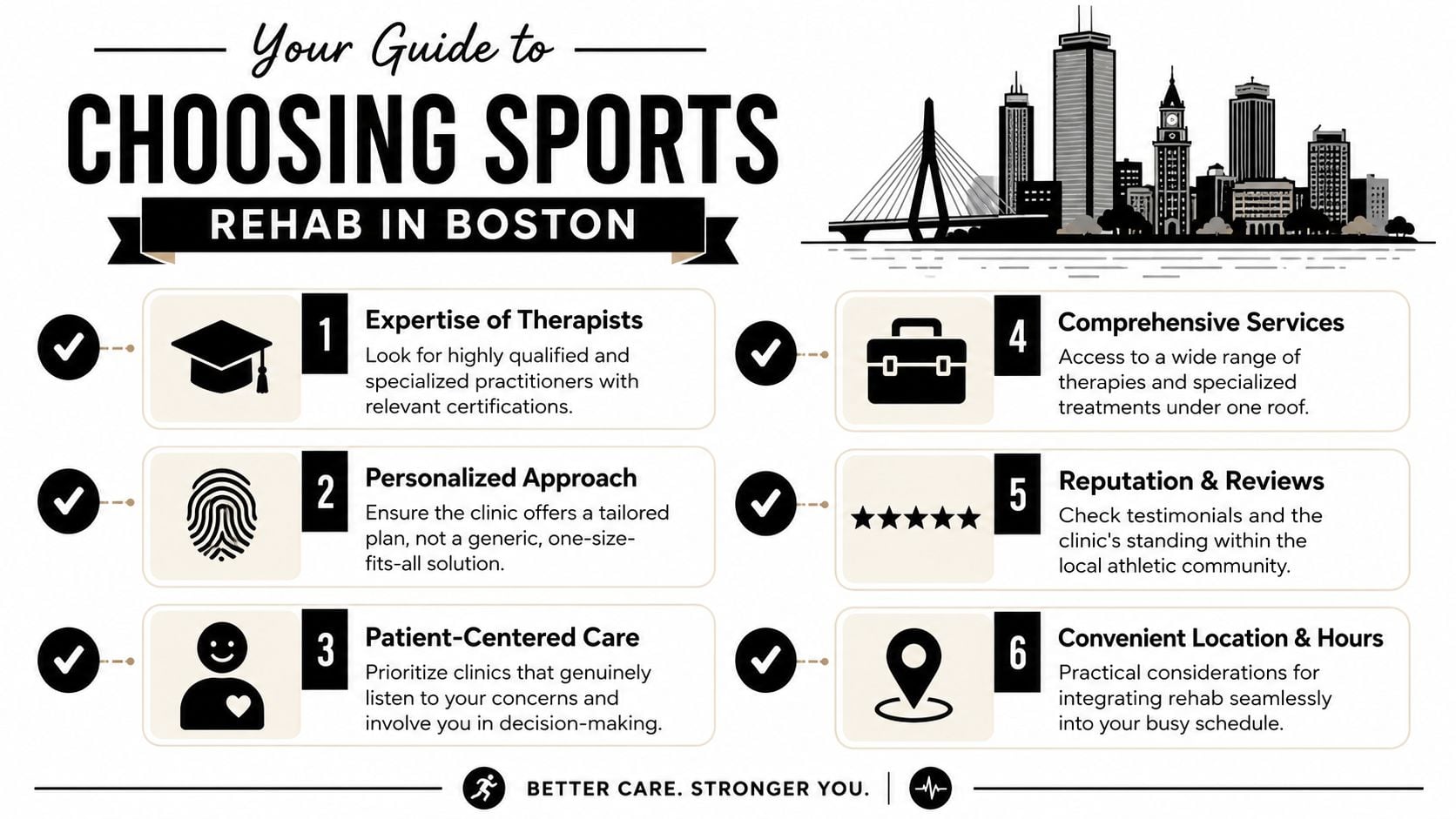
Use these questions when comparing clinics.
- Will you get true 1-on-1 care? Ask who is with you for the full visit. In busy settings, patients are sometimes handed off between providers or support staff. That can work for straightforward cases, but sport-specific rehab usually benefits from one clinician tracking details from session to session.
- Does the evaluation match your sport? A useful exam looks at the movements and training demands that matter to you. Runners, lifters, field athletes, and rowers do not need the same testing.
- How do they progress rehab? Ask what criteria they use to clear running, jumping, cutting, lifting, or full practice. Good clinics use objective markers, not guesswork or a calendar date alone.
- Can they handle more complex cases? Some athletes need pelvic floor PT, vestibular rehab, TMJ treatment, dry needling, hand therapy, or running analysis as part of the plan. If your symptoms cross more than one system, that range matters.
- Is the location realistic for your week? Consistency drives results. A clinic near your office, campus, home, or training route is often the clinic you will attend.
- Does the admin side run well? Scheduling, benefit checks, and authorizations should be clear. If getting started feels confusing, care often gets delayed.
Convenience matters in Boston more than patients expect. Between commute times, weather, class schedules, and training blocks, a plan that looks good on paper can fall apart fast if the clinic is hard to reach. I have seen patients do better with a very good clinic they can attend twice a week than with a slightly better-fit clinic they keep canceling on the way from Back Bay to Cambridge.
A provider such as Joint Ventures Physical Therapy may appeal to patients who want access across neighborhoods including Back Bay, Kenmore Square, Fort Point and the Seaport, Downtown Boston, Brookline and Allston, and nearby communities. The point is not the brand name. The point is whether the setup supports follow-through.
Choose the clinic that can explain its reasoning, test progress objectively, and give you enough direct clinician time to adjust the plan as you improve. That is usually what gets athletes back with fewer setbacks.
Your Next Steps to Booking an Appointment
Once you know you need help, the hardest part often isn't the rehab itself. It's getting started. People delay care because they're unsure about insurance, referrals, scheduling, or what kind of provider they need.
Keep the first step simple.
What to do first
Start with your main limitation, not your diagnosis. Are you trying to return to running, recover after surgery, manage recurring pain during training, or figure out whether a specialty service like pelvic floor PT or vestibular rehab fits your symptoms? That answer usually points you toward the right appointment type.
Then gather a few basics before you book:
- Your main goal: return to a race, sport, gym routine, or pain-free daily movement
- Your symptom timeline: when it started, what aggravates it, and what you've already tried
- Any imaging or referral you already have: useful if available, but not always required
- Scheduling realities: early morning, lunch-hour, or evening needs
What good front-desk support should handle
A strong administrative team removes friction before your first visit. That includes helping verify benefits, explaining what to bring, and flagging whether any authorization steps might apply under your plan.
Patients often underestimate how much this matters. If booking feels confusing, delays pile up. If the process is clear, care starts sooner and momentum is easier to keep.
Booking rule: Choose the clinic that makes starting care easier, not the one that makes you decode the process yourself.
What to expect after you book
You should receive clear instructions about timing, forms, clothing, and any documents that would be useful to bring. From there, the first visit should move quickly into goal-setting and examination so you leave with an actual plan.
For Boston patients, the practical question is usually location plus schedule. If you work downtown, live near Back Bay, train around Kenmore, or need easier access near Fort Point or the Seaport, it helps to book where consistency will be easiest. Rehab works when it's specific, but it also works when you can get there.
Frequently Asked Questions About Sports Rehab
Boston patients usually ask the same few questions at the start, whether they are training for the Marathon, rowing on the Charles, or trying to get back to lifting after work without pain flaring up again.
Do I need a doctor's referral to start physical therapy in Massachusetts
Often, no. Massachusetts allows direct access in many cases, so you may be able to start with a physical therapist without waiting for a physician referral.
Insurance rules can still affect billing, so confirm your benefits before the first visit. A good clinic should help you sort that out quickly.
What should I wear to my appointment
Wear something that makes the involved area easy to examine and move. Shorts work well for hip, knee, ankle, and hamstring issues. A tank top or loose T-shirt helps for shoulder, neck, and upper back problems.
If you are coming from work in Back Bay, Downtown Boston, or the Seaport, bringing gym clothes is often the simplest option.
How long is a sports rehab visit
Visit length varies by clinic and by phase of care. Early visits often need more time for testing, hands-on treatment, and building a plan. Later sessions may focus more on exercise progressions, load management, and return-to-sport work.
The better question is how that time is used. Patients do better when they have direct, uninterrupted time with the clinician who is examining movement, adjusting the program, and answering questions in real time.
What happens at the first visit
Expect a detailed conversation first. We want to know how the problem started, what training or activity brings it on, what your week looks like, and what you need to return to.
Then comes the physical evaluation. That should include movement testing, strength and mobility assessment, and sport-specific reasoning when it applies. A runner preparing for a fall race and a college rower heading back to erg training may both have back pain, but the demands are different, so the plan should be different too.
You should leave with a working diagnosis, a clear first set of treatment priorities, and specific markers that will be used to judge progress.
Can sports rehab help if I'm not a competitive athlete
Yes. Sports rehab is often the right fit for active adults who want more than symptom relief.
That includes recreational runners, CrossFit athletes, tennis players, weekend basketball players, and people who want to train hard without repeating the same injury cycle. The standard is not whether you play for a team. The standard is whether your rehab needs to match real physical demands.
What if I'm dealing with something more complex than a basic injury
That is common in practice. Pain may involve more than one system, or the original diagnosis may not explain why progress has stalled.
A strong sports rehab clinic should be able to screen for overlapping issues and direct care appropriately. Depending on the case, that may include pelvic floor therapy, vestibular rehab, TMJ treatment, hand therapy, occupational therapy, aquatic therapy, or post-surgical rehab. The goal is not to fit every patient into one template. The goal is to identify what is limiting performance and recovery.
How do I know if a clinic is the right fit
Ask direct questions and listen for direct answers. Will you work one-on-one with a clinician? How is progress measured? Do they use objective return-to-sport testing when appropriate? Can they adjust the plan if your case turns out to be more involved than it looked on day one?
In Boston, logistics matter too. A clinic near Kenmore, Fort Point, Brookline, or your work commute only helps if the care itself is specific, consistent, and built around your goals.
Where can I learn more about the clinical side of my injury
Educational resources can help you understand common injuries and recovery principles between visits. Use them to get context, not to replace an evaluation.
If you are ready to get back to running, lifting, rowing, competing, or moving through Boston with more confidence, book an appointment with Joint Ventures Physical Therapy. Their team provides one-on-one physical and occupational therapy across Greater Boston, including Back Bay, Kenmore Square, Fort Point and the Seaport, Downtown Boston, Brookline and Allston, with support for scheduling, insurance verification, and specialty rehab needs.