
You made it through surgery. Now you're home in Boston with a packet of discharge papers, a follow-up appointment on the calendar, and a lot of very practical questions. When do you start moving more? How much pain is normal? Should you go to outpatient PT right away, or do you need a higher level of care first? And if you do need physical therapy, which clinic best fits your life in Back Bay, Kenmore, Downtown, or the Seaport?
Those questions are normal. Recovery after surgery rarely feels neat on day one. It feels like stairs, sidewalks, MBTA commutes, work deadlines, family responsibilities, and the gap between what your surgeon repaired and what your body can safely do today.
Your Boston Post-Surgery Recovery Starts Here
Boston is built for high-level medical care, but good surgery is only part of the story. Post-surgical rehab is a core part of the region's hospital-to-home recovery pathway. Boston's rehab ecosystem includes institutions such as Spaulding Rehabilitation Hospital Boston, which operates 24 hours, along with integrated hospital systems that offer both inpatient and outpatient rehabilitation. That matters because recovery doesn't end when you leave the hospital. It shifts settings.

A Boston recovery path often looks familiar. Someone has a joint replacement, shoulder repair, ligament reconstruction, or spine procedure at a major area hospital. They come home motivated, but also stiff, sore, and unsure how aggressively to move. The first week is usually less about pushing hard and more about doing the right things in the right order.
What Boston patients usually need most
The biggest early mistake is assuming rest alone will carry the recovery. It won't. The other common mistake is doing too much too soon because you feel behind. That won't help either.
What works is a plan that matches your surgery, your restrictions, and your actual Boston routine:
- A realistic schedule: PT has to fit around commuting, parking, work, and family life.
- A neighborhood location: If getting to care is a hassle, consistency usually suffers.
- Clear progression: You should know what you're working on now and what comes next.
- Specialty support when needed: Not every post-op patient is the same. A runner returning to the Charles River path needs something different from an office worker trying to get through a full day at a desk.
The right rehab plan should make daily life feel more manageable each week, not more confusing.
For people searching for post surgical rehab Boston, the local advantage matters. You want a clinic that understands hospital discharge flow, procedure-specific recovery, and the fact that Boston patients often want to get back not just to walking, but to running, lifting, commuting, parenting, traveling, and living independently in a city that demands movement.
Understanding Your Post-Surgical Rehab Journey
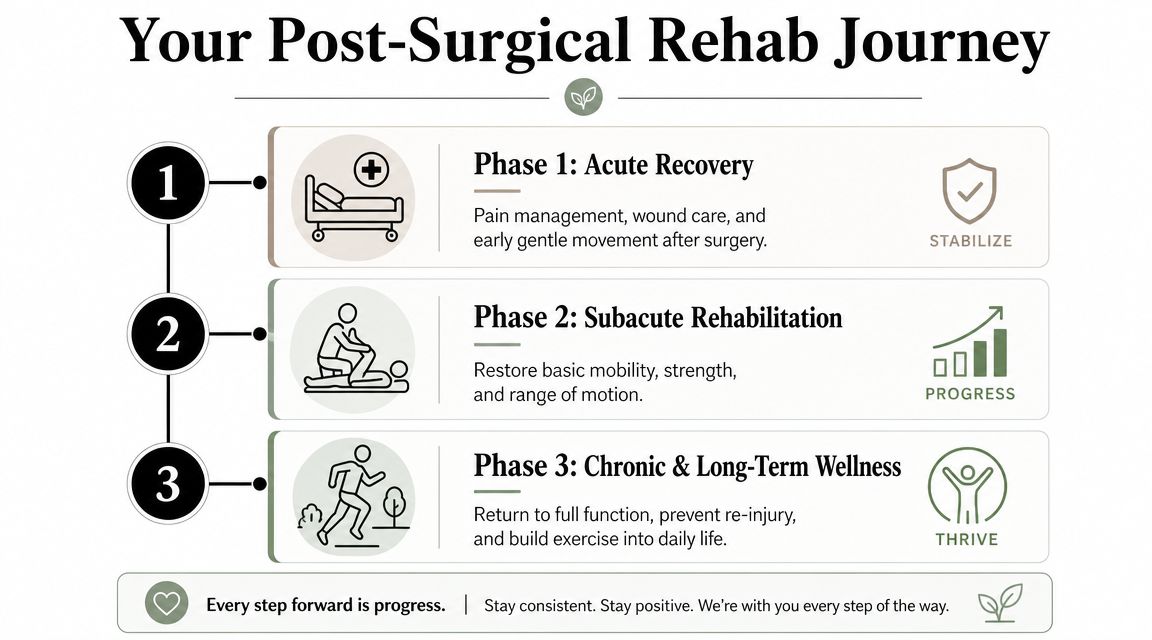
Most post-op rehab follows a pattern, even though every surgery has its own protocol. The simplest way to think about it is in phases. You protect healing tissue first, then rebuild control and strength, then return to higher-level activity.
Boston-area providers note that structured therapy is standard after many operations, including knee, hip, and shoulder replacements, plus reconstruction of major knee ligaments such as the ACL, MCL, PCL, and LCL. Rehab goals are functional and concrete: restoring strength, endurance, motion, balance, coordination, gait, and daily living activities through one-on-one, evidence-based care and procedure-specific guidance, as described by Boston PT Wellness post-surgical rehabilitation services.
Phase one is protection with movement
Right after surgery, the focus is usually pain, swelling, incision precautions, positioning, sleep, and safe movement. This is the phase where people often underestimate how much stiffness can build up.
You're not trying to prove toughness here. You're trying to preserve what can be safely preserved.
For example:
- After ACL reconstruction: the early work often centers on swelling control, regaining basic knee motion, and restoring a clean walking pattern.
- After rotator cuff repair: shoulder protection matters, but so does preventing the whole arm, neck, and upper back from becoming guarded and rigid.
- After hip replacement: patients often need help moving more normally, getting in and out of chairs, and tolerating the walking Boston life requires.
Phase two is where progress becomes visible
This is usually when people feel encouraged because they can do more, but it's also when they can get impatient. Strength doesn't come back just because pain has eased. Control has to be rebuilt.
That means targeted exercise, balance work, movement retraining, and gradual increases in load. If you've ever wondered why rehab can feel repetitive, that's the reason. Your body needs consistent, well-dosed practice.
Practical rule: If an exercise plan changes every visit without a reason, that's not customization. Good rehab progresses with purpose.
A recreational soccer player in South Boston returning after knee surgery needs more than a generic sheet of exercises. So does an active older adult in Back Bay after joint replacement. The details differ, but the principle is the same: restore capacity step by step.
Phase three is return to real life
Rehab should look more like your goals. Work demands. Stairs. Lifting. Long walks. Gym routines. Running. Golf. Weekend sports. Carrying groceries through the city. Standing through a full workday.
If you want a broader overview of how orthopedic rehab is typically structured, this overview of ortho physical therapy is a useful starting point.
A good final phase doesn't just ask, "Does it hurt less?" It asks better questions. Can you move confidently? Can you handle your routine without compensating? Are you ready for the demands that matter to you?
Specialized Rehab Services Available in Boston
Not every clinic is built for the range of post-op problems Boston patients bring in. A generic exercise room can help some people. It won't cover everyone recovering in a city full of runners, desk professionals, students, parents, and active older adults.
What matters after surgery is preventing the paired losses of strength and mobility that happen when pain, swelling, and inactivity stack up. Boston-area rehab guidance describes a progression from symptom management and gentle movement toward neuromuscular control and resistance work after surgeries such as rotator cuff repair, ACL reconstruction, joint replacement, meniscus repair, and spinal surgery. That's the logic behind progressive post-surgical rehabilitation. The clinic choice should support that progression, not interrupt it.
Services that solve real Boston problems
Some examples are easier than a service list.
A patient recovering from lower-extremity surgery may need aquatic therapy because land-based loading feels too aggressive early on. In a walking city, that's useful. Water gives people a way to move with less joint stress while still practicing controlled motion and endurance.
A Financial District professional dealing with post-op guarding through the neck, shoulder, or upper back may benefit from trigger point dry needling as part of a larger rehab plan. It isn't a stand-alone fix, but it can help when protective muscle tension keeps people from moving normally.
A few other local-fit services matter more than many patients realize:
- Vestibular and balance rehab: helpful for patients whose surgery, inactivity, or medication changes have made them feel unsteady.
- Hand and upper extremity therapy: especially important if your job depends on typing, gripping, lifting, or fine motor control.
- Pelvic floor PT: relevant when surgery, pregnancy, delivery, or abdominal pressure changes affect function and confidence.
- Running performance and return-to-sport support: useful for Boston runners who don't just want to be pain-free. They want to train well again.
- Titleist golf evaluations: valuable for golfers trying to return without shifting load into the back, shoulder, or hip.
What works and what usually doesn't
The best post-op care isn't the flashiest. It's the care that matches the stage of healing and the demands of your life.
What tends to work:
- Procedure-aware programming: your exercises should reflect the surgery you had.
- Close observation: form, pacing, swelling response, and compensation patterns matter.
- A bridge back to activity: the plan should eventually resemble the things you want to resume.
What often falls short:
- Cookie-cutter handouts: these can support care, but they can't replace it.
- Pain-only treatment: symptom relief matters, but it doesn't rebuild function on its own.
- Progression by calendar alone: two patients at the same week after surgery may not be ready for the same work.
If you're recovering after a joint replacement, this guide to physical therapy after hip replacement gives a practical example of how procedure-specific rehab is usually approached.
Among local options, Joint Ventures Physical Therapy offers one-on-one physical and occupational therapy in Greater Boston, along with aquatic therapy, dry needling, pelvic floor care, vestibular treatment, hand therapy, running performance services, and other specialty support that can matter during recovery.
How to Choose the Right Physical Therapy Clinic in Boston
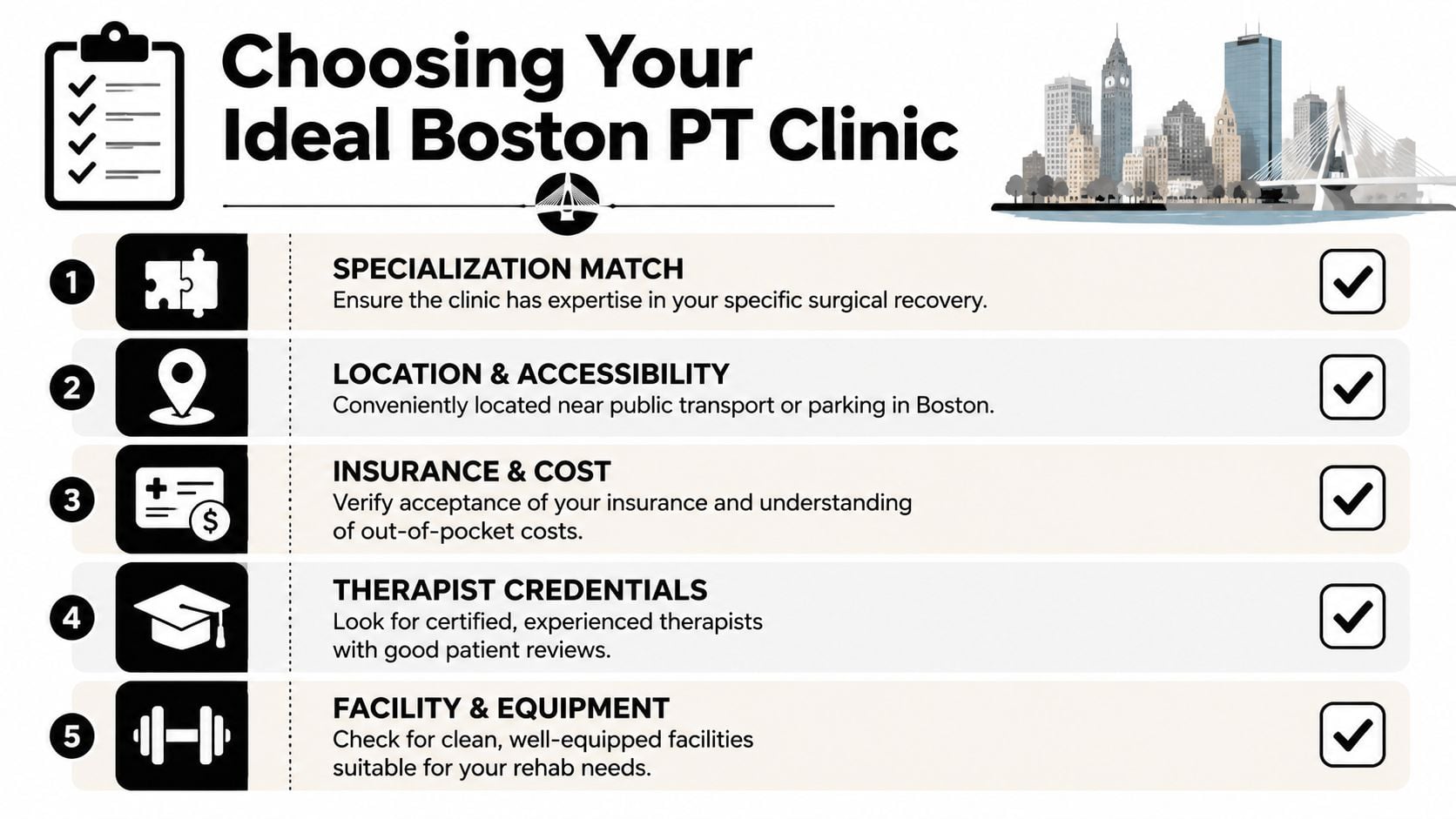
Choosing a PT clinic after surgery isn't just about finding the nearest sign on Google Maps. It's a decision about how your recovery will be measured, progressed, and supported when things don't move in a perfectly straight line.
Boston University researchers reported that outcomes improved when care was measured and adjusted over time. In their dataset, patients averaging seven visits had a 77% chance of success, which supports a model of repeated reassessment rather than passive attendance alone, as described in Boston University Sargent's article on treatment through big data.
A better checklist than location alone
Use this filter when you're comparing clinics in Boston.
| Question | Why it matters |
|---|---|
| Do you get one-on-one time with the therapist? | Post-op progression depends on close watching and timely adjustment. |
| Does the clinic regularly treat your surgery type? | Knee replacement, labral repair, rotator cuff repair, and spinal surgery don't follow the same path. |
| Can you get there consistently? | A Back Bay or Seaport location may be more realistic than a clinic that adds a long commute. |
| Will they measure progress, not just supervise exercises? | Range of motion, tolerance, function, and movement quality should guide decisions. |
| Can the team help with the admin side? | Insurance delays and referral confusion can derail momentum. |
Trade-offs that are worth noticing
A large clinic may offer convenience, but if your visit is split across multiple staff members and the plan changes based on who's available that day, continuity can slip.
A very small clinic may feel personal, but if it doesn't have access to specialty services you need, the fit may still be limited.
Look for a clinic that can answer specific questions clearly: who you'll see, how progress is tracked, when plans change, and what happens if you hit a plateau.
For Boston patients, logistics matter more than people admit. If you're near Kenmore Square, Downtown Crossing, South Station, Fort Point, or Back Bay, choosing a clinic that fits your actual route can be the difference between a completed plan of care and a plan that falls apart halfway through.
Navigating Insurance and Authorizations for Your Care
The clinical part of recovery is hard enough. The paperwork can be worse if no one explains it clearly.
One of the first decisions after surgery is the setting of your care. Some patients move into inpatient rehab or a skilled nursing setting before outpatient therapy begins. Others are medically stable enough to start outpatient PT quickly. Boston-area post-acute guidance notes that the right choice depends on medical complexity and functional need, especially for older adults and people with multiple conditions, as outlined in this overview of post-acute recovery settings near Boston.
The three parts that usually cause confusion
Patients usually run into the same problems.
- Referral questions: some plans require a physician referral, some don't, and some require it only in certain circumstances.
- Authorization delays: your insurance may want approval for visits before treatment proceeds beyond the initial stage.
- Cost uncertainty: copays, deductibles, and visit limits can affect scheduling decisions.
If you want a plain-language primer on how claims move through the system, this resource can help you understand prescription insurance workflow. It isn't PT-specific, but it gives useful context for how insurance processing works behind the scenes.
Where a strong front desk changes the experience
A good administrative team can save patients a lot of frustration. They verify benefits, flag referral needs early, communicate with insurers, and tell you what documents are missing before your first visit instead of after it.
That matters in outpatient recovery. When authorizations lag or paperwork gets lost between offices, patients often skip visits, wait too long, or lose momentum. The smoother the admin side is, the easier it is to focus on walking better, sleeping better, and moving forward.
What to Expect From Your First Visit and Beyond
Your first PT visit after surgery shouldn't feel rushed. It should feel organized.
The therapist starts by listening. What surgery did you have? What did the surgeon tell you about restrictions? What are you struggling with right now? Stairs, sleep, dressing, walking, commuting, getting back to work, or getting back to sport all change the plan.
What happens in the evaluation
Expect a one-on-one conversation followed by a focused physical assessment. Depending on your surgery, that may include movement quality, swelling, range of motion, gait, transfers, tolerance for basic tasks, and how you're compensating around the surgical area.
Then the therapist builds the first version of your roadmap. Not a generic packet. A plan tied to what you can safely do now and what needs to happen next.
Typical first-visit takeaways include:
- Your current priorities: usually the most limiting problems, not everything at once.
- Your home program: simple work you can keep up with between visits.
- Your near-term milestones: signs that you're moving in the right direction.
- Your red flags: what should prompt a call to your surgeon or therapist.
Recovery improves when patients know why they're doing each exercise, not just how to do it.
If you'd like a practical preview before day one, this guide on how to prepare for your first physical therapy appointment covers what to bring and how to think about the visit.
What makes the next few weeks easier
Consistency matters more than perfection. The patients who do well usually aren't the ones chasing heroic workouts. They're the ones who show up, follow the plan, speak up when something changes, and keep the home program realistic.
For deeper educational content on recovery topics, protocols, and anatomy, visit Highbar Health. That's the right place for longer-form educational reading while your local PT team handles the hands-on work of getting you moving again in Boston.
Take the First Step to Your Recovery in Boston
A strong recovery after surgery usually comes down to a few practical things. Get into the right setting. Start with a plan that matches your procedure. Choose a clinic you can reach consistently. Work with a therapist who measures progress instead of guessing. Keep the logistics from becoming the thing that stops your care.
In Boston, that often means thinking locally. The clinic that fits your week in Back Bay may not be the one that fits a Seaport commute or a Downtown work schedule. Convenience isn't a minor detail in post-op rehab. It's part of the treatment plan because it affects whether you are able to complete it.
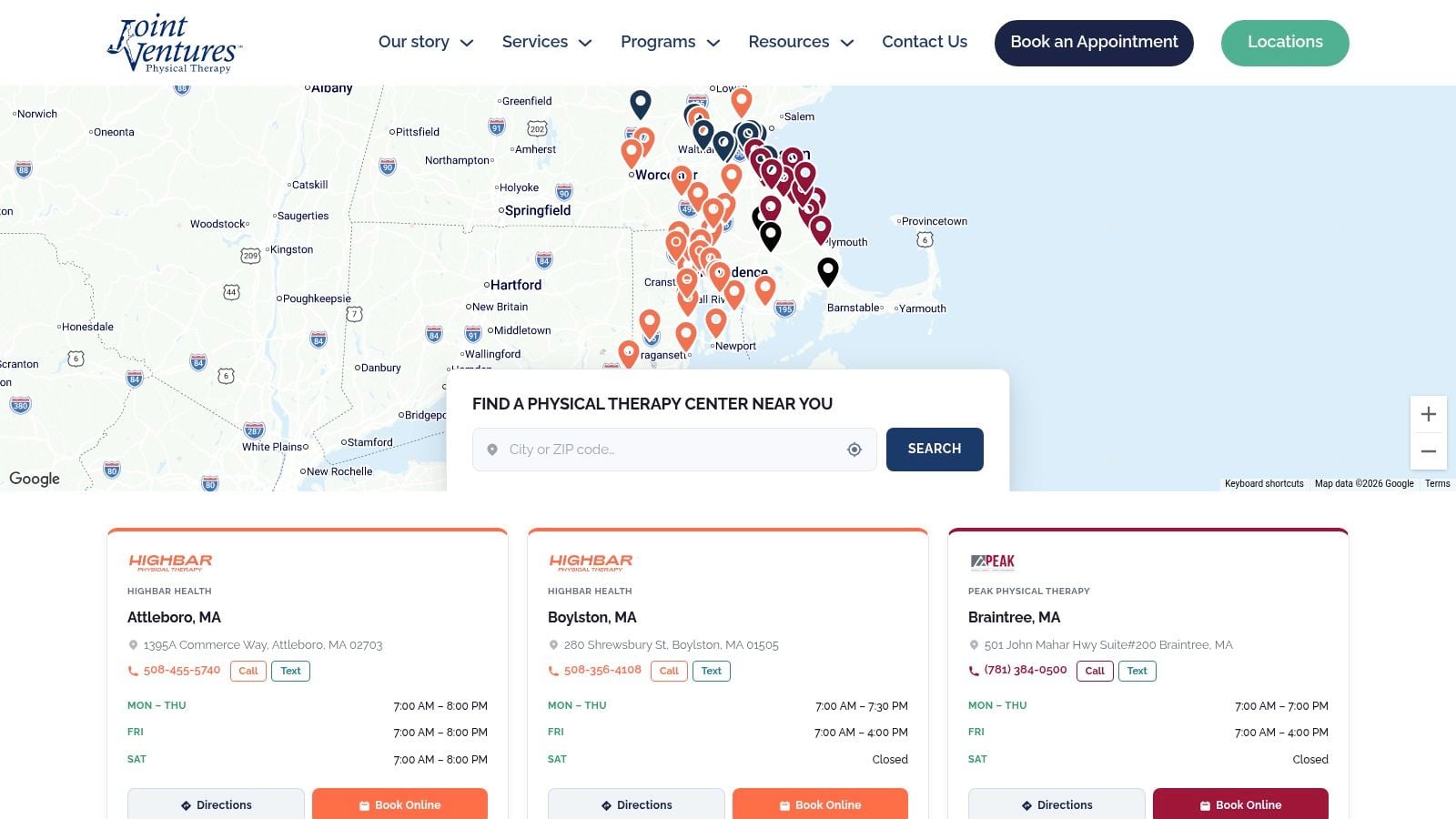
If you're looking for post surgical rehab Boston, focus on the clinic that can handle both sides of the experience. The clinical progression and the everyday realities. That means one-on-one treatment, surgery-specific care, specialty services when needed, and an admin team that helps keep the process moving.
Whether you need care near Back Bay, Kenmore Square, Fort Point and the Seaport, Downtown Boston, Brookline, or Allston, the next step is simple. Book an evaluation, bring your surgical information, and start with a clear plan instead of waiting for things to improve on their own.
If you're ready to start recovering with focused, one-on-one care in Greater Boston, book an evaluation with Joint Ventures Physical Therapy. Their team offers physical and occupational therapy across convenient Boston-area locations, with support for post-surgical rehab, specialty services, and the insurance coordination that helps patients get started without unnecessary delays.