
If you live or work in Seaport, your body usually tells the story of your schedule. It might be low back pain that builds during a long day at a standing desk. It might be a neck that locks up after hours of laptop time and commuting. Or it might be a knee, calf, or hip that starts talking back when you ramp up runs along the Harborwalk.
Many individuals don't need a generic list of stretches. They need a clinic that understands how Seaport residents live. The neighborhood runs on long workdays, packed calendars, training plans, gym sessions, stroller walks, golf weekends, and the constant tug between performance and recovery. That's why finding the right fit for physical therapy Boston Seaport matters more than individuals expect.
Your Partner in Health in the Boston Seaport
A lot of our patients arrive with the same concern in different forms. They've been trying to push through. The startup employee keeps adjusting the monitor and hoping the back pain settles down. The runner swaps shoes and shortens mileage. The new parent waits for “more time” to fix the issue. Nothing fully sticks.

What changes things is individual attention. In Seaport, we see many active professionals who don't need more noise. They need a clinician who listens, tests what's causing the problem, and builds a plan that fits a real week in Boston.
Why Seaport patients respond to one on one care
The Boston-area physical therapy market has grown significantly, and Joint Ventures' expansion to 12 locations reflects that demand, according to Joint Ventures Physical Therapy. The same source notes that its 1-on-1 care delivery model places it in a premium segment, where personalized treatment contributes to higher patient satisfaction and improved clinical outcomes compared to traditional group therapy models.
That difference shows up quickly in practice. A Seaport runner with recurring shin pain may need gait analysis, strength progression, and training adjustments. A consultant with jaw tension and headaches may need TMJ-focused care, postural work, and better tolerance for long desk sessions. Those are not the same problem, even if both patients say, “I just want to feel normal again.”
Practical rule: If your treatment plan could be handed to ten other people without changing much, it probably isn't specific enough.
Care that fits the neighborhood
Seaport isn't a neighborhood where people have extra hours lying around. Convenience matters, but convenience alone isn't enough. Patients stay consistent when they feel the plan is built for their goals, whether that means getting through a presentation without pain, training for race season, or getting back to lifting without guarding every movement.
Our team approaches the neighborhood that way. We're not here to hand out generic exercise sheets and hope for the best. We're here to help you move better in the places that define your week, your office, your gym, the Harborwalk, Logan commutes, and the routines that make Boston feel like home.
Beyond General PT Specialized Services for Seaport Lifestyles
General orthopedic PT can help a lot of people. Seaport patients often need more than general care. Their problems are tied to specific routines, and the treatment works better when the service matches the way they train, work, parent, travel, or recover.
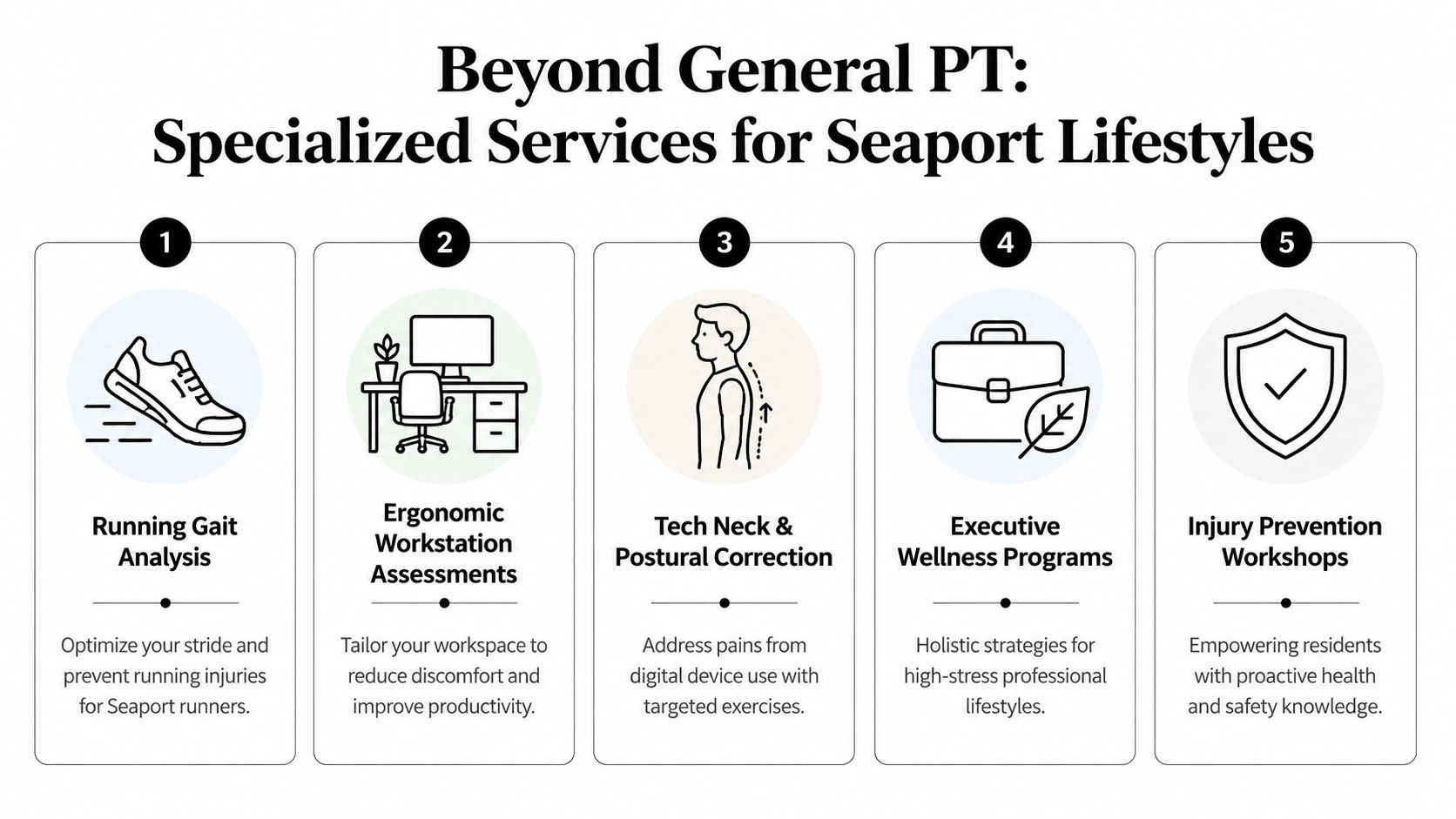
For runners, golfers, and active adults
If you run before work along the waterfront or train through Boston marathon season, a basic rehab template often misses what matters. Running performance work helps connect pain, mechanics, workload, and return-to-run decisions. Golfers usually need the same level of specificity. A Titleist evaluation can uncover movement limitations that affect the swing and keep feeding neck, back, hip, or shoulder symptoms.
Some patients don't need “rest.” They need the right change in load and the right cue at the right time.
- Running Performance Program: Useful for runners dealing with recurring aches, form issues, or a frustrating cycle of building mileage and flaring up.
- Titleist golf evaluations: A strong fit for golfers whose pain appears during rotation, follow-through, or repeated practice sessions.
- Concussion baseline screening: Relevant for athletes and active individuals who want a clearer starting point before a season or return to play.
For desk workers and hybrid professionals
Seaport has no shortage of people spending full days in front of screens. We treat a lot of symptoms that are less about one dramatic injury and more about accumulation. Neck strain, back pain, jaw clenching, shoulder stiffness, wrist irritation, and headaches often show up together.
A workstation setup matters, but it's only part of the answer. If your body can't tolerate the position your job demands, the setup alone won't solve it. That's why workplace ergonomics works best when paired with movement, strength, and tolerance training. For a practical local read on that topic, our team has shared guidance on workplace ergonomics and physical therapy in Boston.
Better ergonomics should reduce friction. It shouldn't become a scavenger hunt for the perfect chair while your symptoms keep getting worse.
For stubborn pain that hasn't responded to basic care
Some Seaport patients arrive after trying massage, rest, online mobility videos, or occasional stretching. Those tools can help, but they often fall short when symptoms keep returning. That's where more targeted services matter.
Consider these examples:
| Service | Who it often helps | What it can address |
|---|---|---|
| Trigger point dry needling | Patients with persistent muscle tightness or protective guarding | Stubborn soft tissue pain and limited motion |
| Pelvic floor physical therapy | Postpartum patients, athletes, and people with pelvic floor symptoms | Recovery, control, pressure management, return to activity |
| Vestibular and balance therapy | Active adults dealing with dizziness or balance changes | Movement confidence and steadier daily function |
| TMJ-focused therapy | People with jaw pain, clenching, headaches, or facial tension | Better jaw function and less strain through the head and neck |
| Hand and upper extremity therapy | Professionals, athletes, and post-injury patients with arm or hand issues | Grip, dexterity, load tolerance, and daily use |
For people who want performance and prevention, not just rehab
A lot of residents in this neighborhood don't want to wait until the pain becomes disruptive. They want tune-ups, movement screens, orthotic fitting, or help preventing the same issue from returning. That's a smart approach.
Joint Ventures Physical Therapy offers one-on-one physical and occupational therapy across Greater Boston, along with services such as dry needling, aquatic therapy, running performance, pelvic floor care, vestibular therapy, TMJ treatment, hand therapy, and workplace ergonomics. For Seaport patients, the primary benefit is matching the tool to the person instead of forcing everyone into the same rehab track.
Conditions We Treat From Tech Neck to Marathon Prep
People usually search for physical therapy Boston Seaport when they're trying to solve a specific problem, not because they want a broad menu of services. The pattern matters. So does the lifestyle behind it.

For the modern professional
Long screen time and high-output work schedules can create a familiar cluster of issues. We often treat:
- Neck pain and tech neck: Common when laptop use, travel, and stress all pile up.
- Low back pain: Especially in people switching between desk work, standing meetings, and long commutes.
- TMJ dysfunction and headaches: Often connected to clenching, postural strain, or jaw tension.
- Wrist and hand symptoms: Important for people typing all day or using handheld devices constantly.
Forward head posture often shows up in this group, but posture advice alone rarely fixes it. If you want a plain-language overview of the topic, PosturaZen's posture correction guide is a useful starting point. In the clinic, we pair posture work with mobility, strength, and tolerance building so the change lasts through a real workday.
For runners and field sport athletes
Athletes in Seaport usually want two things. Clear answers and a path back.
We commonly help with:
- Runner's knee and overuse pain
- Calf, Achilles, and foot issues
- Hip pain during training
- ACL rehab and return to sport
- Rotator cuff and shoulder injuries
- Concussion-related recovery
The one-on-one model matters here because athletes need more than symptom reduction. They need progressions. They need load management. They need someone to tell them what they can still do safely while they recover. If marathon prep is part of your year, our clinic regularly works with runners balancing training goals and injury risk. You can also explore our local perspective on Boston Marathon physical therapy training.
The right rehab plan doesn't just ask, “What hurts?” It asks, “What are you trying to get back to, and what keeps interrupting that?”
For active adults who want steadier movement
Not every patient is training for a race. Some want to walk confidently, move without dizziness, or stop feeling off-balance in busy environments. Vestibular and balance problems can affect exercise, work, and everyday routines in quiet but significant ways.
We also see patients whose symptoms involve more than one system. Neck pain with dizziness. Jaw tension with headaches. Postpartum weakness that changes running mechanics. Those cases need a clinician who can connect the dots instead of chasing one body part at a time.
For a deeper educational look at running injury anatomy and recovery, visit our educational partner Highbar Health.
What to Expect During Your First Visit and Beyond
Understanding what the first appointment will look like often brings comfort. The fear usually isn't the session itself. It's the uncertainty. Am I going to be rushed? Will I tell my story three times? Will I leave with anything more useful than a printout?

The first conversation
Your visit starts with your story. That includes when the problem began, what makes it better or worse, what you've already tried, and what you need to get back to. For one person, that goal is sitting through a full workday without pain. For another, it's training, lifting, parenting, or walking the neighborhood comfortably.
Then we evaluate how you move. We look at the painful area, but we also look at the nearby systems that may be contributing. That might include strength, mobility, balance, coordination, jaw movement, running mechanics, or workplace demands depending on the issue.
The plan after the evaluation
A good evaluation should produce a plan you can understand. Not vague reassurance. Not a stack of unrelated exercises.
Your care plan may include a mix of:
- Hands-on treatment to improve motion or reduce pain enough to move better.
- Targeted exercise built around your actual limitation, not a generic body-part template.
- Education so you know what to modify, what to keep doing, and what doesn't need to scare you.
- Progressions that match your schedule and goals.
Some patients start treatment on day one. Others need a bit more assessment and goal-setting before progressing. Either way, the point is clarity.
When patients leave the first visit knowing why the problem is happening and what the next few weeks should look like, follow-through gets easier.
What ongoing visits should feel like
Your visits shouldn't feel like a handoff line. Good rehab depends on consistency, pattern recognition, and real-time adjustment. If your symptoms change with work travel, race training, or sleep disruption, the plan should change too.
That's especially important in Seaport, where schedules move fast. One week may include office days, flights, a long run, and a golf round. Another may include childcare, a deadline, and a flare-up. The value of one-on-one care is that your therapist can make those adjustments with you instead of forcing your week into a preset script.
Meet Your Seaport Physical Therapy Team
People don't choose a clinic based on services alone. They choose the person they trust to guide the process. In Seaport, that matters even more because many patients are balancing demanding schedules with goals that are highly personal.
Specialists, not a generic rotation
A strong local clinic should give you access to clinicians whose interests and advanced training match the problem you're bringing in. That may mean a therapist who works regularly with runners and understands how Boston training cycles affect the body. It may mean someone with focused experience in TMJ care, vestibular rehab, pelvic floor treatment, hand therapy, or golf performance.
That specialization changes the experience. Instead of spending several visits just “trying things,” you start with a narrower, more informed lens. Patients usually feel that right away in the questions asked, the movement tests chosen, and the home plan they leave with.
The human side matters too
Clinical skill is only part of the equation. Seaport patients often need a therapist who can connect with neighborhood life. Tight timelines. Variable stress. Big goals. Limited patience for fluff.
That's why our team culture matters. We want care to feel focused, collaborative, and welcoming. You should feel like your therapist understands the difference between “I want to move more” and “I need to be ready for a race, a return to lifting, a post-surgical milestone, or a demanding quarter at work.”
If you want to get a sense of the clinicians, backgrounds, and treatment interests across the broader practice, you can browse the Joint Ventures team page.
Planning Your Visit Hours Insurance and Directions
For most Seaport patients, logistics can make or break consistency. If care is hard to reach or hard to understand financially, even a strong treatment plan can fall apart.
Clinic details at a glance
| Detail | Information |
|---|---|
| Location | Fort Point/Seaport area in Greater Boston |
| Best fit for | Residents, professionals, runners, athletes, active adults, and patients seeking specialty PT services |
| Transit access | Convenient for patients using downtown routes and Seaport transit connections, including the Silver Line area |
| Scheduling style | Built for busy city schedules, with appointment options that can work before work, after work, or around the day |
| Insurance support | Administrative help with benefit verification, authorizations, and out-of-pocket clarity |
| Visit format | One-on-one care with an expert clinician |
What busy patients usually want to know
- How easy is it to get to? If you work in Seaport or nearby downtown neighborhoods, choosing a location near your existing routine usually improves follow-through.
- Can appointments fit around work? Early and later appointment availability can make PT realistic for professionals with dense calendars.
- Will someone help with insurance? Patients generally want the answer before they commit to a plan of care, not after a few visits.
A practical tip is to book care near where you already spend time, not near where you wish you had more free time. For many people in this neighborhood, that means choosing a clinic close to the office, the waterfront, or a familiar transit route.
Your Questions Answered About PT in the Seaport
Do I need a doctor's referral to start?
Many patients in Massachusetts can begin physical therapy through direct access, but referral requirements can vary by insurance plan and situation. The simplest move is to contact the clinic and have the front desk confirm what your plan requires before your first visit.
What should I wear?
Wear comfortable clothing that lets your therapist see how you move. Athletic wear usually works well. If your issue shows up during running, lifting, golf, or desk work, it can also help to bring anything relevant, such as shoes or photos of your workstation.
How long does a session last?
Session length can vary by clinic and by what your treatment plan requires. What matters more is that the visit gives enough uninterrupted time for assessment, treatment, progression, and questions. If you're comparing clinics, ask whether you'll be with your therapist for the full session.
Is insurance-based PT or cash-based PT better in Seaport?
This is one of the most important questions people ask, and it deserves a practical answer. In Seaport, some clinics operate on an exclusive cash-based model at $200 to $400 per hour, while Joint Ventures accepts most major insurance plans, according to Bay State Physical Therapy's Boston location information. That same source notes that the administrative team handles the authorization process, helps clarify out-of-pocket costs, and works to maximize benefits, which can be a meaningful financial and access advantage for patients planning a full course of care.
Cash-based care can make sense for some people, especially if they prioritize direct scheduling and are comfortable with the full out-of-pocket cost. Insurance-based care often makes more sense when you expect to need a series of visits and want support navigating benefits and authorizations.
If you're deciding between models, don't ask only about philosophy. Ask what you'll actually pay, how quickly you can be seen, and how the clinic structures one-on-one time.
What if I'm not an athlete?
You don't need to be training for anything to benefit from PT. A large part of our work in Seaport is helping professionals, parents, and active adults move through daily life with less pain and more confidence.
If you're looking for Joint Ventures Physical Therapy, book an evaluation at a Greater Boston location that fits your routine. Our team helps Seaport residents and professionals guide through pain, recovery, and performance with one-on-one care that matches real goals, real schedules, and the way you live.