
If you're in Boston, it's easy to normalize pain that keeps showing up but never feels dramatic enough to justify care. A runner training before work may notice forefoot pain every time they push pace on the Esplanade. A Seaport professional may feel wrist irritation by noon, then jaw tension by the end of a laptop-heavy day. A recreational tennis player may keep blaming a sore elbow on “getting older” while grip strength slips.
Those problems sit in the middle ground where many people don't think to look for occupational therapy Boston services. They assume OT is only for hospital discharge, major disability, or pediatric care. In practice, OT is often exactly where active adults need help most, especially when pain shows up in the hand, wrist, elbow, jaw, neck, or the work and sport routines that keep aggravating it.
Is a Nagging Injury Holding You Back in Boston
A common pattern looks like this. You can still do most things, but none of them feel clean anymore. You finish a long day in Back Bay and notice your thumb and forearm aching after emails, texting, and carrying a gym bag. Or you're building mileage for a spring race and your grip, shoulder tension, or post-run recovery starts affecting sleep and work the next morning.
The frustrating part isn't always the pain itself. It's the way it follows you into the exact tasks that define your routine. Typing. Commuting. Lifting. Training. Cooking. Holding a coffee cup after a heavy upper-body session.
For active adults, the biggest mistake is waiting for the issue to become severe before addressing it. Minor tendon irritation, repetitive strain, jaw clenching, and post-injury guarding often respond better when someone looks early at how you move, how you load tissue, and how your daily setup keeps re-creating the same problem.
Practical rule: If a symptom keeps returning in the same task, the task itself needs treatment, not just the painful body part.
Self-care can help, but only if it's used well. For example, athletes who use massage tools often get relief when they understand what the tool is doing and when to back off. A simple resource like this Signature Lacrosse guide to recovery can be useful if you're trying to reduce tension between sessions without turning recovery into another irritation source.
That middle ground, where you're still functioning but not moving or working well, is where OT often makes the most practical difference.
What Occupational Therapy Means for Active Bostonians
You finish a workday in the Financial District, answer a few last emails on the T, then head to a training session. By the end of the night, your wrist is irritated, your grip is fading, or your shoulder feels tight enough to change how you sleep. That pattern is common in Boston. High-performing adults often ask the same body part to meet office demands, commute demands, and sport demands in the same day.

OT focuses on performance in real life
For active adults, occupational therapy Boston care centers on function under real-world load. The question is not only whether a joint moves or a tendon calms down. The question is whether you can type for hours, carry gear, train, recover, and repeat the routine without symptoms building by Thursday.
That is the part of rehab many active professionals need. OT looks closely at the task itself. We examine how you grip, where you compensate, what your workstation asks of your hands and shoulders, and how your sport or training plan adds stress on top of your workday.
Your occupations include any role or task that fills your day. In Boston, that may mean laptop work in Back Bay, cycling to the office, rowing on the Charles, carrying groceries up narrow stairs, lifting a child, or getting back to a climbing session after a finger injury. For many patients, success means staying active without turning every routine task into a flare trigger.
A lot of people want a clearer explanation of how OT and PT differ. This overview of occupational therapy vs physical therapy explains the distinction well. In practice, the overlap is real, and the trade-off matters. PT often targets broader movement, strength, and mobility. OT often gets more specific about hand use, upper-extremity loading, fine motor control, ergonomics, and the exact daily tasks that keep symptoms going.
What that looks like in practice
An OT session for an active Boston adult might include:
- Task analysis: Breaking down what happens during typing, lifting, gripping, cycling, racket sports, or a return to the gym.
- Ergonomic changes: Adjusting desk setup, mouse use, monitor height, bag carry, or device habits that keep feeding strain.
- Movement retraining: Improving wrist position, shoulder mechanics, grip strategy, and tissue loading so the same task stops provoking symptoms.
- Targeted progression: Building strength, dexterity, endurance, and coordination for the exact work and sport demands you need to handle.
- Protection when needed: Using splinting, taping, pacing, or temporary modifications so you can keep functioning while tissue settles.
Good OT should feel specific from the first visit. A runner with thumb pain from constant phone use and poor arm swing needs a different plan than a lawyer with elbow symptoms from long keyboard hours and weekend tennis. The diagnosis may sound similar. The treatment should not.
Rigorous training matters in these situations. Subtle problems in grip force, desk posture, recovery habits, and return-to-sport timing are easy to miss, and they often determine whether symptoms improve or keep cycling back.
This short video gives a helpful overview of the OT lens in action.
Common Conditions We Treat With OT in Boston
The most useful OT cases in Boston often don't look dramatic from the outside. They're the injuries and overload patterns that interfere with performance, concentration, and confidence even while you're still technically functioning.
Hand, wrist, and elbow problems that disrupt work and training
A large share of outpatient OT revolves around the upper extremity. That includes desk-related overuse, lifting injuries, post-surgical recovery, and sports-specific hand or elbow irritation.
For professionals, common issues include wrist pain from long keyboard hours, thumb pain from repeated gripping and device use, and forearm tension that builds across the workweek. For athletes, it may be tennis elbow, golfer's elbow, finger sprains, climbing strain, or reduced grip confidence after a fall or surgery.
When these problems are treated well, the goal isn't just pain reduction. It's restoring usable function. Can you type without guarding? Can you grip a barbell, racket, paddle, stroller, or steering wheel without symptoms ramping up later?
If your symptoms are centered in the hand, wrist, forearm, or elbow, specialized hand and upper extremity therapy is often the most direct fit.
OT also helps with the tasks around the diagnosis
The diagnosis matters, but the daily demands matter just as much. Two people can both have wrist pain and need completely different plans. One may need ergonomic changes and load management for a finance job. The other may need dexterity, impact tolerance, and return-to-sport progression for rec league play.
Here’s a practical snapshot.
| Condition | Who It Affects | Primary OT Goal |
|---|---|---|
| Carpal tunnel or nerve irritation | Desk workers, commuters, frequent device users | Reduce irritation while restoring hand use for work and daily tasks |
| Tennis or golfer's elbow | Recreational athletes, lifters, racquet sport players | Improve load tolerance and grip function |
| Post-surgical hand or wrist recovery | Patients after fracture care, tendon procedures, or release surgeries | Restore motion, strength, and safe return to daily activity |
| Thumb pain and repetitive strain | Parents, professionals, people with heavy phone or laptop use | Improve pinch, grip, and joint protection strategies |
| Workplace overuse symptoms | Remote workers and hybrid professionals | Change setup and task habits that keep symptoms active |
| Concussion-related functional issues | Student athletes, active adults, workers returning to screens | Support return to work, routine, and symptom-controlled activity |
| TMJ-related jaw tension affecting daily function | People who clench, grind, or hold tension under stress | Reduce strain during speaking, eating, and workday stress loading |
The right OT plan doesn't only ask, “What hurts?” It asks, “What are you trying to get through your day without thinking about?”
A few Boston-specific use cases
Some of the most relevant OT referrals for active Bostonians sit outside the usual hospital-based picture:
- Workplace ergonomics: For people whose symptoms spike during long laptop sessions, dual-monitor setups, repetitive mouse use, or frequent travel days.
- Concussion return to work: Especially for students, professionals, and athletes who can exercise somewhat but struggle with screens, concentration, or symptom flare-ups in busy environments.
- TMJ and tension-related upper quarter problems: Jaw discomfort often overlaps with neck, shoulder, and postural strain, especially in high-stress work patterns.
- Performance support: OT can help when the issue isn't a major injury but a recurring bottleneck in grip, upper body control, dexterity, or load tolerance.
What doesn't work well is generic advice that ignores your actual routine. “Rest it” isn't realistic if your job depends on your hands. “Stretch more” usually isn't enough if your setup, mechanics, and pacing are the root of the problem.
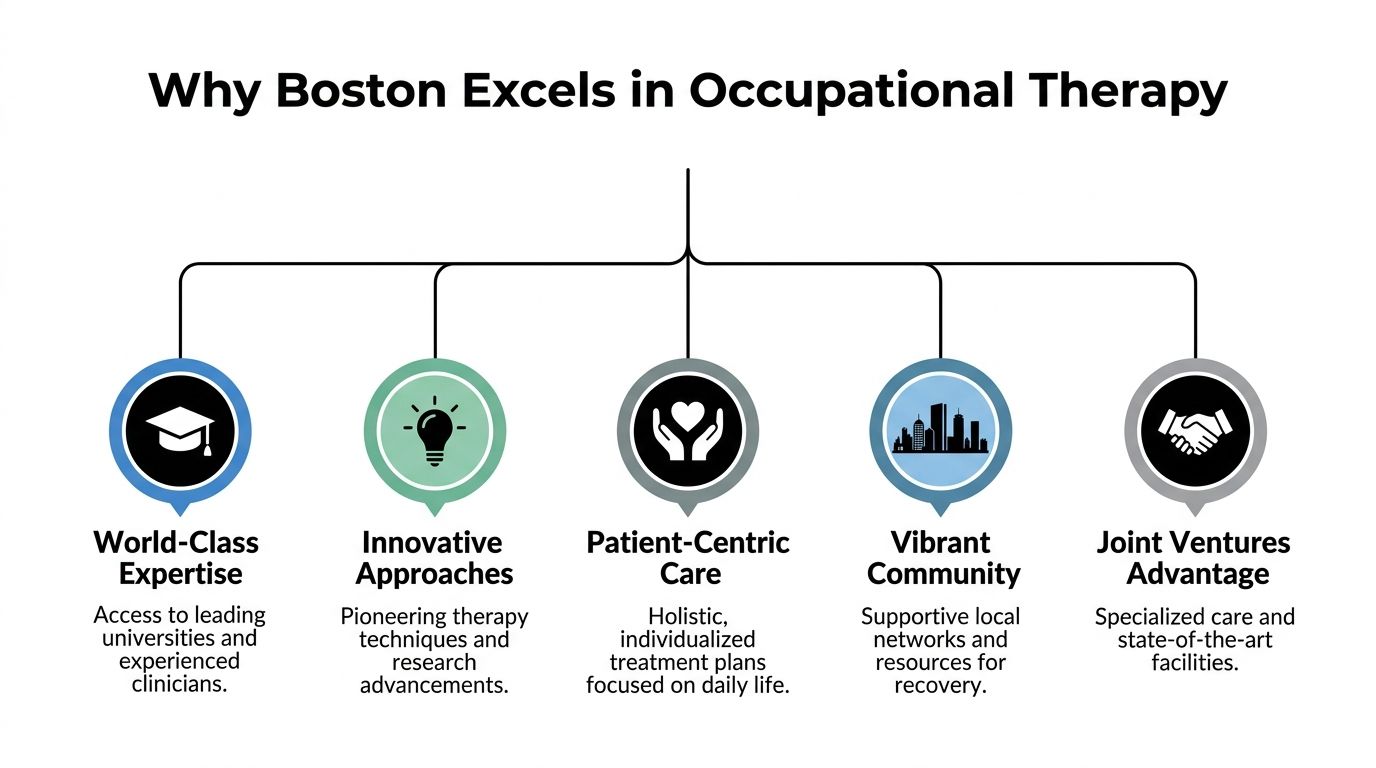
Why Boston is a Leader in Occupational Therapy
A Back Bay consultant who spends the morning on a laptop, the evening at a training session, and the weekend on a bike usually does not need generic rehab. That person needs care that can sort out how desk posture, grip load, recovery habits, and sport demands are all feeding the same problem. Boston tends to produce that level of OT care because the city has built strong academic and clinical training around complex function, not just symptom relief.
The profession has deep roots here. The Boston School of Occupational Therapy page traces that history back to 1918. That long-standing presence matters because cities with established OT training programs usually develop stronger mentorship, tighter referral networks, and more clinicians who are comfortable treating high-functioning adults with specific goals.
Training quality changes the patient experience
Patients feel the difference quickly.
A well-prepared occupational therapist looks past the irritated tissue and asks better functional questions. Why does your wrist flare after long spreadsheet sessions but not during lifting? Why does shoulder pain show up on the bike only after a heavy workweek? Why does jaw tension increase on presentation days? Good clinical reasoning connects those dots and builds a plan around the demands that matter in Boston life.
That matters in a city full of professionals and active adults who are trying to stay productive while they recover. The goal is often to keep working, keep training in some form, and stop the cycle from repeating. That takes more than a handout of stretches. It takes task analysis, load management, ergonomic problem-solving, and a realistic return to performance plan.
Why local specialization matters
Boston also has the right kind of demand. The city has a dense mix of runners, lifters, racquet sport athletes, healthcare workers, finance professionals, students, and remote workers. Their injuries often sit in the overlap between performance and repetition. Hand and wrist irritation from keyboard use can limit lifting. A shoulder issue that starts in the gym can make commuting, dressing, and overhead work harder. Mild concussion symptoms can interfere with both training and screen tolerance.
That overlap pushes OT beyond the old inpatient stereotype. In Boston, strong occupational therapy often looks proactive. It helps people adjust mechanics before a small problem turns into lost training time or reduced work capacity. It also works well alongside other disciplines. If symptoms are tied more directly to running mechanics, strength deficits, or return-to-sport progression, this guide to sports physical therapy in Boston gives useful context on how that side of care fits in.
Boston stands out because patients can find clinicians who understand function at a high level. For active professionals and athletes, that usually means faster decisions, more precise treatment, and fewer guesses.
Your First Occupational Therapy Session at Joint Ventures
You finish a workday in Back Bay with a tight wrist, an irritated shoulder, or a thumb that has been barking through every email, lift, and train ride home. The first OT session should answer a simple question. What is driving this, and what needs to change so you can work, train, and recover without guessing?

What happens in the evaluation
A strong evaluation starts with your symptoms, then moves quickly into your routine. We look at when the pain shows up, which tasks bring it on, how your workload and training load have changed, what you have already tried, and what you cannot afford to keep avoiding.
The exam itself depends on the problem. For an active Boston professional or athlete, that often means checking motion, strength, grip, tissue irritability, coordination, swelling, scar mobility, joint mechanics, and task-specific movement patterns. It can also mean watching how you type, grip a barbell, carry a work bag, use a mouse, or position your wrist on a bike or racket.
That detail matters because the right plan is rarely generic. A sore elbow from tennis, climbing, and laptop work needs a different approach than post-surgical stiffness or hand numbness that shows up during long coding sessions.
Boston clinicians are trained for this level of assessment. Boston University's entry-level OTD includes 24 weeks of supervised Level II Fieldwork and a 14-week Doctoral Capstone, as outlined in BU's technical standards and technology competency requirements. For patients, that translates into better clinical reasoning and treatment plans built around real tasks, not just isolated test findings.
What a useful plan usually includes
The first plan should be specific enough to use the same day.
That may include:
- Targeted exercise: To improve mobility, control, endurance, and tolerance for the exact tissues and movements that are getting overloaded.
- Activity modification: Temporary changes to lifting, keyboard use, commuting, sleep position, or sport technique so symptoms settle without shutting your life down.
- Splinting or support: Used when protection or positioning will improve function, not just because a brace sounds helpful.
- Ergonomic adjustment: Changes to desk setup, mouse choice, monitor height, or bag carry strategy when work habits are feeding the problem.
- Return-to-activity progression: A staged plan for getting back to training, court sports, gym work, parenting tasks, or long computer days without jumping load too fast.
Trade-offs come up early. Sometimes the right call is keeping you active with modified volume instead of full rest. Sometimes it is protecting irritated tissue for a short window so you do not drag a six-week problem into six months. Good OT explains that reasoning clearly.
If you'd like a general outside perspective on how evaluations are structured, this practical guide to occupational therapy assessment is a reasonable companion read.
Clinical reality: The first session identifies the highest-value changes first. It should leave you with a working diagnosis, a treatment direction, and a clearer sense of what you can keep doing safely.
Joint Ventures Physical Therapy is one local option for this style of care, with one-on-one physical and occupational therapy across Greater Boston for orthopedic injuries, hand and upper extremity issues, pelvic floor conditions, vestibular concerns, TMJ dysfunction, and performance-focused services.
How to Find the Right Occupational Therapist in Boston
Boston gives you options. That's helpful, but it can also make the search noisy. The region has 3,890 occupational therapists employed locally, and the area has 57% more occupational therapists per capita than the national average, according to the BLS metro employment data. The challenge usually isn't finding an OT. It's finding one who treats the kind of problem you have.
Questions worth asking before you book
Start with fit, not convenience alone.
- Do you treat my type of problem often? Hand pain, repetitive strain, sports-related upper extremity issues, TMJ, and workplace ergonomics all require different skill sets.
- Will my visits be one-on-one? If your issue is tied to detailed task analysis, divided attention in a busy gym setting may not be enough.
- How do you connect treatment to real tasks? You want a therapist who asks about your keyboard setup, lifting routine, commute, parenting demands, training schedule, or sport.
- What happens after the first few visits? Good care should include progression, not endless symptom management.
- Can you coordinate with other providers if needed? That matters after surgery, with concussion recovery, or when symptoms overlap with multiple systems.
What usually works better than broad general care
For active adults, specialty tends to matter more than branding. A clinic may be close to your office, but if it doesn't understand hand rehabilitation, upper extremity loading, jaw-related dysfunction, or sports return, you'll spend time without solving the main problem.
Good signs include clear condition-specific services, a therapist who can explain why your symptoms keep recurring, and a plan that feels built around your week instead of a generic template.
Less helpful signs are vague exercise sheets, no discussion of work demands, and repeated visits that don't change your ability to do the task that brought you in.
Boston has enough OT depth that you don't need to settle for that.
Book Your OT Appointment at Our Boston Locations
If your hand, wrist, elbow, jaw, or repetitive strain issue is interfering with work or training, local access matters. You want care close to where you live, commute, and spend your day, not a plan that adds more logistical friction.
Joint Ventures offers occupational therapy access across Greater Boston, including Back Bay, Kenmore Square, Fort Point/Seaport, and Downtown Boston, along with surrounding neighborhoods. That makes it easier to schedule around office hours, class schedules, training blocks, and family responsibilities. Early and late appointments can also help if your day starts before the T gets crowded and ends long after standard clinic hours.
For broader educational reading on injury anatomy and recovery, visit Highbar Health. For local booking, the simplest next step is to request an evaluation with the Boston location that fits your routine best.
If you’re dealing with a problem that keeps returning, booking sooner usually helps. It’s easier to adjust a pattern early than unwind months of compensation later.
Get Back to Your Life with Expert Boston OT Care
For active adults, OT is often the missing piece between “I can get through the day” and “I can do what I need without thinking about pain.” That's especially true when symptoms involve the hand, wrist, elbow, jaw, repetitive work strain, or the upper-body demands of sport and city life.
The value of occupational therapy Boston care is practical. It helps you work better, train smarter, recover with more direction, and stop repeating the same aggravating patterns. The right plan doesn't just calm symptoms. It restores useful function in the routines that matter most.
Don't keep negotiating with a problem that keeps taking space in your day. Schedule the evaluation, get a clear plan, and start moving forward.
If hand pain, repetitive strain, TMJ symptoms, or a sport-related upper extremity issue is limiting your routine, Joint Ventures Physical Therapy offers a clear next step. Book a one-on-one occupational therapy evaluation at a Boston-area location and get a plan built around your work, training, and daily life.