
You finish a run along the Charles and your hips feel blocked by mile three. Or you close your laptop in the Financial District, stand up, and realize your shoulders have been creeping toward your ears all day. That pattern is common in Boston. We pack a lot into the week: desk hours, commuting, lifting, pickup sports, training for local races, and trying to stay active in between.
That’s why sports physical therapy Boston shouldn’t just be about treating injuries after they flare up. It should also help you move better for the life you live here. Good mobility work is part of that. Not random stretching. Not forcing range you don’t own. The right drills, done consistently, can make running feel smoother, overhead lifting less cranky, and long workdays easier on your body.
Why Boston's Active Professionals Need Better Mobility
A common Boston week creates a predictable mobility problem. Hours at a laptop in the Financial District or Seaport put the hips in flexion and the upper back in a rounded position. Then the same person heads to a strength class in Back Bay, a tennis court, or a marathon training run along the Charles and asks those joints to rotate, reach, and absorb load.
That gap matters most at the hips and shoulders.
In clinic, I see it all the time. A runner does not complain that their hip feels "tight" in a textbook sense. They say their stride feels blocked by mile four, or one side never seems to open up on hills. A desk worker usually does not walk in asking for shoulder external rotation. They say overhead pressing feels pinchy, their neck gets tense by late afternoon, or taking off a coat feels stiffer than it should.
The issue is rarely just flexibility. Boston's active professionals usually need mobility they can use under load. That means enough range to get into a position, plus enough control to keep the shoulder or hip from shifting into a compensatory pattern.
What that looks like in daily life
For the runner training on the Esplanade, limited hip rotation can change how the leg tracks during stance and push-off. The body still finds a way forward, but the work often gets redistributed to the low back, outer hip, or knee.
For the desk worker who lifts before or after work, limited shoulder rotation usually shows up as a workaround. The ribs flare, the low back extends, or the shoulder rolls forward to get the arm overhead. You still complete the rep. It just costs more than it should.
For lifters, court athletes, and recreational runners, better mobility is useful because it improves access to cleaner positions. Cleaner positions usually make strength work, running mechanics, and recovery easier to tolerate.
Mobility should make movement cleaner, not just make stretching feel productive for a few minutes.
Boston's schedule is part of the problem. Long seated workdays, cold weather stretches that reduce casual walking, and concentrated training blocks before races like the B.A.A. 5K or Boston Marathon all reduce movement variety. If you spend most of the day in a few fixed positions, your body gets efficient there. Then training exposes the ranges you have not maintained.
That is why generic stretching advice often falls flat. The Financial District desk worker and the Charles River runner may both report "tight hips" or "tight shoulders," but they do not need the exact same drill or dose. The right mobility work matches the pattern in front of you and gives you range you can use.
How to Prepare for Safe and Effective Stretching
At 6 p.m. in Boston, this is a common setup. You have been at a desk in the Financial District most of the day, then you head out for a Charles River run or a lift in Kenmore and try to force a stretch the second you stop moving. That is usually the wrong time to chase range.
Many active adults do better with a better entry point. If tissues have been still for hours, or they are already irritated after training, a hard stretch often creates guarding instead of useful motion. Start by raising tissue temperature and getting a few joints moving together. Walk for 3 to 5 minutes, pedal easily, do a set of bodyweight squats, or add 10 to 15 arm circles and trunk rotations before you hold anything.

That short ramp-up matters. A runner who has just come in from a cold-weather workout and a desk worker trying to loosen up before the gym need different intensity, but both usually respond better to gentle prep than to aggressive holds.
Know the difference between stretch and pain
A useful stretch feels like steady tension over a broad area. You can breathe normally, keep the rest of your body quiet, and stay in position without clenching your jaw or bracing your ribs.
Pain feels different. Stop if you notice:
- Sharp pain: A precise, sudden sensation instead of general muscular tension
- Pinching: Often felt at the front of the shoulder or deep in the hip
- Shooting or radiating symptoms: Discomfort traveling down the arm or leg
- Numbness or tingling: A sign that you may be irritating neural tissue rather than stretching muscle
If symptoms change the way you breathe or make you shift out of position, the stretch is not doing its job.
Set up your space and your position
Good stretching is usually quiet and boring. The setup does the work.
Use a stable wall, a doorway that will not move, and enough floor space to get into position without twisting around furniture. If you are stretching at home after work, put the phone on timer mode and keep it out of your hand. A mirror can help more than people expect because it catches the common compensations: shrugging through shoulder work, arching the low back to fake overhead motion, or rotating the pelvis to pretend the hip is opening.
Practical rule: If you have to move three other body parts to feel one stretch, change the setup.
Dose matters too. I usually want people to start with controlled holds they can repeat consistently, not long efforts they have to endure. If shoulder tightness is part of the picture, this guide on how to prevent common shoulder injuries during training and daily activity gives useful context for what to watch for before you push range.
Proper execution matters more than forcing depth. Position, breathing, and timing decide whether a stretch helps you get cleaner motion or just leaves the area irritated for the rest of the night.
PT-Approved Shoulder Stretches for Desk Workers and Athletes
Shoulders tighten for different reasons in Boston. Desk workers drift into internal rotation and forward posture. Lifters get stiff in the front of the shoulder. Overhead athletes lose clean mechanics when the shoulder blade and rotator cuff stop working together. The drills below are the ones I’d want a local runner, rower, climber, or office worker to do well before adding more volume or more load.

Boston places a premium on this kind of specialized skill. As of April 2026, sports physical therapists in Boston average $105,049 annually, reflecting how much demand there is for sports-specific rehab in an active city, based on Boston sports physical therapy salary data from ZipRecruiter.
The Back Bay desk worker’s doorway stretch
This is the move I give people who sit most of the day and feel tightness across the chest and front of the shoulder.
Setup
Stand in a doorway. Place your forearm on the frame with the elbow bent. Your upper arm should sit a little below shoulder height if overhead positions feel stiff.
Technique
Step through gently until you feel a stretch across the front of the chest and shoulder. Keep your ribs down and your neck relaxed. Hold without pushing deeper every few seconds.
Common mistakes
- Shrugging up: If your shoulder climbs toward your ear, you’re missing the target
- Arching the low back: That turns the stretch into a compensation
- Going too high too soon: A lower arm position is often cleaner if you’re stiff
Keep the shoulder blade settled. If the front of the shoulder feels pinchy, lower the arm angle and back off the depth.
The Fenway overhead athlete’s side-lying external rotation
This one looks simple, but it’s useful because it teaches the back of the shoulder to work without your trunk helping.
Setup
Lie on your side with the working arm on top. Tuck a small towel between your elbow and rib cage. Bend the elbow to a right angle.
Technique
Rotate the forearm upward slowly, then lower with control. This is less about stretching hard and more about opening and owning external rotation in a supported position. Move through a pain-free arc.
Common mistakes
- Losing the towel: If the elbow drifts, you’ve changed the motion
- Rolling backward: Keep the rib cage stacked
- Using too much weight: Start light or even unweighted
This is a good example of the difference between mobility and motion. You don’t just want range. You want control at the end of range.
Wall slides for the Seaport laptop posture
Wall slides help people who feel stiff between the shoulder blades, weak overhead, or compressed after long hours of keyboard work.
Setup
Stand with your back against a wall. Place your forearms on the wall in a goalpost position if available, or start lower if needed.
Technique
Slide your arms upward while keeping the ribs from flaring and the shoulders from shrugging. Go only as high as you can while keeping contact and control. Return slowly.
Common mistakes
- Ribs popping forward: That’s your spine stealing motion from the shoulder
- Forcing the top range: Stop where the movement stays clean
- Elbows losing contact immediately: Start lower and earn the range
For a visual walk-through, this demo can help:
What works and what doesn’t
A lot of shoulder mobility fails because people chase sensation instead of mechanics.
| Approach | Usually works | Usually backfires |
|---|---|---|
| Desk-worker stiffness | Gentle chest opening plus wall-based control work | Cranking the arm into end range |
| Gym-related tightness | Controlled external rotation drills | Stretching aggressively after every lift |
| Overhead sport prep | Mobility paired with shoulder blade control | Repeating band work with poor posture |
If your goal is prevention as much as recovery, Joint Ventures’ clinicians in Greater Boston also use sports rehab tools like dry needling, running performance analysis, and one-on-one movement assessment as part of care planning. For more shoulder-specific guidance, see this article on how to prevent shoulder injuries.
Essential Hip Mobility Stretches for Runners and Lifters
Hip mobility problems don’t always feel like hip pain. In Boston runners, they often show up as a stride that feels shortened, a stubborn outer-glute ache, or a low back that gets tight halfway through a long run. In lifters, limited external rotation often appears as knees caving in, depth that disappears, or a squat that feels blocked on one side.
The fix isn’t to jam yourself into end-range positions. The fix is to use stretches that target rotation cleanly and keep the pelvis under control.

The Charles River runner’s figure-4 stretch
This is a strong choice when the outer hip feels dense after mileage or prolonged sitting.
Setup
Lie on your back with both knees bent. Cross one ankle over the opposite thigh, just above the knee.
Technique
Reach through and pull the uncrossed leg toward you until you feel a stretch in the hip of the crossed leg. Keep your head and shoulders relaxed. The motion should come from the hip, not from yanking with the neck and arms.
Common mistakes
- Pulling too hard: More force usually just makes the hip guard
- Twisting the pelvis: Keep the tailbone heavy
- Stretching the knee instead of the hip: Flex the foot gently and keep the position stable
The South End lifter’s 90/90 position
If squats, split squats, or rotational movements feel asymmetrical, 90/90 work often exposes the side that needs attention.
Setup
Sit on the floor with one leg in front and one leg to the side behind you. Both knees are bent to about right angles.
Technique
Sit tall first. Then lean forward over the front shin without collapsing your chest. To bias the back hip, rotate your trunk and explore the position slowly instead of forcing it.
Common mistakes
- Rounding the back immediately: You’ll feel a stretch, but not in the right place
- Leaning onto one hand the whole time: Use support if needed, but don’t dump your weight
- Forcing symmetry: One side often feels very different. That’s useful information
A good hip stretch feels local. If your low back is doing most of the work, change the position before adding intensity.
Pigeon variation for active adults who sit all week
A modified pigeon stretch works well for people who need a stronger posterior hip stretch but don’t tolerate the full floor version.
Setup
Use a bench, box, or couch. Place the front leg bent in front of you with the shin supported. Keep the back leg behind you comfortably.
Technique
Square your hips as much as you can, then hinge forward slightly. Stay long through the spine. If the stretch is intense right away, raise the front hip with a folded towel or pillow.
Common mistakes
- Dumping into the front hip: Support the position so you can breathe
- Letting the pelvis spin open: Keep the stretch targeted
- Treating it like a contest: You’re after a usable position, not a dramatic photo
For people pairing mobility with strength goals, nutrition matters too. If you’re rebuilding capacity in the gym while trying to lean out, this guide on how to burn fat and build muscle at the same time gives a practical overview that fits well with a structured training plan.
Where people get stuck
Hip mobility work often fails for three reasons:
- They only stretch after pain starts: A little consistency beats a once-a-week marathon session.
- They skip strength: New range doesn’t stick if you never load it.
- They choose positions that don’t fit their body: Long femurs, old injuries, and work posture all change what feels effective.
If you want more local guidance on movement quality and progression, this article on how to improve hip mobility is a useful next step.
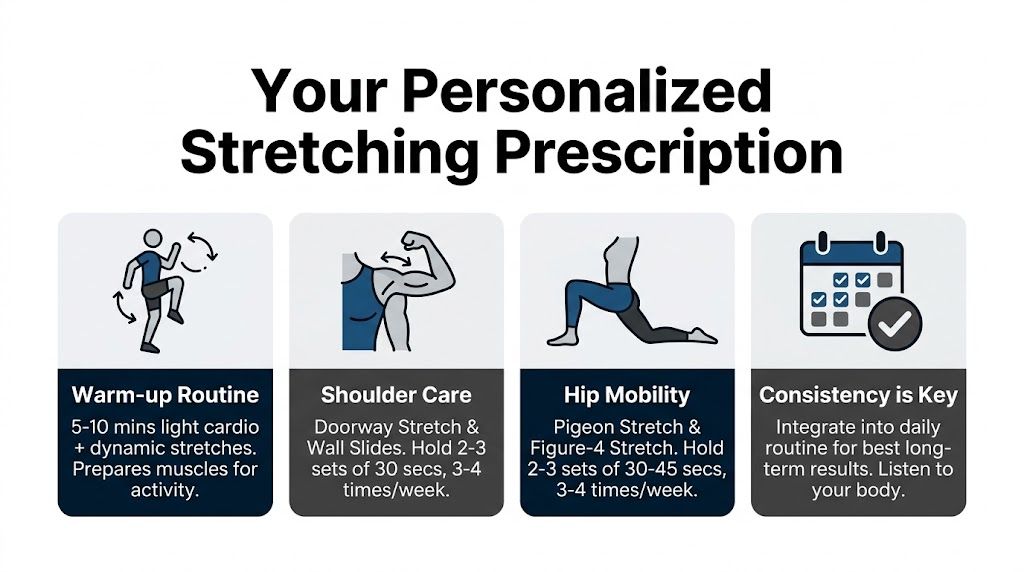
Your Personalized Stretching Prescription
A good mobility plan has to fit the week you live in Boston. If you spend the day at a Financial District desk and squeeze in a run along the Charles before work or after dark, your routine needs to be short enough to repeat and specific enough to address what your body is doing most often.
A practical weekly prescription
Use this framework, then adjust based on your sport, work setup, and recovery:
| Area | Dosage | Notes |
|---|---|---|
| Warm-up | 5 to 10 minutes before stretching | Light cardio plus dynamic movement |
| Shoulders | 2 to 3 sets of 30-second holds, 3 to 4 times per week | Pair with wall slides or controlled rotation work |
| Hips | 2 to 3 sets of 30 to 45-second holds, 3 to 4 times per week | Keep pelvis and trunk position clean |
| Consistency | Fold into your normal week | After runs, after work, or before gym sessions |
The right plan depends on which Boston pattern fits you better.
A desk worker with stiff shoulders usually does better with brief bouts spread through the week. Five minutes after logging off, plus one longer session on the weekend, often works better than trying to cram everything into a single mobility class. A runner or lifter with stubborn hip tightness may need the opposite. A short reset after training, then a separate mobility block on a non-running day, usually keeps the work from feeling rushed.
How to progress and regress
If a stretch bites too early, change the setup first. Reduce the angle, support yourself with a wall or bench, or shorten the hold. That keeps the stretch targeted instead of turning it into a compensation drill.
Progress comes from control, not force. For shoulders, add light banded external rotation or wall lift-offs after the stretch so the new range has a job to do. For hips, move from passive holds into active transitions or loaded split-stance work once the position feels cleaner. If you need equipment for that step, these best resistance bands for physical therapy can make home progressions easier.
One more practical point. Generic mobility plans often miss the demands of the person doing them. Postpartum runners, CrossFit athletes, tennis players, and marathon trainees do not all need the same dosage or exercise selection. A more sport-specific rehab plan should account for impact tolerance, pelvic floor demands, lifting volume, and how symptoms behave during the week. Joint Ventures outlines that approach in its guide to sports therapy and rehab for active adults.
A useful session leaves you looser, steadier, and ready for the next workout or workday. It should not leave you irritated for the next 24 hours.
When to Seek Sports Physical Therapy in Boston
A common Boston pattern looks like this. You spend the day at a Financial District desk, feel your shoulder tighten through the afternoon, then try to loosen it up at home. Or you log miles along the Charles, keep stretching your hips after every run, and still feel the same pinch on stairs or during the first mile the next morning.
At that point, the problem often is not a lack of stretching. It is usually a mismatch between mobility, strength, posture, and load tolerance.
I see this often in Kenmore Square. Runners training for Boston Marathon season may chase hip flexibility when the actual limit is how well the hip handles impact and single-leg control. Desk workers may keep pulling on a stiff shoulder when the driver is neck position, rib cage posture, scapular mechanics, or an irritated tendon that does not want more aggressive stretching.
Signs it’s time to stop guessing
A sports PT evaluation makes sense if any of these show up:
- Stretching makes the pain sharper or more irritable: That usually points to a tissue or joint that needs a different input
- Symptoms have lasted more than two weeks: Short-term stiffness is different from a pattern that keeps returning
- You notice clicking, locking, or catching: Those symptoms change what needs to be examined
- You have numbness or tingling: Nerve symptoms need more than a mobility routine
- You’re changing your day because of it: Cutting runs short, avoiding overhead lifting, sleeping differently, or adjusting your commute all count
What a sports PT visit should actually do
A good sports physical therapy Boston visit should answer a practical question. Why does this keep happening in your real week?
That means looking beyond the sore spot. The exam should look at movement quality, strength deficits, load tolerance, work setup, training volume, and the exact activities that provoke symptoms. For a runner, that may include gait and impact strategy. For a desk worker with shoulder pain, it may include thoracic mobility, neck mechanics, and how the shoulder blade moves under load. For lifters, it should account for training frequency, exercise selection, and whether the current program is feeding the irritation.
Treatment also needs to match the person in front of us. Some cases need a home strength plan and better exercise dosage. Some need hands-on care, running analysis, pelvic floor coordination, vestibular treatment, or a return-to-sport progression. Joint Ventures outlines that approach in its guide to sports therapy and rehab for active adults.
If you are building a home program, band choice matters more than people think. Too much resistance changes the movement and teaches compensation. This review of the best resistance bands for physical therapy is a useful starting point for choosing options that fit your current tolerance.
The goal is a clear plan. If your shoulder still feels pinchy after work, your hips keep tightening on Charles River runs, or you want to get back to lifting without resetting the same problem every week, an evaluation usually saves time and frustration.
If you want one-on-one help from Joint Ventures Physical Therapy, you can schedule at a Greater Boston location including Kenmore Square, Back Bay, Fort Point/Seaport, and Downtown Boston. A focused evaluation can help sort out whether you need mobility work, strength progressions, running analysis, pelvic floor support, or a different rehab plan entirely.