
Your neck starts talking halfway through the workday. It tightens during your Red Line commute, flares after hours on a laptop in the Seaport, or stiffens the morning after a long run along the Charles. By the end of the week, you're turning your whole torso to check traffic on Boylston instead of rotating your head normally.
A lot of people in Boston accept that as part of city life. It isn't. Neck pain is common, but common and normal are not the same thing. If your neck pain is limiting work, sleep, training, driving, or even how comfortably you sit through a meeting, it deserves targeted care.
That Nagging Neck Pain Is Not Normal
The patient I picture most often is easy to recognize in Boston. It's the analyst in Back Bay who spends long stretches at a dual-monitor setup, the graduate student carrying a backpack across campus, or the runner building mileage for marathon season who suddenly notices that arm swing, breathing, and upper-back stiffness all feel off.
At first, neck pain usually looks small. You stretch a little. You crack your neck. You change pillows. You wait for the weekend. But when the same ache keeps returning, or when stiffness starts to spread into the shoulder blades, jaw, or upper back, that's usually a sign that the problem isn't just “sleeping wrong.”
What patients usually notice first
Patients often don't walk into physical therapy saying, “I have a cervical mobility deficit.” They say things like:
- Morning stiffness: Your neck feels locked up when you get out of bed.
- Desk-day aggravation: Pain builds as the day goes on, especially after screen time.
- Workout interference: Lifting, running, swimming, or golf now triggers tension.
- Driving discomfort: Checking blind spots becomes annoying or sharp.
- Stress response: Busy weeks make the symptoms louder.
Practical rule: If your neck pain keeps returning, changes how you move, or starts affecting work or exercise, it's time to stop guessing.
Neck pain is also far from rare. About 70% of people will experience it at some point in life, and up to one-third report neck pain within the last 12 months, according to this neck pain rehabilitation overview. That matters because it reframes the problem. You're not dealing with some strange one-off issue. You're dealing with a condition physical therapists see constantly and treat every day.
The bigger point
The right response usually isn't more rest, random internet stretches, or pushing through until the pain “works itself out.” The useful question is simpler. What's driving the pain in your case, and what will change it?
That's where good neck pain physical therapy in Boston should feel different. It should be specific to your work setup, your commute, your sport, and the movements you need to get back.
Why Neck Pain Is So Common in Boston
Boston packs a lot of neck pain triggers into a normal week. Long desk hours. Laptop-heavy hybrid work. Packed commutes. Cold-weather tension. Marathon training blocks. Student schedules that mix studying, carrying bags, and too little sleep. None of those factors automatically cause pain on their own, but together they create the kind of repeated loading that many necks don't tolerate well.

Boston habits that add up
A classic example is the hybrid worker. Two days in a downtown office might be fine. Then three days at home happen from a kitchen chair, couch, or improvised standing setup. Symptoms often don't explode all at once. They build gradually because the neck, upper back, shoulder girdle, and jaw are absorbing the same low-level stress over and over.
The same pattern shows up in active people. Runners often think neck pain can't be related to training because the pain is “not in the legs.” But arm swing, thoracic rotation, breathing mechanics, and postural endurance all affect how the neck works. Golfers, swimmers, lifters, and cyclists see similar patterns for different reasons.
What helps and what usually falls short
Generic advice often proves insufficient. “Sit up straight” sounds helpful, but it's often too shallow to change persistent symptoms. A recent systematic review found that exercise-based care can reduce pain and disability for nonspecific neck pain, while posture-only advice has weaker and less consistent benefits, as summarized in this Boston review of neck pain treatment and screen-related strain. That matches what clinicians see every week. Better ergonomics can help, but posture reminders alone rarely solve an ongoing problem.
If your symptoms are tied to work setup, it helps to think beyond chair height and monitor position. Muscle endurance, movement quality, and how you load the neck all day matter too. For a practical local read on that side of care, this article on workplace ergonomics and physical therapy in Boston is a useful next step.
Posture matters. But posture without capacity usually doesn't hold up by Thursday afternoon.
A useful Boston-specific lens
Here's the trade-off. Ergonomic changes are low effort and worth doing. But they're support tools, not the whole treatment. If your neck can't tolerate your real life, then the plan has to build tolerance for your real life. That means handling long work blocks, commuting, lifting groceries up a walk-up, training for a race, or studying through finals without your symptoms taking over.
That's why effective neck pain physical therapy in Boston usually works best when it addresses the person's actual weekly demands, not an idealized version of them.
Your First PT Visit at Joint Ventures
Patients often show up to their first visit with one concern beyond the pain itself. They don't want to be rushed through a generic appointment and handed a sheet of chin tucks. That's reasonable.
A strong first evaluation should feel like a problem-solving session, not a transaction.
What happens in the room
The visit usually starts with your story. Not just where it hurts, but when it started, what makes it worse, what you've already tried, whether you're getting headaches, jaw symptoms, dizziness, arm symptoms, sleep disruption, or limits with training or work. For neck pain, those details matter because the same complaint can come from very different movement patterns.
Then the therapist looks at how you move. That often includes neck rotation, extension, flexion, upper-back mobility, shoulder mechanics, breathing pattern, posture under load, and how your symptoms respond to repeated movements or hands-on testing. If your pain shows up while sitting but not while moving, that matters. If it ramps up with running, lifting, or screen use, that matters too.
What the therapist is trying to identify
The first visit is not just about confirming that your neck hurts. It's about sorting out which bucket you're in.
Some common patterns include:
- Mobility-driven pain where the neck or upper back feels stiff and guarded.
- Muscle overuse and endurance problems where symptoms build late in the day.
- Jaw or vestibular overlap when neck pain comes with dizziness, tension headaches, or clenching.
- Radiating symptoms when pain, tingling, or numbness travel into the arm.
That distinction shapes treatment. A patient with workday stiffness needs a different plan than someone whose symptoms spike with overhead lifting or who also reports jaw pain and headaches.
The first goal is clarity. Once the driver is clearer, the plan gets much simpler.
What you should leave with
By the end of the visit, you should understand:
- What seems to be driving the pain
- Which movements or habits are aggravating it
- What the early treatment plan will focus on
- What you can start doing right away at home or work
You don't need every answer on day one. But you should leave feeling like the problem makes more sense than it did when you walked in.
Advanced Neck Pain Treatments for Bostonians
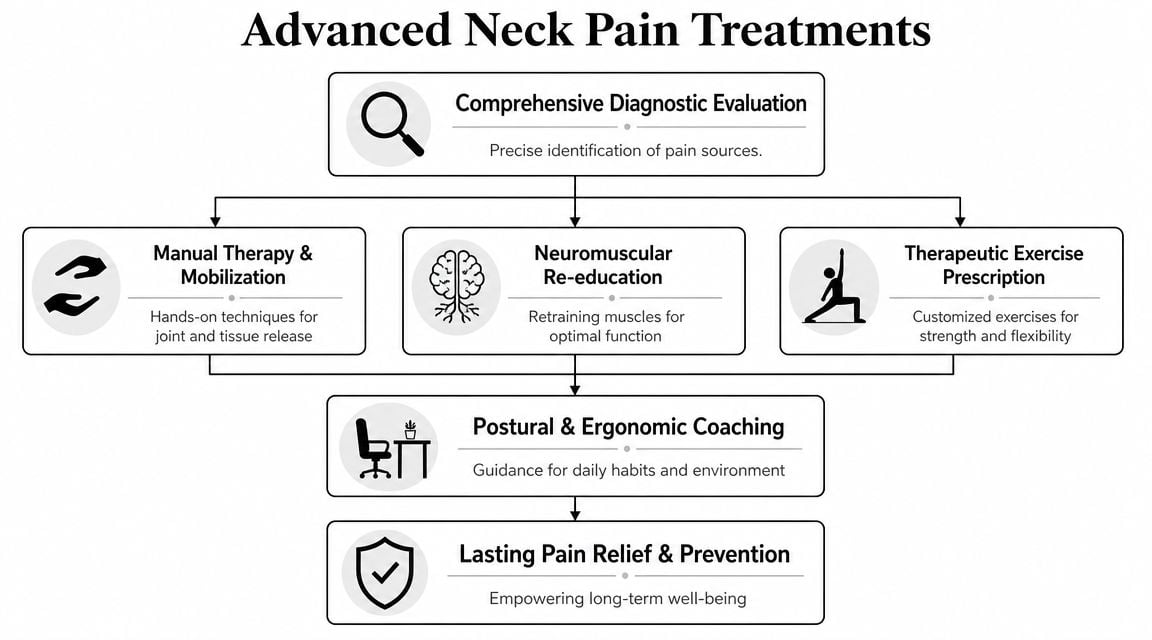
Not every neck problem needs advanced treatment tools. Some people respond quickly to movement changes, strengthening, and manual therapy. Others have been dealing with recurring pain for months, have layered symptoms, or have already tried the basics without enough progress. That's where a broader clinical toolbox matters.
The current standard for chronic neck mobility deficits is not passive care alone. The 2017 JOSPT clinical practice guideline recommends a multimodal program that can include cervical or thoracic manipulation or mobilization, mixed exercise, and dry needling, with the reasoning that improving movement, strength, and endurance helps restore load tolerance through the cervical-thoracic chain, as described in the JOSPT neck pain clinical practice guideline.
When basic care isn't enough
Patients often need more than stretching when they have stubborn muscle guarding, jaw involvement, dizziness, or a heavy sports load. A clinic that offers dry needling, TMJ treatment, vestibular care, and aquatic therapy can handle those mixed presentations more directly.
Here's where those services become especially relevant in Boston:
- Trigger point dry needling: Useful when the neck, upper trapezius, levator scapulae, or jaw-adjacent muscles stay locked down despite exercise and manual work. If you want a closer look at when it's used, this overview of dry needling in Boston explains the local treatment approach.
- TMJ treatment: Helpful when neck pain and jaw tension travel together. Patients who clench during deadlines or wake with facial tension often fit this pattern.
- Vestibular therapy: Important when neck pain is accompanied by dizziness, motion sensitivity, or balance complaints.
- Aquatic therapy: A smart option when land-based exercise is too irritating early on, or when someone needs a lower-load starting point.
Real trade-offs in treatment selection
Every tool has a job. None of them should be used because they sound advanced.
| Treatment approach | Often useful for | Limitation if used alone |
|---|---|---|
| Manual therapy and mobilization | Stiffness, motion loss, guarded joints | Relief may fade if strength and endurance don't improve |
| Dry needling | Persistent muscle tension and trigger points | Doesn't replace active retraining |
| TMJ-focused care | Jaw pain, clenching, headaches with neck pain | Won't fix a full-body loading issue by itself |
| Vestibular treatment | Dizziness or balance symptoms with neck pain | Needs matching to the actual symptom pattern |
| Exercise progression | Long-term resilience and function | Too generic, and patients stop improving |
A good treatment plan doesn't ask one method to do everything.
One option in Greater Boston is Joint Ventures Physical Therapy, which offers one-on-one physical and occupational therapy along with services such as trigger point dry needling, TMJ care, vestibular treatment, aquatic therapy, and workplace ergonomics. For neck pain, that matters because patients don't always fit neatly into a single category.
What this means for the patient
If your neck pain has felt “stubborn,” the answer usually isn't chasing more temporary relief. It's getting a plan that matches the full picture. For a desk worker, that may mean upper-back mobility plus endurance and ergonomic changes. For a runner, it may mean gait-related postural loading and thoracic rotation. For someone with jaw tension and headaches, it may mean combining cervical care with TMJ-focused treatment.
That's the difference between a generic neck program and care built for the person in front of you.
An Active Approach to Neck Pain Recovery
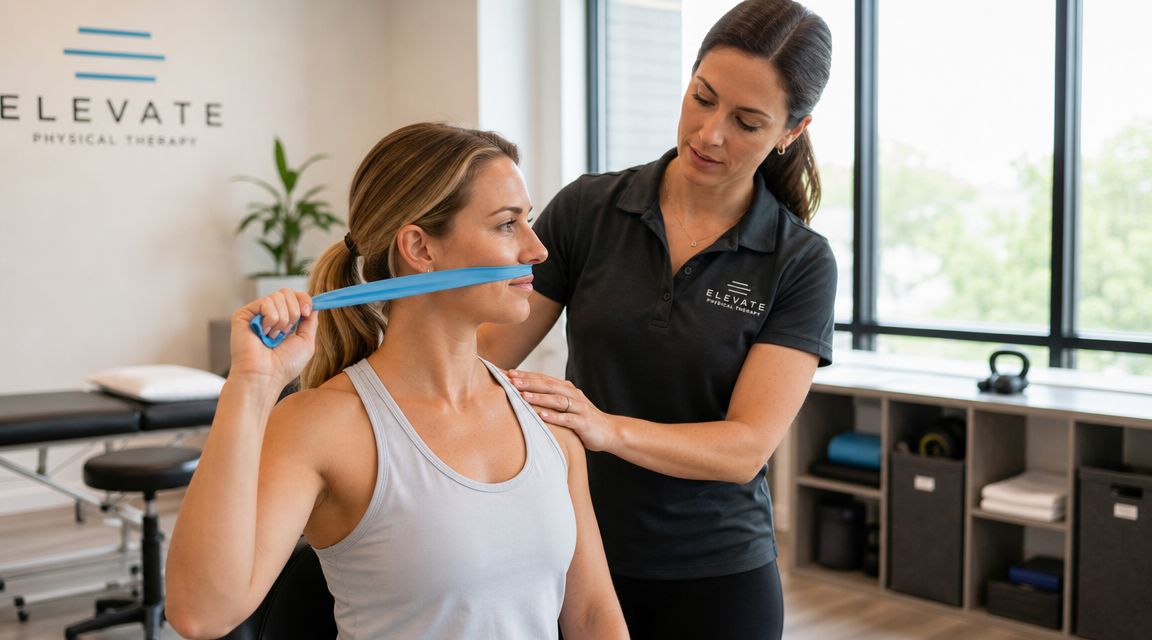
Good treatment should make you less dependent on treatment over time. That's why exercise matters so much in neck pain recovery. Not generic handouts. Not a random collection of stretches. A plan that matches your actual deficits and your actual life.
What an active program should do
A useful exercise program usually has more than one goal. It may need to improve neck motion, build postural endurance, reduce overuse in the upper traps, restore upper-back mobility, and make your shoulders and trunk work better with your neck. If you sit all day, the target is different than if you row, lift, or train for the Boston Marathon.
That's why the best programs are specific. One person needs better tolerance for eight hours at a laptop. Another needs to rotate comfortably to check blind spots while driving. Another needs enough control and endurance to run or golf without the neck taking over.
Reasonable recovery expectations
The timeline shouldn't feel mysterious. In one published study, patients with neck pain who completed an average of 4 weeks of physical therapy, at around 7 visits, showed statistically significant improvement. For chronic neck pain, success rates rose from 70% to 77%, and benefits were often maintained through 4 weeks of follow-up, according to the PubMed record summarizing that neck pain PT study.
That doesn't mean every patient follows the same schedule. It does mean progress should usually be measurable within weeks when the diagnosis is solid and the plan is specific.
If you're doing the same exercises for weeks with no clear change in pain, motion, or function, the plan probably needs to be adjusted.
Education matters because life doesn't stop
Most patients don't need to stop working or stop being active. They need to know what to modify, what to keep doing, and how to progress without feeding the pain cycle. That's where education matters just as much as exercise selection.
For a deeper dive into the anatomy of neck conditions and the science behind these exercises, visit our educational partner, Highbar Health at highbarhealth.com.
A quick visual can help if you want to see one example of guided neck exercise in action:
Prevention is built into recovery
The strongest rehab plans don't stop at symptom relief. They prepare you for the thing that aggravated you in the first place. That may mean better workstation habits, smarter lifting mechanics, a return-to-running progression, or improved control for swimming, tennis, or golf.
That's why active rehab is the center of effective neck pain physical therapy in Boston. The city doesn't get less demanding. Your body just gets better prepared for it.
Convenient Neck Pain Care Across Boston
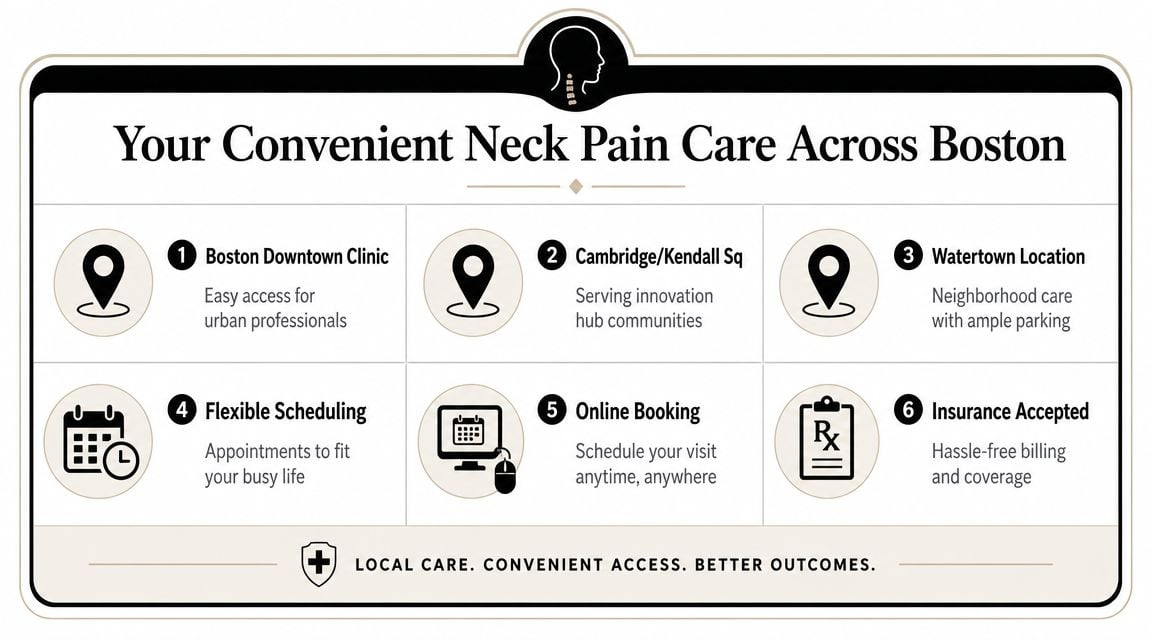
When neck pain is already disrupting your week, logistics matter. If scheduling feels hard, parking feels impossible, or the insurance process feels unclear, people delay care longer than they should.
That's why local access matters just as much as clinical skill.
Where patients usually look first
Boston patients often want care close to where they already live, work, or train. Commonly used neighborhoods include Back Bay, Kenmore Square, Fort Point and Seaport, Downtown Boston, Brookline and Allston, plus surrounding communities. If you want a neighborhood-specific option, this page on physical therapy in Back Bay Boston is a good place to start.
What makes getting started easier
The practical details matter more than most clinics admit. Patients are busy. They need appointments that work around meetings, classes, childcare, and training.
A smoother process usually includes:
- Early or late availability: Helpful for commuters, professionals, and students.
- Front-desk insurance support: Important when you don't want to sort through benefits alone.
- Clear booking options: Easier when symptoms are already distracting enough.
- Location convenience: Useful when your treatment plan includes regular follow-up visits.
The easier it is to get in consistently, the more likely you are to finish the plan and actually improve.
What to ask before you book
Before scheduling neck pain physical therapy in Boston, ask a few direct questions:
- Will I work one-on-one with a licensed clinician each visit?
- Does the clinic treat related issues like TMJ symptoms, dizziness, or sports-specific neck pain?
- Can the front desk help verify insurance and explain next steps?
Those answers usually tell you a lot about how the experience will feel.
Start Your Path to a Pain-Free Neck Today
Neck pain can start small and become part of everything. Work. Sleep. Training. Driving. Concentration. Mood. The problem is that people get used to compensating, and the longer that goes on, the more the pain starts shaping daily life.
It doesn't have to stay that way.
The right care is specific. It looks at how your neck works with your upper back, shoulders, jaw, balance system, work setup, and sport. It uses the tools that fit your presentation, not a one-size-fits-all sequence. And it gives you a plan you can follow in Boston, with your schedule and your routines.
If you've been waiting for the pain to calm down on its own, this is a good time to stop waiting. Whether your symptoms came from desk work, marathon prep, lifting, commuting, jaw tension, or a mix of all of the above, a focused evaluation can clarify the next step quickly.
If you're looking for neck pain physical therapy in Boston, book an evaluation at the location that fits your week and get a plan built around how you live and move.
Ready to move better, work more comfortably, and get back to training without neck pain running the show? Schedule your evaluation with Joint Ventures Physical Therapy and choose the Greater Boston location that's most convenient for you.