
Your hand does not have to be completely unusable to deserve treatment. In Boston, a lot of people wait too long. They type through wrist pain in the Seaport, keep lifting groceries up a Back Bay walk-up with a sore thumb, or try to get back to training after surgery and assume stiffness is just part of the process.
Usually, the problem shows up in ordinary moments first. Opening a water bottle hurts. Gripping the T after a long workday feels weak. Your hand falls asleep while you bike, cook, write, or sleep. If that sounds familiar, hand therapy in Boston is often the missing step between “it's probably fine” and getting your normal life back.
Regain Your Edge with Hand Therapy in Boston
Boston puts a lot on your hands. Students carry laptops and backpacks across campus. Clinicians and lab workers repeat the same motions all day. Runners and lifters rely on grip more than they realize. Remote workers sit for hours with poor desk setup, then wonder why their forearm feels tight and their fingers tingle at night.
I see the same pattern across the city. Someone starts with a mild ache in the wrist or thumb. They adjust their keyboard, shake out the hand, buy a brace online, and hope it settles down. Sometimes it does. Often it doesn't. The symptoms spread from an annoyance to a real limit on work, exercise, sleep, and confidence.
That's where hand therapy becomes useful. Not as a generic rehab add-on, but as focused care for the hand, wrist, forearm, and elbow. Good treatment isn't just about making pain quieter. It's about restoring the movements you need, whether that's gripping a barbell, returning to the clinic after surgery, holding a scalpel steadily, carrying a child, or working through a full day at a laptop without paying for it later.
Practical rule: If hand or wrist symptoms are changing how you work, train, sleep, or use your arm, it's time for a proper evaluation.
In Boston, that matters even more because upper-extremity care is often tied closely to orthopedic and surgical pathways. People aren't just dealing with vague soreness. They're recovering from fractures, tendon injuries, repetitive strain, nerve irritation, and post-operative stiffness. The treatment has to match that level of complexity.
For many patients, the goal isn't “less pain.” It's getting your edge back. Better dexterity. Better grip. Better confidence using the hand without guarding every movement. That's the difference between resting indefinitely and moving forward with a clear plan.
Who Needs Hand Therapy in the Boston Area
Hand therapy in Boston sits inside a very specific healthcare culture. Major academic centers have long treated it as a specialized upper-extremity service, not a generic rehab extra. Mass General's Hand & Arm Occupational Therapy program, for example, treats post-surgical and post-traumatic cases such as tendon repairs, fractures, replantations, and revascularizations, and it requires a physician referral with a date and diagnosis before therapy begins, which reflects Boston's medically integrated model of care for complex upper-extremity problems (Mass General Hand & Arm Occupational Therapy).
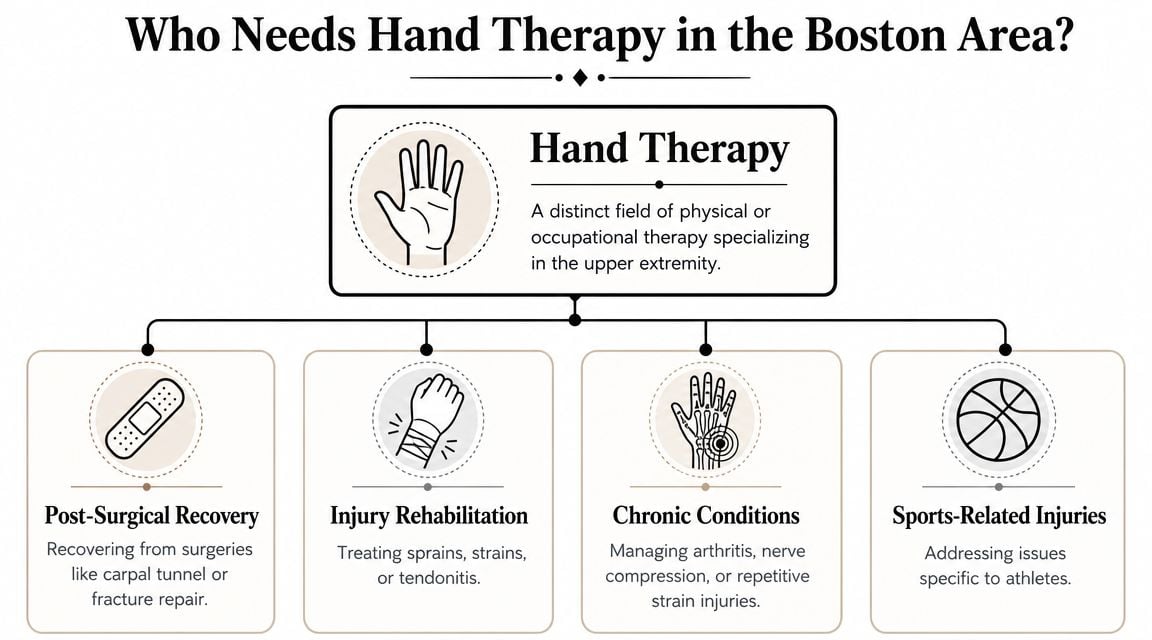
It's not only for post-op patients
A lot of people assume hand therapy is only for surgery recovery. That's too narrow. In Boston, I'd group the most common patients into four broad buckets:
- Post-surgical patients who need guided progression after a procedure on the hand, wrist, or forearm
- People with overuse symptoms from desk work, lab work, childcare, music, or tools
- Athletes and active adults dealing with finger, wrist, or elbow injuries that affect performance
- Adults with persistent stiffness, pain, or nerve symptoms who want to avoid letting a small problem become a long one
The hand is small, but the consequences of poor recovery are not. If you lose grip, pinch strength, motion, or coordination, ordinary tasks get complicated fast.
Common conditions we treat with hand therapy in Boston
| Condition | Who It Affects | Goal of Therapy |
|---|---|---|
| Carpal tunnel syndrome | Desk workers, commuters, people with repetitive hand use | Reduce irritation, improve hand use, support daily function |
| Tennis elbow or forearm overuse | Lifters, racquet sport athletes, professionals who grip or type all day | Calm symptoms and rebuild load tolerance |
| Wrist sprains and strains | Active adults, students, gym-goers, people after falls | Restore motion, stability, and confidence |
| Post-op fracture care | Patients recovering after surgical fixation or immobilization | Recover movement, manage stiffness, regain function |
| Tendon injuries or repairs | Athletes, workers, post-surgical patients | Protect healing tissue while restoring controlled movement |
| Thumb pain and arthritis | Professionals, parents, older adults, people with repetitive pinch demands | Improve comfort and hand function |
| Nerve irritation and numbness | Remote workers, cyclists, sleepers with nighttime symptoms | Reduce aggravation and improve dexterity |
| Finger injuries | Climbers, basketball players, people with jammed or stiff fingers | Restore motion and hand mechanics |
If you're dealing with numbness or wrist pain from daily computer use, our guide on how to treat carpal tunnel syndrome naturally covers the local, practical side of early management.
The right patient for hand therapy isn't defined by a diagnosis alone. It's anyone whose symptoms are interfering with useful hand function.
Your First Hand Therapy Session What to Expect
You wake up with a hand that feels stiff, weak, or numb, then spend the whole morning noticing everything you cannot do comfortably. Holding a coffee cup feels off. Typing is slower. Gripping the T on the ride into downtown Boston or carrying a work bag up a flight of stairs suddenly takes more effort than it should. The first session is designed to sort out why that is happening and what needs to change first.
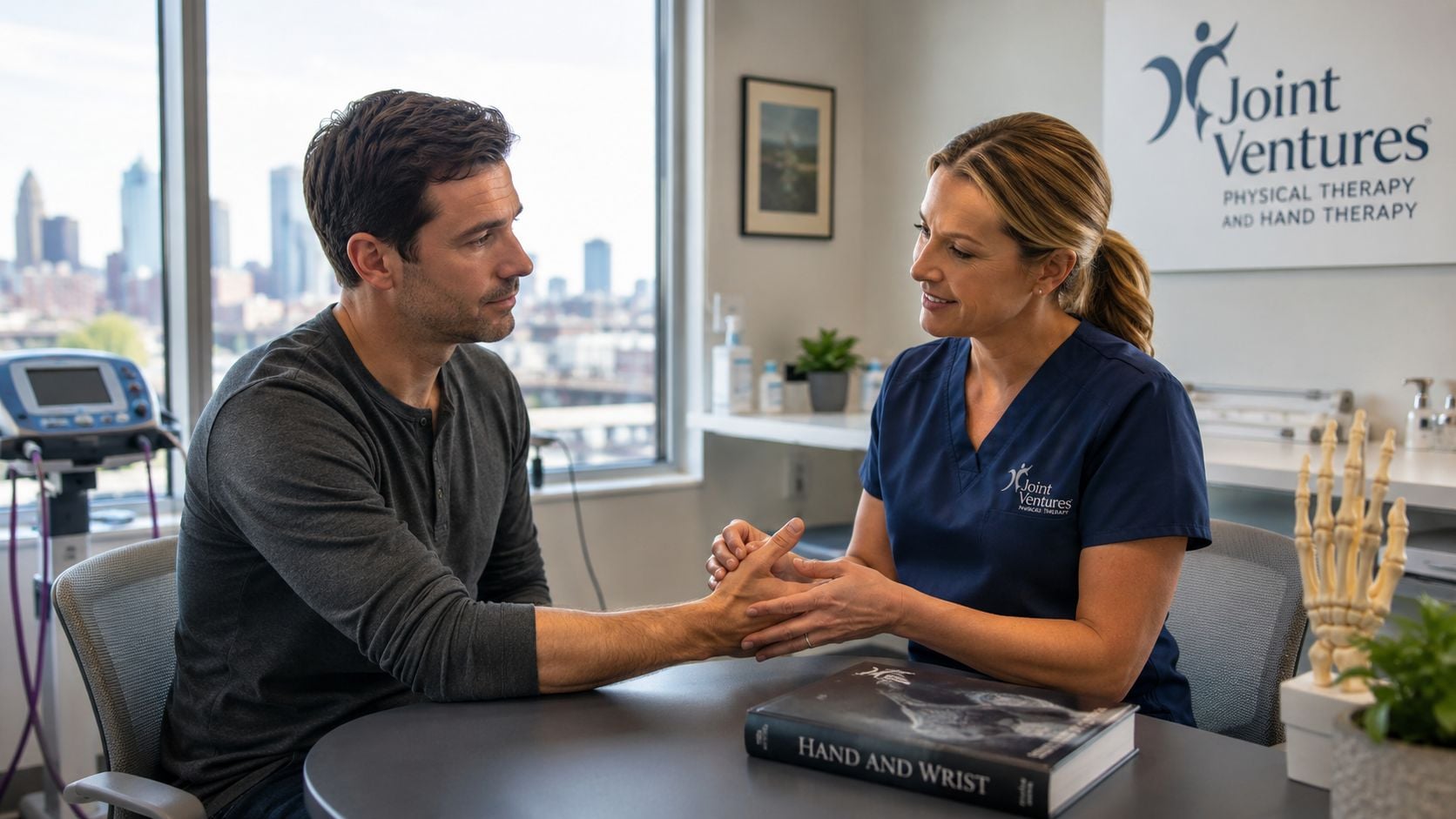
The evaluation starts with your actual day
A good first visit is specific. I want to know when the problem started, what motions set it off, what time of day it is worst, whether you have had imaging, injections, or surgery, and what you need your hand to do in real life. A software engineer in Fort Point, a Longwood medical trainee, a parent carrying a toddler through Back Bay, and a rower trying to get back on the Charles all place different demands on the same wrist or hand.
The exam follows that history. We look at motion, swelling, scar mobility, tenderness, sensation, pinch or grip tolerance when appropriate, and how the fingers, wrist, forearm, and elbow are working together. The goal is to identify the driver of the limitation, not just confirm the place that hurts.
If you want the practical side of forms, clothing, timing, and what to bring, this guide on how to prepare for your first physical therapy appointment is a useful starting point.
What your plan may include
Boston patients often expect either exercises or a splint. Good care is usually more customized than that.
- Hands-on treatment can help reduce stiffness, improve scar mobility, and calm guarded movement.
- Targeted exercises are chosen based on healing stage, irritability, and the hand tasks you need to return to.
- Custom orthoses or splints may protect a repair, unload an irritated structure, or help you use the hand with less aggravation.
- Education covers the habits between visits that affect recovery, including workstation setup, lifting choices, sleep position, and pacing.
There are trade-offs. Push too hard too early and swelling, pain, or tendon irritation can flare. Wait too long to move and stiffness becomes harder to reverse. Early hand therapy often lives in that middle ground, especially after surgery or immobilization.
Later in the visit, it helps to see treatment in action:
Coordination matters in Boston
In Boston, hand therapy often sits inside a larger medical team. Spaulding's Boston-area hand therapy program describes coordinated care for post-operative recovery, edema control, scar management, custom orthoses, sensory re-education, and ergonomic assessment after fractures, crush injuries, ligament repairs, and repetitive strain problems (Spaulding hand therapy in Boston).
That coordination is especially useful if your surgeon is at one of the major hospital systems in the city. Procedure notes, precautions, and follow-up timelines can shape the plan from the start instead of getting pieced together later. In Boston, that is an even more important distinction because many patients are balancing specialist care, dense work schedules, and commutes while trying to recover enough hand function to keep daily life moving.
At Joint Ventures Physical Therapy, care is typically one-on-one and centered on the specific upper-extremity problem in front of you, whether that is post-op stiffness, a tendon issue, or a work-from-home overuse problem.
The Evidence Behind Hand Therapy Outcomes
Patients usually ask some version of the same question. Does this work, or am I just signing up for weeks of exercises I could find online?
The short answer is that the strongest support in hand therapy tends to cluster around a few core treatments. In a mapping review of the literature, exercise appeared in 72.3% of studies, and exercise, education, and orthotic interventions were each used in more than 100 studies. The same review found that osteoarthritis, tendon surgeries, and carpal tunnel syndrome were among the most frequently studied diagnoses, while only 12 studies used activity-based interventions, showing a long-standing emphasis on impairment-focused care rather than task-based rehabilitation (mapping review of hand-therapy literature).
What that means for a patient in Boston
That research pattern lines up with what many Boston patients need most. If you're recovering from a tendon procedure, dealing with carpal tunnel symptoms, or managing hand arthritis, the evidence base is strongest for the basics done well:
- Exercise that matches healing stage and symptom behavior
- Education so you stop feeding the problem between visits
- Orthotic management when protection or support is appropriate
What usually does not work is random internet advice, aggressive gripping drills too early, or wearing a brace around the clock without knowing the purpose. Those approaches often either irritate healing tissue or create unnecessary stiffness and dependence.
The best hand therapy plans are rarely flashy. They're precise, repeatable, and adjusted at the right time.
Patients don't need more complexity. They need the correct dose, the right progression, and a clinician who can tell the difference between normal recovery discomfort and a plan that's pushing too hard. For a deeper look at the clinical research on upper extremity rehabilitation, visit our educational partners at Highbar Health.
How to Choose the Right Hand Therapist in Boston
Not every clinic that treats a wrist or elbow problem offers true hand therapy. In Boston, where patients often move between primary care, orthopedics, urgent care, and hospital systems, provider choice makes a big difference. The right fit can keep recovery moving. The wrong fit can turn a manageable issue into months of stop-and-go progress.
Start with specialization
The clearest credential to look for is Certified Hand Therapist, or CHT. According to the American Society of Hand Therapists, that credential requires at least three years of clinical experience plus a passing score on an advanced examination in upper-extremity rehabilitation, which signals specialized knowledge in anatomy, kinesiology, and task-specific functional retraining for complex hand and upper-extremity conditions (Certified Hand Therapist requirements).
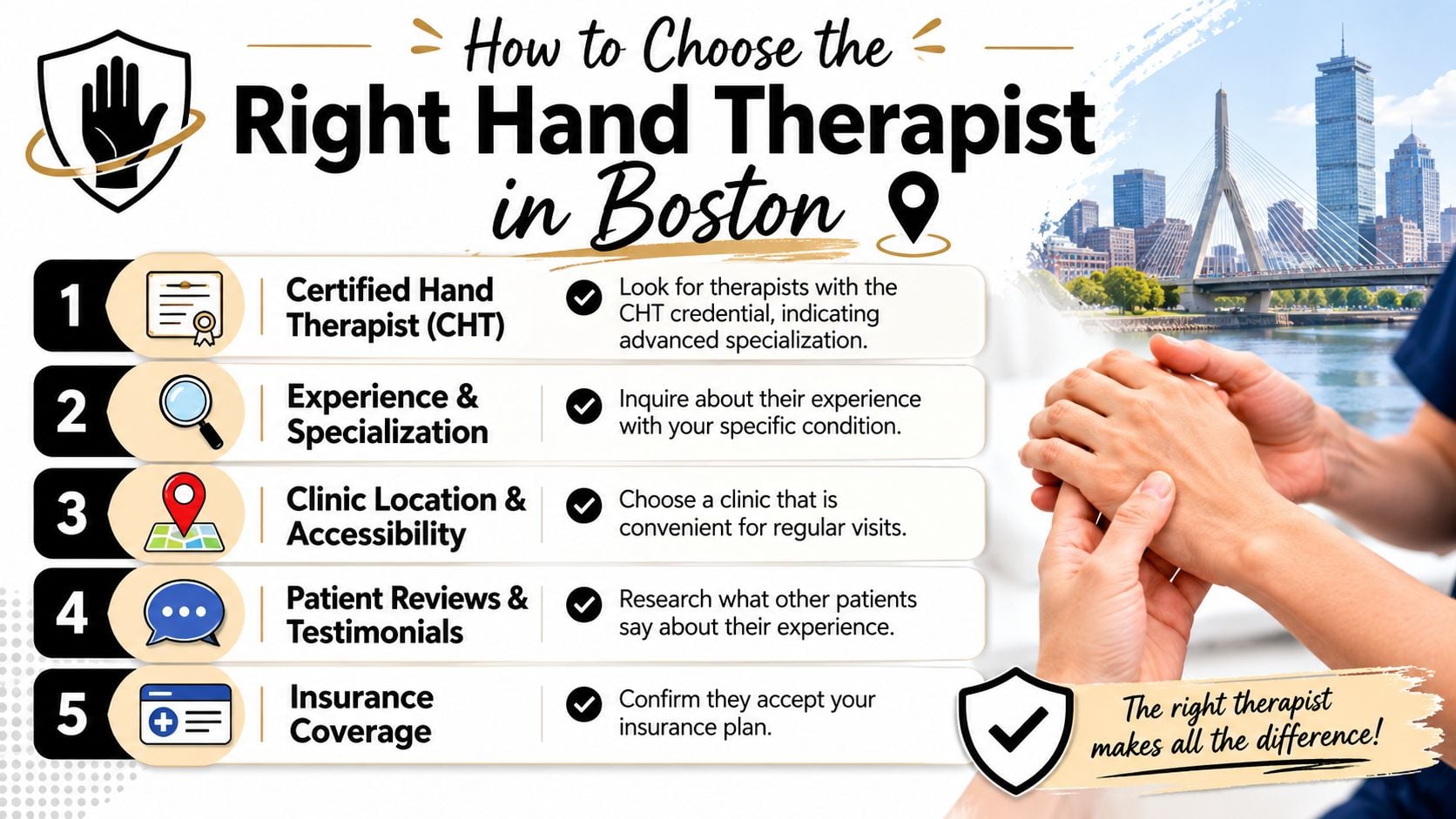
That doesn't mean every non-CHT clinician is a poor fit. It does mean you should ask direct questions if your case is complex. Post-op stiffness, tendon recovery, nerve symptoms, fractures, and persistent hand pain usually benefit from a therapist with deeper upper-extremity training.
Then look at the care model
A good Boston clinic should make practical sense for your life, not just your diagnosis.
- One-on-one time matters if you need splinting, manual treatment, detailed exercise coaching, or close symptom monitoring.
- Condition-specific experience matters if your issue involves surgery, repetitive strain, or return to sport.
- Location matters because hand therapy works best when you can attend consistently. Back Bay, Kenmore Square, Downtown, Fort Point, and nearby neighborhoods all create different commute patterns.
- Administrative support matters when referrals, insurance checks, and scheduling can delay care.
If you're comparing OT and upper-extremity care options locally, our page on occupational therapy in Boston can help clarify what to ask.
Ask a clinic how they handle post-op communication, splinting needs, and progression decisions. If the answers are vague, keep looking.
For readers interested in the professional pipeline behind rehab care in Massachusetts, it can also be useful to explore WeekdayDoc physical therapy careers. It gives context on the kinds of roles and settings that shape clinician experience across the state.
Your Questions About Hand Therapy Answered
Do I need a doctor's referral for hand therapy in Massachusetts
It depends on your case, your insurance, and whether you're entering care through a surgical pathway. In Boston, hospital-based upper-extremity programs often work through physician referral systems, especially for post-operative cases. If you already have a surgeon, orthopedist, or referring provider, bring that information with you. If you're not sure what applies to your situation, call before booking so the front desk can clarify the next step.
Does Joint Ventures accept my insurance
Insurance participation can vary by plan, employer network, and location. The fastest way to get a reliable answer is to contact the clinic directly with your insurance card details. That lets staff verify benefits, explain authorization needs if any apply, and reduce surprises before the first visit.
How long is a typical hand therapy session
Expect enough time for focused evaluation and treatment rather than a rushed check-in. Sessions usually include some combination of assessment, symptom review, exercise progression, hands-on care, home program updates, and discussion of what you're doing at work or outside the clinic that may be helping or hurting recovery. The exact format depends on whether you're early after injury, post-op, or further along.
Where are your clinics located in Boston
Joint Ventures serves Greater Boston with locations convenient to neighborhoods such as Back Bay, Kenmore Square, Fort Point/Seaport, Downtown Boston, Brookline, Allston, and surrounding communities. That matters because hand therapy often works best with steady follow-through, and a realistic commute makes consistency easier.
What should I bring to the first visit
Bring any referral paperwork if you have it, along with imaging reports, operative notes, or discharge instructions if you're coming after surgery or urgent care. Wear something that gives easy access to the elbow, forearm, wrist, or hand. If you already use a brace, splint, or ergonomic device, bring that too. Seeing what you're currently using often helps shape the plan.
How soon should I come in
Sooner is usually better than waiting for the problem to become stubborn. Early treatment can help direct movement, protect healing tissue when needed, and clean up the daily habits that keep symptoms active. If you've been “waiting to see” for a while and the hand still isn't right, that's already useful information.
If hand pain, numbness, stiffness, or post-op recovery is getting in the way of work, workouts, or day-to-day life, book an evaluation with Joint Ventures Physical Therapy. With locations across Greater Boston, it's easy to find care near home or work and start building a clear plan back to comfortable, confident hand use.