
Feeling winded just from climbing a flight of stairs or chasing your kids around the yard is frustrating, we know. But the solution isn’t always more cardio. More often than not, it comes down to retraining how you breathe.
We hear it from folks in our clinic every single day: "I just feel so out of breath all the time." It’s a common complaint, but many people don't realize the fix often lies in retraining a single muscle that’s been working inefficiently, sometimes for years.
Your breathing capacity—how much air your lungs can take in—powers every single move you make. Think of it as your body's engine. If that engine isn't running smoothly, everything else sputters. This isn't just a problem for athletes; it affects your energy for daily life, and we want to help you fix that.
The Diaphragm: Your Body's Main Breathing Muscle
The star player here is your diaphragm, a large, dome-shaped muscle that sits right at the base of your lungs. When you take a proper breath, your diaphragm contracts and moves downward. This simple action creates space in your chest cavity, allowing your lungs to expand fully and pull in a rich supply of oxygen.
Unfortunately, many of us develop a bad habit of "chest breathing." We start relying on smaller, less efficient muscles in our neck, shoulders, and chest to do the primary work of breathing.
This pattern leads to a few key problems we see all the time:
- Shallow Breaths: You take in less air with each breath, so your body gets less oxygen to work with. It's like trying to run a car on fumes.
- Muscle Tension: Overworking your neck and shoulder muscles is a surefire recipe for tightness, stiffness, and even pain.
- Increased Stress: Chest breathing is directly linked to the body's "fight or flight" response, which can keep you in a state of low-grade, chronic stress.
The normal respiratory rate for a resting adult is between 12 to 20 breaths per minute. If you notice your breathing is consistently faster and shallower than this, you might be relying too much on your chest and neck muscles.
To effectively address feeling winded, it's important to first understand what's going on. You can explore what causes shortness of breath to see if there are other factors at play.
Understanding this foundation is the first step toward using targeted exercises to feel stronger and more energetic. It's about making your body's engine more efficient.
Mastering Diaphragmatic Breathing
Before we get into any complex exercises, we have to nail the absolute foundation of good movement: diaphragmatic breathing. Most people we see in the clinic are what we call "chest breathers," relying on the smaller, less efficient muscles in their neck and shoulders to do all the work. It's a habit that almost guarantees neck tension, headaches, and feeling gassed way too easily.
Think of it this way. Your diaphragm is the body's primary, most powerful breathing muscle. When you don't use it, you're asking a couple of small neck muscles to do the job of a V8 engine. They just weren't built for that kind of load, and they wear out fast.
This is exactly what happens when you get winded walking up a flight of stairs. Your breathing pattern shifts, becomes inefficient, and you're left gasping. The key to recovery is shifting it back.
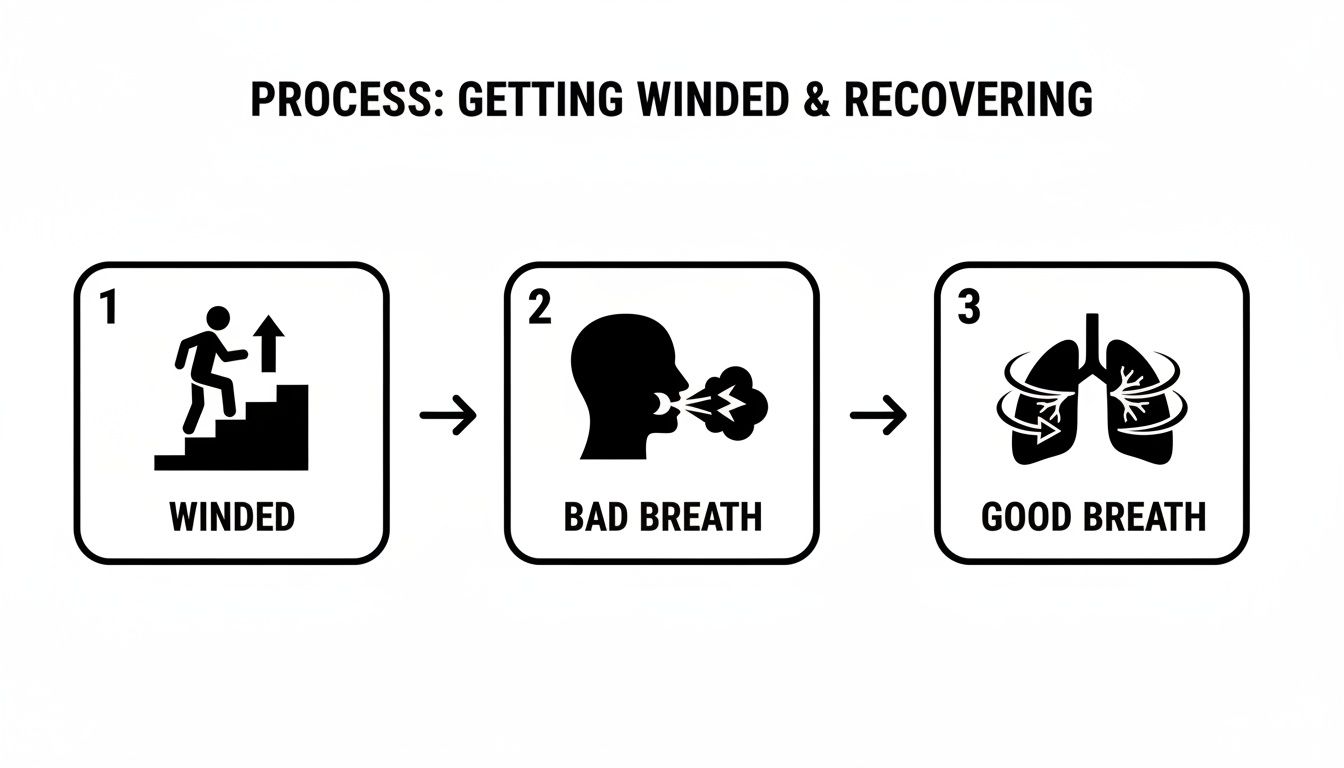
When you feel that out-of-breath sensation, it’s often a sign of inefficient chest breathing taking over. Transitioning back to deep, diaphragmatic breathing is how you regain control. Trust us, retraining this one muscle is a total game-changer, impacting everything from your core stability to how you manage stress.
How to Practice Diaphragmatic Breathing
Let's walk through this just like we would in a one-on-one session. The easiest way to feel this is by lying on your back with your knees bent and feet flat on the floor. This position takes gravity out of the equation and lets your body relax, so you can focus only on your breath.
- First, place one hand flat on your upper chest and the other on your belly, right below your rib cage.
- Now, breathe in slowly through your nose. The goal here is to feel the hand on your belly rise up toward the ceiling. The hand on your chest should stay relatively still.
- Then, exhale slowly through your mouth. Let your belly fall naturally as the air leaves your lungs.
Common Mistake: The most frequent error we see is something called "paradoxical breathing," where the stomach actually sucks in during the inhale. Your hands are your best feedback tool here. If your chest hand is moving more than your belly hand, you're still stuck in that old, inefficient pattern.
Once you get the hang of it lying down, try it while sitting upright in a chair. To really master this, you might find it helpful to understand the nuances of Nasal Breathing vs Mouth Breathing and how each impacts your system.
Finally, practice it while standing. This is where posture comes into play, because a slouched posture can physically block your diaphragm from moving properly. If you find yourself struggling to breathe well while standing, our guide on how your posture can be corrected is a great resource.
Making this single exercise an automatic habit is your first and most important win. It’s the platform for everything else.
Practical Exercises to Improve Lung Function

Alright, once you have the hang of belly breathing, it's time to start challenging the system. We're moving beyond the basics and into drills that build real-world capacity.
These exercises are designed to layer on top of that foundation. We'll work on controlling your breathing tempo, creating more space in your ribcage for your lungs to expand, and even using a simple tool for a surprisingly tough workout. Think of it as moving from practice into the game.
Find Your Rhythm with Paced Breathing
One of the easiest ways to improve your breathing efficiency is simply to slow it down. Paced breathing trains your body to shift out of a high-alert state and into one of calm control. The best part? You can do this absolutely anywhere.
A great place to start is with the 4-7-8 technique:
- Breathe in quietly through your nose for a count of four.
- Hold your breath for a count of seven.
- Exhale fully through your mouth, making a gentle "whoosh" sound, for a count of eight.
The specific numbers aren't magic—it's the ratio that matters. Your exhale should be roughly twice as long as your inhale. This helps ensure you're fully emptying your lungs, which makes room for a much deeper, more satisfying breath on the next cycle.
Create More Space with Rib Cage Mobility
Your lungs are housed inside your ribcage. If that cage is stiff and immobile, it's like trying to blow up a balloon inside a small, rigid box. It can only expand so much. These next drills are all about mobilizing the ribs to give your lungs more room to work.
One of our go-to exercises in the clinic is a simple rib stretch.
- Sit or stand tall and take a deep breath in, filling your lungs completely.
- Hold the breath for a moment as you reach one arm straight up and over your head, creating a gentle "C" curve with your torso. You should feel a light stretch along the side of your ribs.
- Exhale as you come back to the start, then repeat on the other side.
This isn't about forcing a deep, aggressive stretch. The goal is to pair the movement with a full breath. Inhaling while your side is lengthened helps pry open those tight spaces between the ribs, improving your thoracic mobility over time.
Use a Balloon for a Surprise Workout
This might sound like we’re planning a birthday party, but blowing up a balloon is a surprisingly potent exercise for your respiratory muscles. It specifically challenges your expiratory muscles—the ones that do the work of pushing air out. When you strengthen them, you can achieve a more complete exhale.
This simple drill has shown some seriously impressive results. We've seen balloon-blowing exercises become a game-changer for improving lung function, even in difficult patient cases. One study showed significant gains in key lung capacity measures and core muscle activity after just four weeks of consistent practice. You can see the research for yourself and learn more about how this simple drill improves lung function.
Here’s how to try it:
- Take a deep diaphragmatic breath in through your nose.
- Pinch the balloon and bring it to your lips.
- Exhale with force and control into the balloon, trying to push all your air out in one steady stream.
- Take a minute to rest before you go again.
Start with just a few reps. You will be surprised at how much this works your abs and respiratory muscles. As you get stronger, you'll notice you can inflate more of the balloon with a single breath—a clear sign your capacity is on the rise.
For every runner, cyclist, and weekend warrior out there, we need to talk. Breathing isn't just about getting enough oxygen; it’s a critical piece of your performance puzzle. Getting this right is how you push back fatigue, boost your endurance, and recover faster between hard efforts.
So many athletes get hyper-focused on their cardiovascular engine or building muscular strength, but completely neglect the very system that fuels it all. A weak or inefficient respiratory system can be the bottleneck that’s holding you back from that next PR.
The strategies we're about to cover are the same ones we use in our sports rehab programs. They’re designed to help you break through those frustrating performance plateaus by turning your breath into a serious asset.
Use Intensity to Build Breathing Capacity
It might sound a little backward, but one of the most effective ways to improve your breathing capacity is to challenge it with high-intensity exercise. Your training itself is a powerful tool. When you push your body hard, you force your respiratory muscles to adapt and get stronger—just like any other muscle you train in the gym.
This isn't just our hunch; it's backed by solid evidence. High-intensity physical activity is a powerhouse for boosting lung function. A detailed study found that increasing the duration of high-intensity exercise led to a 2.0-unit increase in both Forced Vital Capacity (FVC) and Forced Expiratory Volume (FEV₁) for every unit increase in activity duration. You can check out more details about these findings on athletic breathing capacity.
This shows a direct link between pushing your limits and building a more powerful respiratory system. Those tough interval workouts or hill repeats are doing more than just building leg strength—they are a targeted exercise to increase breathing capacity.
The key here is controlled, progressive overload. Don't go from zero to one hundred. You want to gradually incorporate short bursts of higher intensity into your routine. This allows your body—and your lungs—to adapt and grow stronger over time.
Low-Impact Drills for Respiratory Strength
You don't always need to go all-out to strengthen your breathing muscles. In fact, simple, low-impact drills can be incredibly effective, especially for building a solid foundation without all the stress on your joints.
A great one to start with is 'place running'. It's exactly what it sounds like.
- Start with a light jog in place, focusing on a steady, repeatable rhythm.
- Now, pay close attention to your breath. Try to sync your inhales and exhales with your steps. A good starting point is inhaling for three steps and exhaling for three steps.
- The goal here is to maintain deep, diaphragmatic breathing even as your heart rate starts to climb.
This drill teaches your body to maintain an efficient breathing pattern under physical stress—a skill that translates directly to your performance on the road, trail, or field. For athletes looking to fine-tune every aspect of their game, our guide on Sports Medicine and Rehab offers even more strategies.
Inspiratory Muscle Training (IMT) for a Stronger Diaphragm
Ready to take things to the next level? Let's talk about Inspiratory Muscle Training (IMT). This is a technique many professional athletes use to specifically target and strengthen the diaphragm and other muscles you use to breathe in.
Think of it as weightlifting for your lungs.
IMT involves using a small handheld device that provides resistance when you inhale. This forces your diaphragm to work harder, building its strength and endurance over time. A stronger diaphragm means you can take deeper, more powerful breaths with less effort, which can delay that feeling of breathlessness during intense activity.
While IMT is best done with some guidance, for a competitive athlete, it can be the missing piece of the puzzle. It directly addresses the "engine" of your breathing, making every single breath more efficient.
Building Your Weekly Breathing Routine
Knowing what exercises to do is one thing, but consistency is where the real changes happen. We see this constantly in the clinic—patients learn the right drills but struggle to make them a habit. This is where we shift from theory to a simple, sustainable plan that actually fits your life.
The goal isn't to add another hour-long workout to your already packed schedule. It's about finding those small pockets of time, even just 5-10 minutes a day, to make a real impact.
A Sample Routine for General Wellness
If you're looking to manage stress and boost your overall energy, think consistency over intensity. This routine blends foundational breathing with mobility work, creating a balanced approach that acts like daily maintenance for your respiratory system.
Here’s what a week might look like:
- Daily Morning Practice (5 minutes): Before you even get out of bed, do 20-30 rounds of diaphragmatic breathing. This helps set a calm, efficient breathing pattern for the entire day.
- Mid-day Reset (3-5 minutes): Take a break from work and use a paced breathing technique, like the 4-7-8 method. It’s a fantastic tool for hitting the reset button on stress and regaining focus.
- Pre-Workout or Evening Wind-Down (5-10 minutes): Mix in 2-3 sets of rib stretches and balloon-blowing exercises. This combo is great for improving thoracic mobility while strengthening the muscles you use to exhale.
A question we get all the time is, "How do I know if it's actually working?" You'll start noticing the small things first. You might feel less winded carrying groceries or walking up a flight of stairs. Soon, you'll realize you can take deeper, more satisfying breaths without even thinking about it.
A Sample Routine for Athletes
For athletes, the game changes. We need to integrate breathing drills into existing training to directly boost performance and endurance. Your routine should be more dynamic, challenging your respiratory system right when you’re under physical stress. This is a critical exercise to increase breathing capacity when it counts.
- Warm-ups (5-7 minutes): Before every single workout, perform dynamic rib stretches and a few sets of place running. The key is to focus on syncing your breath to your movement from the very first minute.
- During Workouts: Practice rhythmic breathing during your main sets. If you're on a run, you might inhale for three strides and exhale for three. The goal is to maintain that deep belly breath even as the intensity ratchets up.
- Cool-downs (5-10 minutes): This is the perfect window for Inspiratory Muscle Training (IMT) if you're using a device. If not, finish with slow, controlled diaphragmatic breathing to help shift your body into recovery mode.
Even simple aerobic drills can deliver real results. For example, exercises like place running have been shown to provide tangible upgrades to lung function. One study found that participants saw significant improvements in key measures like Vital Capacity after consistently practicing this type of drill, driven by deeper breathing and stronger respiratory muscles. You can read more about how aerobic drills boost lung capacity in the full study.
Common Questions About Improving Breathing
When we start talking about breathing exercises in the clinic, a few questions always come up. It's only natural. We've seen these drills change the game for so many of our patients, but you want to know what to expect.
Let's get those questions answered so you can get started with confidence.
How Long Does It Take to Increase Breathing Capacity?
This is probably the first question everyone asks. The honest answer? It comes down to consistency.
Everyone’s body adapts at a different pace, but with just 10-15 minutes of focused practice each day, most people feel a tangible difference in their breath control and energy levels within two to four weeks. From what we see in the research, studies looking at these exact types of exercises show measurable lung function improvements in as little as four to six weeks.
The goal here is consistency over intensity. Think of it like any other kind of training. A few focused minutes every day builds capacity far more effectively than one long, exhausting session once a week.
Can Breathing Exercises Help My Anxiety or Jaw Pain?
Absolutely. We see this connection every single day in our practice.
Slow, controlled diaphragmatic breathing is one of the most powerful tools you have for tapping into your parasympathetic nervous system—your body’s "rest and digest" mode. This action directly helps lower your heart rate and dials back the stress hormones that fuel feelings of anxiety, often providing almost immediate relief.
For jaw pain, or TMJ issues, the problem is often mechanical. When you’re stuck in an inefficient chest-breathing pattern, you’re often unknowingly clenching your jaw and over-recruiting your neck muscles. By training your diaphragm to be the primary breathing muscle, you take that chronic strain off those overworked jaw and neck muscles. For many of our patients, this is the key to significant pain relief.
When Should I See a Physical Therapist for Breathing Issues?
While these exercises are safe and beneficial for most people, there are definite times when a professional evaluation is the right call. You should book an appointment with a PT if you experience:
- Pain with breathing
- Consistent dizziness or lightheadedness during your drills
- Shortness of breath that gets in the way of your daily life
It’s also critical to get an expert’s guidance if you're an athlete hitting a performance wall, recovering from surgery, or dealing with a pelvic floor condition. A physical therapist can provide a specific diagnosis and build a personalized plan to help you move forward safely and effectively.
At Joint Ventures Physical Therapy, we don't just treat symptoms—we find the root cause. If you're struggling with your breathing, feeling held back in your daily life or sport, or just want to make sure you're on the right track, we're here to help. Schedule your one-on-one evaluation with our expert team and start building a stronger, more resilient you. Learn more and book your visit at our website.