
You step off a curb in Back Bay, cut sideways in a rec league game, or land awkwardly during a run along the Charles. The ankle rolls, the pain hits fast, and the next thought is usually simple: “I hope this isn't a big deal.”
Sometimes it isn't. Sometimes it becomes the injury that keeps coming back every few months.
For active people in Boston, that difference often comes down to what happens after the first few days. If you want to get back to running, lifting, walking the city comfortably, or playing your sport without feeling unsure on every uneven surface, ankle sprain physical therapy in Boston should be built around more than swelling control and rest. It should be built around restoring movement, strength, balance, and confidence for the way you live here.
That Familiar Ankle Roll on Boston Streets
It happens on the brick sidewalks in Beacon Hill, on a crowded commute near South Station, or during a quick change of direction on a court after work. Boston is a city that asks a lot from your ankles. Uneven pavement, curbs, stairs, packed neighborhoods, and year-round outdoor activity create the perfect setup for a sprain that seems minor at first.

The usual pattern is familiar. You limp for a day or two. The swelling settles. Walking gets easier. Then you assume it's handled. A few weeks later, the ankle still feels stiff going downstairs, shaky when you pivot, or sore after a run on the Esplanade. That's often the moment people realize a sprain isn't just a brief interruption.
Boston patients deal with this all the time because daily life here doesn't offer a smooth, controlled rehab environment. You're navigating T stations, old sidewalks, office buildings, and fast transitions back into activity. That's one reason sprains show up so often among the common injuries treated in Boston and why they happen here.
A sprained ankle can feel “good enough” for daily life before it's actually ready for Boston life.
The patients who recover best usually do one thing early. They stop treating the injury like a short-term annoyance and start treating it like a movement problem that needs a plan. That shift matters if your goal isn't just to stop limping, but to return to running, sport, commuting, and training without wondering when the next roll is coming.
Why Modern Ankle Sprain Rehab Goes Beyond RICE
RICE still helps in the first stretch after an ankle sprain. Rest, ice, compression, and elevation can reduce pain and swelling and make the first few days more manageable. But that is only the starting point.
What keeps Boston patients stuck is not usually swelling alone. It is the leftover loss of motion, strength, balance, and trust in the ankle once daily walking starts to feel tolerable again. You can get through a commute, climb a few stairs, and still be far from ready for a run along the Charles, a workout class, or a return to rec league play.
What passive recovery misses
I hear a version of the same concern all the time: “It feels better, but it still feels shaky.” That description matters. Pain tells you part of the story. It does not tell you whether the ankle can absorb force, control a landing, or react fast enough when you hit an uneven brick sidewalk in Beacon Hill.
Current care reflects that difference. Massachusetts General Hospital describes ankle sprain treatment as more than rest, with physical therapy focused on range of motion, strengthening, and proprioception. Their summary also cites research showing exercise-based rehab lowers the risk of another sprain compared with usual care, as described in Mass General's ankle sprain guidance.
A quiet ankle is not always a ready ankle.
What modern rehab includes
Good rehab restores function in an order that makes sense.
- Restore motion: If dorsiflexion is limited, the body finds a workaround at the foot, knee, or hip. That can change how you squat, descend stairs, and push off while running.
- Rebuild strength: Calf strength, peroneal strength, and single-leg control all help the ankle handle real-life load.
- Retrain balance and position sense: This is often the missing piece after a sprain that seemed “minor” but keeps recurring.
- Reload step by step: Walking comes before jogging. Jogging comes before hopping, cutting, and quick changes of direction.
That progression matters even more in a city where recovery does not happen on flat suburban sidewalks. Boston asks a lot from an ankle. You step on and off curbs, rush for the T, walk on old pavement, and get back to activity sooner than your tissue capacity may allow.
Practical rule: If your ankle feels better only because you stopped asking much from it, rehab is not finished.
Home exercises can help, but the program needs to change as you improve. Early on, the goal may be simple ankle motion and swelling control. A week or two later, the focus should shift toward strength, single-leg stability, and impact tolerance. For a clear example of how progressive loading fits into recovery, see this guide on an exercise band for ankle strengthening.
Your First PT Visit What to Expect in Boston
Most patients show up with two concerns. First, “Did I wait too long?” Second, “Can I still keep doing some of my normal activity?” A good first visit should answer both.
Ankle sprains are common enough that one often encounters someone who has had one, but that familiarity can be misleading. An estimated 25,000 people per day suffer an ankle sprain in the U.S., and evidence summarized by Boston Sports Medicine MD reports recurrent sprains in 22% of usual-care patients versus 16% in those who receive exercise-based rehab, which is why a structured assessment matters in the first place, as noted in this ankle sprain overview.
The conversation comes first
Your therapist should start by asking how the injury happened and what matters most to you now. The plan for a college athlete trying to return to cutting and jumping won't look the same as the plan for a Financial District professional who needs to walk to work and get through a long day without swelling.
That conversation usually covers:
- Mechanism of injury: Rolling inward, awkward landing, missed step, sport contact, or repeat episode.
- Current limits: Walking, stairs, standing, commuting, workouts, or sport-specific movements.
- Your goal: Run a race, return to league play, handle a vacation, or feel stable again.
The physical exam should be specific
Then comes the hands-on part. A solid evaluation looks at how the ankle moves, how much swelling is present, whether the joint feels unstable, and how the rest of the leg is compensating.
Expect some combination of the following:
- Range of motion testing to see whether the ankle is stiff in directions that matter for gait and sport.
- Strength testing for the ankle, calf, and nearby muscle groups that support control.
- Balance and single-leg control work to see how well your system manages load.
- Walking or movement analysis so the therapist can spot limping or protective patterns.
The first visit shouldn't feel like a generic protocol. It should feel like someone is figuring out why your ankle doesn't trust the ground yet.
If you haven't started PT before, this guide on how to prepare for your first physical therapy appointment can help you walk in knowing what to bring and what questions to ask.
The outcome of that first session should be clear. You should know what phase you're in, what to avoid for now, what you can keep doing safely, and what milestones will tell you that you're moving forward.
Your Ankle Sprain Recovery Timeline A Phased Approach
Recovery is rarely linear. Some days the ankle feels good until the end of the day, then stiffens up after a commute or workout. That's normal. What matters is whether the plan matches the phase you're in.
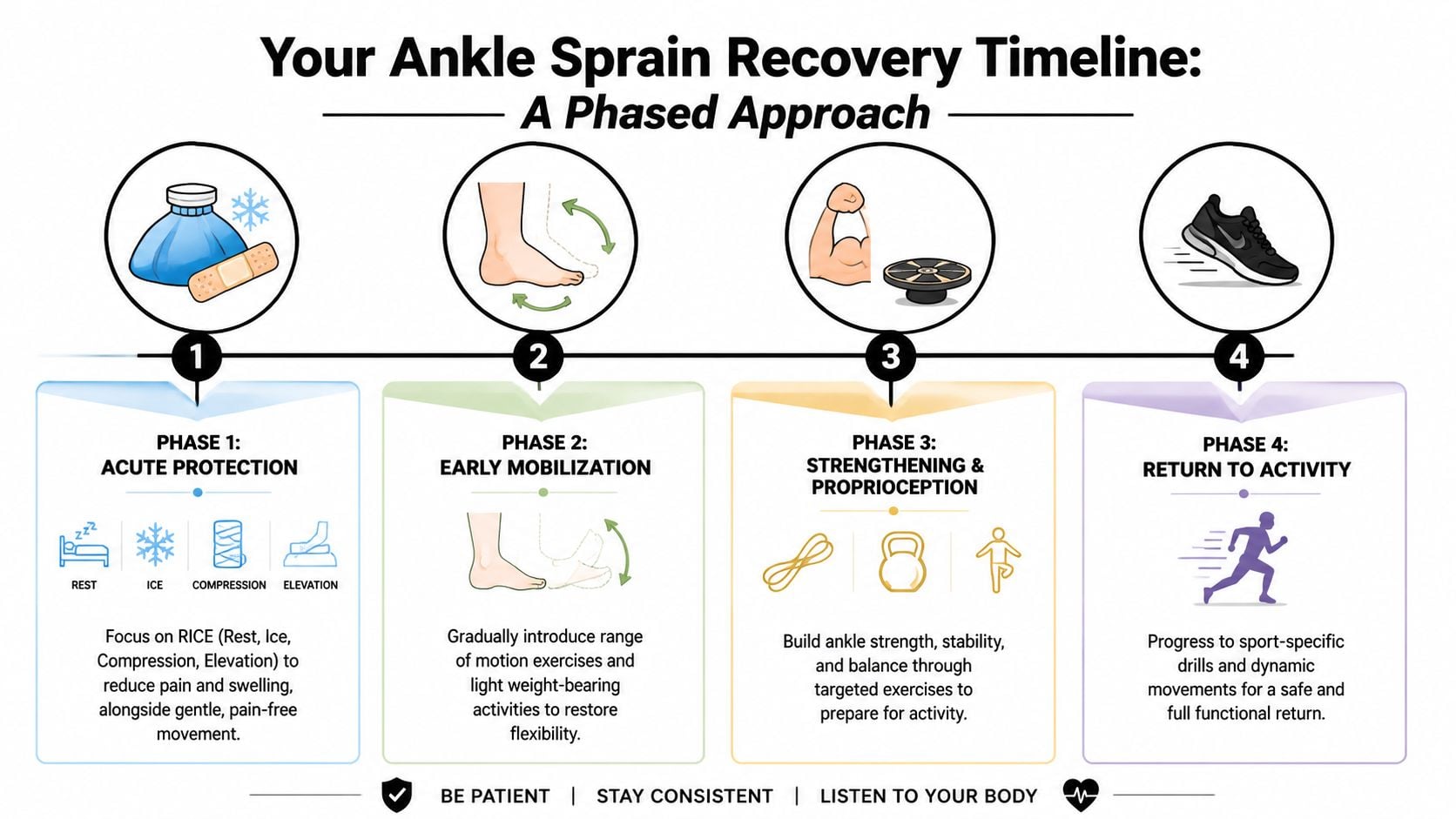
A typical ankle sprain rehabilitation plan often lasts 4 to 12 weeks, depending on severity, goals, and functional progress, and Boston Sports Medicine notes that early, protected weight-bearing with support can lead to faster recovery than rigid immobilization in appropriate cases, as explained in their ankle therapy guidance.
Phase 1 means protection, not shutdown
Right after the injury, the goal is to protect the ankle while keeping recovery moving.
This phase usually includes swelling management, compression, relative rest, and pain-free movement. The key trade-off is simple. Too much activity too soon can irritate the injury. Too much rest for too long can leave you stiff, weak, and delayed.
A brace or supportive device can be useful here because it lets many people start loading the ankle in a controlled way instead of avoiding weight-bearing longer than needed.
Phase 2 restores movement and basic loading
Once the ankle tolerates more, the focus shifts to mobility and early strengthening. At this stage, people often get impatient because pain is lower, but function still isn't back.
Common priorities in this phase include:
- Ankle mobility work to restore range needed for walking, stairs, and squatting
- Calf and foot activation to rebuild support
- Gradual weight-bearing progressions that reduce limping
- Basic gait cleanup so you stop reinforcing protective movement
This phase is also where home exercise consistency starts to matter more. The clinic helps direct the progression, but day-to-day repetition drives a lot of the change.
A visual overview helps many patients see how these stages fit together:
Phase 3 is where reinjury prevention happens
This is the phase that separates “my ankle stopped hurting” from “my ankle is ready again.”
Balance work, proprioception drills, and progressive strengthening all show up here. You may be standing on one leg, reaching, stepping, changing direction, or doing controlled impact work depending on your goals. The point isn't to make rehab look athletic. The point is to retrain the ankle to react well when life gets less predictable.
If you always feel fine in straight lines but uneasy when you pivot or land, you probably need more of this phase, not less.
Phase 4 earns the return to running and sport
For Boston runners, this might mean a graded return to pavement, hills, and pace changes. For court and field athletes, it means testing the ankle with more demanding movements before full play. For active adults, it may be stairs, long walks, gym work, or weekend sports.
Here's a simple view of the progression:
| Phase | Main focus | What usually improves |
|---|---|---|
| Phase 1 | Protect and calm symptoms | Swelling, pain, tolerance for standing and walking |
| Phase 2 | Restore motion and basic strength | Gait, mobility, everyday function |
| Phase 3 | Build stability and control | Balance, confidence, single-leg loading |
| Phase 4 | Return to higher demand activity | Running, cutting, jumping, sport-specific work |
What doesn't work is jumping from “I can walk” straight to “I'm back.” That shortcut is where a lot of repeat sprains start.
Advanced Rehab Tools Available in Boston
Boston patients often ask about the high-tech side of rehab. The useful answer is simple. Tools matter when they remove a bottleneck.
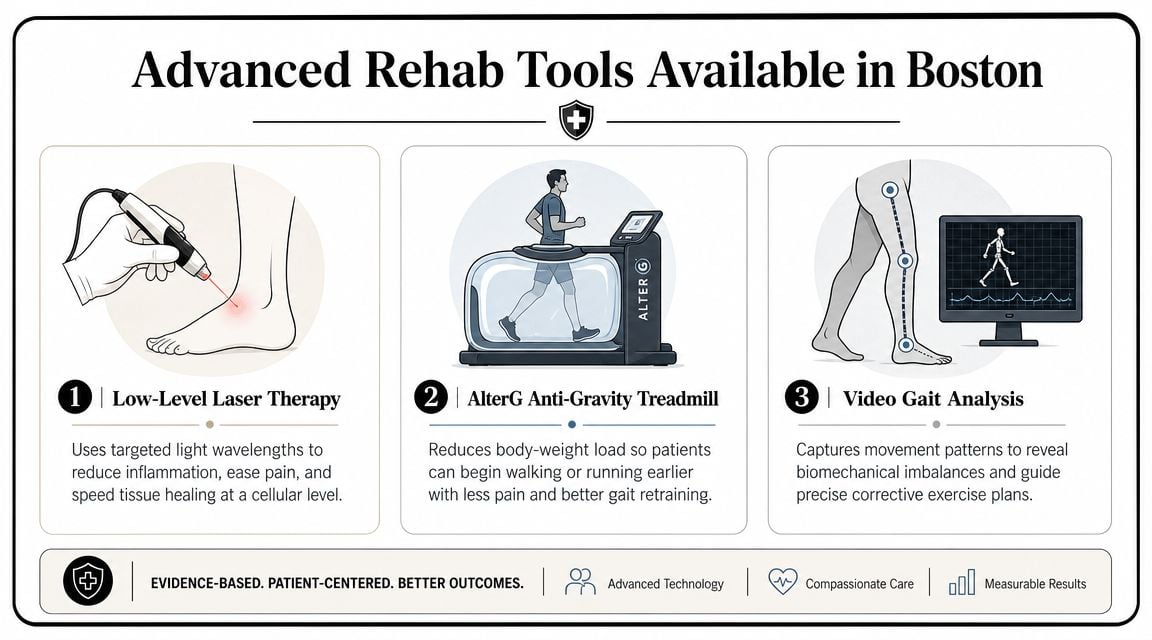
A stubborn ankle does not always need more exercises. Sometimes it needs the right environment or the right test. In Boston, that can mean using a pool when walking still flares the joint, or using video analysis when the ankle feels fine in the clinic but falls apart once you get back to the Esplanade, a pickup league, or hill work.
When support changes the plan
Aquatic therapy helps when weight-bearing is still limited and standard gym work is too irritating. The water unloads the ankle enough to practice walking, regain motion, and start strengthening sooner. For a patient who lives in a walk-heavy city, that can keep progress going during a phase where too much pavement still feels like too much.
Later in rehab, the limiting factor often changes. Pain may be down, swelling may be manageable, and strength may look decent on a table test. Then the problem shows up only during faster, more demanding movement. Running performance analysis or video gait analysis can catch the leftover compensation patterns that matter for Boston runners and court athletes, especially if the ankle still feels off on push-off, stairs, uneven brick, or quick direction changes.
Tools that help, and how to judge them
The better question is not, "What equipment does this clinic have?" Ask, "What problem is this solving?"
- Aquatic therapy: Useful when impact tolerance is low but early movement still needs to happen.
- Trigger point dry needling: Can help if calf or lower leg guarding is limiting motion or making loading uncomfortable.
- Video movement analysis: Helps when daily walking is fine but running, cutting, or landing still feels uneven.
- Return-to-performance testing: Useful for patients who want to get back to sport, training, or higher-speed movement with more confidence.
There is a trade-off here. Advanced tools can sharpen a good rehab plan, but they do not fix poor exercise progression, weak load management, or vague return-to-sport criteria.
Use the tool that answers the problem in front of you. Skip the rest. That approach usually gets Boston athletes and active adults back faster, with fewer setbacks.
Finding the Right Ankle Sprain PT in Boston
Boston has no shortage of rehab options. The challenge is finding a clinic that matches your actual goal. If all you need is a generic exercise sheet, almost anywhere will do. If you want a durable return to training, sport, and city life without repeated setbacks, the bar should be higher.
What to look for first
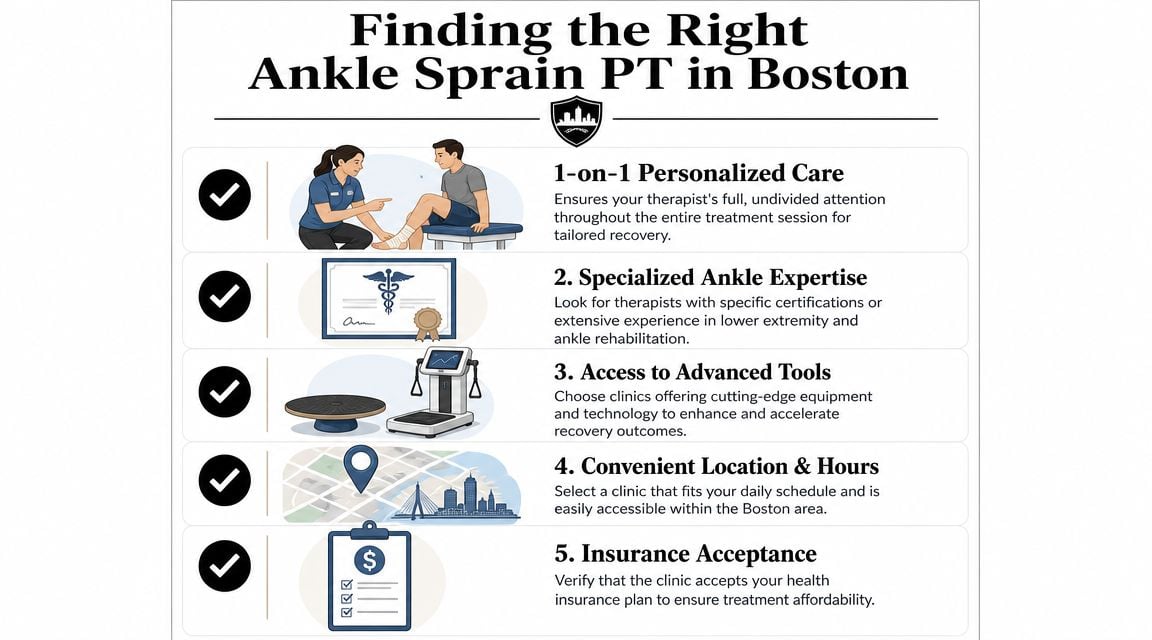
A strong clinic for ankle sprain physical therapy in Boston should make it easy to answer a few practical questions.
- Will you get one-on-one attention? An ankle that keeps giving way needs observation and progression, not a rushed handoff.
- Does the clinic understand active goals? Being able to commute is different from being ready to cut, sprint, or run hills.
- Are locations and hours workable? Compliance drops fast when getting to appointments becomes a second job.
- Can they progress past basic rehab? Strength, balance, and return-to-sport testing should all be part of the conversation when appropriate.
Pain-free is not the same as ready
Many patients approach this incorrectly. They use pain as the only test. That's not enough.
Hampton Physical Therapy notes that a major challenge in ankle rehab is knowing when someone is ready to return to sport, and that being pain-free alone is not enough. Proper rehab needs to address deficits in range of motion, strength, and balance to reduce the risk of chronic ankle instability, as described in their discussion of how physical therapy can help ankle sprains.
A good therapist should be willing to tell you not just when you're improving, but when you're still compensating. That honesty matters more than fast reassurance.
Ask a direct question: “What would tell you I'm not ready yet?” The answer will tell you a lot about the clinic.
For Boston patients, convenience also matters more than people admit. A clinic near Back Bay, Kenmore Square, Fort Point, the Seaport, Downtown, Brookline, or Allston can make it much easier to stay consistent through the full course of care. And consistency is what turns a decent recovery into a complete one.
Take the Next Step Toward a Full Recovery
You step off a curb in Back Bay, your ankle rolls again, and that split-second hesitation is back. That is usually the moment people realize the ankle never fully came back.
A sprained ankle can calm down without recovering the strength, control, and confidence you need for Boston life. Sidewalks, T stairs, uneven brick, pickup basketball, and a run along the Charles all ask more from the joint than walking around your apartment. Good rehab closes that gap. It gives you a plan to restore motion, load the ankle safely, and build enough stability to trust it under speed, fatigue, and quick direction changes.
That is the practical value of ankle sprain physical therapy in Boston. You get a clear progression instead of guessing. For active adults, that often determines whether the ankle fades into the background or keeps showing up every few months.
Do not wait for a second scare.
If you are still limping, still stiff in the morning, avoiding stairs, or changing how you train because the ankle feels unreliable, get it checked. The longer those compensation patterns stick around, the harder they are to clean up. In clinic, I often see people who are no longer very painful but still cannot push off well, balance well, or trust the ankle on uneven ground. That gap matters.
If you want deeper educational content on injury recovery, movement, and rehab principles, visit Highbar Health.
If you're looking for Joint Ventures Physical Therapy, you can book one-on-one care at Boston-area locations including Back Bay, Kenmore Square, Fort Point/Seaport, Downtown Boston, and surrounding neighborhoods. The team can help you sort out next steps, verify insurance, and build a plan that fits your schedule and return-to-activity goals.