
If you're a Boston golfer, you may already know the pattern. You practice. You take a lesson. You buy a new training aid or tweak your setup. For a week or two, things feel better. Then the same lower back tightness shows up on the back nine, your lead shoulder gets cranky, or your swing falls apart late in the round.
That usually means the problem isn't only technique. It's often your body's ability to get into, and repeat, the positions your swing asks for.
For active adults in Back Bay, Seaport, Kenmore, Downtown Boston, and nearby neighborhoods, that matters because golf has to fit into a real schedule. Long workdays, commuting, limited warm-up time, and inconsistent gym habits all show up in the swing. Good golf physical therapy in Boston looks at those realities and connects them to what you're feeling on the course.
Why Your Golf Swing Is More Than Just Technique
A common Boston example is the player who works in Seaport, sits most of the day, gets to the course on weekends, and notices two things. First, the swing feels stiff early. Second, the body gets sore before the scorecard is finished.

That golfer often assumes the answer is another swing thought. Sometimes it is. But just as often, the bigger issue is physical capacity. If your hips don't rotate well, your thoracic spine is stiff, or your trunk can't control speed through impact, your body will find another way to create the shot. That's when compensation starts.
What the body changes when it can't move well
Compensation doesn't always look dramatic. It can be subtle.
- Limited hip rotation: You slide or over-rotate through the pelvis to find speed.
- Restricted upper back motion: The lower back twists more than it should.
- Poor shoulder mobility: The club path changes because your body can't get the arm where it needs to be.
- Weakness or poor control: Your posture fades late in the round and contact gets inconsistent.
Golfers usually don't need more tips first. They need to know whether their body can support the swing they're trying to make.
This is why golf physical therapy works as a body-first model. A golfer can have a technically sound lesson and still struggle because the body keeps forcing the same workaround.
Golf is worth protecting for the long term
Golf also isn't just a hobby people want to squeeze in when life allows. It's one of the few sports people can keep playing across decades. A 2020 review in the International Journal of Golf Science concluded that golfers had, on average, a 40% lower mortality rate than non-golfers, corresponding to nearly 5 additional years of life expectancy according to the International Journal of Golf Science review summary.
That changes the conversation. Golf rehab isn't only about calming down pain before your next tee time. It's also about preserving a sport that supports mobility, balance, and long-term activity. If you want another useful non-clinical read on that bigger picture, Dartee Golf's perspective on golf wellness is a good overview.
Golf Physical Therapy Versus a Golf Lesson
The biggest mistake golfers make is assuming every swing problem belongs in a lesson. Sometimes it does. Often it doesn't.
A golf instructor works on how the swing is happening. A physical therapist works on why your body can't produce or tolerate that movement in the first place. Those are related, but they aren't the same service.
The key difference
Boston-area golf performance content often blurs coaching and rehab. The more useful clinical question is whether you have a modifiable movement limitation or injury that should be addressed before swing changes, as highlighted by this Boston-area TPI screening discussion.
If your lead hip won't internally rotate, your coach may see early extension or loss of posture. If your thoracic rotation is restricted, your coach may see a short backswing or a rushed transition. The lesson identifies the visible swing fault. PT asks what physical restriction is driving it.
What a PT assessment looks for
A golf-specific PT evaluation usually looks at the joints and body regions that most often shape the swing:
- Trunk rotation
- Shoulder mobility
- Hip internal and external rotation
- Power expression and control
That root-cause approach matters in Greater Boston because a lot of golfers aren't dealing with a pure golf problem. They're dealing with a desk-job body trying to perform an athletic, rotational task on weekends.
| Focus Area | Golf Physical Therapy | Golf Lesson |
|---|---|---|
| Primary question | Why does your body produce this pattern or pain? | How can the swing pattern be changed? |
| Main lens | Mobility, stability, strength, tissue tolerance | Mechanics, sequencing, setup, club delivery |
| Assessment style | Movement screen, range of motion, symptom behavior, strength testing | Ball flight, swing video, setup, tempo, contact |
| Best for | Pain, stiffness, recurring limitations, movement restrictions | Skill development, shot shaping, course performance |
| Main output | Treatment plan and corrective program | Swing cues, drills, technical adjustments |
Practical rule: If a swing change keeps failing, or it hurts every time you try it, stop assuming it's only a coaching issue.
Where lessons help and where they don't
Lessons help when the body can do the job and the player needs better sequencing, setup, rhythm, or decision-making. They don't solve a mobility block, irritated tendon, load-intolerant back, or shoulder that doesn't tolerate repeated high-speed rotation.
That distinction matters because golfers waste months chasing mechanics that their body can't support yet. Once the physical limitation is identified and treated, the lesson often becomes much more effective.
Common Golf Injuries We Treat in Boston
Boston golfers usually don't present with one clean, isolated problem. They show up with a mix of pain, stiffness, and performance drop-off. The common thread is that the swing asks for rotation, force transfer, and repeated loading. If one link in that chain is restricted, another area pays for it.
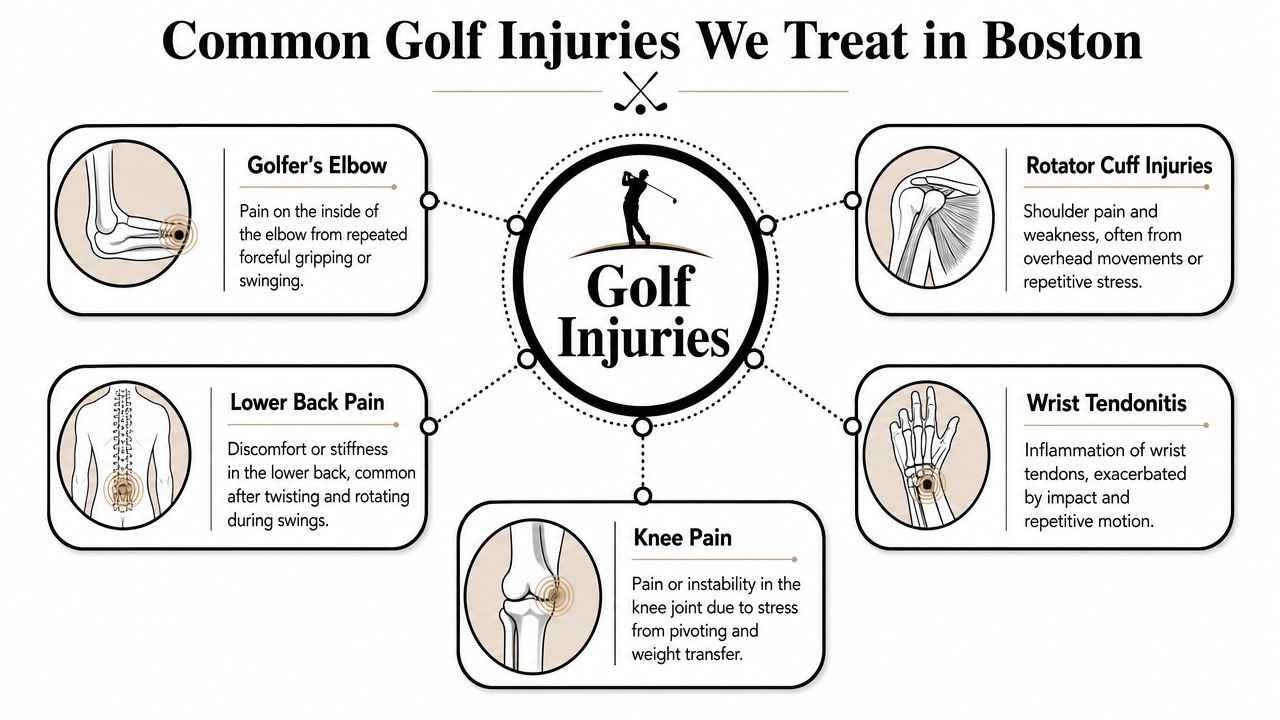
Lower back pain
This is one of the most common complaints in golfers. In Boston professionals, it often pairs with long hours at a desk, limited hip motion, and rushed warm-ups before the first tee.
When the hips and upper back don't contribute enough rotation, the lower back often twists and extends more than it tolerates well. The golfer feels it after a bucket, after a round, or the next morning.
Elbow, wrist, and shoulder issues
Upper extremity pain often comes from repeated force transfer through a body that isn't controlling speed well.
- Golfer's elbow: Usually tied to repeated gripping, impact stress, and compensations through the forearm when the larger body segments aren't doing enough.
- Wrist irritation: Often shows up when contact is inconsistent or the player relies on the hands to create speed.
- Shoulder pain: Common when mobility is limited or when a golfer keeps swinging through symptoms without rebuilding control.
Knee pain and rotational stress
Golf doesn't look like a field sport, but the knee still deals with pivoting, deceleration, and weight transfer. If the hips are stiff or balance is poor, the knee often absorbs motion that should come from somewhere else.
Pain location matters less than movement cause. A sore elbow may start with the grip, but it may also start with poor trunk and hip mechanics.
For golfers who want a broader conversation about tissue recovery and healing decisions, Dr. Yurth's injury healing masterclass is a useful outside perspective.
Your Golf Assessment with Titleist Performance Institute Screening
A strong golf evaluation should be specific enough to explain your swing complaints in plain English. That's where Titleist Performance Institute screening is useful.
The Titleist Performance Institute has certified over 19,000 professionals in 63 countries, creating a widely recognized framework for golf-specific movement screening, as described in this overview of TPI-based golf performance care. For a golfer in Boston, that means the screen isn't a vague fitness check. It's a structured way to connect physical findings to swing demands.
Here's the general flow of the process.
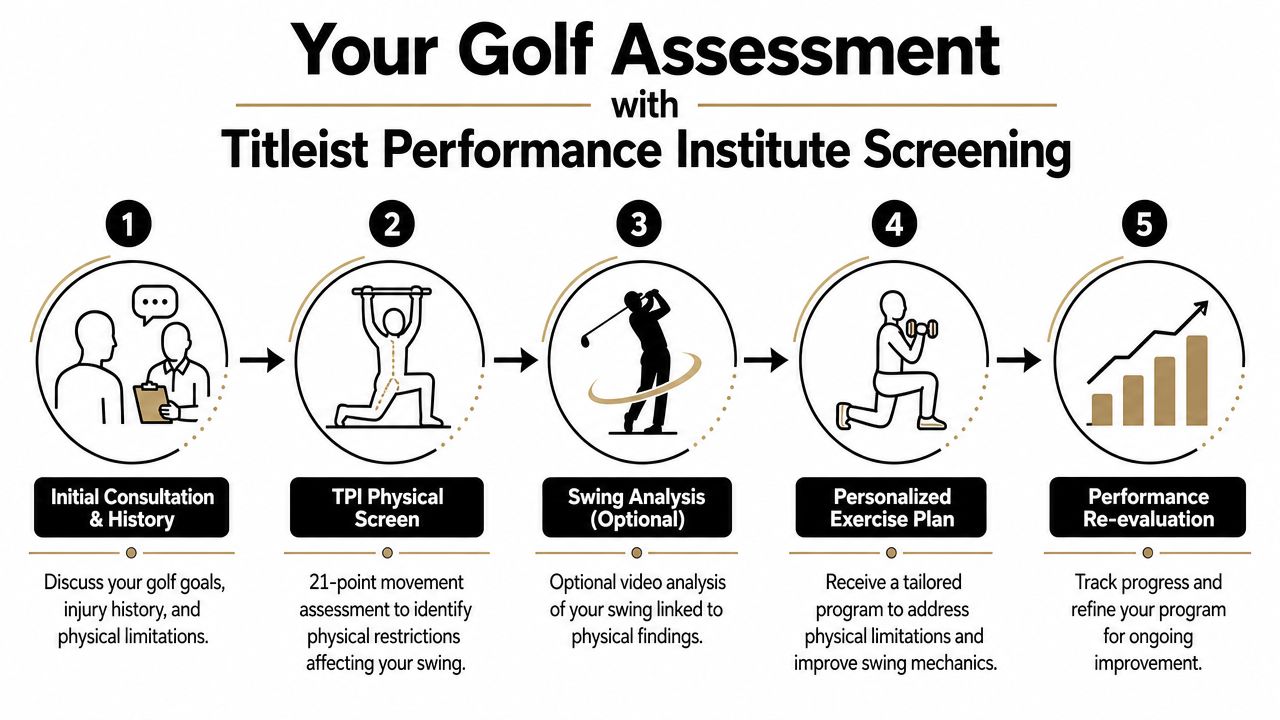
Step one and step two
The first part is the conversation. You talk through your golf background, current pain, training habits, goals, and what happens during or after a round. That history matters because the same swing fault can come from different physical limitations in different people.
Then comes the movement screen. In practical terms, the assessment checks whether your body can access and control the positions golf requires. That often includes:
- Hip mobility
- Thoracic or trunk rotation
- Shoulder motion
- Balance and stability
- Rotational control and power transfer
Step three and step four
A swing video can be useful when it's paired with the physical findings. Video alone can show what the club and body are doing. The screen helps explain why.
Then the findings get translated into a plan. If a golfer has limited trail hip rotation, poor trunk separation, and an irritated lead elbow, the program shouldn't look like a generic mobility handout. It should match those specific deficits.
A local option for that process is the Titleist Performance Evaluation at Joint Ventures Physical Therapy, which outlines a golf-specific evaluation and customized fitness plan.
What the screen should give you
You should leave with clear answers to questions like these:
- What movement limitation is affecting my swing most?
- Which symptom is a warning sign versus ordinary post-round soreness?
- What should I work on first so practice transfers?
This short video gives a visual sense of a golf performance screening environment:
Your Personalized Golf Performance and Recovery Plan
Once the assessment identifies the limiting factor, the treatment plan gets much simpler. Not easy, but simpler. You stop chasing random drills and start targeting the specific issue that's holding the swing back.
A good golf rehab plan usually has two tracks running at the same time. One track reduces pain and restores motion. The other builds the strength and control needed to keep the problem from coming right back.
What usually works
Treatment should fit the deficit. If the hips are stiff, restoring motion matters. If the trunk collapses under speed, stability and strength matter more. If symptoms are coming from irritated tissue, load has to be dosed appropriately instead of pushed blindly.
Common pieces of a golf-specific plan include:
- Manual therapy: Used to improve joint and soft tissue mobility when stiffness is blocking movement quality.
- Trigger point dry needling: Often helpful when protective muscle tension is keeping a golfer from moving or rotating comfortably.
- Corrective exercise: Targeted work tied directly to the screen findings, not a random list of stretches.
- Progressive strengthening: Added once mobility and symptom behavior improve enough to support more power and resilience.
The home program benchmark
An expert golf PT program often includes a short, repeatable daily routine of 10 to 15 minutes that targets the specific limitation, followed by progressive strengthening, based on this expert discussion of golf PT programming. That short routine matters because golfers are far more likely to stay consistent with something they can fit into a Boston workday.
The golfers who improve most aren't always the ones doing the hardest program. They're the ones doing the right program often enough.
If you're also looking for a practical pre-round routine, warm up for lower golf scores offers ideas that pair well with a clinician-built plan.
How it fits with broader sports rehab
Golf rehab isn't separate from sports rehab. It's sports rehab applied to the specific rotational, balance, and load demands of golf. For a broader look at how performance-based rehab works for active adults, the sport performance physical therapy overview is a helpful next read. For deeper educational content on injury recovery, movement mechanics, and return-to-sport topics, visit Highbar Health at highbarhealth.com.
Why Boston Golfers Choose Joint Ventures
Golfers in Boston usually want three things from PT. They want someone to identify the actual problem, they want a plan that respects their schedule, and they want care that doesn't feel like a generic exercise rotation.
That's where the local clinic setup matters. Joint Ventures Physical Therapy serves golfers across Back Bay, Kenmore Square, Fort Point/Seaport, Downtown Boston, Brookline, Allston, and nearby communities with 1-on-1 care, sports rehab experience, and access to specialty services like trigger point dry needling and Titleist evaluations.
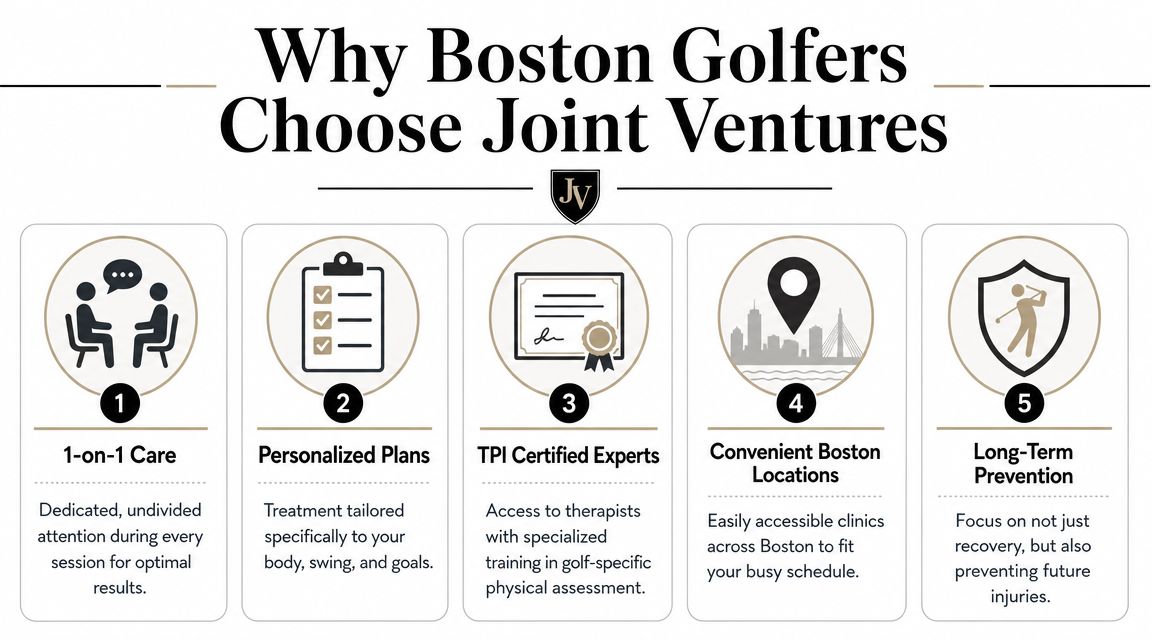
What tends to matter most to local patients
A golf-specific PT plan works better when the clinician uses a root-cause model. In Greater Boston golf rehab, that means breaking the swing into joint-limited components such as trunk rotation and hip mobility, then building the plan around the actual deficit instead of giving generic exercises, as described in this overview of golf performance PT assessment.
For busy professionals, there are also practical reasons this model is appealing:
- One clinician for the full visit: You get continuity, not a handoff-driven session.
- Boston-friendly access: Locations near where people live and work make adherence easier.
- Early and late hours: Helpful if you train before work or come in after the office.
- Administrative support: Insurance verification and authorizations are handled in a way that reduces friction.
Why that changes outcomes
Golfers improve faster when the plan fits real life. A perfect home program doesn't help if it's too long, too vague, or disconnected from what happens in the swing. A thoughtful local sports rehab setup helps close that gap.
If you want a broader look at how golf rehab fits into active adult and athlete care in the city, the sports rehab Boston guide is a useful next step.
Frequently Asked Questions About Golf PT
Do I need a doctor's referral to start physical therapy in Massachusetts
Many golfers can start by contacting a clinic directly. The details can vary based on your insurance plan and your situation, so it's smart to confirm benefits and any referral requirements before the first visit. A front desk team that checks this ahead of time saves a lot of hassle.
How many sessions will I need
That depends on the problem you're solving. A golfer with a mild mobility restriction and no significant pain may need a shorter course focused on a targeted program and progression. A golfer dealing with longer-standing back, elbow, or shoulder symptoms usually needs a more involved plan with reassessment over time.
What should I wear to a golf assessment
Wear comfortable athletic clothing that lets you move easily. Shorts or pants with stretch and a T-shirt or athletic top usually work well. If you have golf shoes and the clinic wants to observe specific movement patterns related to stance or setup, they'll tell you ahead of time.
Does insurance cover TPI screening
Coverage depends on how the visit is structured and whether it's being performed as part of medically necessary physical therapy. If you're coming in for pain, functional limits, or injury-related concerns, that may be handled differently than a purely performance-focused session. The best move is to ask the clinic to verify benefits before you book.
Should I get a lesson or start with PT
If you have pain, recurring stiffness, or a swing change that never sticks, start with the body. If you feel healthy and you're mainly chasing better mechanics or shot-making, a lesson may be the first step. Many golfers eventually benefit from both, but the order matters.
If pain is shaping your swing, the body has to be evaluated before more swing changes get layered on top.
If your swing hurts, feels restricted, or keeps reverting to the same pattern, schedule an evaluation with Joint Ventures Physical Therapy. With locations across Greater Boston, including Back Bay, Kenmore Square, Fort Point/Seaport, and Downtown Boston, it's a practical place to start if you want to play pain-free and build a more repeatable golf game.