
Knee pain in Boston usually shows up at the worst time. It starts during marathon training on the Charles, halfway up the stairs at Park Street, after a long workday in Back Bay, or the morning after a weekend basketball game, ski trip, or round of golf. What makes it frustrating isn't just the pain. It's not knowing whether you should rest, push through, stretch, ice, book PT, call an orthopedist, or get imaging.
Individuals don't need more generic advice. They need a clear next step.
The good news is that knee pain physical therapy in Boston can be more than a packet of exercises. Done well, it gives you a working diagnosis, a plan built around your actual life, and a way to move forward without guessing. For a lot of active adults, that matters just as much as the treatment itself. Pain affects confidence, sleep, training, and mood, which is one reason broader conversations about integrating mental and physical wellness are worth paying attention to when pain starts dragging into daily life.
If your knee has been limiting your commute, your workouts, or how comfortable you feel moving through the city, the right evaluation can tell you whether PT is the right first step and what recovery should look like.
Your Boston Life Should Not Hurt
A lot of Boston patients walk in with the same story, even when their jobs and sports look different.
One is a runner in Kenmore Square who can still get through mileage, but every downhill and every speed day leaves the front of the knee irritated. Another is a Seaport professional who hasn't run in months, yet still feels knee pain stepping off the T and standing up after meetings. Another is an active older adult in Back Bay who wants to keep walking the Esplanade, traveling, and staying independent without wondering whether every flare-up means something is getting worse.
What they all want is clarity.
Knee pain can come from very different problems. Arthritis, overuse, tendon irritation, a meniscus issue, a ligament injury, swelling after a twist, or pain that builds because strength and movement mechanics changed over time can all feel similar at first. That's why the first conversation matters. The right plan depends on what your knee is doing, how long it's been happening, and what you're trying to get back to.
A good rehab plan shouldn't just reduce pain. It should make your next week, your next training block, and your next commute feel manageable again.
In Boston, that often means care has to fit real life. You may be balancing long work hours, walking-heavy commutes, stair-filled subway stations, local races, university athletics, or recovery after surgery in a city where expectations are high and schedules are tight. Your treatment should account for that. Not fight against it.
Your First Knee Pain Assessment in Boston
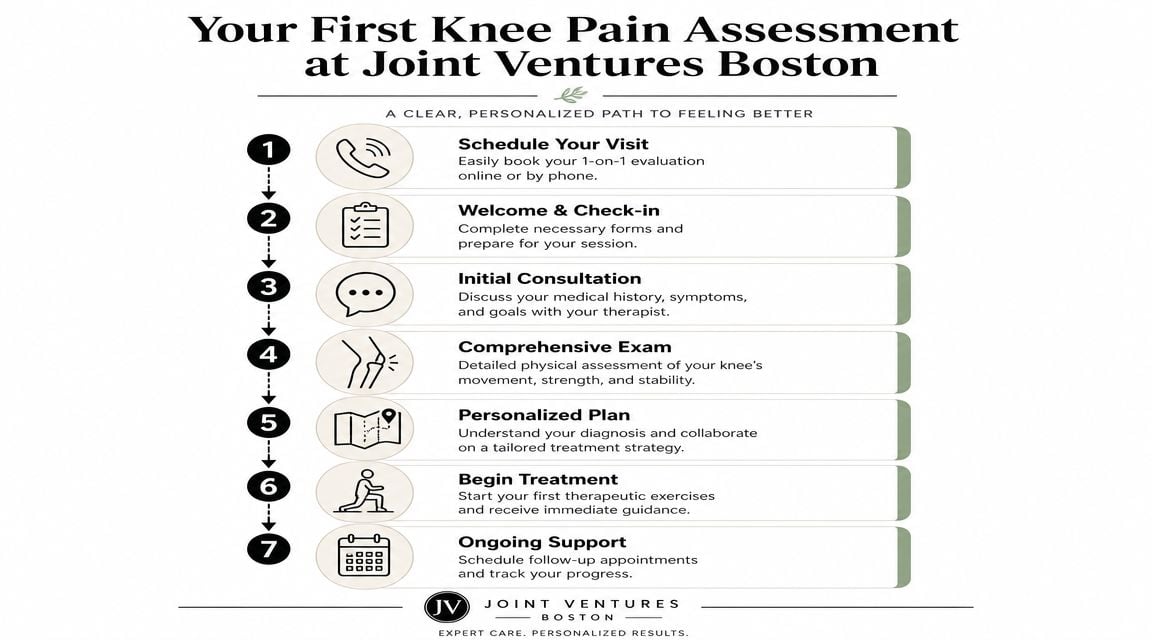
Your first visit should feel organized, specific, and useful from the start.
At a one-on-one knee evaluation, the first job isn't to hand you generic strengthening drills. It's to answer a more important question. Is physical therapy the right first step for your knee, right now? That's a real clinical decision, not a formality.
What happens in the room
A thorough knee assessment usually starts with your story. Not just where it hurts, but how it started, what loads it, what calms it down, whether it clicks, gives way, swells, locks, or feels unstable, and what you're trying to return to. A marathon build, recreational tennis, lifting, chasing kids, or getting through a workday all create different demands.
Then comes the exam. That often includes:
- Movement testing to see how you squat, step, lunge, walk, or change direction
- Strength testing around the hips, knee, and lower leg
- Mobility checks for the knee itself, plus the ankle and hip when needed
- Load response to understand which positions or tasks reproduce symptoms
- Stability screening if your history suggests ligament or meniscus involvement
The point isn't to collect data for its own sake. It's to find the main driver.
When PT is enough and when it isn't
One of the biggest gaps in knee pain guidance is explaining when PT should come first. That's important because knee pain isn't one diagnosis. Causes can include arthritis, ligament or meniscus injuries, overuse, bursitis, and tendonitis, so treatment has to follow the diagnosis, and a careful first assessment helps identify red flags that may require imaging or orthopedic referral, as noted in this Boston-area knee care overview.
Here are common reasons a PT may recommend moving forward with rehab first:
- Gradual-onset pain with activity that behaves like an overuse or load-management issue
- Knee pain with clear movement deficits in strength, control, or mobility
- Stiffness and functional limitation without major signs of instability or acute trauma
A PT may push for orthopedic follow-up sooner if your history suggests a more urgent issue.
Practical rule: If the knee has major swelling, recurrent buckling, true locking, or pain that doesn't fit a typical rehab pattern, the evaluation should slow down and the triage should sharpen up.
To prepare before that first visit, this guide on what to bring and expect at your first physical therapy appointment can help you show up ready.
Your Personalized Knee Pain Treatment Toolkit
A good knee plan should fit your actual week in Boston. If your commute includes stairs at Park Street, your workout is a run along the Charles, or your job keeps you sitting for hours before you rush to pickleball or the gym, treatment has to match those demands. Generic knee advice usually misses that.
Boston-based research on knee osteoarthritis shows many patients do not start physical therapy until symptoms have been around for a while or the history is more complicated, according to this Boston-area knee osteoarthritis study. By the time I see many new patients, the issue is rarely just pain. It is pain plus lost strength, reduced confidence, and a pattern of flaring every time activity picks back up.
The tools we use, and why
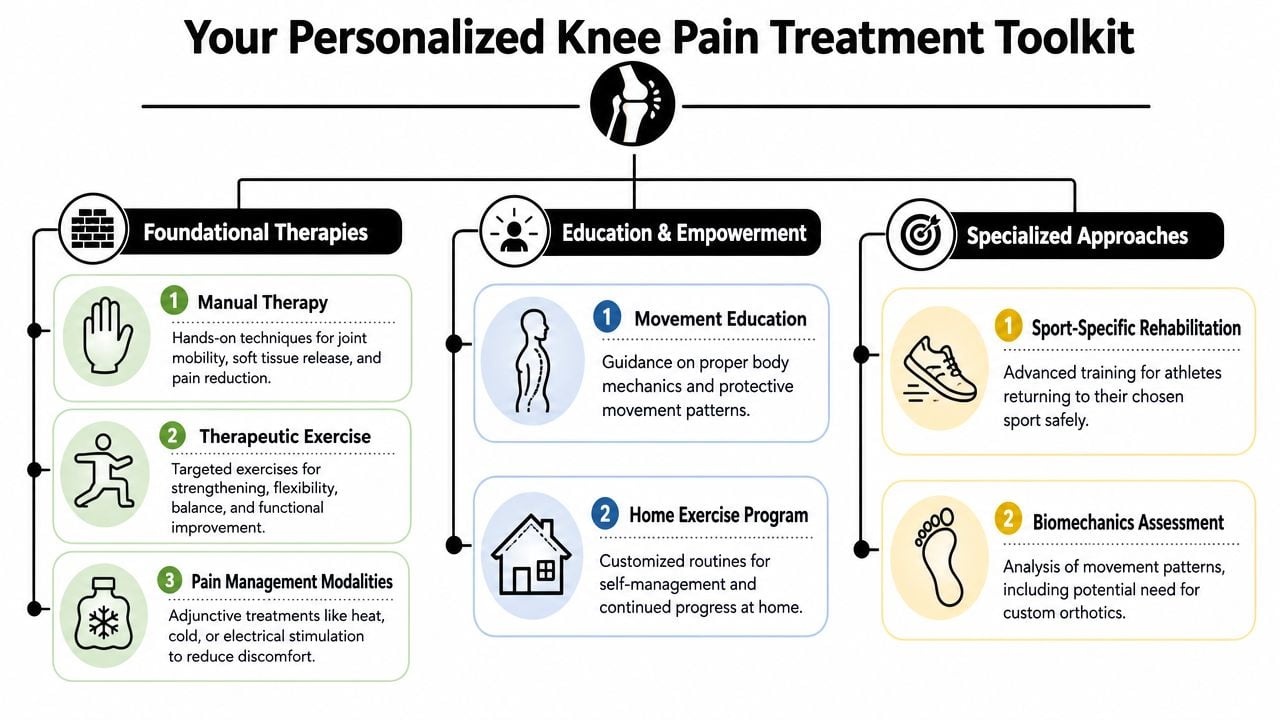
Strong rehab plans usually combine several pieces, each with a clear purpose.
- Targeted strengthening builds the capacity your knee needs for stairs, hills, squats, running, and getting up from a chair. The knee is influenced by the hip, quad, calf, and foot, so treatment often extends above and below the joint.
- Manual therapy helps when stiffness or pain is limiting motion enough to interfere with exercise. It can reduce symptoms and improve movement, but the benefit lasts longer when it is paired with active rehab.
- Load management keeps you active while the knee calms down. That may mean changing mileage, squat depth, class frequency, or how often you take stairs for a short period instead of stopping everything.
- Movement retraining matters when the knee can handle some load, but your mechanics still drive irritation. We often work on step-down control, landing strategy, squat pattern, running form, or how you cut and pivot.
- A home program keeps progress going between visits. The best programs are short enough to follow and specific enough to matter.
This is the trade-off patients need to understand. Rest may reduce pain for a few days, but capacity drops if the knee is unloaded for too long. On the other hand, pushing through a flare because the knee "should be fine" usually keeps the cycle going. The right middle ground is graded loading.
Common mistakes that slow recovery
Patients often lose time with strategies that sound reasonable but do not match how knees improve.
| Less effective approach | Better approach |
|---|---|
| Waiting for the knee to feel perfect before exercising | Starting with a level of loading the knee can tolerate now |
| Pulling random drills from social media | Using exercises that match your diagnosis, irritability, and goals |
| Relying on passive care alone | Pairing symptom relief with progressive strength and movement work |
| Returning to full sport or lifting volume after one good week | Building volume in stages so the knee can absorb it |
If your knee keeps hurting every time you restart the same activity, the plan needs to change.
For lifters, small exercise changes can keep training productive during rehab. Box squats, split-stance patterns, slower tempo work, or shorter ranges can reduce irritation while you keep strength work in place. RepStack's guide to knee-friendly lifts shows the kind of substitutions we often discuss in the clinic.
Patients also ask what to do between visits. A structured set of knee injury recovery exercises for home practice can help, but the bigger point is matching the exercise to the phase of recovery. Early on, the goal may be pain control and basic loading tolerance. Later, the goal shifts to strength, speed, and confidence under real-world demands.
Advanced Treatments for Boston's Active Community
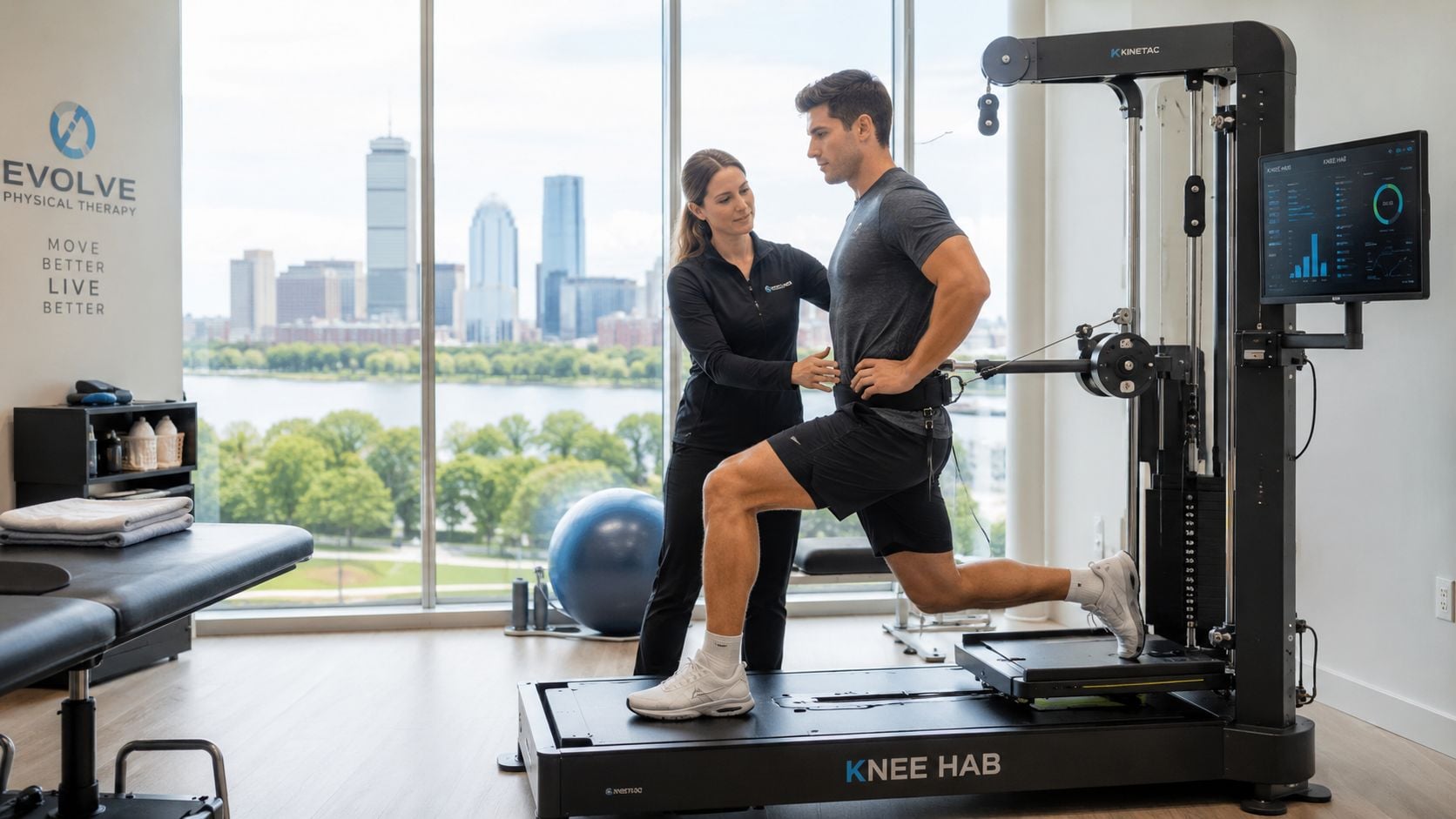
Boston doesn't need one-style-fits-all rehab. The city has runners, rowers, court sport athletes, desk workers with long commutes, students, active parents, and older adults who want to keep moving at a high level. That changes what good knee rehab looks like.
Specialty care that matches the problem
A runner training through winter in the Fenway and Kenmore area often needs more than basic quad work. They may need cadence review, load planning, return-to-hill guidance, and a running performance lens that catches the mechanic driving repeat symptoms.
An office professional in Downtown Boston may have a different pattern. They might tolerate a workout but stiffen up after long sitting, then flare on stairs or after travel. In that case, trigger point dry needling, movement re-education, and a realistic workday strategy may matter more than high-volume exercise right away.
Aquatic therapy can be especially helpful for people whose knees are too irritable for comfortable land loading, including some patients with arthritis or post-operative sensitivity. The pool lets them train without fighting full weight-bearing from the first minute of the session.
Why the local fit matters
Weekend golfers often benefit from a more rotational approach that connects the knee to the hip, trunk, and swing mechanics. That's where a Titleist screen or golf-specific movement analysis can help direct rehab instead of treating the knee as an isolated hinge.
Active adults with balance issues or dizziness sometimes have knee pain wrapped into a larger mobility problem. If balance confidence is low, walking mechanics change, stairs become awkward, and the knee can get overloaded secondarily. Vestibular and balance treatment can be part of cleaning that up.
Generic rehab can reduce symptoms. Specialized rehab is what helps people return to the way they actually live and train.
For post-surgical athletes and patients navigating ligament rehab, this overview of ACL recovery physical therapy in Boston is a useful next read. In Greater Boston, Joint Ventures Physical Therapy is one option for this kind of one-on-one care, including running performance, aquatic therapy, dry needling, and return-to-sport progression.
Setting Realistic Recovery Timelines and Outcomes
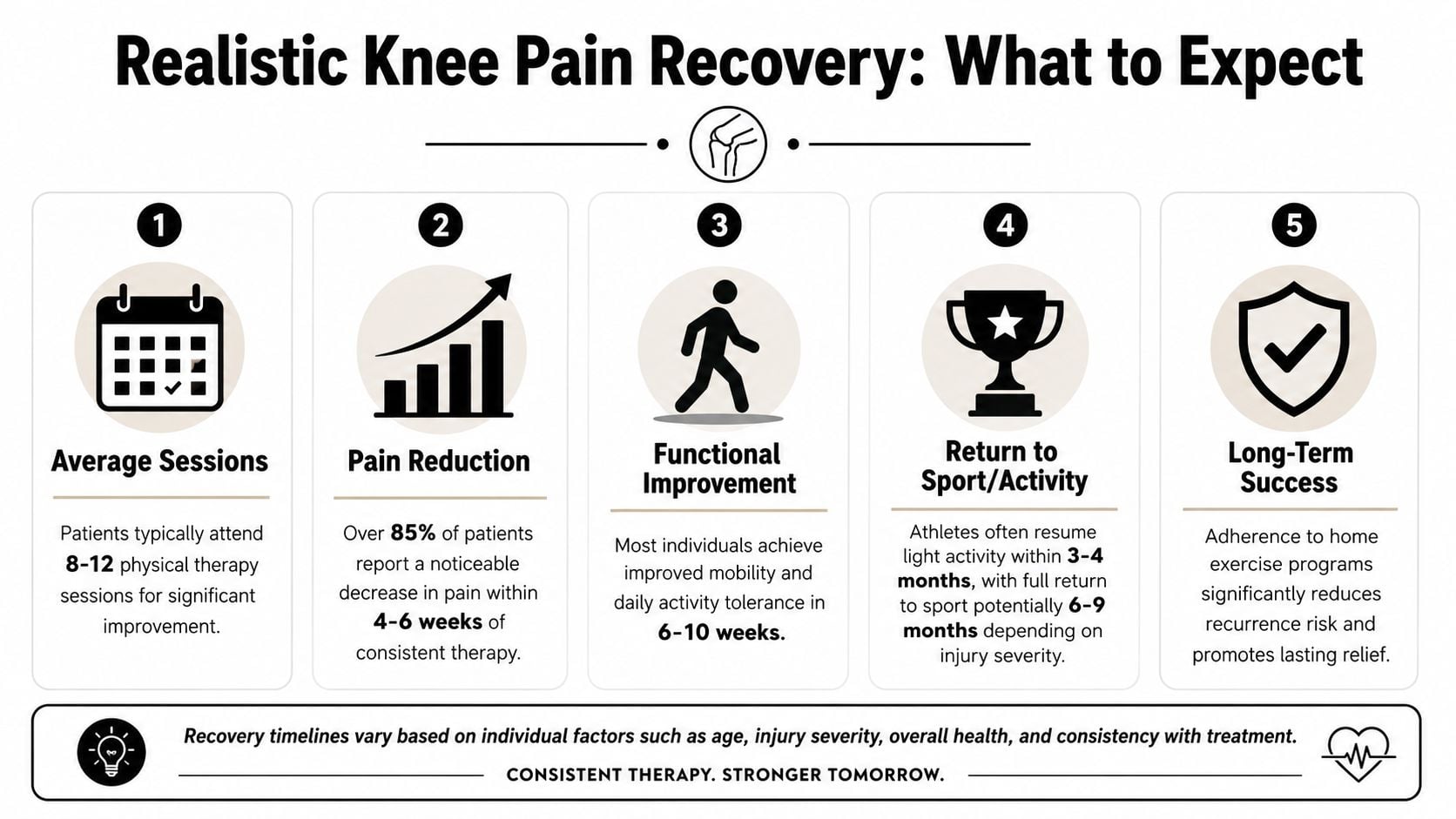
The biggest mistake people make with knee rehab is expecting a dramatic turnaround in the first few visits. Sometimes symptoms settle quickly. Often, the more meaningful gains come from consistent work done well over time.
A Mass General Brigham study of people with knee osteoarthritis, meniscal tear, and knee pain found that adding regular physical therapy visits to a home exercise program produced only a small extra improvement in pain at 6 and 12 months, while differences at 3 months were not clinically important or statistically significant. The same study included a standard PT group and a sham PT group, and those groups had similar outcomes, which supports the idea that the structured exercise component may matter as much as the modality package itself, according to this Mass General Brigham knee pain research summary.
That finding is useful because it sets the right expectation. Exercise is the foundation. Supervised PT adds value by improving adherence, progression, technique, and decision-making. That's different from promising a quick fix.
What patients should take from that
If your therapist emphasizes consistency, exercise progression, and follow-up, that's not a lesser plan. It's often the evidence-based one.
Here's what that usually means in practice:
- Your home program matters because clinic work alone isn't enough to change capacity
- Your plan should evolve as pain settles and function improves
- Passive care has limits if it isn't tied to stronger, more confident movement
- Progress isn't always linear especially when you increase training, stairs, travel, or sport exposure
PT affects more than pain scores
Physical therapy also matters beyond symptoms.
Boston University research analyzing more than 67,000 patient records found that physical therapy within 90 days before or after total knee replacement was associated with a lower likelihood of long-term opioid use. The same research reported that six or more outpatient PT sessions after surgery were linked to reduced long-term opioid risk, and starting outpatient PT within 30 days of surgery was also beneficial, as described in this Boston University knee replacement and PT report.
That's an important frame for Boston patients recovering from major knee surgery. PT isn't just there to check the rehab box. It can be part of a safer long-term pain-management strategy.
The best timeline is the one built around tissue healing, load tolerance, and your goal, not your impatience.
Find Your Knee Pain Specialist at Joint Ventures
Access matters when your knee hurts. If getting to care is a hassle, people delay treatment, miss visits, and try to self-manage longer than they should.
For Boston patients, convenience usually means choosing a clinic that fits the way you already move through the city. Joint Ventures serves Greater Boston with locations in Back Bay, Kenmore Square, Fort Point and Seaport, Downtown Boston, and nearby neighborhoods, which makes it easier to schedule around work, school, training, and commuting.
What to expect when you book
The process should be straightforward:
- Choose the location that matches your routine. Near the office is often better than near home if it increases follow-through.
- Book online or by phone based on what feels easier.
- Let the admin team handle the insurance details. Benefit checks and authorizations should happen before they become your problem.
- Show up with your goals. Pain relief matters, but so does returning to running, lifting, walking, golf, pickleball, or post-op milestones.
What patients usually care about most
A short checklist helps narrow the decision:
- One-on-one time so your visit doesn't feel rushed or shared
- Clinicians who can triage well when symptoms suggest PT should coordinate with orthopedic care
- Scheduling options that work for early mornings, later evenings, or busy city schedules
- A front desk that helps with insurance and logistics
If you're comparing clinics for knee pain physical therapy in Boston, don't just ask what treatments they offer. Ask how they evaluate, how they decide when referral is needed, and whether the plan will be built around your actual activity goals.
Take the First Step to a Pain-Free Knee
You step off the Green Line, head down the stairs, and feel that familiar catch in your knee. By the time you get to work, you are already adjusting how you walk. That pattern matters. In Boston, knee pain is not just a gym problem. It shows up on commutes, on uneven sidewalks, on stair-heavy workdays, and during weekend runs along the Charles.
The right first step is not guessing. It is figuring out whether your knee needs physical therapy now, a referral first, or a plan that coordinates both. That triage process is what keeps small problems from turning into months of reduced activity.
Good rehab is usually straightforward. A careful assessment identifies what is driving the pain, then treatment focuses on the right mix of strength, mobility, load management, and progression. Recovery also has to fit real life in Boston. A plan only works if you can follow it between work, training, childcare, classes, and commuting.
If your knee is limiting how you work, train, commute, or move through Boston, schedule an evaluation with Joint Ventures Physical Therapy. You'll get one-on-one care, a clear assessment of whether PT is the right first step, and a treatment plan built for your goals and your neighborhood.