
You notice it first in small moments. Reaching for a coffee cup at your desk. Pulling on a jacket before heading out of Back Bay Station. Rolling onto your side at night and getting that sharp reminder that your shoulder isn't happy.
For a lot of active Bostonians, shoulder pain starts as an annoyance and turns into a pattern. You stop lifting overhead at the gym. You cut a run short because your arm swing feels off. You spend a full workday in front of a laptop and leave with an ache that sits in the front or top of the shoulder and doesn't fully go away.
Shoulder pain physical therapy in Back Bay should solve that problem in a way that fits real life here. That means care that works for someone who runs along the Charles, commutes through Copley, works in the Hancock Tower, or wants to get back to training without guessing from internet videos.
That Nagging Shoulder Pain in Back Bay
One of the most common stories behind shoulder pain is simple. Nothing dramatic happened. No big fall. No one collision. The shoulder just started talking back.
It might be the ache that shows up after a long day at a keyboard. It might be the pinch when you press weights overhead. It might be the stiffness that makes it harder to put a bag in the back seat or reach into a high cabinet in a Back Bay apartment. The frustrating part is that people often wait because they can still function. They just can't function normally.
When shoulder pain starts changing your routine
In Back Bay, that usually means your pain is competing with a busy schedule. You work through it because meetings don't stop. You modify workouts because you don't want to lose momentum. You try stretching a few times, maybe ice it, maybe rest for a weekend, then go right back to the same load that irritated it in the first place.
That cycle is common. Rest can calm symptoms for a moment, but it usually doesn't rebuild the shoulder's capacity.
A lot of people also try self-treatment first. Tools like muscle relief using lacrosse balls can help settle down tight muscles around the shoulder blade, pecs, or upper back. That's useful when the shoulder feels guarded or stiff. But if pain keeps returning with pressing, reaching, running, or desk work, the issue usually isn't just a knot that needs to be rolled out.
Shoulder pain that keeps coming back usually needs a loading plan, not just a temporary release.
Why local care matters
Back Bay isn't a place where people have extra hours sitting around. Access matters. In central Boston, clinic availability can make the difference between starting rehab now and putting it off for weeks. One Back Bay clinic lists hours from 7:00 am to 8:00 pm Monday through Thursday and 7:00 am to 5:00 pm Friday, with access near the Green Line Copley T stop and multiple bus routes at 607 Boylston St., 4th Floor, Boston, MA 02116. That kind of schedule makes it easier to keep appointments around work and commuting in the neighborhood, which matters when shoulder rehab depends on showing up consistently and following through with home exercise (Back Bay clinic access details).
The right next step isn't more random stretching. It's figuring out why your shoulder hurts, what movements are driving it, and what kind of progression will let you get back to normal activity without constantly managing around pain.
Why Your Shoulder Hurts A Bostonian's Guide to Causes
A shoulder doesn't get irritated in a vacuum. In Back Bay, the pattern often reflects how you live.

The desk worker pattern
If you spend most of the day on a laptop, your shoulder often ends up working from a poor position. The upper back stiffens. The shoulder blade stops moving well. The front of the shoulder starts doing more than it should.
That can feel like pain at the front of the shoulder, pain with reaching, or an ache that builds as the day goes on. Sometimes the problem isn't weakness in the obvious sense. It's that the shoulder isn't sharing load well with the rest of the system.
The active Boston pattern
Runners, lifters, swimmers, tennis players, and weekend athletes get a different version. They usually have enough strength to be active, but the dosage is off. Too much pressing. Too much overhead volume. Too fast a return after a flare. Too little control around the shoulder blade and trunk.
The result can look like several familiar presentations:
- Front-of-shoulder irritation that shows up during presses, push-ups, or reaching behind the body
- Rotator cuff overload that makes side lifting or overhead work painful
- Mobility loss that changes mechanics, especially after a period of guarding
- Instability or poor control where the shoulder feels weak, sloppy, or unreliable under load
If you're dealing with pain in the front of the shoulder, this breakdown of common causes your physical therapist will look for gives a useful local companion to what you're feeling.
Why YouTube advice often misses the point
Generic shoulder videos usually fail for one reason. They don't sort people into the right bucket first.
A marathoner with stiff thoracic rotation and irritated arm swing mechanics doesn't need the same plan as someone who sits at a desk all day and loses shoulder blade control by mid-afternoon. A lifter with pain at lockout doesn't need the same exercise sequence as someone recovering from a surgery consultation or repeated overuse.
The same movement can help one shoulder and aggravate another. The difference is timing, dosage, and fit.
If you want a deeper educational library on shoulder anatomy, injury patterns, and rehab concepts, that belongs on Highbar Health. For someone in Back Bay, the practical question is more specific. Which movements are bothering your shoulder, and what has to change so those movements become tolerable again?
Your First Physical Therapy Visit in Back Bay
Individuals often anticipate exercises during a first visit. The first thing that matters is clarity.
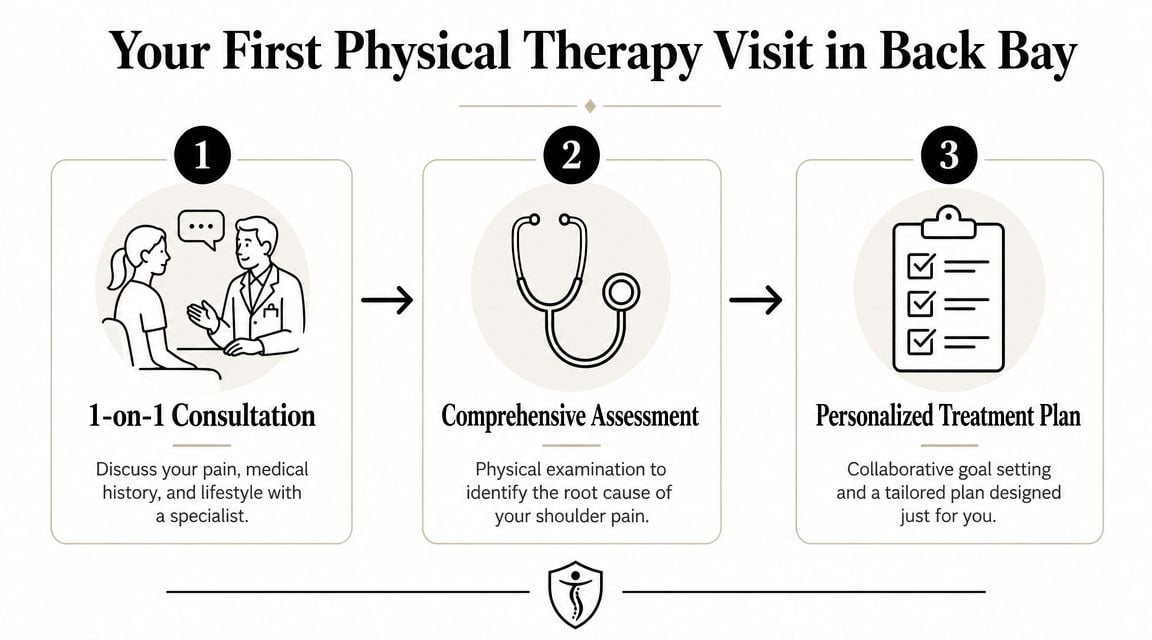
Step one is your story
A good evaluation starts with the pattern, not the shoulder in isolation. When did it start. What movements hurt. What have you stopped doing. What have you already tried. What are you trying to get back to.
Those details shape the plan. The person training for a race, the recreational lifter, the parent carrying a child, and the office worker all use their shoulder differently. The exam should reflect that.
Step two is a structured exam
Evidence-based shoulder care starts with a structured examination of strength, range of motion, and movement impairments, then pairs that assessment with individualized exercise, manual therapy, and a home program that emphasizes activity modification and progressive strengthening matched to the patient's goals (shoulder PT guidance).
In practice, that means looking at more than where it hurts. A clinician may check:
- Range of motion to see whether the shoulder is stiff, guarded, or moving asymmetrically
- Strength under load to see which positions trigger pain or poor control
- Scapular mechanics to understand how the shoulder blade moves during reaching and lifting
- Relevant neighboring areas like the neck, upper back, rib cage, or trunk when they affect shoulder position
Step three is a plan you can actually follow
Personalized 1-on-1 care is vital. The plan should make sense for your day, your commute, and your goals. If you work long hours, the home program needs to be efficient. If you lift regularly, the discussion needs to include what stays in, what gets modified, and what temporarily comes out.
A solid first visit usually ends with three things:
| What you leave with | Why it matters |
|---|---|
| A working explanation | You understand what's likely driving the pain |
| Clear modifications | You know what to avoid, reduce, or change right away |
| A starting program | You have a few targeted exercises that match your presentation |
Practical rule: If your first session gives you a random handout without a clear reason behind it, that's not personalized rehab.
The best first visits don't just tell you what's weak. They show you what your shoulder can tolerate today and how that will progress.
How We Treat Shoulder Pain at Joint Ventures
Modern shoulder rehab is active. That isn't a slogan. It's the center of the evidence.
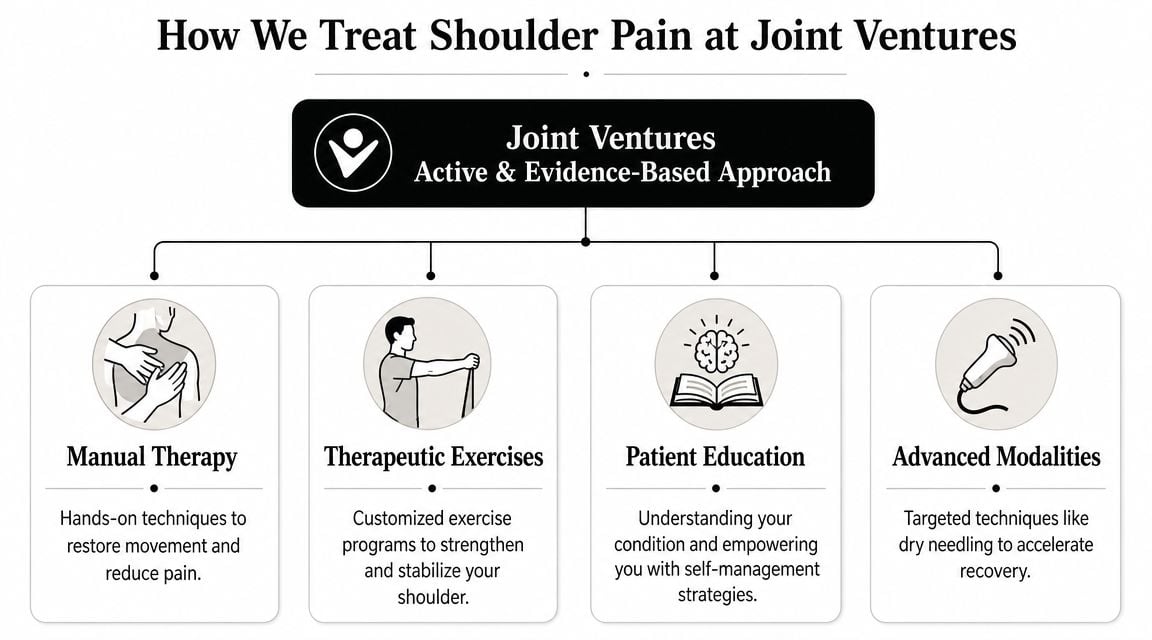
A 2024 systematic review and meta-analysis found that shoulder-specific exercise therapy reduced pain for chronic shoulder pain for up to 52 weeks, with a pooled mean difference of -2.1 versus usual medical care, with a 95% CI of -3.5 to -0.7. The same review found that adding electro-physical agents, injections, or manual therapy offered only small additional benefit, with mean differences clustered around -2.3 to -2.5. That tells us the exercise plan is the core driver, while add-ons play a supporting role (2024 shoulder exercise meta-analysis).
What works and what doesn't
Passive treatment alone usually doesn't hold up. Massage can feel good. Heat can feel good. A few manual techniques can create a temporary window. But if the shoulder isn't regaining strength, tolerance, and control, the pain often returns when you go back to normal life.
That doesn't mean hands-on care has no place. It means it has a role.
A practical treatment plan often includes:
- Progressive loading through targeted strengthening for the rotator cuff, shoulder blade, and supporting trunk mechanics
- Movement retraining so the shoulder handles reaching, pressing, carrying, and sport-specific motion with less irritation
- Manual therapy when indicated to improve mobility or reduce guarding so you can train more effectively
- A home program that is short enough to follow and specific enough to matter
Where specialty services fit
This is also where local specialty care can make a difference. At Joint Ventures Physical Therapy, clinicians may pair shoulder rehab with services such as trigger point dry needling, hand and upper extremity care, workplace ergonomics, or sport-specific progression depending on what's limiting the patient.
For some patients, dry needling helps reduce muscular guarding around the shoulder girdle so exercise becomes easier to perform well. It isn't the main event, but it can be a useful tool inside a broader plan. If you're curious how that service is used locally, this page on dry needling in Boston gives more context.
Why 1-on-1 changes the result
Exercise for shoulder pain isn't just about the exercise name. It's about dosage.
A desk worker might start with lower-load positional work, rowing variations, thoracic mobility, and gradual exposure to overhead reach. A runner with shoulder tension during long mileage might need scapular endurance and trunk rotation work. A lifter may need careful re-entry to incline press, landmine press, or overhead volume with rep-by-rep correction.
Good shoulder rehab isn't a list of exercises. It's a sequence.
That sequence is why supervised care often outperforms random home exercise pulled from a generic video. You need someone adjusting the load before you do too much, and pushing the load before you stay too cautious for too long.
Mapping Your Recovery From Pain to Performance
The first question asked is fair. How long is this going to take?
The honest answer is that recovery depends on what you're treating, how irritable the shoulder is, what your goal is, and how consistently you follow the plan. There isn't one timeline that fits every shoulder in Back Bay.
What progress usually looks like
Meaningful progress tends to happen in layers, not all at once.
First, daily pain settles down. Reaching gets easier. Sleep may improve. Then the shoulder starts tolerating more load. After that, you rebuild confidence in the activities that matter to you, whether that's lifting, swimming, carrying, commuting, or working at a desk without constantly repositioning.
A simple way to judge progress is to look at three questions:
- Are symptoms less reactive? Pain doesn't spike as easily with normal tasks.
- Is capacity improving? You can do more before symptoms appear.
- Are you returning to your real activities? Not just clinic drills, but life.
Why adherence matters more than quick fixes
Shoulder rehab rewards consistency. Missing sessions, skipping the home program, and bouncing between total rest and hard training usually drags recovery out. A smaller amount of well-dosed work done repeatedly tends to beat occasional bursts of motivation.
That also applies outside the clinic. Sleep, stress, training balance, and basic fueling affect how well you recover from loading. If you're getting back to exercise and need simple ideas to support that process, a practical list of post-workout recovery snacks can help you think through easy options after training or rehab sessions.
Red flags that need a different conversation
Not every painful shoulder belongs in a routine rehab lane. Some symptoms deserve faster medical follow-up.
Watch for patterns like:
- Pain with major weakness after an injury when the arm suddenly won't lift or hold load
- Persistent night pain that feels unusual for you and isn't behaving like a mechanical flare
- Numbness, tingling, or neck-related symptoms that suggest the source may not be only the shoulder
- Worsening loss of motion or function despite appropriate modification
If those show up, the next step may be referral, imaging, or a co-managed plan rather than pushing harder in therapy.
Recovery should feel like a steady climb. If things are getting sharper, weaker, or stranger, don't ignore that.
The bigger point is this. Shoulder pain physical therapy in Back Bay shouldn't just reduce pain for a week. It should move you from pain management to actual performance, on a timeline that makes sense for your body and your goals.
Your Best Choice for Shoulder Pain Relief in Back Bay
The biggest difference between clinics isn't the exercise band or the treatment table. It's attention.
Why 1-on-1 care matters in this neighborhood
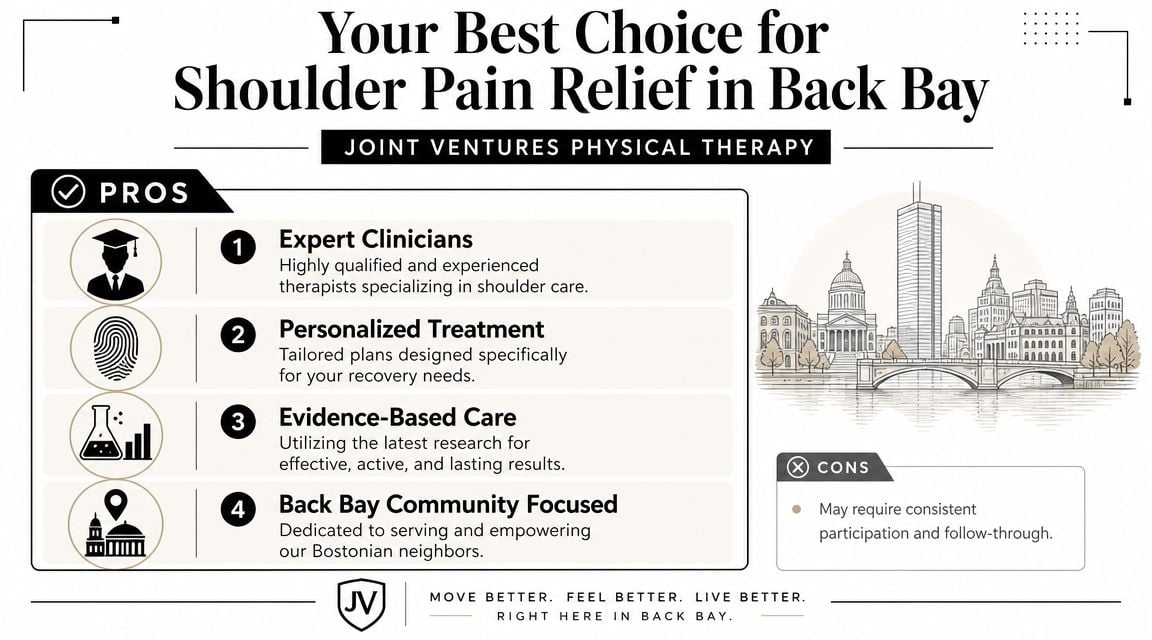
For shoulder rehab, 1-on-1 physical therapy is critical because it lets a clinician individualize progressive loading and exercise dosage, which are central to modern rehab, in a way that generic home exercise or group formats can't. In Back Bay, access also matters. A local clinic at 607 Boylston St. with hours from 7:00 am to 8:00 pm is built around the kind of direct access and consistency that supports adherence for busy patients (Back Bay physical therapy access and hours).
That matters in real life. A therapist can adjust your plan when your shoulder is irritated from travel, sitting, or a return to the gym. They can progress load when you're ready instead of waiting too long. They can spot when your mechanics look fine at low effort but fall apart under fatigue.
What that means for a marathoner versus a desk worker
This is the "why" behind personalized care.
A marathoner may not need a lot of heavy pressing, but they may need better arm swing mechanics, upper-back mobility, scapular endurance, and a plan that doesn't interfere with training volume. A desk worker may need a setup review, positional changes during the day, and a progression that rebuilds tolerance for repeated reaching and prolonged sitting.
Those are different problems. They shouldn't get the same printout.
Here's the practical comparison:
| Patient type | What personalized care changes |
|---|---|
| Marathoner | Matches rehab load to running schedule and upper-body demands |
| Desk worker | Builds a program around work posture, laptop time, and symptom triggers |
| Gym lifter | Modifies pressing and pulling volume instead of stopping everything |
| Post-surgical patient | Progresses carefully around healing stage and functional goals |
If you're comparing options for physical therapy in Back Bay Boston, look for that level of specificity. You want a therapist who can explain not just what you're doing, but why it fits your shoulder and your routine.
The decision most people regret
People usually don't regret starting PT too early. They regret waiting while symptoms become more stubborn, movement gets more protective, and activity drops further.
If your shoulder is changing how you work, train, sleep, or move through the city, that's enough reason to get it looked at. The goal isn't to become a full-time rehab patient. The goal is to get the right diagnosis, the right progression, and a plan that gets you back to normal life in Back Bay with less guesswork.
If shoulder pain is getting in the way of work, workouts, or everyday movement, book an evaluation with Joint Ventures Physical Therapy. You'll get 1-on-1 care, a plan built around your schedule and goals, and a clearer path back to running, lifting, commuting, and living comfortably in Boston.