
Shoulder pain usually starts small in Boston. You notice it when you pull a backpack off the Green Line, reach into a cabinet for a coffee mug before work, or swing your arm during a run along the Charles and feel that sharp catch again. Then it starts changing how you move. You carry groceries on the other side. You avoid overhead presses at the gym. You sleep on one shoulder less and less.
A long anatomy lecture isn't what's needed at that point. They need a clear local plan. They want to know whether this sounds like a rotator cuff problem, whether physical therapy makes sense before a surgical consult, what rehab looks like, and where they can get care that fits a Boston workday.
This guide is built for that moment. It's centered on the Boston patient journey, from first symptoms to first appointment, with practical advice that reflects how people here live. Active commuters, runners, desk workers, rowers, college athletes, parents, and older adults who want to stay independent all run into the same question. What should I do with this shoulder pain now?
Your Guide to Healing Shoulder Pain in Boston
A common story goes like this. Your shoulder has been grumbling for weeks. At first it only hurts when you reach into the back seat or lift a tote bag. Then it starts showing up in routine parts of the day. Carrying groceries home through Back Bay feels awkward. Pulling on a coat before work takes extra effort. A weekend run on the Esplanade leaves your upper arm and shoulder irritated for the rest of the day.
That pattern matters because rotator cuff problems rarely affect just one movement. They start interfering with normal Boston life. Commuting. Desk work. Fitness classes. Weekend sports. Sleep. People often wait too long because they assume shoulder pain will fade if they stretch a little and push through it.
Sometimes it settles down. Often it doesn't.
What most patients want to know first
Before anyone asks about exercise bands or imaging, they usually want answers to a few direct questions:
- Is this my rotator cuff or just a sore shoulder from sleeping wrong?
- Should I rest it completely or keep using it?
- Do I need a surgeon first or is PT a reasonable place to start?
- How long will recovery take if I handle it early?
Those are the right questions. Good rotator cuff care isn't about guessing. It's about matching the right plan to the right presentation.
Boston patients usually do better when they stop treating shoulder pain like an inconvenience and start treating it like a movement problem that needs a real exam.
If you want a simple movement-focused starting point, this guide to best exercises for shoulder pain can help you understand the kinds of drills therapists often use and which ones tend to aggravate the shoulder when they're done too soon.
Why local care matters
Boston has no shortage of healthcare options, but shoulder rehab works better when it's convenient enough to stick with. If your clinic is near work in Back Bay, close to class in Kenmore Square, or easy to reach from Fort Point or Downtown, you're more likely to stay consistent. Consistency is what turns a sore, guarded shoulder into a strong, reliable one.
Is It Your Rotator Cuff and When Should You See a PT
Rotator cuff pain usually isn't dramatic at first. It often feels like a nagging ache in the outer shoulder or upper arm, pain with reaching overhead, or weakness when you try to lift something away from your body. In Boston, I see it show up in desk workers after long days at a laptop, in runners who notice arm swing discomfort, and in active adults who suddenly realize that taking a suitcase down from a shelf hurts more than it should.

Signs that fit the pattern
A rotator cuff issue becomes more likely when pain shows up during common tasks like these:
- Reaching overhead: getting a mug from a shelf, putting dishes away, grabbing luggage from an overhead bin
- Lifting away from the body: carrying a heavy bag, raising a backpack, picking up a child
- Behind-the-back movements: fastening a bra, tucking in a shirt, reaching for a back pocket
- Sleep disruption: shoulder pain when you lie on that side or roll onto it at night
Pain location alone doesn't confirm the diagnosis. Front-of-shoulder pain can come from more than one structure, which is why a physical exam matters more than internet self-diagnosis. This article on front-of-shoulder pain and what a physical therapist will look for gives a useful look at how clinicians sort through those possibilities.
When PT makes sense as a first step
A lot of patients assume shoulder pain means they should see an orthopedic surgeon first. That's not always the most efficient path. A 2024 review in the Journal of the American Academy of Orthopaedic Surgeons noted that nonoperative management like physical therapy is appropriate for many patients with rotator cuff symptoms, especially those without major weakness or acute traumatic tears (clinical summary).
That lines up with what many of us see in practice. If your shoulder pain came on gradually, you can still move the arm, and you don't have obvious major weakness after a sudden injury, PT is often a smart first move.
When not to wait
Some presentations need faster medical escalation. Get assessed promptly if you have:
| Situation | Why it matters |
|---|---|
| A clear traumatic injury | A fall, collision, or sudden force changes the decision-making |
| Major weakness | If the arm suddenly can't do what it normally can, that needs attention |
| Rapid loss of function | Worsening ability to raise or use the arm isn't something to watch for weeks |
| Pain that feels out of proportion | Severe symptoms deserve a more urgent workup |
Practical rule: If the shoulder hurt gradually and still works, even if it's painful, PT is often the right first door. If it failed suddenly after trauma or the weakness is obvious, get medical evaluation quickly.
Your Phased Rotator Cuff Rehab Plan
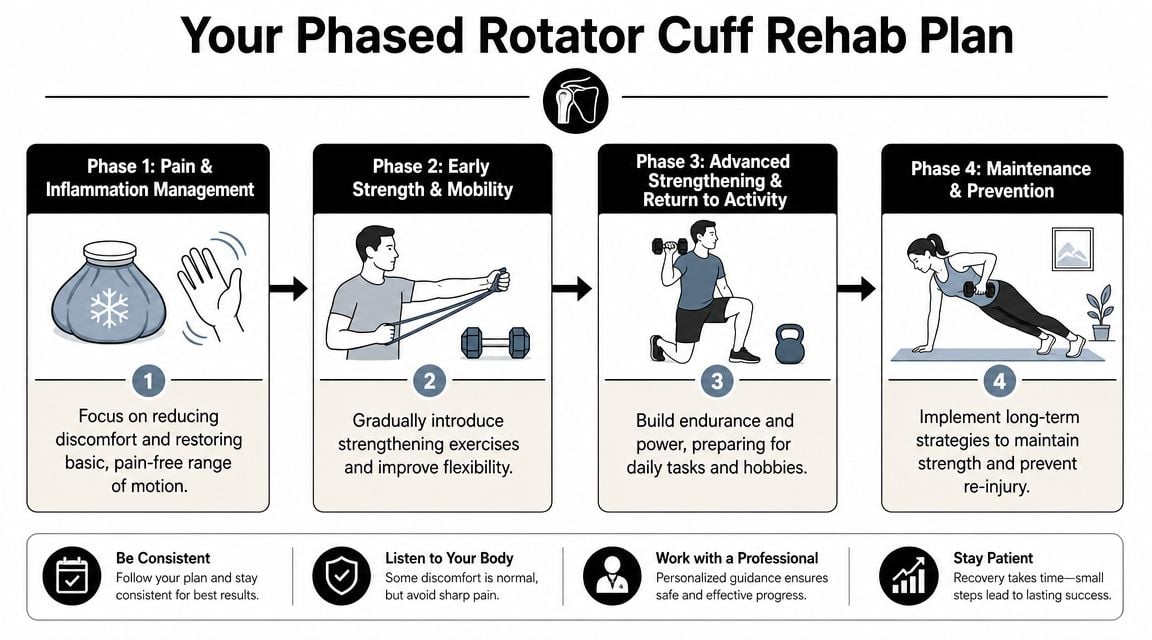
Individuals often benefit when rotator cuff rehab feels organized. Not rushed, not random, and not based on whatever shoulder exercise they found online the night before. In a good PT plan, each phase has a job. The early phase calms things down. The middle phases restore motion and rebuild control. The later phase gets your shoulder ready for real Boston life again.
This visual gives a simple overview of that progression.
Phase 1 pain control and movement reset
Early rehab is about reducing irritation without letting the shoulder get stiff and guarded. Often, many patients make their first mistake here. They either stop moving completely or they keep testing the painful movement over and over to see if it's "better yet."
Neither works well.
In this phase, treatment often includes:
- Activity modification: reducing the motions that spike pain, especially repeated overhead reaching or heavy lifting
- Gentle range of motion work: controlled movement that keeps the joint from stiffening
- Postural setup: changing workstation or daily positions that keep the shoulder compressed and irritated
- Manual guidance: cueing how the shoulder blade and arm should move together
Phase 2 mobility with better mechanics
Once pain is calmer, the next step is cleaner motion. Many shoulders can move, but they don't move well. The shoulder blade tips forward. The rib cage flares. The upper trap takes over. The person shrugs through every lift.
This is where skilled cueing matters. Better motion usually comes from a combination of thoracic mobility, shoulder blade control, and gradual exposure to previously painful positions.
A short video can help you picture how shoulder rehab often starts with precise, low-load movement rather than hard strengthening.
Phase 3 strength that doesn't flare the shoulder
During rehabilitation, many people become impatient. They jump from pain to push-ups. Or they grab weights that are too heavy because the exercise seems easy. Rotator cuff rehab usually responds better to restraint.
Local experts at Northeastern University recommend using very light resistance, often just 1 to 2 lb weights or light bands, for rotator cuff exercises, as overexertion can provoke pain. They also stress correcting rounded-shoulder posture common in desk workers to reduce mechanical impingement (Northeastern guidance).
That matters in Boston because so many patients spend hours at a laptop, on the T, in the car, or on a phone. Rounded posture doesn't automatically cause every case of pain, but it can reduce the shoulder's tolerance for loading.
Common strengthening work at this stage may include:
- External rotation with a light band: elbow at the side, no swinging
- Internal rotation with a light band: controlled return, no twisting through the torso
- Scapular retraction drills: teaching the shoulder blade to support the arm
- Supported elevation patterns: lifting the arm with clean mechanics instead of shrugging
If you want examples of how therapists build this part of the program, this article on how to strengthen rotator cuff muscles is a useful companion read.
If an exercise makes you compensate by shrugging, swinging, or holding your breath, the load is too much or the timing is wrong.
Phase 4 return to your actual life
The last phase isn't just "more reps." It's specific. A rower on the Charles needs a different finish than a college student carrying a heavy backpack across campus. A runner training through shoulder tension needs a different plan than a finance professional who wants to work pain-free at a desk and lift overhead confidently again.
A solid return phase usually includes this kind of progression:
| Goal | Rehab focus |
|---|---|
| Desk work without flare-ups | posture tolerance, scapular endurance, workstation strategy |
| Gym return | controlled pressing, pulling, and load progression |
| Running and outdoor activity | arm swing comfort, trunk control, recovery from repetitive strain |
| Recreation like rowing or golf | rotational control, endurance, and movement sequencing |
Rotator cuff physical therapy in Boston should feel personal. The shoulder isn't training for a generic test. It's training for your commute, your sport, your workday, and your weekends.
Recovery Timelines Outcomes and Red Flags
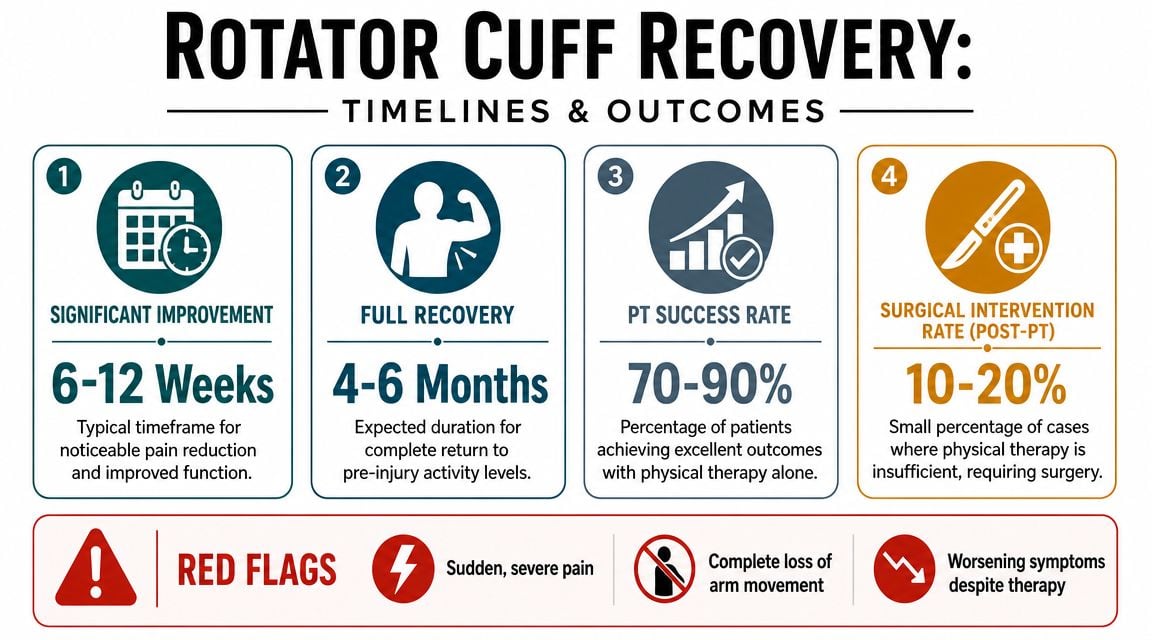
Most patients ask two questions quickly. How long is this going to take, and what are the odds PT works? The answer depends on your presentation, your irritability level, your consistency, and whether the shoulder pain came on gradually or followed a more serious event.
What matters most is this. Recovery is not linear. Many people improve in steps. A painful reach becomes easier. Sleep gets better. Strength comes back more slowly. Then one awkward lift at home irritates it again. That's normal. It doesn't mean the plan failed.
What outcomes tell us
Boston has contributed important evidence here. A multicenter prospective cohort study published by the Boston Shoulder Institute found that non-operative treatment was effective for approximately 75% of patients with atraumatic full-thickness rotator cuff tears at two-year follow-up, using surgery as the definition of failure. In practical terms, about three out of four patients avoided surgery while still showing significant improvement on validated outcome scores (Boston Shoulder Institute study).
That doesn't mean every tear or every painful shoulder should be handled the same way. It does mean PT deserves to be taken seriously, especially when the problem developed without a major traumatic event.
How rehab usually feels over time
Instead of focusing on a rigid calendar, think in milestones:
- Early progress: pain settles, motion feels less guarded, daily tasks become easier
- Middle-stage progress: overhead reach improves, strength work becomes more tolerable, flare-ups become less frequent
- Later-stage progress: your shoulder handles work, exercise, and recreational demands with less compensation and more confidence
People who do well usually have two things in common. They follow a plan that matches their irritability level, and they don't skip the boring parts because pain decreased before strength and control were ready.
Good rehab often feels slower than you want in the middle and more rewarding than you expected at the end.
Red flags that change the plan
PT isn't the answer to everything. A responsible shoulder program also knows when to refer out. Seek prompt medical evaluation if you have:
- A traumatic mechanism: a fall, collision, or sudden heavy load that changed your shoulder immediately
- Marked weakness: not just pain-limited effort, but real loss of ability to lift or control the arm
- Progressive decline: the shoulder keeps getting worse instead of gradually stabilizing
- Severe pain or near inability to move the arm: especially when that presentation is new
Those cases may still involve PT, but they often need imaging or orthopedic input earlier.
How to Choose the Right PT Clinic in Boston
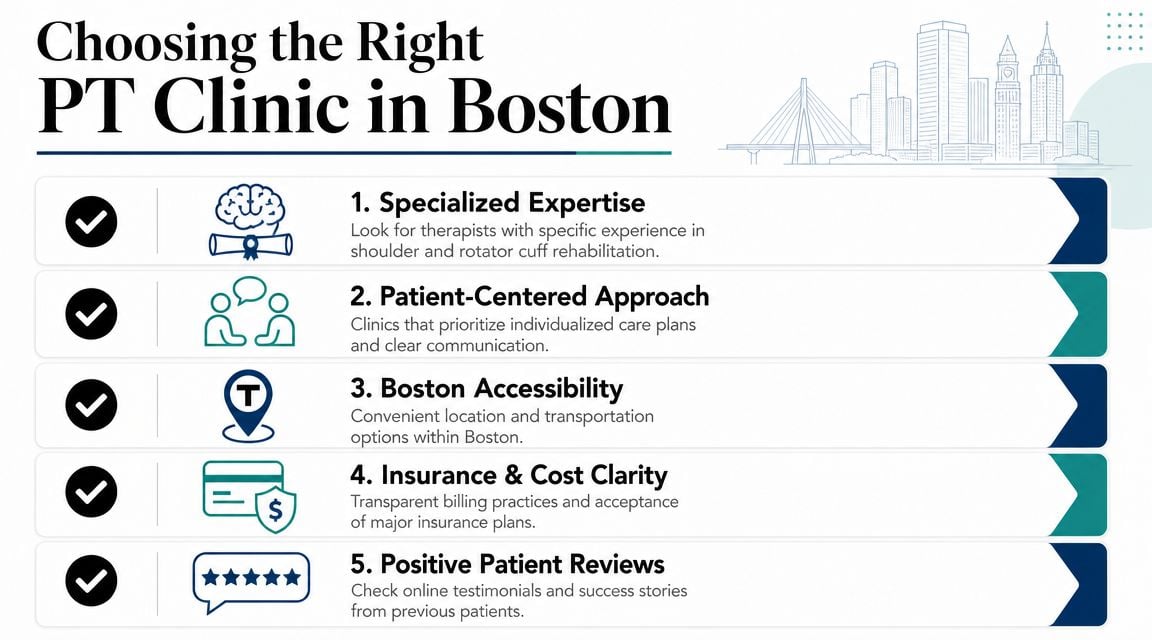
Boston gives you a lot of options. That's useful, but it can also make shoulder care harder to choose. Search results make many clinics sound interchangeable. They aren't. For rotator cuff rehab, the details matter. You want a place that can evaluate the whole movement problem, not just hand you a band and a printed sheet of exercises.
What to look for in a Boston shoulder clinic
Start with four filters.
- One-on-one treatment time: Shoulder rehab depends on observation, cueing, and progression. If a therapist cannot watch how you move, the plan loses value.
- Upper extremity experience: Rotator cuff cases overlap with neck issues, shoulder blade mechanics, postural stress, and sport demands. Broad orthopedic skill helps.
- Useful specialty services: Some patients benefit from dry needling for secondary muscle tension, aquatic therapy when land movement is too irritable, or workplace ergonomics if desk setup keeps feeding the problem.
- A location you can realistically attend: Back Bay, Kenmore Square, Fort Point, Downtown Boston, Brookline, and Allston all create different commute patterns. Convenience affects follow-through.
Why standards matter in this city
Boston sets a high bar for shoulder care. Institutions like the Boston Shoulder Institute publish formal PT protocols that have become part of the standard of care, reflecting the city's commitment to evidence-based rehabilitation (Boston Shoulder Institute protocols).
That matters because patients here should expect more than generic exercise instruction. They should expect structured progression, coordination when referral is needed, and treatment that reflects how major shoulder programs operate.
How to compare clinics without overthinking it
If you're narrowing options, ask practical questions:
| Question | What a strong answer sounds like |
|---|---|
| Who will I work with each visit | Clear explanation of treatment model and continuity |
| Do you treat active adults and athletes | Comfort with both daily-life rehab and performance goals |
| Can you address contributing factors beyond the shoulder | Neck, posture, thoracic mobility, ergonomics, training load |
| Is the clinic accessible from my routine | Easy to reach from work, home, campus, or the T |
Joint Ventures Physical Therapy is one local option for patients who want one-on-one care in neighborhoods like Back Bay, Kenmore Square, Fort Point/Seaport, and Downtown Boston, along with services such as trigger point dry needling, aquatic therapy, running performance, Titleist evaluations, and workplace ergonomics.
Patient feedback can also tell you whether a clinic communicates well, stays organized, and follows through. For people comparing local providers, this guide to monitoring brand mentions and reviews is a practical way to think about how online reputation reflects the patient experience.
Start Your Recovery at Joint Ventures Physical Therapy
The first visit should lower your stress, not add to it. Most Boston patients already have enough on their plate. They're trying to keep up with work, family, commuting, training, or all of the above while dealing with a shoulder that suddenly makes simple tasks annoying. Starting care should feel straightforward.
What the first appointment should accomplish
A strong initial evaluation usually answers questions quickly. You should leave with a working explanation of what the therapist sees, which movements are currently aggravating the shoulder, what to stop doing for now, and what your first stage of rehab will look like.
For rotator cuff physical therapy in Boston, a good first session should also connect treatment to your actual routine:
- Work demands: laptop use, commuting, carrying bags, long desk hours
- Fitness demands: gym training, rowing, running, climbing, rec sports
- Home demands: sleep position, lifting, reaching, childcare, daily tasks
What to expect from the process
Before the first session, many patients want help sorting out the practical side. Insurance verification, scheduling, and authorizations can make healthcare feel harder than it needs to be. Good front-desk support makes a difference because it lets you focus on getting better instead of chasing paperwork.
At the evaluation itself, expect a detailed conversation, movement testing, strength checks, and hands-on coaching. The point isn't to impress you with medical terminology. The point is to figure out why your shoulder hurts, what it can tolerate today, and how to move it forward without setting it off.
The right first visit leaves you with fewer unknowns. You should know what you're dealing with, what the next step is, and what success will look like in your own life.
If you want a deeper educational overview of shoulder injuries and recovery principles, visit Highbar Health. That's the right place for broader condition education, while local clinic choice and scheduling should stay focused on what works for your daily life in Boston.
If your shoulder pain is changing how you work, train, sleep, or move around the city, don't wait for it to become your new normal.
If you're ready to take the next step, book an appointment with Joint Ventures Physical Therapy. With convenient Greater Boston locations and personalized one-on-one care, it's a practical place to start when shoulder pain is getting in the way of daily life.